Results by title
10 books match the query 'African Americans in the motion picture industry'
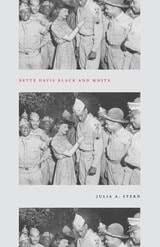
Bette Davis Black and White
Julia A. Stern
University of Chicago Press, 2021
Bette Davis was not only one of Hollywood’s brightest stars, but also one of its most outspoken advocates on matters of race. In Bette Davis Black and White, Julia A. Stern explores this largely untold facet of Davis’s brilliant career.
Bette Davis Black and White analyzes four of Davis’s best-known pictures—Jezebel (1938), The Little Foxes (1941), In This Our Life (1942), and What Ever Happened to Baby Jane? (1962)—against the history of American race relations. Stern also weaves in memories of her own experiences as a young viewer, coming into racial consciousness watching Davis’s films on television in an all-white suburb of Chicago.
Davis’s egalitarian politics and unique collaborations with her Black costars offer Stern a window into midcentury American racial fantasy and the efforts of Black performers to disrupt it. This book incorporates testimony from Davis’s Black contemporaries, including James Baldwin and C. L. R. James, as well as the African American fans who penned letters to Warner Brothers praising Davis’s work. A unique combination of history, star study, and memoir, Bette Davis Black and White allows us to contemplate cross-racial spectatorship in new ways.
Black Film/White Money
Jesse Algeron Rhines
Rutgers University Press, 1996
In this vivid portrait of their historic and present-day contributions, Jesse Rhines explores the roles African American men and women have played in the motion picture business from 1915 to the present. He illuminates his discussion by carefully linking the history of early Black filmmaking to the current success of African American filmmakers and examines how African Americans have been affected by changes that have taken place in the industry as a whole. He focuses on the crucial role of distribution companies, the difficulty of raising money for production, the compromises that directors and writers must make to get funding, and the effect of negative, sensationalistic images on the Black community. Many well-known directors, including Spike Lee, Reginald Hudlin, and Grace Blake are interviewed in the book, allowing Rhines to give readers an inside look at how deal making does--or does not--work.
Rhines surveys significant eras in film history and their impact on African Americans, from the silent era and the impact of The Birth of a Nation , through the emergence of the Black-owned Lincoln Motion Picture Company, and the later introduction of sound, to the postwar era, the antitrust suit against Paramount Pictures, the introduction of television, and Blaxploitation movies that won audiences back. He brings the story up to date with present-day blockbusters and the success of Spike Lee, who began as an independent and became a force in the industry, and others who hope to follow in Lee's footsteps. Rhines, who has worked behind the camera himself, reflects on independent filmmaking, the risks of both failure and success, and his hope for positive change in the African African community if more African American filmmakers can come to the forefront in the business.
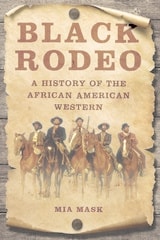
Black Rodeo
A History of the African American WesternMia Mask
University of Illinois Press, 2023
A first-of-its kind survey, Black Rodeo illuminates the figure of the Black cowboy while examining the intersection of African American film history and the western.
Cinema Civil Rights
Regulation, Repression, and Race in the Classical Hollywood EraScott, Ellen C
Rutgers University Press, 2015
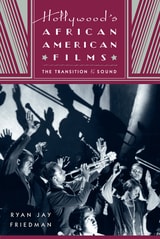
Hollywood's African American Films
The Transition to SoundRyan Friedman
Rutgers University Press, 2011
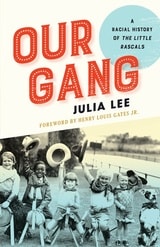
Our Gang
A Racial History of The Little RascalsJulia Lee
University of Minnesota Press, 2015
It was the age of Jim Crow, riddled with racial violence and unrest. But in the world of Our Gang, black and white children happily played and made mischief together. They even had their own black and white version of the KKK, the Cluck Cluck Klams—and the public loved it.
The story of race and Our Gang, or The Little Rascals, is rife with the contradictions and aspirations of the sharply conflicted, changing American society that was its theater. Exposing these connections for the first time, Julia Lee shows us how much this series, from the first silent shorts in 1922 to its television revival in the 1950s, reveals about black and white American culture—on either side of the silver screen. Behind the scenes, we find unconventional men like Hal Roach and his gag writers, whose Rascals tapped into powerful American myths about race and childhood. We meet the four black stars of the series—Ernie “Sunshine Sammy” Morrison, Allen “Farina” Hoskins, Matthew “Stymie” Beard, and Billie “Buckwheat” Thomas—the gang within the Gang, whose personal histories Lee pursues through the passing years and shifting political landscape.
In their checkered lives, and in the tumultuous life of the series, we discover an unexplored story of America, the messy, multiracial nation that found in Our Gang a comic avatar, a slapstick version of democracy itself.
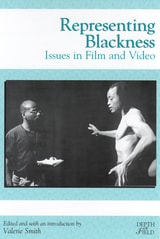
Representing Blackness
Issues in Film and VideoSmith, Valerie
Rutgers University Press, 1997
The essays in this collection provide a variety of perspectives on black representation and questions of racial authenticity in mainstream as well as African American independent cinema. This volume includes seminal essays on racial stereotypes, trenchant critiques of that discourse, original essays on important directors such as Haile Gerima and Charles Burnett, and an insightful discussion of black gay and lesbian film and video.
The contributors include Donald Bogle, Thomas Cripps, Jane Gaines, Nathan Grant, Stuart Hall, Tommy L. Lott, Wahneema Lubiano, Mike Murashige, Valerie Smith, James Snead, and David Van Leer. This volume is an important contribution to the Depth of Field series and should be indispensible for courses and individual scholars in film and multicultural studies. The book contains a mix of original and previously published pieces.
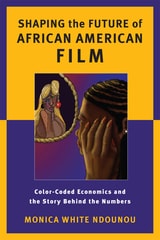
Shaping the Future of African American Film
Color-Coded Economics and the Story Behind the NumbersMonica White Ndounou
Rutgers University Press, 2014
In Hollywood, we hear, it’s all about the money. It’s a ready explanation for why so few black films get made—no crossover appeal, no promise of a big payoff. But what if the money itself is color-coded? What if the economics that governs film production is so skewed that no film by, about, or for people of color will ever look like a worthy investment unless it follows specific racial or gender patterns? This, Monica Ndounou shows us, is precisely the case. In a work as revealing about the culture of filmmaking as it is about the distorted economics of African American film, Ndounou clearly traces the insidious connections between history, content, and cash in black films.
How does history come into it? Hollywood’s reliance on past performance as a measure of potential success virtually guarantees that historically underrepresented, underfunded, and undersold African American films devalue the future prospects of black films. So the cycle continues as it has for nearly a century. Behind the scenes, the numbers are far from neutral. Analyzing the onscreen narratives and off-screen circumstances behind nearly two thousand films featuring African Americans in leading and supporting roles, including such recent productions as Bamboozled, Beloved, and Tyler Perry’s Diary of a Mad Black Woman, Ndounou exposes the cultural and racial constraints that limit not just the production but also the expression and creative freedom of black films. Her wide-ranging analysis reaches into questions of literature, language, speech and dialect, film images and narrative, acting, theater and film business practices, production history and financing, and organizational history.
By uncovering the ideology behind profit-driven industry practices that reshape narratives by, about, and for people of color, this provocative work brings to light existing limitations—and possibilities for reworking stories and business practices in theater, literature, and film.

Trying to Get Over
African American Directors after Blaxploitation, 1977-1986By Keith Corson
University of Texas Press, 2016
From 1972 to 1976, Hollywood made an unprecedented number of films targeted at black audiences. But following this era known as “blaxploitation,” the momentum suddenly reversed for black filmmakers, and a large void separates the end of blaxploitation from the black film explosion that followed the arrival of Spike Lee’s She's Gotta Have It in 1986. Illuminating an overlooked era in African American film history, Trying to Get Over is the first in-depth study of black directors working during the decade between 1977 and 1986.
Keith Corson provides a fresh definition of blaxploitation, lays out a concrete reason for its end, and explains the major gap in African American representation during the years that followed. He focuses primarily on the work of eight directors—Michael Schultz, Sidney Poitier, Jamaa Fanaka, Fred Williamson, Gilbert Moses, Stan Lathan, Richard Pryor, and Prince—who were the only black directors making commercially distributed films in the decade following the blaxploitation cycle. Using the careers of each director and the twenty-four films they produced during this time to tell a larger story about Hollywood and the shifting dialogue about race, power, and access, Corson shows how these directors are a key part of the continuum of African American cinema and how they have shaped popular culture over the past quarter century.
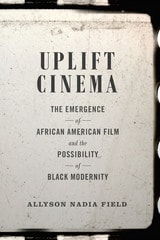
Uplift Cinema
The Emergence of African American Film and the Possibility of Black ModernityAllyson Nadia Field
Duke University Press, 2015