Results by title
12 books match the query 'Ages'
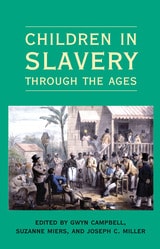
Children in Slavery through the Ages
Gwyn Campbell
Ohio University Press, 2009
Significant numbers of the people enslaved throughout world history have been children. The vast literature on slavery has grown to include most of the history of this ubiquitous practice, but nearly all of it concentrates on the adult males whose strong bodies and laboring capacities preoccupied the masters of the modern Americas. Children in Slavery through the Ages examines the children among the enslaved across a significant range of earlier times and other places; its companion volume will examine the children enslaved in recent American contexts and in the contemporary/modern world.
This is the first collection to focus on children in slavery. These leading scholars bring our thinking about slaving and slavery to new levels of comprehensiveness and complexity. They further provide substantial historical depth to the abuse of children for sexual and labor purposes that has become a significant humanitarian concern of governments and private organizations around the world in recent decades.
The collected essays in Children in Slavery through the Ages fundamentally reconstruct our understanding of enslavement by exploring the often-ignored role of children in slavery and rejecting the tendency to narrowly equate slavery with the forced labor of adult males. The volume’s historical angle highlights many implications of child slavery by examining the variety of children’s roles—as manual laborers and domestic servants to court entertainers and eunuchs—and the worldwide regions in which the child slave trade existed.
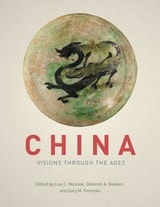
China
Visions through the AgesEdited by Lisa C. Niziolek, Deborah A. Bekken and Gary M. Feinman
University of Chicago Press, 2018
China’s long history is one of the richest and most complex in the known world, and the Cyrus Tang Hall of China offers visitors a wonderful, comprehensive survey of it through some 350 artifacts on display, spanning from the Paleolithic period to present day. Now, with China: Visions through the Ages, anyone can experience the marvels of this exhibition through the book’s beautifully designed and detailed pages. Readers will gain deeper insight into The Field Museum’s important East Asian collections, the exhibition development process, and research on key aspects of China’s fascinating history. This companion book, edited by the exhibition’s own curatorial team, takes readers even deeper into the wonders of the Cyrus Tang Hall of China and enables them to study more closely the objects and themes featured in the show. Mirroring the exhibition’s layout of five galleries, the volume is divided into five sections. The first section focuses on the Paleolithic and Neolithic periods; the second, the Bronze Age, the first dynasties, and early writing; the third, the imperial system and power; the fourth, religion and performance; and the fifth, interregional trade and the Silk Routes. Each section also includes highlights containing brief stories on objects or themes in the hall, such as the famous Lanting Xu rubbing.
With chapters from a diverse set of international authors providing greater context and historical background, China: Visions through the Ages is a richly illustrated volume that allows visitors, curious readers, and China scholars alike a chance to have an enduring exchange with the objects featured in the exhibition and with their multifaceted histories.
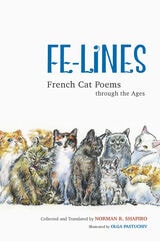
Fe-Lines
French Cat Poems through the AgesCollected and Translated by Norman Shapiro
University of Illinois Press, 2015
Norman R. Shapiro lionizes the feline's limitless allure in this one-of-a-kind collection. Spanning centuries and styles, he draws on she-cats and toms, and an honor roll of French poets, well known and lesser known, who have served as their devoted champions. He reveals the remarkable range of French cat poems, with most works presented here for the first time in English translation. Scrupulously devoted to evoking the meaning and music of the originals, Shapiro also respects the works' formal structures. Pairing Shapiro's translations with Olga Pastuchiv's elegant illustrations, Fe-Lines guides the reader through the marvels and inscrutabilities of the Mystique féline.

Heiress of All the Ages
Sex and Sentiment in the Genteel TraditionWilliam Wasserstrom
University of Minnesota Press, 1959
Heiress of All the Ages was first published in 1959. Minnesota Archive Editions uses digital technology to make long-unavailable books once again accessible, and are published unaltered from the original University of Minnesota Press editions.
In a provocative study of American literature, Professor Wasserstrom reappraises the genteel tradition and its place in social and intellectual history. He shows that our image of this tradition has been inadequate, that most of our writers and critics have failed to recognize its profound effects.
Basing his discussion primarily on a study of the major novelists of the period from 1830 to the present, the author examines the role of women in fiction and defines some of our national attitudes toward love. He discusses especially the world of Henry James (from whose phrase "heir of all the ages" the title of this book is derived), William Dean Howells, Nathaniel Hawthorne, James Fenimore Cooper, Edith Wharton, and Robert Penn Warren. He also considers such well known novelists of their day as Bret Harte, Edgar Fawcett, Robert Herrick, Henry B. Fuller, Hamlin Garland, and Gertrude Atherton. In addition, his study is based on source material of the period: diaries, recipe books, family magazines, early issues of sociology and psychology journals, and travel books.
This book will interest not only students of literature and history but also those in the general field of American civilization and sociologists and psychologists concerned with the relation of American literature to our mores.
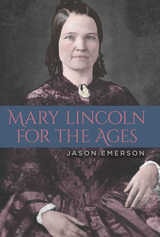
Mary Lincoln for the Ages
Jason Emerson
Southern Illinois University Press, 2019
Mary Lincoln for the Ages first articulates how reliance on limited sources has greatly restricted our understanding of the subject, evaluating their flaws and benefits and pointing out the shallowness of using the same texts to study her life. Emerson then presents more than four hundred bibliographical entries of nonfiction books and pamphlets, scholarly and popular articles, journalism, literature, and juvenilia. More than just listings of titles and publication dates, each entry includes Emerson’s deft analysis of these additional works on Mary Lincoln that should be used—but rarely have been—to better understand who she was during her life and why we see her as we do. The volume also includes rarely used illustrations, including some that have never before appeared in print.
A roadmap for a firmer, more complete grasp of Mary Lincoln’s place in the historical record, this is the first and only extensive, analytical bibliography of the subject. In highlighting hundreds of overlooked sources, Emerson changes the paradigm of Mary Lincoln’s legacy.
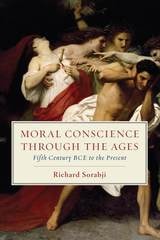
Moral Conscience through the Ages
Fifth Century BCE to the PresentRichard Sorabji
University of Chicago Press, 2014
Sorabji examines an impressive breadth of topics: the longing for different kinds of freedom of conscience, the proper limits of freedom itself, protests at conscience’s being ‘terrorized,’ dilemmas of conscience, the value of conscience to human beings, its secularization, its reliability, and ways to improve it. These historical issues are alive today, with fresh concerns about topics such as conscientious objection, the force of conscience, or the balance between freedoms of conscience, religion, and speech. The result is a stunningly comprehensive look at a central component of our moral understanding.
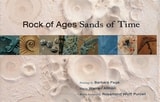
Rock of Ages, Sands of Time
Paintings by Barbara Page, Text by Warren AllmonBarbara Page and Warren D. Allmon
University of Chicago Press, 2001
These are just a few scenes from the magnificent drama that unfolds in glorious full color and three-dimensional texture in Rock of Ages, Sands of Time. Each of Barbara Page's 544 contiguous painted panels represents a million years of the history of life on earth, with fossil plants and animals depicted at the same scale and in association with each other just as they might be found by a paleontologist in the field. A muted rainbow of background colors evoke the rocks in which the fossils were found—the Texas Red Beds, for instance, or the yellow Solnhofen limestone—and keystone events are shown metaphorically, with fat rolls of paint marking major extinctions or continental drift.
To fully experience the awesome impact of an eon's worth of time spread across 500 feet of bas-relief panels, you'd have to visit the Museum of the Earth in Ithaca, New York, where Page's specially commissioned work will be installed when the museum opens in 2002. But this book is the next best thing. Not only does it contain crisp color reproductions of each painting, but it also includes an accessible essay from paleontologist Warren Allmon giving the scientific context behind the art.
For fossil lovers of all ages, and anyone interested in the merging of art and science, Rock of Ages, Sands of Time will be the find of a lifetime.
Rock of Ages
Subcultural Religious Identity and Public Opinion among Young EvangelicalsJeremiah J. Castle
Temple University Press, 2019
Evangelicals and Republicans have been powerful—and active—allies in American politics since the 1970s. But as public opinions have changed, are young evangelicals’ political identities and attitudes on key issues changing too? And if so, why? In Rock of Ages, Jeremiah Castle answers these questions to understand their important implications for American politics and society.
Castle develops his own theory of public opinion among young evangelicals to predict and explain their political attitudes and voting behavior. Relying on both survey data and his own interviews with evangelical college students, he shows that while some young evangelicals may be more liberal in their attitudes on some issues, most are just as firmly Republican, conservative, and pro-life on abortion as the previous generation.
Rock of Ages considers not only what makes young evangelicals different from the previous generation, but also what that means for both the church and American politics.
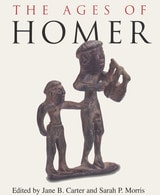
The Ages of Homer
A Tribute to Emily Townsend VermeuleEdited by Jane B. Carter and Sarah P. Morris
University of Texas Press, 1995
Homer’s Iliad and Odyssey have fascinated listeners and readers for over twenty-five centuries. In this volume of original essays, collected to honor the distinguished career of Emily T. Vermeule, thirty-four leading experts in Homeric studies and related fields provide up-to-date, multidisciplinary accounts of the most current issues in the study of Homer.
The book is divided into three sections. The first section treats the Bronze Age setting of the poems (around 1200 B.C.), using archaeological evidence to reveal how poetic memory preserves, distorts, and invents the past. The second section explores the early Iron Age, in which the poems were written (c. 800-500 B.C.), using the strategies of comparative philology and mythology, literary theory, historical linguistics, anthropology, and iconography to determine how the poems took shape. The final section traces the use of Homer for literary and artistic inspiration by classical Greece and Rome.
The Celestial Twins
Poetry and Music through the AgesH.T. Kirby-Smith
University of Massachusetts Press, 2000
H. T. Kirby-Smith makes his case with wit and erudition, proceeding chronologically and citing numerous examples of specific poems—from Latin, Old French, Italian, Anglo-Saxon, modern French, and English. He points out that ancient Greek poetry, including the epics, was part of a musical context. By contrast, almost no surviving Latin poetry was written for musical performance, but the meters of Latin poetry were borrowed from Greek musical meters. Similarly, in their own ways, Thomas Hardy, T. S. Eliot, and Langston Hughes all wrote out of musical contexts: Hardy from west-of-England songs and dances; Eliot from Wagnerian opera and late Beethoven chamber music; and Hughes from blues, jazz, and spirituals.
Although poets from Horace to Shakespeare to Dickinson have instinctively recognized the separation of music and poetry, there have also been well-meaning attempts to bring these allied arts back into close association with each other. But in Kirby-Smith's view, poetry of the highest order has always maintained a respectful distance from music, even while retaining some memory of musical rhythms and organization.
Volcanoes
Encounters through the AgesDavid M. Pyle
Bodleian Library Publishing, 2017
That’s Pliny the Younger, writing to Tacitus about the eruption of Vesuvius in 79 CE, one of many volcanic eruptions that have become part of the story of human history. We have always, it seems, been simultaneously fascinated and terrified by volcanoes, and this book brings together an unforgettable selection of firsthand accounts from around the world and through the centuries.
In these pages, anonymous seventeenth-century seafarers tell of exploding islands, Alexander Von Humboldt and Charles Darwin show us volcanoes through the eyes of developing science, and artists sketch the spectacular London sunsets created by the eruption of Krakatoa, half the world away. As the years pass, words and paintings give way to the first photograph of an eruption, and eventually to detailed satellite imagery, but the awesome force of volcanoes still comes through, sublime and spectacular.
As we were reminded in 2010 when the eruption of Iceland’s Eyjafjallajökull snarled travel throughout Europe, volcanoes remain powerful and unpredictable even today. In the pages of this book, we can appreciate their majesty from a safe distance.
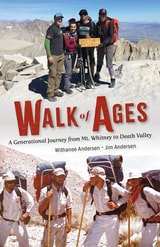
Walk of Ages
A Generational Journey from Mt. Whitney to Death ValleyWithanee Andersen
University of Nevada Press, 2024
With hopes of being listed in the Guinness Book of World Records, Jim led the first documented walk from the highest to lowest point in the contiguous United States in 1974. He lived, albeit just barely, to tell the tale to his daughter, sparking a desire in Withanee to retrace his steps in his honor. In 2017, she took on the incredible task of recreating Jim’s legacy trek of 131 miles with the help of divine intervention, ice-cold beer, and her parents, who were following along as the support party.
Walk of Ages humorously relates the parallel journey of an epic adventure told from two perspectives—a daughter’s difficult quest, and a father who supports her through it while recalling his own experiences from four decades earlier. Throughout this momentous odyssey, readers will realize how a once-in-a-generation adventure leads to life-changing transformation, and that the bond between father and daughter knows no bounds.