Results by title
69 books match the query 'American Culture' and 9 start with a
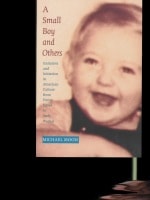
A Small Boy and Others
Imitation and Initiation in American Culture from Henry James to Andy WarholMichael Moon
Duke University Press, 1998
Moon illuminates the careers of James, Warhol, and others by examining the imaginative investments of their protogay childhoods in their work in ways that enable new, more complex cultural readings. He deftly engages notions of initiation and desire not within the traditional framework of “sexual orientation” but through the disorienting effects of imitation. Whether invoking the artist Joseph Cornell’s early fascination with the Great Houdini or turning his attention to James’s self-described “initiation into style” at the age of twelve—when he first encountered the homoerotic imagery in paintings by David, Géricault, and Girodet—Moon reveals how the works of these artists emerge from an engagement that is obsessive to the point of “queerness.”
Rich in historical detail and insistent in its melding of the recent with the remote, the literary with the visual, the popular with the elite, A Small Boy and Others presents a hitherto unimagined tradition of brave and outrageous queer invention. This long-awaited contribution from Moon will be welcomed by all those engaged in literary, cultural, and queer studies.

A Very Serious Thing
Women’s Humor and American CultureNancy A. Walker
University of Minnesota Press, 1988
A Very Serious Thing was first published in 1988. Minnesota Archive Editions uses digital technology to make long-unavailable books once again accessible, and are published unaltered from the original University of Minnesota Press editions.
"It is a very serious thing to be a funny woman." –Frances Miriam Berry Whitcher
A Very Serious Thing is the first book-length study of a part of American literature that has been consistently neglected by scholars and underrepresented in anthologies—American women's humorous writing. Nancy Walker proposes that the American humorous tradition to be redefined to include women's humor as well as men's, because, contrary to popular opinion, women do have a sense of humor.
Her book draws on history, sociology, anthropology, literature, and psychology to posit that the reasons for neglect of women's humorous expression are rooted in a male-dominated culture that has officially denied women the freedom and self-confidence essential to the humorist. Rather than a study of individual writers, the book is an exploration of relationships between cultural realities—including expectations of "true womanhood"—and women's humorous response to those realities.
Humorous expression, Walker maintains, is at odds with the culturally sanctioned ideal of the "lady," and much of women's humor seems to accept, while actually denying, this ideal. In fact, most of American women's humorous writing has been a feminist critique of American culture and its attitudes toward women, according to the author.
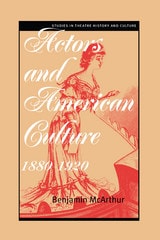
Actors and American Culture, 1880-1920
Benjamin Mcarthur
University of Iowa Press, 2000
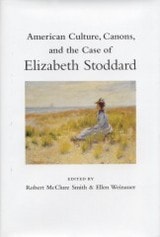
American Culture, Canons, and the Case of Elizabeth Stoddard
Robert McClure Smith
University of Alabama Press, 2003
Elizabeth Stoddard was a gifted writer of fiction, poetry, and journalism; successfully published within her own lifetime; esteemed by such writers as William Dean Howells and Nathaniel Hawthorne; and situated at the epicenter of New York’s literary world. Nonetheless, she has been almost excluded from literary memory and importance. This book seeks to understand why. By reconsidering Stoddard’s life and work and her current marginal status in the evolving canon of American literary studies, it raises important questions about women’s writing in the 19th century and canon formation in the 20th century.
Essays in this study locate Stoddard in the context of her contemporaries, such as Dickinson and Hawthorne, while others situate her work in the context of major 19th-century cultural forces and issues, among them the Civil War and Reconstruction, race and ethnicity, anorexia and female invalidism, nationalism and localism, and incest. One essay examines the development of Stoddard’s work in the light of her biography, and others probe her stylistic and philosophic originality, the journalistic roots of her voice, and the elliptical themes of her short fiction. Stoddard’s lifelong project to articulate the nature and dynamics of woman’s subjectivity, her challenging treatment of female appetite and will, and her depiction of the complex and often ambivalent relationships that white middle-class women had to their domestic spaces are also thoughtfully considered.
The editors argue that the neglect of Elizabeth Stoddard’s contribution to American literature is a compelling example of the contingency of critical values and the instability of literary history. This study asks the question, “Will Stoddard endure?” Will she continue to drift into oblivion or will a new generation of readers and critics secure her tenuous legacy?

And Sadly Teach
Teacher Education and Professionalization in American CultureJurgen Herbst
University of Wisconsin Press, 1991
To lend weight to his charge that the public school teacher has been betrayed and gravity to his indictment of the educational establishment for that betrayal, Jurgen Herbst goes back to the beginnings of teacher education in America in the 1830s and traces its evolution up to the 1920s, by which time the essential damage had been done.
Initially, attempts were made to upgrade public school teaching to a genuine profession, but that ideal was gradually abandoned. In its stead, with the advent of newly emerging graduate schools of education in the early decades of the twentieth century, came the so-called professionalization of public education. At the expense of the training of elementary school teachers (mostly women), teacher educators shifted their attention to the turning out of educational "specialists" (mostly men)—administrators, faculty members at normal schools and teachers colleges, adult education teachers, and educational researchers.
Ultimately a history of the neglect of the American public school teacher, And Sadly Teach ends with a plea and a message that ring loud and clear. The plea: that the current reform proposals for American teacher education—the Carnegie and the Holmes reports—be heeded. The message: that the key to successful school reform lies in educating teacher’s true professionals and in acknowledging them as such in their classrooms.

Animal Rites
American Culture, the Discourse of Species, and Posthumanist TheoryCary Wolfe
University of Chicago Press, 2002

At War
The Military and American Culture in the Twentieth Century and BeyondKieran, David
Rutgers University Press, 2018
At War offers short, accessible essays addressing the central issues in the new military history—ranging from diplomacy and the history of imperialism to the environmental issues that war raises and the ways that war shapes and is shaped by discourses of identity, to questions of who serves in the U.S. military and why and how U.S. wars have been represented in the media and in popular culture.

Authenticity Guaranteed
Masculinity and the Rhetoric of Anti-Consumerism in American CultureSally Robinson
University of Massachusetts Press, 2018
Americans love to hate consumerism. Scholars, intellectuals, musicians, and writers of all kinds take pleasure in complaining that consumer culture endangers the “real” things in life, including self-determination and individualism. In Authenticity Guaranteed, Sally Robinson brings to light the unacknowledged gender and class assumptions of anti-consumerist critique in the second half of the twentieth century. American anti-consumerism, despite its apparent complexity, takes a remarkably consistent and predictable narrative form. From the mid-century Organization Man to the millennial No Logo, anti-consumerist critique reinforces the gender order by insisting that authenticity is threatened, and masculine agency curtailed, by the feminizing forces of consumer culture.
Robinson identifies a tradition of masculine protest and rebellion against feminization in iconic texts such as The Catcher in the Rye and Fight Club, as well as in critiques of postmodernism, academic denunciations of shopping, and a variety of other discourses that aim to diagnose what ails American consumer culture. This fresh and timely argument enters into conversation with a wide range of existing scholarship and opens up new questions for scholarly and political discussion.
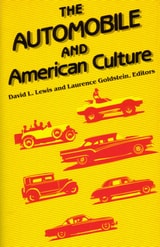
Automobile and American Culture
David L. Lewis and Laurence Goldstein, Editors
University of Michigan Press, 1983