Results by title
10 books match the query 'American Education'

American Education
Yesterday, Today, TomorrowEdited by Thomas L. Good
University of Chicago Press, 2000
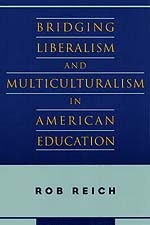
Bridging Liberalism and Multiculturalism in American Education
Rob Reich
University of Chicago Press, 2002
Linking political theory with educational history and policy, Rob Reich offers provocative new answers to these questions. He develops a liberal theory of multicultural education in which the leading goal is the cultivation of individual autonomy in children. Reich draws out the policy implications of his theory through one of the first sustained considerations of homeschooling in American education. He also evaluates three of the most prominent trends in contemporary school reform—vouchers, charter schools, and the small school movement—and provides pedagogical recommendations that sharply challenge the reigning wisdom of many multicultural educators.
Written in clear and accessible language, this book will be of interest to political theorists, philosophers, educators, educational policymakers, and teachers.
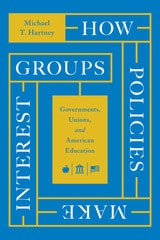
How Policies Make Interest Groups
Governments, Unions, and American EducationMichael T. Hartney
University of Chicago Press, 2022
As most American labor organizations struggle for survival and relevance in the twenty-first century, teachers unions appear to be an exception. Despite being all but nonexistent until the 1960s, these unions are maintaining members, assets—and political influence. As the COVID-19 epidemic has illustrated, today’s teachers unions are something greater than mere labor organizations: they are primary influencers of American education policy. How Policies Make Interest Groups examines the rise of these unions to their current place of influence in American politics.
Michael Hartney details how state and local governments adopted a new system of labor relations that subsidized—and in turn, strengthened—the power of teachers unions as interest groups in American politics. In doing so, governments created a force in American politics: an entrenched, subsidized machine for membership recruitment, political fundraising, and electoral mobilization efforts that have informed elections and policymaking ever since. Backed by original quantitative research from across the American educational landscape, Hartney shows how American education policymaking and labor relations have combined to create some of the very voter blocs to which it currently answers. How Policies Make Interest Groups is trenchant, essential reading for anyone seeking to understand why some voices in American politics mean more than others.
Indicators of Trends in American Education
Abbott Lamoyne Ferriss
Russell Sage Foundation, 1969
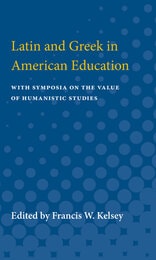
Latin and Greek in American Education
With Symposia on the Value of Humanistic StudiesEdited by Francis W. Kelsey
University of Michigan Press, 1911
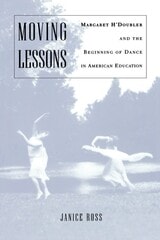
Moving Lessons
Margaret H'Doubler and the Beginning of Dance in American EducationJanice Ross
University of Wisconsin Press, 2000
Ross brings together many discourses—from dance history, pedagogical theory, women's history, feminist theory, American history, and the history of the body—in intelligent, exciting, and illuminating ways and adds a new chapter to each of them. She shows how H'Doubler, like Isadora Duncan and other modern dancers, helped to raise dance in the eyes of the middle class from its despised status as lower-class entertainment and "dangerous" social interaction to a serious enterprise. Taking a nuanced critical approach to the history of women's bodies and their representations, Moving Lessons fills a very large gap in the history of dance education.
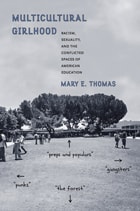
Multicultural Girlhood
Racism, Sexuality, and the Conflicted Spaces of American EducationMary E. Thomas
Temple University Press, 2011
High school turf wars are often a teenage rite of passage, but there are extremes—as when a race riot at a Los Angeles campus in the spring of 2005 resulted in a police lockdown. In her fascinating book,Multicultural Girlhood, Mary Thomas interviewed 26 Latina, Armenian, Filipina, African-American, and Anglo girls at this high school to gauge their responses to the campus violence. They all denounced the outbreak, calling for multicultural understanding and peaceful coexistence.
However, as much as the girls want everyone to just “get along,” they also exhibit strong racist beliefs and validate segregated social spaces on campus and beyond. How can teenagers and “girl power” work together to empower instead of alienate multicultural groups? In her perceptive book, Thomas foregrounds the spaces of teen girlhood and the role that space plays in girls' practices that perpetuate social difference, and she explains the ways we navigate the intellectual terrain between scholarship and school yard.
Parents and Schools
The 150-Year Struggle for Control in American EducationWilliam W. Cutler III
University of Chicago Press, 2000
Cutler shows how in the 1920s and 1930s schools expanded their responsibility for children's well-being outside the classroom. These efforts sowed the seeds for later conflict as schools came to be held accountable for solving society's problems. Finally, he brings the reader into recent decades, in which a breakdown of trust, racial tension, and "parents' rights" have taken the story full circle, with parents and schools once again at odds.
Cutler's book is an invaluable guide to understanding how parent-teacher cooperation, which is essential for our children's educational success, might be achieved.
The Enigmatic Academy
Class, Bureaucracy, and Religion in American EducationChristian J. Churchill
Temple University Press, 2012
The Enigmatic Academy is a provocative look at the purpose and practice of education in America. Authors Christian Churchill and Gerald Levy use three case studies—a liberal arts college, a boarding school, and a Job Corps center—to illustrate how class, bureaucratic, and secular-religious dimensions of education prepare youth for participation in American foreign and domestic policy at all levels.
The authors describe how schools contribute to the formation of a bureaucratic character; how middle and upper class students are trained for leadership positions in corporations, government, and the military; and how the education of lower class students often serves more powerful classes and institutions.
Exploring how youth and their educators encounter the complexities of ideology and bureaucracy in school, The Enigmatic Academy deepens our understanding of the flawed redemptive relationship between education and society in the United States. Paradoxically, these three studied schools all prepare students to participate in a society whose values they oppose.
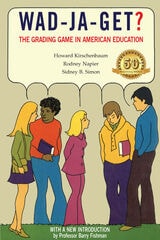
Wad-Ja-Get?
The Grading Game in American Education, 50th Anniversary EditionHoward Kirschenbaum, Rodney Napier, and Sidney B. Simon; With a new introduction by Professor Barry Fishman
Michigan Publishing Services, 2020
Grades and grading are an accepted part of modern education. But why? Why do we accept a system that is more focused on ranking students than on learning? Why do we accept the negative effects of standard grading approaches, including turning students off from learning, increasing stress, creating winners and losers, and perpetuating racial and economic inequality? Why do we accept these things when there are better alternatives?
Wad-Ja-Get? is a unique discussion of grading and its effects on students. The book was written by three education professors who have had first-hand contact with the problems of grading in all its forms. Written in the form of a novel, the topic is explored through the eyes of students, teachers, and parents in one high school embroiled in a controversy around grading. Possible alternatives to the grading system are examined in detail and the research on grading is summarized in an appendix. This 50th anniversary edition of the book includes a new introduction by Professor Barry Fishman, updating the research and setting the original book in the context of today’s educational and societal challenges. Wad-Ja-Get? remains timely five decades after its original publication, and will be inspiring to students, parents, educators, and policymakers.