Results by title
5 books match the query 'American Republic'
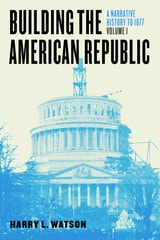
Building the American Republic, Volume 1
A Narrative History to 1877Harry L. Watson
University of Chicago Press, 2018
Volume 1 starts at sea and ends on the battlefield. Beginning with the earliest Americans and the arrival of strangers on the eastern shore, it then moves through colonial society to the fight for independence and the construction of a federalist republic. From there, it explains the renegotiations and refinements that took place as a new nation found its footing, and it traces the actions that eventually rippled into the Civil War.
This volume goes beyond famous names and battles to incorporate politics, economics, science, arts, and culture. And it shows that issues that resonate today—immigration, race, labor, gender roles, and the power of technology—have been part of the American fabric since the very beginning.
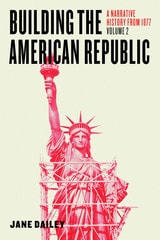
Building the American Republic, Volume 2
A Narrative History from 1877Jane Dailey
University of Chicago Press, 2018
The American nation came apart in a violent civil war less than a century after ratification of the Constitution. When it was reborn five years later, both the republic and its Constitution were transformed. Volume 2 opens as America struggles to regain its footing, reeling from a presidential assassination and facing massive economic growth, rapid demographic change, and combustive politics.
The next century and a half saw the United States enter and then dominate the world stage, even as the country struggled to live up to its own principles of liberty, justice, and equality. Volume 2 of Building the American Republic takes the reader from the Gilded Age to the present, as the nation becomes an imperial power, rethinks the Constitution, witnesses the rise of powerful new technologies, and navigates an always-shifting cultural landscape shaped by an increasingly diverse population. Ending with the 2016 election, this volume provides a needed reminder that the future of the American republic depends on a citizenry that understands—and can learn from—its history.
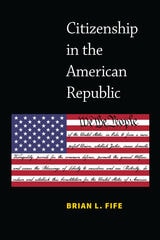
Citizenship in the American Republic
Brian L. Fife
University of Michigan Press, 2021
The Constitution has governed the United States since 1789, but many Americans are not aware of the structural rules that govern the oldest democracy in the world. Important public policy challenges require a knowledgeable, interested citizenry able to address the issues that represent the rich pageantry of American society. Issues such as climate change, national debt, poverty, pandemics, income inequality, and more can be addressed sufficiently if citizens play an active role in their own republic. Collectively, citizens are vulnerable to exploitation and manipulation if we place limits on our individual political knowledge. A more informed, engaged citizenry can best rise to the great policy challenges of contemporary society and beyond.
Brian L. Fife provides readers with essential information on all aspects of American politics, showing them how to use political knowledge to shape the future of the republic. Activist citizens are the key to making the United States a more vibrant democracy. Fife equips citizens and would-be citizens with the tools and understanding they need to engage fully in the political process. At the end of each chapter, he analyzes why citizenship matters and how citizens can use that chapter’s material in their own lives. Fife also provides readers with a citizen homework section that presents web links to further explore issues raised in each chapter.
City and Regime in the American Republic
Stephen L. Elkin
University of Chicago Press, 1987
The present workings of American urban political institutions are, Elkin maintains, characterized by a close relationship between politicians and businessmen, a relationship that promotes neither political equality nor effective social problem-solving. Elkin pays particular attention to the issue of land-use in his analysis of these failures of popular control in traditional city politics. Urban political institutions, however, are not just instruments for the dispensing of valued outcomes or devices for social problem-solving—they help to form the citizenry. Our present institutions largely define citizens as interest group adversaries and do little to encourage them to focus on the commercial public interest of the city. Elkin concludes by proposing new institutional arrangements that would be better able to harness the self-interested behavior of individuals for the common good of a commercial republic.
Ready-Made Democracy
A History of Men's Dress in the American Republic, 1760-1860Michael Zakim
University of Chicago Press, 2003
By the early nineteenth century, homespun began to disappear from the American material landscape. Exhortations of industry and modesty, however, remained a common fixture of public life. In fact, they found expression in the form of the business suit. Here, Zakim traces the evolution of homespun clothing into its ostensible opposite—the woolen coats, vests, and pantaloons that were "ready-made" for sale and wear across the country. In doing so, he demonstrates how traditional notions of work and property actually helped give birth to the modern industrial order. For Zakim, the history of men's dress in America mirrored this transformation of the nation's social and material landscape: profit-seeking in newly expanded markets, organizing a waged labor system in the city, shopping at "single-prices," and standardizing a business persona.
In illuminating the critical links between politics, economics, and fashion in antebellum America, Ready-Made Democracy will prove essential to anyone interested in the history of the United States and in the creation of modern culture in general.