Results by title
31 books match the query 'Analysis, appreciation'

A Texas-Mexican Cancionero
Folksongs of the Lower BorderBy Américo Paredes
University of Texas Press, 1995
The folksongs of Texas's Mexican population pulsate with the lives of folk heroes, gringos, smugglers, generals, jailbirds, and beautiful women. In his cancionero, or songbook, Américo Paredes presents sixty-six of these songs in bilingual text—along with their music, notes on tempo and performance, and discography. Manuel Peña's new foreword situates these songs within the main currents of Mexican American music.
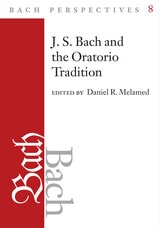
Bach Perspectives, Volume 8
J.S. Bach and the Oratorio TraditionEdited by Daniel R. Melamed
University of Illinois Press, 2011
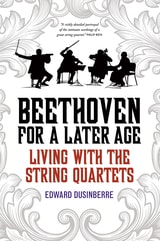
Beethoven for a Later Age
Living with the String QuartetsEdward Dusinberre
University of Chicago Press, 2016
Founded in Hungary in 1975 and now based in Boulder, Colorado, the Takács is one of the world’s preeminent string quartets, and performances of Beethoven have been at the center of their work together for over forty years. Using the history of both the Takács Quartet and the Beethoven quartets as a foundation, Beethoven for a Later Age provides a backstage look at the daily life of a quartet, showing the necessary creative tension between individual and group and how four people can at the same time forge a lasting artistic connection and enjoy making music together over decades. The key, Dusinberre reveals, to a quartet crafting its own sound is in balancing continuity with change and experimentation—a theme that lies at the heart of Beethoven’s remarkable compositions. In an accessible style, suitable for novices and chamber music enthusiasts alike, Dusinberre illuminates the variety and contradictions of Beethoven's quartets, which were composed against the turbulent backdrop of the Napoleonic Wars and their aftermath, and he brings the technical aspects of the music to life.
Beethoven for a Later Age vividly shows that creative engagement with Beethoven’s radical and brilliant quartets continues to be as stimulating now as it was for its first performers and audiences. Musicians and music lovers will be intrigued by Dusinberre’s exploration of the close collaboration at the heart of any great performance.
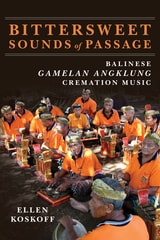
Bittersweet Sounds of Passage
Balinese Gamelan Angklung Cremation MusicEllen Koskoff
University of Illinois Press, 2025
Koskoff examines the history, cultural significance, and musical structures of contemporary gamelan angklung cremation music through the lens of three intertwined stories: existing scholarship on this music, written mostly by Western composers and scholars; the views of those performing and experiencing the music who regard it as dharma--ritual obligation, a basic concept in Balinese Hinduism; and the music itself, with a musical analysis focusing on changes in rasa--feeling, flavor and musical flow.
A journey inside a tradition, Bittersweet Sounds of Passage reveals the overlooked music of an important ritual in Balinese village life.
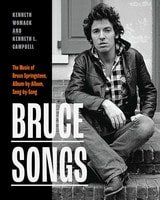
Bruce Songs
The Music of Bruce Springsteen, Album-by-Album, Song-by-SongKenneth Womack
Rutgers University Press, 2024
Bruce Songs is an authoritative guide that offers an in-depth exploration of Bruce Springsteen's musical legacy. Covering Springsteen's entire discography, from Greetings from Asbury Park, N.J. to Only the Strong Survive, this unique book combines historical context, literary analysis, and meticulous research.
Unlike any other resource, it provides detailed analyses of each album, essays on their historical significance, and a chronological examination of every studio song. Discover the stories behind the recordings and gain insight into Springsteen's creative process.
Rich with contemporary reviews, insider accounts, photographs, and special sections highlighting pivotal moments and key figures, Bruce Songs is an indispensable companion for fans and scholars. It offers an immersive journey through the music of the Boss, making it an essential read for anyone captivated by Springsteen's enduring musical legacy.
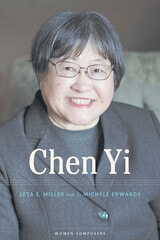
Chen Yi
Leta E. Miller and J. Michele Edwards
University of Illinois Press, 2020
Winner of the Leila Webster Memorial Music Award for the International Alliance for Women in Music of the 2022 Pauline Alderman Awards for Outstanding Scholarship on Women in Music
Chen Yi is the most prominent woman among the renowned group of new wave composers who came to the US from mainland China in the early 1980s. Known for her creative output and a distinctive merging of Chinese and Western influences, Chen built a musical language that references a breathtaking range of sources and crisscrosses geographical and musical borders without eradicating them.
Leta E. Miller and J. Michele Edwards provide an accessible guide to the composer's background and her more than 150 works. Extensive interviews with Chen complement in-depth analyses of selected pieces from Chen's solos for Western or Chinese instruments, chamber works, choral and vocal pieces, and compositions scored for wind ensemble, chamber orchestra, or full orchestra. The authors highlight Chen's compositional strategies, her artistic elaborations, and the voice that links her earliest and most recent music. A concluding discussion addresses questions related to Chen's music and issues such as gender, ethnicity and nationality, transnationalism, border crossing, diaspora, exoticism, and identity.
Commentaries on the Cantatas of Johann Sebastian Bach
A Selective GuideHans-Joachim Schulze. Translated by James A. Brokaw II
University of Illinois Press, 2024
The University of Illinois Press has paired the volume with a special web-based companion overseen by the translator and hosted by the Illinois Open Publishing Network. This online resource includes Brokaw’s translations of all 225 of Schulze’s essays alongside digital tools for searching, sorting, and bundling the commentaries according to date of composition, position within the liturgical church year sequence, and librettist.
Distant Cycles
Schubert and the Conceiving of SongRichard Kramer
University of Chicago Press, 1994
Returning the songs to their original keys, Kramer reveals linkages among songs which were often obscured as Schubert readied his compositions for publication. His analysis thus conveys even familiar songs in fresh contexts that will affect performance, interpretation, and criticism. After addressing problems of multiple settings and revisions, Kramer presents a series of briefs for the reconfiguring of sets of songs to poems by Goethe, Rellstab, and Heine. He deconstructs Winterreise, using its convoluted origins to illuminate its textual contradictions. Finally, Kramer scrutinizes settings from the Abendrote cycle (on poems by Friedrich Schlegel) for signs of cyclic process. Probing the farthest reaches of Schubert's engagement with the poetics of lieder, Distant Cycles exposes tensions between Schubert the composer and Schubert the merchant-entrepreneur.
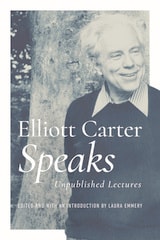
Elliott Carter Speaks
Unpublished LecturesElliott Carter. Edited and with an Introduction by Laura Emmery
University of Illinois Press, 2021
Expansive and essential, Elliott Carter Speaks opens up the artist's teaching and introspection to new contemporary perspectives on his thought and art.
Please note that the order and arrangement of materials in this book differs from that of Elliott Carter’s original lectures.
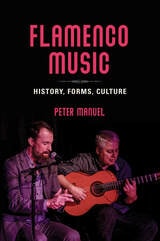
Flamenco Music
History, Forms, CulturePeter Manuel
University of Illinois Press, 2023
An iconic symbol of Spain, flamenco has become a global phenomenon. Peter Manuel offers English-language readers a rare portrait of the music’s history, styles, and cultural impact. Beginning with flamenco’s Moorish and Roma influences, Manuel follows the music’s evolution through its consolidation in the mid-1800s and on to the vibrant contemporary scene. An investigation of flamenco’s major song-types looks at rhythm and compás, guitar technique, and many other aspects of the music while Manuel’s description and analysis of the repertoire range from soleares and bulerías to tangos. His overview of contemporary flamenco culture provides insight into issues that surround the music, including globalization, gender dynamics, notions of ownership, and the ongoing debates on purity versus innovation and the relative roles played by Gitanos and non-Gitanos.
Multifaceted and entertaining, Flamenco Music is an in-depth study of the indelible art form that inspires enthusiasts and practitioners around the world.

Gamelan Gong Kebyar
The Art of Twentieth-Century Balinese MusicMichael Tenzer
University of Chicago Press, 2000
Combining the tools of the anthropologist, composer, music theorist, and performer, Tenzer moves fluidly between ethnography and technical discussions of musical composition and structure. In an approach as intricate as one might expect in studies of Western classical music, Tenzer's rigorous application of music theory and analysis to a non-Western orchestral genre is wholly original. Illustrated throughout, the book also includes nearly 100 pages of musical transcription (in Western notation) that correlate with 55 separate tracks compiled on two accompanying compact discs.
The most ambitious work on gamelan since Colin McPhee's classic Music in Bali, this book will interest musicians of all kinds and anyone interested in the art and culture of Southeast Asia, Indonesia, and Bali.
Hating Jazz
A History of Its Disparagement, Mockery, and Other Forms of AbuseAndrew S. Berish
University of Chicago Press, 2025
A rock guitarist plays four notes in front of one thousand people, while a jazz guitarist plays one thousand notes in front of four people. You might laugh or groan at this jazz joke, but what is it about jazz that makes people want to disparage it in the first place?
Andrew S. Berish’s Hating Jazz listens to the voices who have denounced, disparaged, and mocked the music. By focusing on the rejection of the music, Berish says, we see more holistically jazz’s complicated place in American cultural life. Jazz is a display of Black creativity and genius, an art form that is deeply embedded in African American life. Though the explicit racial tenor of jazz jokes has become muted over time, making fun of jazz, either in a lighthearted or aggressive way, is also an engagement with the place of Blackness in America. An individual’s taste in music may seem personal, but Berish’s analysis of jazz hatred demonstrates that musical preferences and trends are a social phenomenon. Criticism of jazz has become inextricable from the ways we understand race in America, past and present. In addition to this form of criticism, Berish also considers jazz hate as a form of taste discrimination and as a conflict over genre boundaries within different jazz cultures.
Both enlightening and original, Hating Jazz shows that our response to music can be a social act, unique to our historical moment and cultural context—we react to music in certain ways because of who we are, where we are, and when we are.
Hearing Harmony
Toward a Tonal Theory for the Rock EraChristopher Doll
University of Michigan Press, 2017
Here for the Hearing
Analyzing the Music in Musical TheaterMichael Buchler and Gregory J. Decker, Editors
University of Michigan Press, 2023
Winner of the Society for Music Theory's Outstanding Multi-Author Collection Award
This book offers a series of essays that show the integrated role that musical structure (including harmony, melody, rhythm, meter, form, and musical association) plays in making sense of what transpires onstage in musicals. Written by a group of music analysts who care deeply about musical theater, this collection provides new understanding of how musicals are put together, how composers and lyricists structure words and music to complement one another, and how music helps us understand the human relationships and historical and social contexts. Using a wide range of musical examples, representing the history of musical theater from the 1920s to the present day, the book explores how music interacts with dramatic elements within individual shows and other pieces within and outside of the genre. These essays invite readers to consider issues that are fundamental both to our understanding of musical theater and to the multiple ways we engage with music.
Il trovatore
Critical Edition Study ScoreGiuseppe Verdi
University of Chicago Press, 2016
Based on Verdi’s autograph score and an examination of important secondary sources, including contemporary manuscript copies and performing parts, this edition of Il trovatore identifies and resolves numerous ambiguities of harmony, melodic detail, text, and phrasing that have marred previous scores. Scholars and performers alike will find a wealth of information in the critical apparatus to inform their research and interpretations. The introduction to the score outlines the work’s genesis, sources, and performance history, while the critical commentary discusses all editorial decisions.

Jazz in the sixties
the expansion of musical resources and techniquesMichael J. Budds
University of Iowa Press, 1990
La traviata
Critical Edition Study ScoreGiuseppe Verdi
University of Chicago Press, 2017
The University of Chicago Press, in collaboration with Casa Ricordi, has undertaken to publish the first critical edition of the complete works of Giuseppe Verdi. The series, based exclusively on original sources, is the only one to present authentic versions of all of the composer’s works; together with his operas, the critical edition presents his songs, his choral music and sacred pieces, and his string quartet and other instrumental works.
The Works of Giuseppe Verdi will be an invaluable standard reference work—a necessary acquisition for all music libraries and a joy to own for all lovers of opera. The new series of study scores presents an adaptation of each critical edition that provides scholars with an affordable and portable option for exploring Verdi’s oeuvre. The study scores have been designed to distinguish editors’ marks from Verdi’s own notations while remaining clear enough for use in performance. The introduction to each score discusses the work’s sources, composition, and performance history, as well as performance practices, instrumentation, and problems of notation. The newest editions of the study scores examine two of Verdi’s three-act operas: La traviata and Rigoletto.
Listening to Bob Dylan
Larry Starr
University of Illinois Press, 2021
Reader-friendly and revealing, Listening to Bob Dylan encourages hardcore fans and Dylan-curious seekers alike to rediscover the music legend.
Mahler's Symphonic World
Music for the Age of UncertaintyKarol Berger
University of Chicago Press, 2025
Between 1888 and 1909 Gustav Mahler completed nine symphonies and the orchestral song cycle Das Lied von der Erde; his tenth symphony was left incomplete at his death in 1911. Mahler’s Symphonic World provocatively suggests that over his lifetime, the composer pursued a single vision and a single, ideal symphony that strived to capture his personal outlook on human existence. Writing at the turn of the twentieth century, when all trust in firm philosophical and spiritual foundations had evaporated, Mahler’s music reflected a deep preoccupation with human suffering and transience and a search for sources of possible consolation.
In Karol Berger’s reading, each of the symphonies follows a similar trajectory, with an opening quest leading to the final unveiling of a transcendent, consolatory vision. By juxtaposing single movements—the opening Allegros, the middle movements, the Finales—across different works, Berger traces recurring plotlines and imagery and discloses the works’ multiple interrelationships as well as their cohesiveness around a central idea. Ultimately, Mahler’s Symphonic World locates Mahler’s music within the matrix of intellectual currents that defined his epoch and offers a revelatory picture of his musical way of being in the world.
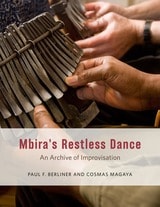
Mbira's Restless Dance
An Archive of ImprovisationPaul F. Berliner and Cosmas Magaya
University of Chicago Press, 2020
Mbira’s Restless Dance is written to be played. This two-volume, spiral-bound set features musical transcriptions of thirty-nine compositions and variations, annotated with the master player’s advice on technique and performance, his notes and observations, and commentary by Berliner. Enhanced with extensive website audiovisuals, Mbira’s Restless Dance is in effect a series of masterclasses with Magaya, suitable for experienced mbira players and those learning the fundamentals.
Together with Berliner's The Art of Mbira, in which he provides an indispensable historical and cultural guide to mbira in a changing world, Mbira's Restless Dance breaks new ground in the depth and specificity of its exploration of an African musical tradition, and in the entwining of the authors’ collaborative voices. It is a testament to the powerful relationship between music and social life—and the rewards of lifelong musical study, performance, and friendship.
Messa da Requiem
Critical Edition Study ScoreGiuseppe Verdi
University of Chicago Press, 2016
This edition of Messa da Requiem is based on Verdi’s autograph score and other original sources. The appendices include two pieces from the compositional history of the Requiem: an early version of the Libera me, composed in 1869 as part of a collaborative work planned as a memorial to Rossini; and the Liber scriptus, which in the original score of the Manzoni memorial Requiem was composed as a fugue for chorus. The introduction to the score traces the complex compositional and performance histories of the Requiem and discusses the work’s problems of instrumentation and notation, while the critical commentary gives a full description of the sources and an account of all editorial decisions.
Ne me quitte pas
A Song by Jacques Brel and Interpreted by Nina Simone and OthersMaya Angela Smith
Duke University Press, 2025
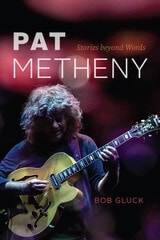
Pat Metheny
Stories beyond WordsBob Gluck
University of Chicago Press, 2024
Guitarist and composer Pat Metheny, among the most acclaimed, visionary musicians of our time, has for five decades toured with his many creative musical projects, most prominently the Pat Metheny Group, while collaborating with celebrated artists, including Charlie Haden, Ron Carter, Herbie Hancock, Ornette Coleman, and Steve Reich.
Bob Gluck, whose perspective as pianist, composer, and educator has illuminated the music of Herbie Hancock and Miles Davis in his two previous books, now focuses his lens on the music of Metheny. Neither a biography nor chronological record of Metheny’s musical output, Pat Metheny: Stories beyond Words instead captures Metheny’s self-conception as a musician and the threads that unite and distinguish his creative process. Drawing upon a wealth of new interviews and close readings of musical examples, Gluck offers a bird’s-eye view of Metheny’s musical ideas. Among these are the metaphor of storytelling, the complementarity of simplicity and complexity, and the integrated roles of composer, performer, and band leader. Much like Metheny’s signature style, this book is accessible to a wide range of readers, presenting new clarity, musical insight, and historical perspective about the legacy of Metheny’s groundbreaking music.
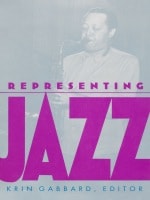
Representing Jazz
Krin Gabbard
Duke University Press, 1995
Krin Gabbard has gathered essays by distinguished writers from a variety of fields. They provide engaging analyses of films such as Round Midnight, Bird, Mo’ Better Blues, Cabin in the Sky, and Jammin’ the Blues; the writings of Eudora Welty and Dorothy Baker; the careers of the great lindy hoppers of the 1930s and 1940s; Mura Dehn’s extraordinary documentary on jazz dance; the jazz photography of William Claxton; painters of the New York School; the traditions of jazz autobiography; and the art of "vocalese." The contributors to this volume assess the influence of extramusical sources on our knowledge of jazz and suggest that the living contexts of the music must be considered if a more sophisticated jazz scholarship is ever to evolve. Transcending the familiar patterns of jazz history and criticism, Representing Jazz looks at how the music actually has been heard and felt at different levels of American culture.
With its companion anthology, Jazz Among the Discourses, this volume will enrich and transform the literature of jazz studies. Its provocative essays will interest both aficionados and potential jazz fans.
Contributors. Karen Backstein, Leland H. Chambers, Robert P. Crease, Krin Gabbard, Frederick Garber, Barry K. Grant, Mona Hadler, Christopher Harlos, Michael Jarrett, Adam Knee, Arthur Knight, James Naremore
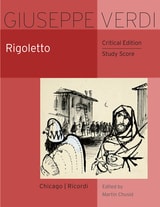
Rigoletto
Critical Edition Study ScoreGiuseppe Verdi
University of Chicago Press, 2017
The University of Chicago Press, in collaboration with Casa Ricordi, has undertaken to publish the first critical edition of the complete works of Giuseppe Verdi. The series, based exclusively on original sources, is the only one to present authentic versions of all of the composer’s works; together with his operas, the critical edition presents his songs, his choral music and sacred pieces, and his string quartet and other instrumental works.
The Works of Giuseppe Verdi will be an invaluable standard reference work—a necessary acquisition for all music libraries and a joy to own for all lovers of opera. The new series of study scores presents an adaptation of each critical edition that provides scholars with an affordable and portable option for exploring Verdi’s oeuvre. The study scores have been designed to distinguish editors’ marks from Verdi’s own notations while remaining clear enough for use in performance. The introduction to each score discusses the work’s sources, composition, and performance history, as well as performance practices, instrumentation, and problems of notation. The newest editions of the study scores examine two of Verdi’s three-act operas: La traviata and Rigoletto.
Sounding Out Pop
Analytical Essays in Popular MusicMark Spicer and John Covach, editors
University of Michigan Press, 2010
"A variety of approaches are brought to bear on fascinating repertoire, but with the underlying aim of better understanding some brilliant music. There’s nothing more exciting in music writing than something which entices you to listen to what’s familiar to you in a new way, and this collection brings such excitement in abundance."
---Allan Moore, author of Jethro Tull: Aqualung and Rock: The Primary Text
"These essays bring together a remarkable range of tools and perspectives to such diverse topics and contexts as the behind-the-scenes collaborations of composers, performers, arrangers, producers and engineers; pop culture; narratology; and race, politics and gender. The reader continuously benefits from a complementary lineup of sensitive ears that discover novelty in the familiar, exposing the heart of many rock and pop classics through imaginative and authoritative prose."
---Walter Everett, author of The Foundations of Rock and The Beatles as Musicians
The nine essays in Sounding Out Pop work together to map the myriad styles and genres of the pop-rock universe through detailed case studies that confront the music from a variety of engaging, thought-provoking perspectives---from historical to music-analytic, aesthetic to ethnographic, with several authors drawing liberally from ideas in other disciplines. The range of bands and artists covered is as vast and varied as the more than fifty-year history of pop and rock music, from the Coasters and Roy Orbison to Marvin Gaye, Bob Dylan, Radiohead, Beck, Genesis, Tori Amos, and the Police. Together these diverse essays cover a broad spectrum of studies ideally suited for classroom use and for other readers interested in gaining a deeper knowledge of the way popular music works.
Mark Spicer is Associate Professor and Director of Undergraduate Studies in Music at Hunter College and the Graduate Center, City University of New York. His writings have appeared in Contemporary Music Review, Gamut, Music Theory Online, twentieth-century music, and other scholarly journals and essay collections.
John Covach is Professor of Music at the University of Rochester and Professor of Theory at the Eastman School of Music. He is the author of the college textbook What's That Sound? An Introduction to Rock and Its History and the coeditor of Understanding Rock, American Rock and the Classical Music Tradition, and Traditions, Institutions, and American Popular Music.
Cover art credit: © iStockphoto.com/Aleksandar Dickov
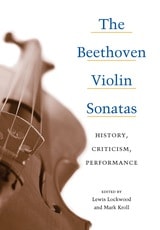
The Beethoven Violin Sonatas
History, Criticism, PerformanceEdited by Lewis Lockwood and Mark Kroll
University of Illinois Press, 2004
Lewis Lockwood and Mark Kroll's volume The Beethoven Violin Sonatas is the first scholarly book in English devoted exclusively to the Beethoven sonatas, and deals with them in unprecedented depth. It presents seven critical and historical essays by some of the most important American and European Beethoven specialists of our time. The authors examine the sonatas within the history of the genre, the social and cultural context in which they were written, their significance within Beethoven's life and works, and the issues they raise regarding performance practices of the period.
The String Quartets of Beethoven
Edited by William Kinderman
University of Illinois Press, 2020
The Virtual Haydn
Paradox of a Twenty-First-Century KeyboardistTom Beghin
University of Chicago Press, 2015
With The Virtual Haydn, Tom Beghin—himself a professional keyboard player—delves deeply into eighteenth-century history and musicology to help us hear a properly complex Haydn. Unusually for a scholarly work, the book is presented in the first person, as Beghin takes us on what is clearly a very personal journey into the past. When a discussion of a group of Viennese sonatas, for example, leads him into an analysis of the contemporary interest in physiognomy, Beghin applies what he learns about the role of facial expressions during his own performance of the music. Elsewhere, he analyzes gesture and gender, changes in keyboard technology, and the role of amateurs in eighteenth-century musical culture.
The resulting book is itself a fascinating, bravura performance, one that partakes of eighteenth-century idiosyncrasy while drawing on a panoply of twenty-first-century knowledge.
Tonality as Drama
Closure and Interruption in Four Twentieth-Century American OperasEdward D. Latham
University of North Texas Press, 2008

What Did You Hear?
The Music of Bob DylanSteven Rings
University of Chicago Press, 2025
Named one of PopMatters’ Best Books of 2025! Discover a new side of the songs of Bob Dylan by exploring the virtues of rough sounds, peculiar intonation, and a raspy voice.
Folk troubadour, rock star, country crooner—for a musician who adopted so many personas, Bob Dylan always sounds like himself. While he’s written many of the most iconic and impactful lyrics of the past sixty years, Dylan’s music has also reshaped our sonic imagination with his ragged voice, wailing harmonica, and rough-hewn guitar.
Music theorist Steven Rings argues that such sonic imperfections are central to understanding Dylan’s songs and their appeal. These blemishes can invoke authenticity or persona, signal his social commitments, and betray his political shortcomings. Rings begins—where else?—with Dylan’s voice, exploring its changeability, its unmistakable features, and its ability to inhabit characters, including the female narrator of “House of the Rising Sun.” Rings then turns to Dylan as an instrumentalist, examining his infamous adoption of the electric guitar in 1965, as well as his stylistically varied acoustic playing, which borrows sounds and techniques from Black blues musicians, among other influences. Rings charts the histories audible in Dylan’s harmonica as well as piano, which has been central to his music making since his earliest days of imitating Little Richard in his hometown of Hibbing, Minnesota. Finally, Rings guides readers through one of Dylan’s most famous songs, “A Hard Rain’s a-Gonna Fall,” analyzing its musical sources as well as variations in live performances. A companion website of audio and video examples helps readers notice the nuances and idiosyncrasies inherent in Dylan’s work and, even more importantly, their effects.
A close look at an underdiscussed but essential aspect of Dylan’s oeuvre, What Did You Hear? offers a fresh understanding of a singular performer, his musical choices, and the meanings that we can hear in his imperfect sounds.