Results by title
38 books match the query 'Ancient Languages'
1 Clement
A Reader's EditionTheodore A. Bergren
Catholic University of America Press, 2020
A Commentary on Aristophanes' Knights
Carl Arne Anderson and T. Keith Dix
University of Michigan Press, 2020
In addition to the complete Greek text and commentary, this volume includes a substantial introduction to the playwright’s career and to the historical and political background of the play. It includes advice for students on grammar and syntax, meter, festivals and staging, as well as topical and literary references and allusions that will help guide students to a mature appreciation of the comedy’s humor, seriousness, and artistic quality. Priced and sized for classroom use, this is the first full commentary on Knights since 1901 and will be widely welcomed.
A Grammar of Ugaritic
John Screnock
SBL Press, 2022
A Greek-English Lexicon of the New Testament and Other Early Christian Literature
Walter Bauer
University of Chicago Press, 2000
In this edition, Frederick W. Danker's broad knowledge of Greco-Roman literature, as well as papyri and epigraphs, provides a more panoramic view of the world of Jesus and the New Testament. Danker has also introduced a more consistent mode of reference citation, and has provided a composite list of abbreviations to facilitate easy access to this wealth of information.
Perhaps the single most important lexical innovation of Danker's edition is its inclusion of extended definitions for Greek terms. For instance, a key meaning of "episkopos" was defined in the second American edition as overseer; Danker defines it as "one who has the responsibility of safeguarding or seeing to it that something is done in the correct way, guardian." Such extended definitions give a fuller sense of the word in question, which will help avoid both anachronisms and confusion among users of the lexicon who may not be native speakers of English.
Danker's edition of Bauer's Wörterbuch will be an indispensable guide for Biblical and classical scholars, ministers, seminarians, and translators.
A Sanskrit Grammar
Manfred Mayrhofer
University of Alabama Press, 1972
Translated for the benefit of Englishspeaking students of Sanskrit and students of comparative Indo-European linguistics. Mayrhofer's Sanskrit grammar can be used successfully in three different types of course: in elementary Sanskrit courses along with such an elementary text as Jan Gonda's A Concise Elementary Grammar of the Sanskrit Language, with exercises, reading selections, and a glossary, translated from the German by Gordon B. Ford, Jr.; in courses where the linguistic structure of Sanskrit is to be presented; and, finally, in comparative lndo-European courses together with such texts as Antoine Meillet's Introduction to the Comparative Study of the Inda-European Languages, translated from the French by Gordon B. Ford, Jr. All three groups of students should find this important book extremely useful, and I hope that its publication in an English edition will promote the study of Sanskrit in the English-speaking world.
A Sourcebook for Ancient Greek
Grammar, Poetry, and ProseJohn Tomarchio
Catholic University of America Press, 2022
A Student Commentary on Pausanias Book 2
Patrick Paul Hogan
University of Michigan Press, 2018
A Student Commentary on Plato’s Euthyphro
Charles Platter
University of Michigan Press, 2019
This accessible student commentary by Charles Platter presents an introduction to the Euthyphro, the full Greek text, and a commentary designed for undergraduates and selected graduate students. As part of the series Michigan Classical Commentaries, now edited by Josiah Osgood and Alexander Sens at Georgetown University, and K. Sara Myers at the University of Virginia, the volume is sized and priced for student use.
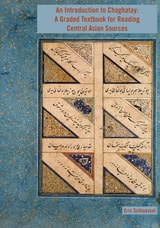
An Introduction to Chaghatay
A Graded Textbook for Reading Central Asian SourcesEric Schluessel
Michigan Publishing Services, 2018
An Introduction to Chaghatay is the first textbook in over a century to introduce this language to English-speaking students. This book is designed to build a foundation in reading Chaghatay without assuming any background knowledge on the part of the reader. These graded, cumulative lessons include common vocabulary, accessible grammar explanations, and examples of Chaghatay manuscripts. Authentic texts introduce the student to different genres, including hagiographies, documents, “stories of the prophets,” and newspapers while introducing critical skills in paleography.
Eric Schluessel is Assistant Professor of Chinese History and Politics at the University of Montana. He holds a PhD in History and East Asian Languages from Harvard University, an MA in Linguistics from the School of Oriental and African Studies, and an MA in Central Eurasian Studies from Indiana University. He is the author of several articles on the history of Chinese Central Asia and is currently preparing a critical edition and translation of Mullah Musa Sayrami’s Tarikh-i Hamidi, a chronicle of Xinjiang in the nineteenth century.
Aristophanes' Clouds
A CommentaryS. Douglas Olson
University of Michigan Press, 2021
This is the first substantial commentary on Clouds since Dover’s 1968 edition. Intended for intermediate Greek students at undergraduate and graduate levels, the commentary pays careful attention to the basic characteristics of ancient Greek syntax, as well as to how Greek words are formed and can be analyzed. It offers robust staging notes, information about daily life in late 5th-century Athens, and constant reference to the rhetorical and dramatic strategies of the text. Full support is offered for those interested in the metrical structure of the songs, but in a way that allows instructors to leave such issues aside, should they choose to do so. The first and second appendices offer a basic means of entry into the rich but complex world of the comic fragments. An English-language bibliography is provided. The edition will interest professional classicists of all sorts seeking an accessible introduction to one of Aristophanes’ greatest plays, to philosophers concerned with Socrates and the sophistic movement, and to theater professionals who wish to stage the play.
Commentary on Thucydides, Book 3
Rachel Bruzzone
University of Michigan Press, 2025
Commentary on Thucydides, Book 3 remedies this situation by offering detailed linguistic explanations and grammatical clarifications designed to appeal both to seasoned Classicists and to a broader group of non-specialist readers who may still be developing their Greek language skills. Starting with 428 BCE, Book 3 covers a critical period of the Peloponnesian War in which the conflict began to manifest its extraordinary violence and scale. The book contains influential and controversial discussions, including Thucydides’ own analysis of the nature of war and the ways that it teaches “lessons of violence” to individuals and states. Book 3 also features the famous Mytilenean Debate, an argument premised on the thesis that all international relations are, or should be, fundamentally amoral. Educated readers have always looked to Thucydides in turbulent times, and this commentary will open up his text to a wider audience.
Ecclesiastical Latin
A Primer on the Language of the ChurchCharles G. Kim, Jr.
Catholic University of America Press, 2024

Ecclesiastical Latin
An Answer Key and CommentaryCharles G. Kim Jr.
Catholic University of America Press, 2026
Elementary Classical Greek, Revised Edition
Frederick Williams
Southern Illinois University Press, 2004
Now in paperback for the first time, Elementary Classical Greek is a trusted handbook for learning the language that does not presuppose a knowledge of Latin. Based on the premise that average American students can learn the language, the lessons are thorough but not pedantic, simple but not superficial, and the textbook has been proven in the classroom and for independent learners.
Elementary Classical Greek stresses a clear and orderly presentation of the language, accompanied by individual sentences or short passages that illustrate grammar, give practice in reading, and help build vocabulary. Drawing on decades of experience teaching classical Greek, Frederick Williams presents a text in which grammatical explanations are clear, succinct, and correct and the selected readings are varied, interesting, and useful. Included in the nearly one-hundred reading passages are excerpts from Plato’s Ion and Republic, Aristophanes’s Clouds, and Paul’s first letter to the Corinthians.
The popular textbook is designed for a course meeting for two semesters. There are twenty-four lessons in all, with appendixes on prepositions, Greek numbers, and the Greek verb, plus Greek-English and English-Greek vocabularies, a grammatical index of subjects, and a list of Greek authors cited. Selected readings are presented first in simple, then more complex, language until the reader is led to the actual words of the ancient author—all within the same lesson. This elementary device helps bridge many of the difficult gaps between modern English and ancient Greek.
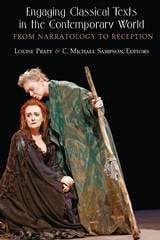
Engaging Classical Texts in the Contemporary World
From Narratology to ReceptionLouise Pratt and C. Michael Sampson, Editors
University of Michigan Press, 2018
This volume considers perennial favorites of classical literature—the Iliad and Odyssey, Greek tragedy, Roman comedy, the Argonautica, and Ovid’s Metamorphoses—and their influence on popular entertainment from Shakespeare’s plays to Hollywood’s toga films. It also engages with unusual and intriguing texts across the centuries, including a curious group of epigrams by Artemidorus found on the island sanctuary of Thera, mysterious fragments of two Aeschylean tragedies, and modern-day North African novels. These essays engage an array of theoretical approaches from other fields—narratology, cognitive literary theory, feminist theory, New Historicist approaches to gender and sexuality, and politeness theory—without forsaking more traditional philological methods. A new look at hospitality in the Argonautica shows its roots in the changed historical circumstances of the Hellenistic world. The doubleness of Helen and her phantom in Euripides’ Helen is even more complex than previously noted. Particularly illuminating is the recurrent application of reception studies, yielding new takes on the ancient reception of Homer by Apollonius and of Aeschylus by Macrobius, the reception of Plautus by Shakespeare, and more contemporary examples from the worlds of cinema and literature.
Students and scholars of classics will find much in these new interpretations and approaches to familiar texts that will expand their intellectual horizons. Specialists in other fields, particularly English, comparative literature, film studies, and gender and sexuality studies, will also find these essays directly relevant to their work.
Florentine Codex
Book 1: Book 1: The GodsBernardino de Sahagun
University of Utah Press, 1981
Two of the world’s leading scholars of the Aztec language and culture have translated Sahagún’s monumental and encyclopedic study of native life in Mexico at the time of the Spanish Conquest. This immense undertaking is the first complete translation into any language of Sahagún’s Nahuatl text, and represents one of the most distinguished contributions in the fields of anthropology, ethnography, and linguistics.
Written between 1540 and 1585, the Florentine Codex (so named because the manuscript has been part of the Laurentian Library’s collections since at least 1791) is the most authoritative statement we have of the Aztecs’ lifeways and traditions—a rich and intimate yet panoramic view of a doomed people.
The Florentine Codex is divided by subject area into twelve books and includes over 2,000 illustrations drawn by Nahua artists in the sixteenth century.
Book One describes in detail the gods of the Aztec people, including Uitzilopochtli, Tlatoc, and Quetzalcoatl. This colorful and clear translation brings to life characteristics of each god, describing such items as clothing or adornment worn by individual gods, as well as specific personality traits.
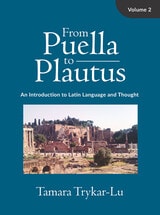
From Puella to Platus
An Introduction to Latin Language and Thought, Volume 2Tamara Trykar-Lu
Catholic University of America Press, 2019
From Puella to Plautus
An Introduction to Latin Language and Thought, Volume 1Tamara Trykar-Lu
Catholic University of America Press, 2019
Greek for Reading
Gerda Seligson
University of Michigan Press, 1994
Historical Linguistics and Biblical Hebrew
Steps Toward an Integrated ApproachRobert Rezetko
SBL Press, 2014
A philologically robust approach to the history of ancient Hebrew
In this book the authors work toward constructing an approach to the history of ancient Hebrew that overcomes the chasm of academic specialization. The authors illustrate how cross-textual variable analysis and variation analysis advance research on Biblical Hebrew and correct theories based on extra-linguistic assumptions, intuitions, and ideologies by focusing on variation of forms/uses in the Masoretic text and variation between the Masoretic text and other textual traditions.
Features:
- A unique approach that examines the nature of the sources and the description of their language together
- Extensive bibliography for further research
- Tables of linguistic variables and parallels
Hittite Diplomatic Texts
Gary M. Beckman
SBL Press, 1999
Hittite Myths, Second Edition
Harry A. Hoffner
SBL Press, 1998
Iliad, Book 1
Homer
University of Michigan Press, 2002
Iron Age Hieroglyphic Luwian Inscriptions
Annick Payne
SBL Press, 2012
Ossa Ostensa
A Proven System for Demystifying Latin, Book 2Laura Pooley
Catholic University of America Press, 2023
Ossa Ostensa
A Proven System for Demystifying Latin, Book 3Laura Pooley
Catholic University of America Press, 0
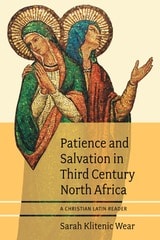
Patience and Salvation in Third Century North Africa
A Christian Latin ReaderSarah Wear
Catholic University of America Press, 2022
Philodemus, On Death
W. Benjamin Henry
SBL Press, 2009
Philodemus, On Property Management
Voula Tsouna
SBL Press, 2013
Proverbs
An Eclectic Edition with Introduction and Textual CommentaryMichael V. Fox
SBL Press, 2015
A new critical text for Proverbs drawing from many manuscripts
This first volume of The Hebrew Bible: A Critical Edition series, features a critical text of Proverbs with extensive text-critical introductions and commentaries. This and future HBCE volumes bring together a scholar’s critical decisions into a single text. construct an eclectic text, drawing from many manuscripts or placing entirely variant texts side by side. A common approach for critical editions of other ancient books, including the New Testament, the eclectic approach and scope used in the HBCE is a first of its kind for the Hebrew Bible.
Features:
- Emendations set in context rather than singly and marginally
- Introduction that sets out the method and purpose of the volume
- Extensive list of abbreviations and sigla
Reading Greek with Jonah
A Mini-Course in Ancient GreekJames McDonough
Catholic University of America Press, 2026

Sahidic Coptic
An Introductory TextbookBill Manley
University College London, 2026
An introduction to reading and analyzing texts in Sahidic Coptic, the primary literary language in Late Antique Egypt.
This concise textbook provides beginner students with the knowledge and skills required for reading primary sources and teaches the grammar of documents written in Sahidic Coptic. Learners are invited to study aspects of the language across twenty structured lessons and, from the beginning, apply their learning directly to reading authentic ancient texts written by men and women between 380 and 750 AD. The book introduces the language through engagement with ancient texts rather than artificial exercises, enabling students to explore the history and culture of Egyptian communities under Byzantine and early Islamic rule, as well as key topics such as the development of Christian orthodoxy, the lives of women, and the emergence of monasticism as a major cultural force.
Scribal Worlds
Scholarship and Classification in Cuneiform CulturesEdited by Eduardo A. Escobar, Kiersten Neumann, and C. Jay Crisostomo
University College London, 2026
Revealing the scholarly worlds behind the world’s first writing system, this volume explores how cuneiform cultures classified, transmitted, and interpreted knowledge.
Cuneiform is the world’s first preserved writing system, yet cuneiform texts and the associated cultures and practices remain undervalued across several disciplines. Scribal Worlds: Scholarship and Classification in Cuneiform Cultures explores the history of the earliest writing cultures of the ancient Middle East. Case studies reconstruct the intellectual frameworks and the transmission of knowledge of scribal cultures to show how specific texts and objects can be interpreted within their cultural contexts.

The Afterlife of Virgil
Edited by P Mack and John North
University of London Press, 2017
The Ahhiyawa Texts
Gary M. Beckman
SBL Press, 2011
The Best of the Grammarians
Aristarchus of Samothrace on the IliadFrancesca Schironi
University of Michigan Press, 2018
Francesca Schironi presents a more robust picture of Aristarchus as a scholar than anyone has offered previously. Based on her analysis of over 4,300 fragments from his commentary on the Iliad, she reconstructs Aristarchus’ methodology and its relationship to earlier scholarship, especially Aristotelian poetics. Schironi departs from the standard commentary on individual fragments, and instead organizes them by topic to produce a rigorous scholarly examination of how Aristarchus worked.
Combining the accuracy and detail of traditional philology with a big-picture study of recurrent patterns and methodological trends across Aristarchus’ work, this volume offers a new approach to scholarship in Alexandrian and classical philology. It will be the go-to reference book on this topic for many years to come, and will usher in a new way of addressing the highly technical work of ancient scholars without losing philological accuracy. This book will be valuable to classicists and philologists interested in Homer and Homeric criticism in antiquity, Hellenistic scholarship, and ancient literary criticism.
The Concise Greek-English Lexicon of the New Testament
Frederick William Danker
University of Chicago Press, 2009
Frederick William Danker, a world-renowned scholar of New Testament Greek, is widely acclaimed for his 2000 revision of Walter Bauer’s A Greek-English Lexicon of the New Testament and Other Early Christian Literature. With more than a quarter of a million copies in print, it is considered the finest dictionary of its kind.
Danker’s Concise Greek-English Lexicon of the New Testament will prove to be similarly invaluable to ministers, seminarians, translators, and students of biblical Greek. Unlike other lexica of the Greek New Testament, which give only brief glosses for headwords, The Concise Greek-English Lexicon offers extended definitions or explanations in idiomatic English for all Greek terms.
Each entry includes basic etymological information, short renderings, information on usage, and plentiful biblical references. Greek terms that could have different English definitions, depending on context, are thoughtfully keyed to the appropriate passages. An overarching aim of The Concise Greek-English Lexicon is to assist the reader in recognizing the broad linguistic and cultural context for New Testament usage of words.
The Concise Greek-English Lexicon retains all the acclaimed features of A Greek-English Lexicon in a succinct and affordable handbook, perfect for specialists and nonspecialists alike.
The Myths of Fiction
Studies in the Canonical Greek NovelsEdmund P. Cueva
University of Michigan Press, 2004
The tradition of historical literature begun by Herodotus and Thucydides molded the early Greek novel. As the genre evolved, however, Greek novels moved away from their historical roots to become more heavily influenced by mythological traditions. Edmund Cueva's new book examines the literary uses to which the ancient novelists put their mythological material. His work offers a stimulating discussion of myths and their rise to prominence as the key feature of the fully developed Greek novel. He also takes into account the impact of the Roman conquest on the development of the Greek novel, the last true literary creation of the Greek world. The Myths of Fiction will interest scholars of Greek literarure, imperial history, literary myth, intertextuality, and comparative literature.
Edmund Cueva is Associate Professor and Chair of Classics at Xavier University.