Results by title
21 books match the query 'Anti-communist movements'
A Blacklist Education
American History, a Family Mystery, and a Teacher Under FireJane S. Smith
Rutgers University Press, 2025
Finalist for the Society of Midland Authors Richard Frisbie Award for Adult Nonfiction
In A Blacklist Education, a mysterious file of family papers triggers a journey through the dark days of political purges in the 1950s. Jane S. Smith tells the story of the anticommunist witch hunt that sent shockwaves through New York City’s public schools as more than a thousand teachers were targeted by Board of Education investigators. Her father was one of them—a fact she learned only long after his death.
Beginning in 1949, amid widespread panic about supposed communist subversion, investigators questioned teachers in their homes, accosted them in their classrooms, and ordered them to report to individual hearings. The interrogations were not published, filmed, open to the public, or reported in the news. By 1956, hundreds of New York City teachers had been fired, often because of uncorroborated reports from paid informers or anonymous accusers.
Most of the targeted teachers resigned or retired without any public process, their names recorded only in municipal files and their futures never known. Their absence became the invisible outline of an educational void, a narrowing of thought that pervaded classrooms for decades. In this highly personal story, family lore and childhood memory lead to restricted archives, forgotten inquisitions, and an eerily contemporary campaign to control who could teach and what was acceptable for students to learn.
American Labor and the Cold War
Grassroots Politics and Postwar Political CultureCherny, Robert
Rutgers University Press, 2004
The American labor movement seemed poised on the threshold of unparalleled success at the beginning of the post-World War II era. Fourteen million strong in 1946, unions represented thirty five percent of non-agricultural workers. Why then did the gains made between the 1930s and the end of the war produce so few results by the 1960s?
This collection addresses the history of labor in the postwar years by exploring the impact of the global contest between the United States and the Soviet Union on American workers and labor unions. The essays focus on the actual behavior of Americans in their diverse workplaces and communities during the Cold War. Where previous scholarship on labor and the Cold War has overemphasized the importance of the Communist Party, the automobile industry, and Hollywood, this book focuses on politically moderate, conservative workers and union leaders, the medium-sized cities that housed the majority of the population, and the Roman Catholic Church. These are all original essays that draw upon extensive archival research and some upon oral history sources.

Anti-Communism in Britain During the Early Cold War
A Very British Witch-HuntMatthew Gerth
University of London Press, 2022
The Cold War produced in many countries a form of political repression and societal paranoia which often infected governmental and civic institutions. In the West, the driving catalyst for the phenomenon was anti-communism. While much has been written on the post-war American red scare commonly known as McCarthyism, the domestic British response to the “red menace” during the early Cold War has until now received little attention. Anti-communism in Britain During the Early Cold War is the first book to examine how British Cold War anti-communism transpired and manifested as McCarthyism raged across the Atlantic.
Drawing from a wealth of archival material, this book demonstrates that while policymakers and politicians in Britain sought to differentiate their anti-communist initiatives from the “witch hunt hysteria” occurring in the United States, they were often keen to conduct—albeit less publicly—their own hunts as well. Through analyzing how domestic anti-communism exhibited itself in state policies, political rhetoric, party politics, and the trade union movement, Matthew Gerth argues that an overreaction to the communist threat occurred. In striking detail, this book describes a nation at war with a specific political ideology and its willingness to use a variety of measures to either disrupt or eradicate its influence.

Behind the Bamboo Hedge
The Impact of the Homeland Politics in the Parisian Vietnamese CommunityGisele L. Bousquet
University of Michigan Press, 1991
Black Scare / Red Scare
Theorizing Capitalist Racism in the United StatesCharisse Burden-Stelly
University of Chicago Press, 2023
In the early twentieth century, two panics emerged in the United States. The Black Scare was rooted in white Americans’ fear of Black Nationalism and dread at what social, economic, and political equality of Black people might entail. The Red Scare, sparked by communist uprisings abroad and subversion at home, established anticapitalism as a force capable of infiltrating and disrupting the American order. In Black Scare / Red Scare, Charisse Burden-Stelly meticulously outlines the conjoined nature of these state-sanctioned panics, revealing how they unfolded together as the United States pursued capitalist domination. Antiradical repression, she shows, is inseparable from anti-Black oppression, and vice versa.
Beginning her account in 1917—the year of the Bolshevik Revolution, the East St. Louis Race Riot, and the Espionage Act—Burden-Stelly traces the long duration of these intertwined and mutually reinforcing phenomena. She theorizes two bases of the Black Scare / Red Scare: US Capitalist Racist Society, a racially hierarchical political economy built on exploitative labor relationships, and Wall Street Imperialism, the violent processes by which businesses and the US government structured domestic and foreign policies to consolidate capital and racial domination. In opposition, Radical Blackness embodied the government’s fear of both Black insurrection and Red instigation. The state’s actions and rhetoric therefore characterized Black anticapitalists as foreign, alien, and undesirable. This reactionary response led to an ideology that Burden-Stelly calls True Americanism, the belief that the best things about America were absolutely not Red and not Black, which were interchangeable threats.
Black Scare / Red Scare illuminates the anticommunist nature of the US and its governance, but also shines a light on a misunderstood tradition of struggle for Black liberation. Burden-Stelly highlights the Black anticapitalist organizers working within and alongside the international communist movement and analyzes the ways the Black Scare/Red Scare reverberates through ongoing suppression of Black radical activism today. Drawing on a range of administrative, legal, and archival sources, Burden-Stelly incorporates emancipatory ideas from several disciplines to uncover novel insights into Black political minorities and their legacy.
Buried Histories
The Anticommunist Massacres of 1965–1966 in IndonesiaJohn Roosa
University of Wisconsin Press, 2022
Drawing upon years of research and interviews with survivors, Buried Histories is an impressive contribution to the literature on genocide and mass atrocity, crucially addressing the topics of media, military organization, economic interests, and resistance.
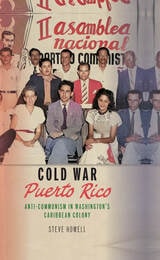
Cold War Puerto Rico
Anti-Communism in Washington’s Caribbean ColonySteve Howell
University of Massachusetts Press, 2026
A gripping history of FBI surveillance, political repression, and the fight for Puerto Rican independence
In the 1940s, with the construction of a naval base and a bombing range, Puerto Rico became a major geo-political military outpost for the United States. For a power claiming global leadership in a decolonizing world, however, the archipelago’s colonial condition underscored the dissonance between American democratic rhetoric and its imperial reality. The solution was a deal that, in 1952, gave Puerto Rico a degree of self-government without changing its legal status as an “unincorporated” US territory. The US then publicly claimed Puerto Rico was now more autonomous while using repressive tactics such as FBI surveillance, arrests, destabilization, and other methods developed in Washington to silence activists and political parties pushing for full independence.
In Cold War Puerto Rico, Steve Howell examines how J. Edgar Hoover and the FBI targeted Puerto Rican communists as part of an offensive against pro-independence parties and activists generally. Howell’s US-born father, who fell afoul of Hoover for producing radical cartoons while working in San Juan in the 1940s, remained on the FBI’s watch list long after exiling himself in Britain. His close friends, the Puerto Rican author César Andreu Iglesias and Jane Speed de Andreu, were meanwhile arrested and imprisoned three times during the 1950s. Drawing on a wealth of new sources, including interviews and FBI files, Howell tells their stories along with those of other activists who battled indictment in 1954 under the Smith Act, challenged the jurisdiction of the House Un-American Activities Committee in San Juan in 1959, and revived the Puerto Rican independence movement in the 1960s, despite the FBI deploying the covert tactics of COINTELPRO against them.
Puerto Rico is virtually invisible in histories of what is generally called McCarthyism, yet anti-communist repression was in many ways more intense there than in the mainland US. Now, with Puerto Rico’s future currently hanging in the balance, Howell’s compelling history demonstrates why we need to understand the long enforcement of its colonial status.
Dark Days in the Newsroom
McCarthyism Aimed at the PressEdward Alwood
Temple University Press, 2007
Dark Days in the Newsroom traces how journalists became radicalized during the Depression era, only to become targets of Senator Joseph McCarthy and like-minded anti-Communist crusaders during the 1950s. Edward Alwood, a former news correspondent describes this remarkable story of conflict, principle, and personal sacrifice with noticeable élan. He shows how McCarthy's minions pried inside newsrooms thought to be sacrosanct under the First Amendment, and details how journalists mounted a heroic defense of freedom of the press while others secretly enlisted in the government's anti-communist crusade.
Relying on previously undisclosed documents from FBI files, along with personal interviews, Alwood provides a richly informed commentary on one of the most significant moments in the history of American journalism. Arguing that the experiences of the McCarthy years profoundly influenced the practice of journalism, he shows how many of the issues faced by journalists in the 1950s prefigure today's conflicts over the right of journalists to protect their sources.
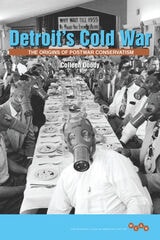
Detroit's Cold War
The Origins of Postwar ConservatismColleen Doody
University of Illinois Press, 2017
From Red-Baiting to Blacklisting
The Labor Plays of Manny FriedBarry B. Witham
Southern Illinois University Press, 2020
Author Barry B. Witham reclaims the work of Manny Fried, an essential American playwright so thoroughly blacklisted after he defied the House Committee on Un-American Activities in 1954, and again in 1964, that his work all but completely disappeared from the canon. Witham details Manny Fried’s work inside and outside the theatre and examines his three major labor plays and the political climate that both nurtured and disparaged their productions. Drawing on never-before-published interview materials, Witham reveals the details of how the United States government worked to ruin Fried’s career.
From Red-Baiting to Blacklisting includes the complete text of Fried’s major labor plays, all long out of print. In Elegy for Stanley Gorski, Fried depicts one of the many red-baiting campaigns that threatened countless unions in the wake of the Taft-Hartley Act and the collusion of the Catholic Church with these activities. In Drop Hammer, Fried tackles the issues of union dues, misappropriation, and potential criminal activities. In the third play, The Dodo Bird, perhaps his most popular, Fried achieves a remarkable character study of a man outsourced from his job by technology and plant closures.
Manny Fried’s plays portray the hard edges of capitalism and government power and illuminate present-day struggles with hostility to labor unions and the passage in several states of right-to-work laws. Fried had no illusions about the government’s determination to destroy communism and unionism—causes to which he was deeply committed.
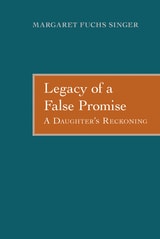
Legacy of a False Promise
A Daughter's ReckoningMargaret Fuchs Singer
University of Alabama Press, 2009
Margaret Fuchs was thirteen in June 1955 when she learned that her parents had been Communists while working for the U.S. government in the 1930s and '40s. This book chronicles the years during which her parents were exposed and her father was subpoenaed before the House Un-American Activities Committee. Eventually he named names, and subsequently lost his job as a law professor at American University, and was blacklisted from teaching ever again. Legacy of a False Promise also details the author's quest as an adult to learn whether or not her parents ever spied for the Soviet Union.
Based on eight years of research using family records, FBI files, American University archives, personal interviews, and the recently declassified Venona cables, Legacy of a False Promise offers unique insights into the McCarthy Era. Most "red-diaper babies" who have written on the subject had parents who refused to give in to HUAC's demands. Singer's work instead recounts the shame and series of betrayals that her father's decision to name names brought to her family. Furthermore, it explores the campaign of the liberal anti-Communist movement to publicize its political position while defending a fired ex-Communist professor, the nature and activities of secret Communist underground cells, and the motivation of New Deal government workers who spied for the Soviets.
This is a poignant meditation on family secrets, father-daughter relationships in times of crisis, teenage loneliness in the midst of trauma, and the effects of parents' actions on the lives of their children. It also serves as a timely reminder of the dangers of sacrificing civil liberties in the name of national security.
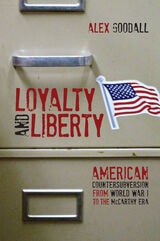
Loyalty and Liberty
American Countersubversion from World War 1 to the McCarthy EraAlex Goodall
University of Illinois Press, 2013
Identifying varied interest groups such as business tycoons, Christian denominations, and Southern Democrats, Goodall demonstrates how countersubversive politics was far from unified: groups often pursued clashing aims while struggling to balance the competing pulls of loyalty to the nation and liberty of thought, speech, and action. Meanwhile, the federal government pursued its own course, which alternately converged with and diverged from the paths followed by private organizations. By the end of World War II, alliances on the left and right had largely consolidated into the form they would keep during the Cold War. Anticommunists on the right worked to rein in the supposedly dictatorial ambitions of the Roosevelt administration, while New Deal liberals divided into several camps: the Popular Front, civil liberties activists, and embryonic Cold Warriors who struggled with how to respond to communist espionage in Washington and communist influence in politics more broadly.
Rigorous in its scholarship yet accessible to a wide audience, Goodall's masterful study shows how opposition to radicalism became a defining ideological question of American life.
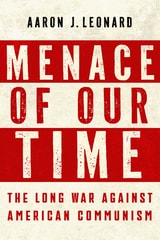
Menace of Our Time
The Long War Against American CommunismAaron J. Leonard
Rutgers University Press, 2025
A survey of the far-reaching measures the U.S. government brought to bear against the CPUSA, from poison-pen letters to the Red Scare and beyond.
Beginning at the turn of the twentieth century and ending only with the Soviet Union’s collapse in 1991, the U.S. government and major elements in the wider society waged an unrelenting campaign to suppress and criminalize domestic communism. This long-overdue book details the longest and most extensive repressive operation ever undertaken by U.S. authorities against a domestic political organization that, however problematic, was largely operating within the scope of constitutionally mandated freedoms. Beyond that, this is the story of how systemic measures against U.S. communists—in contrast to the vaunted claims of American political freedom—defined the political landscape of the last century.
Menace of Our Time tracks the suppression efforts aimed at the group, including the state laws of the twenties that imprisoned the fledgling communist leadership; the tactics used by police and local authorities against communists as they fought for unions, racial equality, and the unemployed; the trials and imprisonment of communist leaders mid-century; the extra-legal efforts of the Counterintelligence Program (COINTELPRO) in the sixties; and the ongoing, relentless surveillance by the FBI that followed. In examining the far-reaching measures the government brought to bear against the Communist Party USA, Aaron J. Leonard provides a clearer picture of the mechanics of social and political repression that abound in the society we still inhabit.
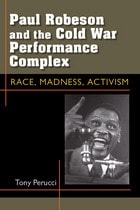
Paul Robeson and the Cold War Performance Complex
Race, Madness, ActivismTony Perucci
University of Michigan Press, 2012
Actor and singer Paul Robeson's performances in Othello, Show Boat, and The Emperor Jones made him famous, but his midcentury appearances in support of causes ranging from labor and civil rights to antilynching and American warmongering made him notorious. When Robeson announced at the 1949 Paris Peace Conference that it was "unthinkable" for blacks to go to war against the Soviet Union, the mainstream American press declared him insane.
Notions of Communism, blackness, and insanity were interchangeably deployed during the Cold War to discount activism such as Robeson's, just a part of an array of social and cultural practices that author Tony Perucci calls the Cold War performance complex. Focusing on two key Robeson performances---the concerts in Peekskill, New York, in 1949 and his appearance before the House Committee on Un-American Activities in 1956---Perucci demonstrates how these performances and the government's response to them are central to understanding the history of Cold War culture in the United States. His book provides a transformative new perspective on how the struggle over the politics of performance in the 1950s was also a domestic struggle over freedom and equality. The book closely examines both of these performance events as well as artifacts from Cold War culture---including congressional documents, FBI files, foreign policy papers, the popular literature on mental illness, and government propaganda films---to study the operation of power and activism in American Cold War culture.
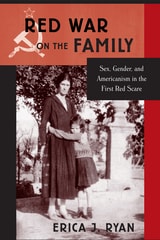
Red War on the Family
Sex, Gender, and Americanism in the First Red ScareErica J Ryan
Temple University Press, 2016
In her probing and engaging book, Red War on the Family, Erica Ryan traces the roots of sexual modernism and the history of antiradicalism and antifeminism. She illuminates how Americans responded to foreign and domestic threats and expressed nationalism by strengthening traditional gender and family roles-especially by imposing them on immigrant groups, workers, women, and young people.
Ryan argues that the environment of political conformity in the 1920s was maintained in part through the quest for cultural and social conformity, exemplified by white, middle-class family life. Red War on the Family charts the ways Americanism both reinforced and was reinforced by these sexual and gender norms in the decades after World War I.
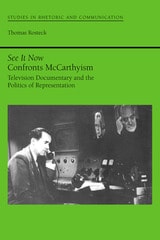
See It Now Confronts McCarthyism
Television Documentary and the Politics of RepresentationThomas Rosteck
University of Alabama Press, 1994
See It Now, Edward R. Murrow and Fred W. Friendly’s early documentary television program, has come to be recognized as the exemplar of nonfiction television. One important element in its reputation is a series of four telecasts directly dealing with abuses of McCarthyism and the Red Scare. This book is about those programs, but it is also about the early 1950s in America, the troubled era in which these programs were broadcast. This book is, then, both cultural history and media analysis.
As media analysis, this book seeks to understand the symbolic form, the aesthetic construction, and the subsequent experience that these four programs offered viewers. This sort of critical analysis is a development of recent vintage in American media studies. Whereas a decade ago television and the media were studied largely through an empiricist social scientific paradigm, now humanistic approaches to media discourses engage the interest of scholars in history, rhetoric and communication, political science, anthropology, and American studies. As case study, then, this book bridges classical humanist and contemporary mass media approaches, and as we go, I shall essay the utility of humanistic methods for the understanding and explication of mass media that is primarily visual in nature.
As cultural history, this book seeks to illuminate a unique era in the recent American past. My aim is to understand the programs as articulations of public “common sense” and as artifacts that help convey this common sense. Thus, a second theme of this book will be to locate-through the analysis of public discourse cast in the television documentary form—an American ideology: a set of “templates” that both ground the programs and reveal the cultural assumptions of the historical period.
In addition, from a slightly different historical perspective, our increased understanding of these See It Now broadcasts gives us an appreciation of the development of the television industry and the genre of television documentary. Coming at a time when few Americans had television sets, these See It Now programs coincided with an exponential increase in television ownership and popularity. As an elaborate defense of free speech for the medium, these documentaries may have helped to establish autonomy and a direction for a nascent broadcasting industry. More specifically, as the paradigm for the television documentary and as the first regularly scheduled documentary series, these See It Now programs shaped expectations and set the benchmark to which all nonfiction television, from Twentieth Century to White Paper to Sixty Minutes, has been compared. Thus, a third theme will be the implications of these seminal programs for media institutions and for the genre of television news documentary.
Spider Web
The Birth of American AnticommunismNick Fischer
University of Illinois Press, 2016
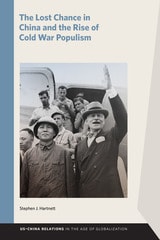
The Lost Chance in China and the Rise of Cold War Populism
Stephen J. Hartnett
Michigan State University Press, 2025
The Politics of Fear
Joseph R. McCarthy and the SenateRobert Griffith
University of Massachusetts Press, 1970
Winner of the Organization of American Historians’ Frederick Jackson Turner Award
Originally published in 1970, and now a classic in its field, The Politics of Fear traces the rise and fall of one of America’s most notorious political demagogues. Robert Griffith concludes that McCarthy’s enormous power owed less to the force of the senator’s unique personality than to the issues and symbols with which he identified and that McCarthy was the product, not the progenitor, of the postwar politics of anticommunism. For this edition, Griffith has provided a new introduction covering the recent literature on McCarthyism and the changing views on the topic.
The Republic Shall Be Kept Clean
How Settler Colonial Violence Shaped Antileft RepressionTariq D. Khan
University of Illinois Press, 2023
The colonizing wars against Native Americans created the template for anticommunist repression in the United States. Tariq D. Khan’s analysis reveals bloodshed and class war as foundational aspects of capitalist domination and vital elements of the nation’s long history of internal repression and social control. Khan shows how the state wielded the tactics, weapons, myths, and ideology refined in America’s colonizing wars to repress anarchists, labor unions, and a host of others labeled as alien, multi-racial, multi-ethnic urban rabble. The ruling classes considered radicals of all stripes to be anticolonial insurgents. As Khan charts the decades of red scares that began in the 1840s, he reveals how capitalists and government used much-practiced counterinsurgency rhetoric and tactics against the movements they perceived and vilified as “anarchist.”
Original and boldly argued, The Republic Shall Be Kept Clean offers an enlightening new history with relevance for our own time.

Un-American Womanhood
Antiradicalism, Antifeminism, and the First Red ScareKim Nielsen
The Ohio State University Press, 2001