Results by title
12 books match the query 'Antitrust law'
Antitrust Law, Second Edition
Richard A. Posner
University of Chicago Press, 2001
Antitrust Law was fundamental to redefining the field of antitrust law and it remains the definitive textbook for those teaching or learning the subject, Richard Posner's book has played a major role in transforming the field of antitrust law into a body of economically rational principles largely in accord with the ideas set forth in the first edition. Today's antitrust professionals may disagree on specific practices and rules, but most litigators, prosecutors, judges, and scholars agree that the primary goal of antitrust laws should be to promote economic welfare, and that economic theory should be used to determine how well business practices conform to that goal.
In this thoroughly revised edition, Posner explains the economic approach to new generations of lawyers and students.
"The antitrust laws are here to stay," Posner writes, "and the practical question is how to administer them better-more rationally, more accurately, more expeditiously, more efficiently." This fully revised classic will continue to be the standard work in the field.

Are Predatory Commitments Credible?
Who Should the Courts Believe?John R. Lott, Jr.
University of Chicago Press, 1999
John R. Lott, Jr. provides long-awaited empirical analysis in this book. By examining firms accused of or convicted of predation over a thirty-year period of time, he shows that these firms are not organized as the game-theoretic or other models of predation would predict. In contrast, what evidence exists for predation suggests that government enterprises are more of a threat.
Lott presents crucial new data and analysis, attacking an issue of major legal and economic importance. This impressive work will be of great interest to economists, legal scholars, and antitrust policy makers.
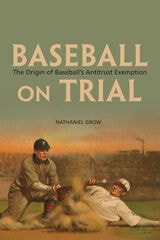
Baseball on Trial
The Origin of Baseball's Antitrust ExemptionNathaniel Grow
University of Illinois Press, 2014
Currently a billion dollar enterprise, professional baseball teams crisscross the country while the games are broadcast via radio, television, and internet coast to coast. The sheer scope of this activity would seem to embody the phrase "interstate commerce." Yet baseball is the only professional sport--indeed the sole industry--in the United States that currently benefits from a judicially constructed antitrust immunity. How could this be?
Drawing upon recently released documents from the National Baseball Hall of Fame, Grow analyzes how the Supreme Court reached this seemingly peculiar result by tracing the Federal Baseball litigation from its roots in 1914 to its resolution in 1922, in the process uncovering significant new details about the proceedings. Grow observes that while interstate commerce was measured at the time by the exchange of tangible goods, baseball teams in the 1910s merely provided live entertainment to their fans, while radio was a fledgling technology that had little impact on the sport. The book ultimately concludes that, despite the frequent criticism of the opinion, the Supreme Court's decision was consistent with the conditions and legal climate of the early twentieth century.
Law and Economic Policy in America
The Evolution of the Sherman Antitrust ActWilliam Letwin
University of Chicago Press, 1981
The Atlantic Divide in Antitrust
An Examination of US and EU Competition PolicyDaniel J. Gifford and Robert T. Kudrle
University of Chicago Press, 2015
With The Atlantic Divide in Antitrust, Daniel J. Gifford and Robert T. Kudrle explore many of the main contested areas of contemporary antitrust, including mergers, price discrimination, predatory pricing, and intellectual property. After identifying how prevailing analyses differ across these areas, they then examine the policy ramifications. Several themes run throughout the book, including differences in the amount of discretion firms have in dealing with purchasers, the weight given to the welfare of various market participants, and whether competition tends to be viewed as an efficiency-generating process or as rivalry. The authors conclude with forecasts and suggestions for how greater compatibility might ultimately be attained.
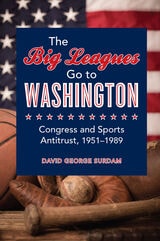
The Big Leagues Go to Washington
Congress and Sports Antitrust, 1951-1989David George Surdam
University of Illinois Press, 2015
In The Big Leagues Go to Washington, David Surdam chronicles the key issues that arose during the hearings and the ways opposing sides used economic data and theory to define what was right, what was feasible, and what was advantageous to one party or another. As Surdam shows, the hearings affected matters as fundamental to the modern game as broadcasting rights, player drafts and unions, league mergers, and the dominance of the New York Yankees. He also charts how lawmakers from the West and South pressed for the relocation of ailing franchises to their states and the ways savvy owners dodged congressional interference when they could and adapted to it when necessary.
The Causes and Consequences of Antitrust
The Public-Choice PerspectiveEdited by Fred S. McChesney and William F. Shughart II
University of Chicago Press, 1995
The contributors are Peter Asch, George Bittlingmayer, Donald J. Boudreaux, Malcolm B. Coate, Louis De Alessi, Thomas J. DiLorenzo, B. Epsen Eckbo, Robert B. Ekelund, Jr., Roger L. Faith, Richard S. Higgins, William E. Kovacic, Donald R. Leavens, William F. Long, Fred S. McChesney, Mike McDonald, Stephen Parker, Richard A. Posner, Paul H. Rubin, Richard Schramm, Joseph J. Seneca, William F. Shughart II, Jon Silverman, George J. Stigler, Robert D. Tollison, Charlie M. Weir, Peggy Wier, and Bruce Yandle.

The Collected Works of William Howard Taft, Volume V
Popular Government and The Anti-trust Act and the Supreme CourtDavid H. Burton
Ohio University Press, 2003
The fifth volume of The Complete Works of William Howard Taft presents two publications Taft wrote as Kent Professor of Constitutional Law at Yale University, the position he assumed in 1913 after he was defeated in his bid for re-election as U.S. president. The first, Popular Government, was prepared for a series of lectures, but was motivated by Taft’s passion over the issue of constitutional interpretation, which had been hotly contested during the campaign. Organized around the preamble of the Constitution, the lectures and later the book were opportunities for Taft to restate his opposition to the direct democracy movement and to reveal the workings of a conservative mind.
In the second, The Anti-trust Act and the Supreme Court, Taft articulates his position in the ongoing debate over the conventional nineteenth-century notion of “laissez faire” and the provisions of the Sherman Antitrust Act. Taft had pursued a policy of vigorous antitrust enforcement during his presidency. In this book he intended to demonstrate that restraint of trade was part of the common law, thereby arguing to good effect in favor of reasonable restraint of trade in his own time.
Taft's careful distinction between predatory monopolistic practices and the reasonable business practices of well-behaved corporations continues to inform today's chambers of government.
The Microsoft Case
Antitrust, High Technology, and Consumer WelfareWilliam H. Page and John E. Lopatka
University of Chicago Press, 2007
In 1998, the United States Department of Justice and state antitrust agencies charged that Microsoft was monopolizing the market for personal computer operating systems. More than ten years later, the case is still the defining antitrust litigation of our era. William H. Page and John E. Lopatka’s The Microsoft Case contributes to the debate over the future of antitrust policy by examining the implications of the litigation from the perspective of consumer welfare.
The authors trace the development of the case from its conceptual origins through the trial and the key decisions on both liability and remedies. They argue that, at critical points, the legal system failed consumers by overrating government’s ability to influence outcomes in a dynamic market. This ambitious book is essential reading for business, law, and economics scholars as well as anyone else interested in the ways that technology, economics, and antitrust law have interacted in the digital age.
“This book will become the gold standard for analysis of the monopolization cases against Microsoft. . . . No serious student of law or economic policy should go without reading it.”—Thomas C. Arthur, Emory University
The Organization of Industry
George J. Stigler
University of Chicago Press, 1983
In part one, Stigler examines the nature of competition and monopoly. In part two he discusses the forces that determine the size structure of industry, including barriers to entry, economics of scale, and mergers. Part three contains articles on a wide range of topics, such as profitability, delivered price systems, block booking, the economics of information, and the kinky oligopoly demand curve and rigid price. Part four offers a discussion of antitrust policy and includes Stigler's recommendations for future policy as well as an examination of the effects of past policies.
"Stigler's writings might well be subtitled 'The Joys of Doing Economics.' He, more than any other contemporary American economist, dispels the gloom surrounding economic theory. It is impossible to confront the subject treated with such humor and verve and come away still believing that economics is the dismal science."—Shirley B. Johnson, American Scholar

The Supreme Court and Patents and Monopolies
Edited by Philip B. Kurland
University of Chicago Press, 1975
The Supreme Court and the NCAA
The Case for Less Commercialism and More Due Process in College SportsBrian L. Porto
University of Michigan Press, 2013
Two Supreme Court decisions, NCAA v. Board of Regents (1984) and NCAA v. Tarkanian (1988), have shaped college sports by permitting the emergence of a supercharged commercial enterprise with high financial stakes for institutions and individuals, while failing to guarantee adequate procedural protections for persons charged with wrongdoing within that enterprise. Brian L. Porto examines the conditions that led to the cases, the reasoning behind the justices' rulings, and the consequences of those rulings.
Arguing that commercialized college sports should be compatible with the goals of higher education and fair to all participants, Porto suggests that the remedy is a federal statute. His proposed College Sports Legal Reform Act would grant the NCAA a limited "educational exemption" from the antitrust laws, enabling it to enhance academic opportunities for athletes. The Act would also afford greater procedural protections to accused parties in NCAA disciplinary proceedings. Porto's prescription for reform in college sports makes a significant contribution to the debate about how best to address perennial problems in college sports such as cost containment, access to a meaningful education for athletes, and fairness in rule enforcement.