Results by title
9 books match the query 'Apology'
A Guilted Age
Apologies for the PastAshraf A. H. Rushdy
Temple University Press, 2015
Public apologies have become increasingly common scenes and representative moments in what appears to be a global process of forgiveness. The apology-forgiveness dynamic is familiar to all of us, but what do these rituals of atonement mean when they are applied to political and historical events?
In his timely, topical, and incisive book A Guilted Age, Ashraf Rushdy argues that the proliferation of apologies by politicians, nations, and churches for past events—such as American slavery or the Holocaust—can be understood as a historical phenomenon. In our post–World War II world, Rushdy claims that we live in a “guilted age.”
A Guilted Age identifies the two major forms of apologies—political and historical—and Rushdy defines the dynamics and strategies of each, showing how the evolution of one led to the other. In doing so, he reveals what apology and forgiveness do to the past events they respectively apologize for and forgive—and what happens when they fail.

Apology to Apostrophe
Autobiography and the Rhetoric of Self-Representation in SpainJames D. Fernandez
Duke University Press, 1992
As Fernández demonstrates, recent developments in critical theory provide new and fruitful approaches to autobiographical works that have long been neglected, misunderstood, or, in some cases, virtually unknown. Focusing primarily but not exclusively on nineteenth-century Spain, Fernández exposes a rhetorical tension that often occurs in autobiographical discourse, between self-justification, or "apology," and the transcendence of this worldly impulse, or "apostrophe." This tension, he argues, is of particular interest in the case of Spain, but not peculiar to that nation, and his attention to the theoretical nature of autobiography leads to insightfl considerations of many canonical European autobiographies, including those of Saint Augustine, Rousseau, Saint Teresa, and Cardinal Newman.
Considering Spanish autobiography in the context of first-person narrative in Europe and in the terms of current debates on the relationship between writing and selfhood, Apology to Apostrophe marks a significant advance in our historical understanding and critical discussion of the genre. The book will be of great value not only to Hispanists but also to those interested in autobiography and cultural history.
Philosophy 101 by Socrates
An Introduction to Philosophy via Plato's ApologyPeter Kreeft
St. Augustine's Press, 2002
“If only every introductory course were as engaging as Philosophy 101 by Peter Kreeft! Kreeft offers a marvelous way of using Plato’s Apology both to introduce the whole scope of philosopher and to evoke a personal response. Even the diffident freshman, prone to keeping a new subject like philosopher as arm’s length, will feel the enchantment of love-for-wisdom that philosophy is supposed to be.” – Joseph W. Koterski, S.J., chair, Department of Philosophy, Fordham University
“A terrific introduction to philosophy through this not uncontroversial commentary on Plato’s Apology. Not everyone will agree that Socrates provided the best possible defense for himself nor that he intended to. But Kreeft’s is an eminently defensible reading of the Apology and will awaken many a student to the delights of Plato and Philosophy. The comparisons of Socrates with Christ are fascinating. This book will go a long way to consoling those who are not privileged to have Socrates or Kreeft as teachers in the flesh.” – Janet Smith, Sacred Heart Major Seminary, Detroit
Philosophy as Agôn
A Study of Plato’s Gorgias and Related TextsRobert Metcalf
Northwestern University Press, 2018
In Philosophy as Agôn: A Study of Plato's Gorgias and Related Texts, Robert Metcalf offers a fresh interpretation of Plato's dialogues as dramatic texts whose philosophy is not so much a matter of doctrine as it is a dynamic, nondogmatic, and open-ended practice of engaging others in agonistic dialogue.
Metcalf challenges prevailing interpretations according to which the agôn (contest or struggle) between the interlocutors in the dialogues is inessential to Plato's philosophical purpose, or simply a reflection of the cultural background of ancient Greek life. Instead, he argues that Plato understands philosophy as essentially agonistic—involving the adversarial engagement of others in dialogue such that one's integrity is put to the test through this engagement, and where the agôn is structured so as to draw adversaries together in agreement about the matters at issue, though that agreement is always open to future contest.
Based on a careful reading of the Gorgias and related Socratic dialogues, such as Apology and Theaetetus, Metcalf contends that agôn is indispensable to the critique of prevailing opinions, to the transformation of the interlocutor through shame-inducing refutation, and to philosophy as a lifelong training (askêsis) of oneself in relation to others.
Reexamining Socrates in the Apology
Edited by Patricia Fagan and John Russon
Northwestern University Press, 2009
An oracle was reported to have said, "No one is wiser than Socrates." And in fact it was Socrates’ life’s work to interpret these words, which demanded and defined the practice of philosophy. Each of these original essays attends carefully to the specifics of the Apology, looking to its dramatic details, its philosophic teaching, and its complexity as a work of writing to bring into focus the "Socrates" of the Apology.
Overall, the contributors, distinguished scholars of ancient philosophy, share a belief in the unity of the letter and the spirit of Platonic philosophy: the conviction that the Platonic text cannot be reached except through reading and cannot be read except through thinking. In this way, the readings in this volume mirror Socrates’ own hermeneutical practice of uniting the demands of the mind and the demands of the text—the Socratic "examination." The result, true to the Socratic injunction that the unexamined life is not worth living, continues that practice of examination, here offering a reexamination of Socrates in the Apology.
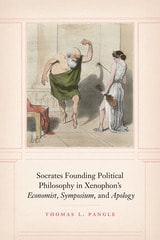
Socrates Founding Political Philosophy in Xenophon's "Economist", "Symposium", and "Apology"
Thomas L. Pangle
University of Chicago Press, 2020
Unlike the Socrates of Plato, Xenophon’s Socrates is more complicated and human, an individual working out the problem of what it means to live well and virtuously. While the Memorabilia defends Socrates by stressing his likeness to conventionally respectable gentlemen, Xenophon’s remaining Socratic texts offer a more nuanced characterization by highlighting how Socrates also diverges from conventions of gentlemanliness in his virtues, behaviors, and peculiar views of quotidian life and governmental rule. One question threads through the three writings: Which way of life best promotes human existence, politics, and economics—that of the Socratic political philosopher with his philosophic virtues or that of the gentleman with his familial, civic, and moral virtues? In uncovering the nuances of Xenophon’s approach to the issue in the Economist, Symposium, and Apology, Pangle’s book cements the significance of these writings for the field and their value for shaping a fuller conception of just who Socrates was and what he taught.
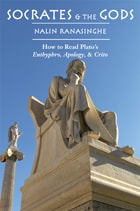
Socrates and the Gods
How to Read Plato's Euthyphro, Apology, and CritoNalin Ranasinghe
St. Augustine's Press, 2012
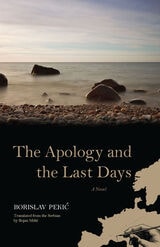
The Apology and the Last Days
A NovelBorislav Pekic
Northwestern University Press, 2012
Originally published in 1975, The Apology and the Last Days is the final volume in a trilogy of novels—also including The Rise and Fall of Icarus Gubelkian and How to Quiet a Vampire—about the aftermath of World War II, by Borislav Pekić, one of the former Yugoslavia’s most important postwar writers. The narrator tells his story from prison, where he is serving time for the murder of a former Nazi official. As the novel unfolds, we learn that the victim was the same person whom the narrator, while a lifeguard during the war, saved from drowning, thus making him vulnerable to charges of collaboration. In this tragicomic tale, Pekić explores eternal questions of fate and individual responsibility.
Xenophon's Socrates
Leo Strauss
St. Augustine's Press, 2004