Results by title
7 books match the query 'Arabic poetry'
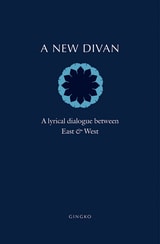
A New Divan
A Lyrical Dialogue between East and WestEdited by Barbara Schwepcke and Bill Swainson
Gingko, 2019
Reaching through time, language, and poetic history, A New Divan offers a lyrical conversation and opens paths of connection across cultures.
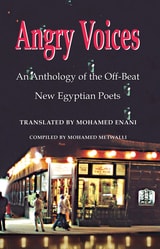
Angry Voices
An Anthology of the Off-Beat New Egyptian PoetsMohamed Enani
University of Arkansas Press, 2003
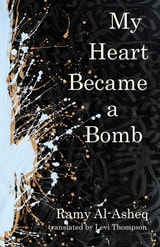
My Heart Became a Bomb
Poems by Ramy al-Asheq; translated by Levi Thompson
University of Texas Press, 2021
My Heart Became a Bomb is the first collection of poetry by Syrian-Palestinian poet Ramy al-Asheq to be translated into English. Poignant and raw, these poems take the reader along a path of forced emigration from Bashar al-Assad’s prisons in Syria to Amsterdam to Auschwitz to Berlin, Germany, where Al-Asheq is now creating a new home. By turns melancholy and reflective, celebratory and hopeful, Al-Asheq’s newly translated poems offer the English-reading audience a contemporary perspective on the experience of exile in a world facing the phenomeno of mass migration, whether for political or environmental reasons. The translations are the result of a long collaboration between Al-Asheq and Thompson (who also edited this collection). Raising questions about the nature of love, identity, and the role of poetry in the face of constant flux and great uncertainty, My Heart Became a Bomb introduces an important new voice to the world of contemporary poetry.
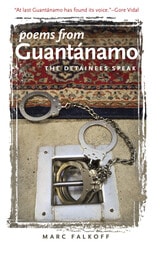
Poems from Guantanamo
The Detainees SpeakMarc Falkoff
University of Iowa Press, 2007
Since 2002, at least 775 men have been held in the U.S. detention center at Guantánamo Bay, Cuba. According to Department of Defense data, fewer than half of them are accused of committing any hostile act against the United States or its allies. In hundreds of cases, even the circumstances of their initial detainment are questionable.
This collection gives voice to the men held at Guantánamo. Available only because of the tireless efforts of pro bono attorneys who submitted each line to Pentagon scrutiny, Poems from Guantánamo brings together twenty-two poems by seventeen detainees, most still at Guantánamo, in legal limbo.
If, in the words of Audre Lorde, poetry “forms the quality of light within which we predicate our hopes and dreams toward survival and change,” these verses—some originally written in toothpaste, others scratched onto foam drinking cups with pebbles and furtively handed to attorneys—are the most basic form of the art.
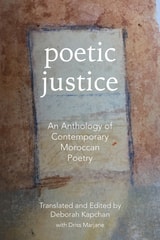
Poetic Justice
An Anthology of Contemporary Moroccan PoetryBy Deborah Kapchan
University of Texas Press, 2019
Poetic Justice is the first anthology of contemporary Moroccan poetry in English. The work is primarily composed of poets who began writing after Moroccan independence in 1956 and includes work written in Moroccan Arabic (darija), classical Arabic, French, and Tamazight.
Why Poetic Justice? Moroccan poetry (and especially zajal, oral poetry now written in Moroccan Arabic) is often published in newspapers and journals and is thus a vibrant form of social commentary; what’s more, there is a law, a justice, in the aesthetic act that speaks back to the law of the land. Poetic Justice because literature has the power to shape the cultural and moral imagination in profound and just ways.
Reading this oeuvre from independence until the new millennium and beyond, it is clear that what poet Driss Mesnaoui calls the “letters of time” have long been in the hands of Moroccan poets, as they write their ethics, their aesthetics, as well as their gendered and political lives into poetic being.
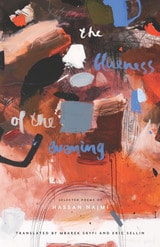
The Blueness of the Evening
Selected Poems of Hassan NajmiMbarek Sryfi
University of Arkansas Press, 2018
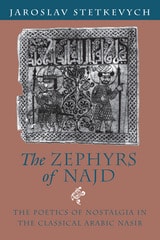
The Zephyrs of Najd
The Poetics of Nostalgia in The Classical Arabic NasibJaroslav Stetkevych
University of Chicago Press, 1993
Stetkevych concentrates on the "places of lost bliss" that furnish the dominant motif in the lyric-elegiac opening section (nasib) of the classic Arab code, or qusidah. In defining the Arabic lyrical genre, he shows how pre-Islamic lamentations over abandoned campsites evolved, in Arabo-Islamic mystical poetry, into expressions of spiritual nostalgia. Stetkevych also draws intriguing parallels between the highlands of Najd in Arabic poetry and Arcadia in the European tradition. He concludes by exploring the degree to which the pastoral-paradisiacal archetype of the nasib pervades Arabic literary perception, from the pre-Islamic ode through the Thousand and One Nights and later texts.
Enhanced by Stetkevych's sensitive translations of all the Arabic texts discussed, The Zephyrs of Najd brings the classical Arabic ode fully into the purview of contemporary literary and critical discourse.