Results by title
34 books match the query 'Arctic regions'
A Naturalist's Guide to the Arctic
E. C. Pielou
University of Chicago Press, 1994
A Prehistory of the North
Human Settlement of the Higher LatitudesHoffecker, John F
Rutgers University Press, 2004
Early humans did not simply drift northward from their African origins as their abilities to cope with cooler climates evolved. The initial settlement of places like Europe and northern Asia, as well as the later movement into the Arctic and the Americas, actually occurred in relatively rapid bursts of expansion. A Prehistory of the North is the first full-length study to tell the complex story, spanning almost two million years, of how humans inhabited some of the coldest places on earth.
In an account rich with illustrations, John Hoffecker traces the history of anatomical adaptations, diet modifications, and technological developments, such as clothing and shelter, which allowed humans the continued ability to push the boundaries of their habitation. The book concludes by showing how in the last few thousand years, peoples living in the circumpolar zone—with the exception of western and central Siberia—developed a thriving maritime economy.
Written in nontechnical language, A Prehistory of the North provides compelling new insights and valuable information for professionals and students.
Abandoned
The Story of the Greely Arctic Expedition 1881-1884Alden Todd
University of Alaska Press, 2001
Abandoned is the gripping account of men battling for survival as they are pitted against the elements and each other. It is also the most complete and authentic account of the controversial Greely Expedition ever published, an exemplar of the best in chronicles of polar exploration.
Across Arctic America
Narrative of the Fifth Thule ExpeditionKnud Rasmussen
University of Alaska Press, 1999
It was the people who most captivated the Greenland-born Rasmussen, who had become a virtual adopted son to the Eskimos of the far northern district still known by the name of the trading post he established there, Thule. His first four Thule Expeditions extended the limits of the known world in Greenland solely, but Rasmussen’s Fifth Thule Expedition demonstrated the unity of the Eskimo world from the Atlantic Ocean to the Chukchi Sea, proving the people all shared the same basic language and culture. As historian Terrence Cole notes in his introductory biography, “The intellectual and spiritual life of the people themselves were his primary interest, not simply geographical discovery, and thus even when following the tracks of previous explorers, he found uncharted territory. His basic principle was to first earn the trust of the local people by showing understanding and patience: living with the people and not apart from them, sharing their work and their food….” That was how Rasmussen approached the entire Arctic: he did not live apart from it, skimming over its surface like the fame-seeking polar explorers of the time such as Peary and Cook, but immersed himself in it—so successfully that a Canadian Inuit elder once marveled that he was “the first white man [he had ever seen] who was also an Eskimo.”
Of most significance to readers today, though, is that Rasmussen was also a noted writer. He wanted to share not just the observations he made but the feelings he experienced, and so in Across Arctic America offered what fellow arctic explorer Vilhjalmur Stefansson described as “not only a work of literary charm but also one of the deepest and soundest interpretations” of Eskimo life ever put into a book.
This volume, published in commemoration of the 75th anniversary of the completion of the Fifth Thule Expedition, includes an introduction by Classic Reprint Series editor Terrance Cole and an index.
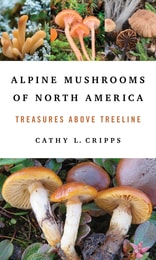
Alpine Mushrooms of North America
Treasures above TreelineCathy L. Cripps
University of Illinois Press, 2025
Features include:
- More than 200 color photographs
- Small size perfect for use in the field
- In-depth scientific information on 150 species, including some recently discovered and most not found outside alpine or Arctic habitats
- Division of species into ecological groups to aid with searching and identification
- Coverage of the Rocky Mountains of Montana, Wyoming, and Colorado, with extensions into British Columbia and Alaska, with many of the same mushrooms also found in the Arctic
- Tips on collecting for both professional researchers and amateur enthusiasts
- A conservation-based approach aimed at the general public, mycologists, researchers, naturalists, land managers, and others
Easy to use and charged with cutting-edge science, Alpine Mushrooms of North America is an expert guide to mycology’s final frontier.
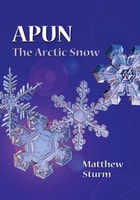
Apun
The Arctic SnowMatthew Sturm
University of Alaska Press, 2009
There are some twenty-five words for “snow” in the Inupiaq language. Each word denotes a different kind of snow—fresh powder snow, hard pack, soft snow, very wet snow, or just snow. Such fine distinction is reasonable, for over the centuries, Natives of the Arctic have had to rely on their knowledge of the snow to survive. Now Matthew Sturm has prepared an educational children’s book designed to teach a new generation of Arctic residents the importance of Arctic snow cover. Fully illustrated to demonstrate the cycle of the snow cover, Apun covers each phase of the “snow year.” Geared towards grades 3–4, this is a must read for elementary science classes.
Apun
The Arctic Snow (A Teacher's Guide)Matthew Sturm
University of Alaska Press, 2009
There are some twenty-five words for “snow” in the Inupiaq language. Each word denotes a different kind of snow—fresh powder snow, hard pack, soft snow, very wet snow, or just snow. Such fine distinction is reasonable, for over the centuries, Natives of the Arctic have had to rely on their knowledge of the snow to survive. Now Matthew Sturm has prepared an educational children’s book designed to teach a new generation of Arctic residents the importance of Arctic snow cover. Fully illustrated to demonstrate the cycle of the snow cover, Apun covers each phase of the “snow year.” Geared towards grades 3–4, this is a must read for elementary science classes.
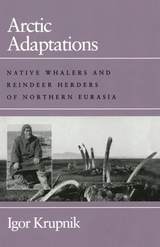
Arctic Adaptations
Native Whalers and Reindeer Herders of Northern EurasiaIgor Krupnik
Dartmouth College Press, 2002

Arctic Politics
Conflict and Cooperation in the Circumpolar NorthOran R. Young
Dartmouth College Press, 1992
Building in the North
Eb Rice
University of Alaska Press, 2008
Community-Based Monitoring in the Arctic
Finn Danielsen, Noor Johnson, Olivia Lee, Maryann Fidel, Lisbeth Iversen, Michael K. Poulsen, Hajo Eicken, Ania Albin, Simone G. Hansen, Peter L. Pulsifer, Peter Thorne, and Martin Enghoff
University of Alaska Press, 2020
Contributors include Finn Danielsen, Noor Johnson, Olivia Lee, Maryann Fidel, Lisbeth Iversen, Michael K. Poulsen, Hajo Eicken, Ania Albin, Simone G. Hansen, Peter L. Pulsifer, Peter Thorne, and Martin Enghoff.
Critical Norths
Space, Nature, TheoryEdited by Sarah J. Ray and Kevin Maier
University of Alaska Press, 2017
This book brings together scholars from a range of disciplines to ask key questions about the North and how we’ve conceived it—and how conceiving of it in those terms has caused us to fail the region’s human and nonhuman life. Engaging questions of space, place, indigeneity, identity, nature, the environment, justice, narrative, history, and more, it offers a crucial starting point for an essential rethinking of both the idea and the reality of the North.
Dangerous Work
Diary of an Arctic AdventureArthur Conan Doyle
University of Chicago Press, 2012
In 1880 a young medical student named Arthur Conan Doyle embarked upon the “first real outstanding adventure” of his life, taking a berth as ship’s surgeon on an Arctic whaler, the Hope. The voyage took him to unknown regions, showered him with dramatic and unexpected experiences, and plunged him into dangerous work on the ice floes of the Arctic seas. He tested himself, overcame the hardships, and, as he wrote later, “came of age at 80 degrees north latitude.”
A special limited, numbered edition of the clothbound book is also available. In addition, a text-only e-book edition is published as Dangerous Work: Diary of an Arctic Adventure, Text-only Edition.
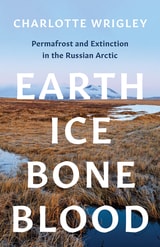
Earth, Ice, Bone, Blood
Permafrost and Extinction in the Russian ArcticCharlotte Wrigley
University of Minnesota Press, 2023
Exploring one of the greatest potential contributors to climate change—thawing permafrost—and the anxiety of extinction on an increasingly hostile planet
Climate scientists point to permafrost as a “ticking time bomb” for the planet, and from the Arctic, apocalyptic narratives proliferate on the devastating effects permafrost thaw poses to human survival. In Earth, Ice, Bone, Blood, Charlotte Wrigley considers how permafrost—and its disappearance—redefines extinction to be a lack of continuity, both material and social, and something that affects not only life on earth but nonlife, too.
Earth, Ice, Bone, Blood approaches the topic of thawing permafrost and the wild new economies and mitigation strategies forming in the far north through a study of the Sakha Republic, Russia’s largest region, and its capital city Yakutsk, which is the coldest city in the world and built on permafrost. Wrigley examines people who are creating commerce out of thawing permafrost, including scientists wishing to recreate the prehistoric “Mammoth steppe” ecosystem by eventually rewilding resurrected woolly mammoths, Indigenous people who forage the tundra for exposed mammoth bodies to sell their tusks, and government officials hoping to keep their city standing as the ground collapses under it. Warming begets thawing begets economic activity— and as a result, permafrost becomes discontinuous, both as land and as a social category, in ways that have implications for the entire planet. Discontinuity, Wrigley shows, eventually evolves into extinction.
Offering a new way of defining extinction through the concept of “discontinuity,” Earth, Ice, Bone, Blood presents a meditative and story-focused engagement with permafrost as more than just frozen ground.
Finding the Arctic
History and Culture Along a 2,500-Mile Snowmobile Journey from Alaska to Hudson’s BayMatthew Sturm
University of Alaska Press, 2012
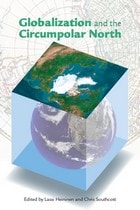
Globalization and the Circumpolar North
Edited by Lassi Heininen and Chris Southcott
University of Alaska Press, 2010
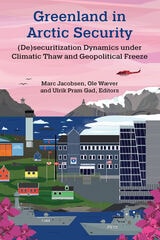
Greenland in Arctic Security
(De)securitization Dynamics under Climatic Thaw and Geopolitical FreezeMarc Jacobsen, Ole Wæver, and Ulrik Pram Gad, Editors
University of Michigan Press, 2024
By combining these different analyses, Greenland in Arctic Security provides new, theoretically informed discussions on how security politics can manifest across different scales and territorial borders. At times, these politics can have consequences beyond their original intent. With Greenland geopolitics and securitization theory of current interest to political and academic debates, this book offers timely insights for readers.
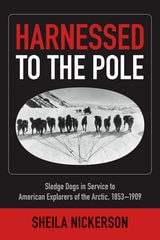
Harnessed to the Pole
Sledge Dogs in Service to American Explorers of the Arctic 1853-1909Sheila Nickerson
University of Alaska Press, 2014
Harnessed to the Pole follows the adventures of eight American explorers and their dog teams, starting with Elisha Kent Kane and ending with Robert Peary, controversial claimant of the title of first to reach the North Pole. While history has long forgotten these “little camels of the north,” Sheila Nickerson reveals how critical dogs were to the Arctic conquest. Besides providing transportation in extreme conditions, sledge dogs protected against wolves and polar bears, helped in hunting, found their way through storms, and provided warmth in extreme cold. They also faced rough handling, starvation, and the possibility of being left behind as expeditions plunged ahead. Harnessed to the Pole is an extraordinary—and unflinching—look at the dogs that raced to the top of the world.
Ice Floe II
International Poetry of the Far NorthEdited by Shannon Gramse and Sarah Kirk
University of Alaska Press, 2011
The long-awaited second volume of the newly revived Ice Floe series, Ice Floe II features new and exciting works of poetry from a vibrant and diverse group of writers from Alaska, Canada, Russia, Sweden, Iceland, and beyond. All work is presented here in both its original language and in English translation. With contributors that include former Alaska poet laureate Tom Sexton, Riina Katajavuori, Yuri Vaella, Gunnar Randversson, and dozens of other established and emerging poets, this wonderful collection of voices from the northern latitudes will be a great read for all lovers of poetry and international literature.
Ice Floe III
Edited by Shannon Gramse and Sarah Kirk
University of Alaska Press, 2012
The third volume of the revived Ice Floe series, Ice Floe III features new and exciting works of poetry by authors from Alaska, Canada, Iceland, the Faroe Islands, Norway, Sweden, Finland, and Russia. All work is presented in both its original language and in English translation. The contributors—Nancy Lord, Tom Sexton, Eira Stenberg, and Riina Katajavuori, among others—include established and emerging poets. This dynamic and vibrant collection of voices from the northern latitudes will be a great read for all poetry enthusiasts and devoted readers of international literature.
Ice Floe
New & Selected PoemsEdited by Shannon Gramse and Sarah Kirk
University of Alaska Press, 2010
Ice Floe, the celebrated and award-winning journal of circumpolar poetry, is here reborn as an annual book series. This first volume features the best of the journal's first seven years, along with evocative new poetry from Alaska, Canada, Iceland, Norway, Sweden, Finland, and Russia. All work is presented in both its original language and in English translation. With contributors including former Alaska poet laureate John Haines, Gunnar Harding, Robert Bly, Lennart Sjögren, and dozens of other established and emerging poets, this wonderful collection of voices from the northern latitudes is a great read for all lovers of poetry and international literature.
Ice Geographies
The Colonial Politics of Race and Indigeneity in the ArcticJen Rose Smith
Duke University Press, 2025
North by 2020
Perspectives on Alaska’s Changing Social-Ecological SystemsEdited by Amy Lauren Lovecraft and Hajo Eicken
University of Alaska Press, 2011
Originating from a series of workshops held at the Alaska Forum of the Fourth International Polar Year, this interdisciplinary volume addresses a host of current concerns regarding the ecology and rapid transformation of the arctic. Concentrating on the most important linked social-ecological systems, including fresh water, marine resources, and oil and gas development, this volume explores opportunities for sustainable development from a variety of perspectives, among them social sciences, natural and applied sciences, and the arts. Individual chapters highlight expressions of climate change in dance, music, and film, as well as from an indigenous knowledge–based perspective.
Northern Exposures
An Adventuring Career in Stories and ImagesJonathan Waterman
University of Alaska Press, 2013
North of the sixtieth parallel, the sun shines for less than six hours in the winter, and towering mountains are the only skyscrapers. Pristine waters serve caribou, moose, and bears in an unbroken landscape. At any given moment in this spectacular scenery, there’s a chance that Jonathan Waterman is present, trekking across the land. A masterful adventurer, Waterman has spent decades exploring the farthest reaches of our beautiful spaces. The essays and photographs collected in Northern Exposures are a product of this passion for exploration and offer an unparalleled view into adventuring in the north and beyond.
Picking up after In the Shadow of Denali, his first book of essays, Northern Exposures collects twenty-three stories from Waterman’s thirty-year career that show the evolution of the adventurer’s career and work, from ducking avalanches near the Gulf of Alaska, to searching for the most pristine tundra on the continent, and from writing haiku on Denali in the depth of winter to decrying oil development in the Arctic National Wildlife Refuge. Ninety-six spectacular photographs taken by Waterman during his expeditions lend a broader context and allow readers to fully understand his heartfelt argument for protecting these places. Whether active, aspiring, or just armchair adventurers, readers will be inspired by Waterman’s daring spirit.
Out of the Cold
Archaeology on the Arctic Rim of North AmericaOwen K. Mason
University Press of Colorado, 2018
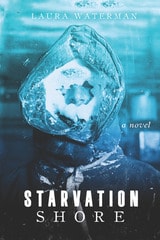
Starvation Shore
Laura Waterman
University of Wisconsin Press, 2019
Drawing upon historic records, diaries, and letters of the men who inhabited the makeshift shelter they called Camp Clay, Laura Waterman reimagines the true story of polar explorers fighting for their lives and their sanity under dehumanizing conditions. This gripping, tragic tale of hunger, fear, and hope is told through the eyes of men at their worst—and most desperate—moments.
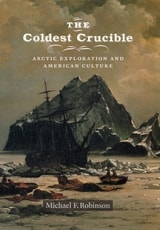
The Coldest Crucible
Arctic Exploration and American CultureMichael F. Robinson
University of Chicago Press, 2006
With chronological chapters featuring emblematic Arctic explorers—including Elisha Kent Kane, Charles Hall, and Robert Peary—The Coldest Crucible reveals why the North Pole, a region so geographically removed from Americans, became an iconic destination for discovery.
The History of Cartography, Volume Two, Book Three
Cartography in the Traditional African, American, Arctic, Australian, and Pacific SocietiesEdited by David Woodward and G. Malcolm Lewis
University of Chicago Press, 1998
"The maps in this book provide an evocative picture of how indigenous peoples view and represent their worlds. They illuminate not only questions of material culture but also the cognitive systems and social motivations that underpin them" (from the introduction).
Although they are often rendered in forms unfamiliar to Western eyes, maps have existed in most cultures. In this latest book of the acclaimed History of Cartography, contributors from a broad variety of disciplines collaborate to describe and address the significance of traditional cartographies. Whether painted on rock walls in South Africa, chanted in a Melanesian ritual, or fashioned from palm fronds and shells in the Marshall Islands, all indigenous maps share a crucial role in representing and codifying the spatial knowledge of their various cultures. Some also serve as repositories of a group's sacred or historical traditions, while others are exquisite art objects.
The indigenous maps discussed in this book offer a rich resource for disciplines such as anthropology, archaeology, art history, ethnology, geography, history, psychology, and sociology. Copious illustrations and carefully researched bibliographies enhance the scholarly value of this definitive reference.
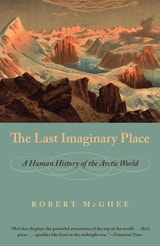
The Last Imaginary Place
A Human History of the Arctic WorldRobert McGhee
University of Chicago Press, 2007
The Arctic of towering icebergs and midnight sun, of flaming auroras and endless winter nights, has long provoked flights of the imagination. Now, in The Last Imaginary Place, renowned archeologist Robert McGhee lifts the veil to reveal the true Arctic world. Based on thirty years of work with native peoples of the Arctic and travel in the region, McGhee’s account dispels notions of the frozen land as an exotic, remote world that exists apart from civilization.
Between the frigid reality and lurid fantasy lies McGhee’s true interest, the people who throughout human history have called the Arctic home. He paints a vivid portrait of Viking farmers, entrepreneurial Inuit, and Western explorers who have been seduced by the natural wealth and haunting beauty of this land. From lively accounts of fur trading, ivory hunting, and whaling to white-knuckle tales of the first, doomed expeditions, McGhee takes the reader on a whirlwind journey across this disorienting, dreamlike terrain that has fascinated mankind for centuries.
“In prose infused by his position as curator of Arctic archaeology at the Canadian Museum of Civilization—which has taken him to sites in several countries—McGhee demolishes some persistent illusions about the white North . . . evocative.”—Times Literary Supplement
“[A] compelling account . . . [McGhee] believes that the Arctic is not so much a region as a dream—what he sees as a dream of a unique, attractive world . . . An archaeologist who has spent thirty years there, the author lets his love for the region shine through on every page.—Booklist
“McGhee displays the powerful attractions of the top of the world . . . [his] prose . . . sparkles like frost in the midnight sun.”—Financial Times
“McGhee has written a sensitive, fascinating and extremely important book.”—Canadian Geographic

To the Arctic!
The Story of Northern Exploration from Earliest TimesJeannette Mirsky
University of Chicago Press, 1970
"Excellent. . . . This is a book which anyone interested in almost any facet of the north will find of value."—William Cody, Canadian Field Naturalist
"A book filled with adventure."—Daily News Journal
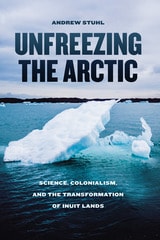
Unfreezing the Arctic
Science, Colonialism, and the Transformation of Inuit LandsAndrew Stuhl
University of Chicago Press, 2016
In Unfreezing the Arctic, Andrew Stuhl brings a fresh perspective to this defining challenge of our time. With a compelling narrative voice, Stuhl weaves together a wealth of distinct episodes into a transnational history of the North American Arctic, proving that a richer understanding of its social and environmental transformation can come only from studying the region’s past. Drawing on historical records and extensive ethnographic fieldwork, as well as time spent living in the Northwest Territories, he closely examines the long-running interplay of scientific exploration, colonial control, the testimony and experiences of Inuit residents, and multinational investments in natural resources. A rich and timely portrait, Unfreezing the Arctic offers a comprehensive look at scientific activity across the long twentieth century. It will be welcomed by anyone interested in political, economic, environmental, and social histories of transboundary regions the world over.
The author intends to donate all royalties from this book to the Alaska Youth for Environmental Action (AYEA) and East Three School's On the Land Program.
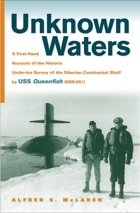
Unknown Waters
A First-Hand Account of the Historic Under-Ice Survey of the Siberian Continental Shelf by USS Queenfish (SSN-651)Alfred S. McLaren
University of Alabama Press, 2008
“A first-person view of submarine under-ice operations that appears in very few other works.” —Gary E. Weir, author of Rising Tide: The Untold Story of the Russian Submarines that Fought the Cold War
Unknown Waters tells the story of the brave officers and men of the nuclear attack submarine USS Queenfish (SSN-651), who made the first survey of an extremely important and remote region of the Arctic Ocean. The unpredictability of deep-draft sea ice, shallow water, and possible Soviet discovery, all played a dramatic part in this engrossing 1970 voyage.
Covering 3,100 miles over a period of some 20 days at a laborious average speed of 6.5 knots or less, the attack submarine carefully threaded its way through innumerable underwater canyons of ice and over irregular seafloors, at one point becoming entrapped in an “ice garage.” Only cool thinking and skillful maneuvering of the nearly 5,000-ton vessel enabled a successful exit.

Until Death Do Us Part
The Letters and Travels of Anna and Vitus BeringEdited by Peter Ulf Møller and Natasha Okhotina Lind
University of Alaska Press, 2008
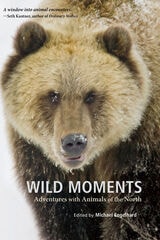
Wild Moments
Adventures with Animals of the NorthEdited by Michael Engelhard
University of Alaska Press, 2009
It is nearly impossible to live in Alaska without being influenced by its natural environment. Residents have no choice but to coexist with the Alaska wilderness and its animal inhabitants, and this extraordinary experience—along with the stunning landscape—is what often draws people to Alaska. Wild Moments offers a fascinating range of creative nonfiction essays that describe the chance meetings that bring Alaska residents face to face with their animal neighbors. These imaginative accounts speak to the ability of nature to transform the human experience, and the authors urge us through their works to protect these often threatened creatures who share our planet.
The contributors to this collection include some of Alaska’s most prestigious nature writers, such as Peggy Shumaker, Ned Rozell, Nick Jans, Debbie S. Miller, Craig Childs, Richard Nelson, and Drew Pogge. Wild Moments presents some of the best and most innovative nonfiction writing in an environmental context, and it will be of interest to all readers with a passion and concern for the natural world.