Results by title
109 books match the query 'Artificial intelligence' and 25 start with a
A Way With Words
Style in the Age of Artificial IntelligenceJohn Marsh
University of Michigan Press, 2026
Using examples from papers students might actually write, the book invites readers to apply what they have learned to quizzes that mix and match issues—vague pronouns, sentence fragments, punctuating quotations—from previous chapters. The book includes a thoughtful discussion about balancing the competing demands of writing well and fighting linguistic discrimination. Finally, A Way with Words prompts readers to consider what artificial intelligence programs like ChatGPT and Bard will mean for student writing. It offers advice about how writers can distinguish their writing from the assembly-line writing that artificial intelligence tends to generate, and how they can develop their style to stand out to their teachers, employers, and clients.
AI Tips and Traps
Patrick Barry
Michigan Publishing Services, 2026
Based on a series of popular courses and workshops that Professor Patrick Barry has created for students, professionals, and anyone else interested in taking a skills-based approach to artificial intelligence, this book gives you a chance to engage with important AI concepts, experiment with exploratory AI exercises, and then ultimately develop your own customized list of AI traps to try as well as AI traps to avoid.
AI for Emerging Verticals
Human-robot computing, sensing and networkingMuhammad Zeeshan Shakir
The Institution of Engineering and Technology, 2021
AI for Everyone?
Critical PerspectivesPieter Verdegem
University of Westminster Press, 2021
Editor Pieter Verdegem was shortlisted for best edited collection in the 2022 MeCCSA outstanding achievement awards. See https://uwestminsterpress.blog/2022/08/18/original-and-timely-uwp-title-shortlisted-for-major-academic-book-prize/ for more details.
We are entering a new era of technological determinism and solutionism in which governments and business actors are seeking data-driven change, assuming that Artificial Intelligence is now inevitable and ubiquitous. But we have not even started asking the right questions, let alone developed an understanding of the consequences. Urgently needed is debate that asks and answers fundamental questions about power. This book brings together critical interrogations of what constitutes AI, its impact and its inequalities in order to offer an analysis of what it means for AI to deliver benefits for everyone. The book is structured in three parts: Part 1, AI: Humans vs. Machines, presents critical perspectives on human-machine dualism. Part 2, Discourses and Myths About AI, excavates metaphors and policies to ask normative questions about what is ‘desirable’ AI and what conditions make this possible. Part 3, AI Power and Inequalities, discusses how the implementation of AI creates important challenges that urgently need to be addressed. Bringing together scholars from diverse disciplinary backgrounds and regional contexts, this book offers a vital intervention on one of the most hyped concepts of our times.
AI for Status Monitoring of Utility Scale Batteries
Shunli Wang
The Institution of Engineering and Technology, 2022
AIoT Technologies and Applications for Smart Environments
Mamoun Alazab
The Institution of Engineering and Technology, 2022
AIoT for Smart Transportation
Transforming the future of mobilityMeenu Gupta
The Institution of Engineering and Technology, 2025

Access Control and Security Monitoring of Multimedia Information Processing and Transmission
Zhihan Lyu
The Institution of Engineering and Technology, 2024

Advanced Robotics and Intelligent Machines
J.O. Gray
The Institution of Engineering and Technology, 1996
Advances in Cognitive Systems
Samia Nefti
The Institution of Engineering and Technology, 2010
Affective Computing Applications using Artificial Intelligence in Healthcare
Methods, approaches and challenges in system designM. Murugappan
The Institution of Engineering and Technology, 2024
Agentic AI
Foundations, architectures and enterprise deploymentShriram K. Vasudevan
The Institution of Engineering and Technology, 2026
Algorithms of Education
How Datafication and Artificial Intelligence Shape PolicyKalervo N. Gulson
University of Minnesota Press, 2022
A critique of what lies behind the use of data in contemporary education policy
While the science fiction tales of artificial intelligence eclipsing humanity are still very much fantasies, in Algorithms of Education the authors tell real stories of how algorithms and machines are transforming education governance, providing a fascinating discussion and critique of data and its role in education policy.
Algorithms of Education explores how, for policy makers, today’s ever-growing amount of data creates the illusion of greater control over the educational futures of students and the work of school leaders and teachers. In fact, the increased datafication of education, the authors argue, offers less and less control, as algorithms and artificial intelligence further abstract the educational experience and distance policy makers from teaching and learning. Focusing on the changing conditions for education policy and governance, Algorithms of Education proposes that schools and governments are increasingly turning to “synthetic governance”—a governance where what is human and machine becomes less clear—as a strategy for optimizing education.
Exploring case studies of data infrastructures, facial recognition, and the growing use of data science in education, Algorithms of Education draws on a wide variety of fields—from critical theory and media studies to science and technology studies and education policy studies—mapping the political and methodological directions for engaging with datafication and artificial intelligence in education governance. According to the authors, we must go beyond the debates that separate humans and machines in order to develop new strategies for, and a new politics of, education.
An Artificial History of Natural Intelligence
Thinking with Machines from Descartes to the Digital AgeDavid W. Bates
University of Chicago Press, 2024
We imagine that we are both in control of and controlled by our bodies—autonomous and yet automatic. This entanglement, according to David W. Bates, emerged in the seventeenth century when humans first built and compared themselves with machines. Reading varied thinkers from Descartes to Kant to Turing, Bates reveals how time and time again technological developments offered new ways to imagine how the body’s automaticity worked alongside the mind’s autonomy. Tracing these evolving lines of thought, An Artificial History of Natural Intelligence offers a new theorization of the human as a being that is dependent on technology and produces itself as an artificial automaton without a natural, outside origin.
Applications of Artificial Intelligence in E-Healthcare Systems
Munish Sabharwal
The Institution of Engineering and Technology, 2022
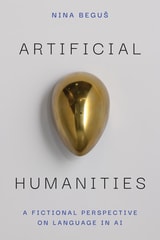
Artificial Humanities
A Fictional Perspective on Language in AINina Beguš
University of Michigan Press, 2025
Highlighting the impact of human-like AI design, from gendered virtual assistants to romanticized social robots, the book shows how these technologies intersect with longstanding humanistic questions about the concepts of creativity and language as well as the relations between humans and machines. Additionally, the book explores AI’s applications in medical fields, particularly psychiatry and neurotechnology, including how AI interacts with the human body and mind to address conditions like paralysis. By emphasizing the philosophical and cultural implications of these technologies, Beguš highlights the need for responsible innovation that prioritizes human well-being as well as machine potential outside of human imitation. Accessible and thought-provoking, Artificial Humanities offers tools for analyzing and assessing technologies while they are being developed and invites readers to see how the humanities can guide us toward a more thoughtful future for AI.
Artificial Intelligence Applied to Satellite-based Remote Sensing Data for Earth Observation
Maria Pia Del Rosso
The Institution of Engineering and Technology, 2021
Artificial Intelligence In Libraries And Publishing
Ruth Pickering
Against the Grain, LLC, 2022
This Charleston Briefing seeks to provide some answers to these very important questions, offering both general essays on AI and more specific essays on AI in scholarly publishing, academic libraries, and AI in information discovery and knowledge building. The essays will help publishers, librarians, and researchers better understand the actual impact of AI on libraries and publishing so that they can respond to the potentially transformative impact of AI in a measured and knowledgeable manner.
Charleston Briefings: Trending Topics for Information Professionals is a thought-provoking series of brief books concerning innovation in the sphere of libraries, publishing, and technology in scholarly communication. The briefings, growing out of the vital conversations characteristic of the Charleston Conference and Against the Grain, will offer valuable insights into the trends shaping our professional lives and the institutions in which we work.
Artificial Intelligence Techniques in Power Systems
Kevin Warwick
The Institution of Engineering and Technology, 1997
Artificial Intelligence and Blockchain Technology in Modern Telehealth Systems
Agbotiname Lucky Imoize
The Institution of Engineering and Technology, 2024
Artificial Intelligence and the Internet of Things
UK Policy Opportunities and ChallengesMercedes Bunz and Laima Janciute
University of Westminster Press, 2018
Through algorithms and artificial intelligence (AI), objects and digital services now demonstrate new skills they did not have before, right up to replacing human activity through pre-programming or by making their own decisions. As part of the internet of things, AI applications are already widely used today, for example in language processing, image recognition and the tracking and processing of data.
This policy brief illustrates the potential negative and positive impacts of AI and reviews related policy strategies adopted by the UK, US, EU, as well as Canada and China. Based on an ethical approach that considers the role of AI from a democratic perspective and considering the public interest, the authors make policy recommendations that help to strengthen the positive impact of AI and to mitigate its negative consequences.

Artificial Intelligence for Biometrics and Cybersecurity
Technology and applicationsAhmed A. Abd El-Latif
The Institution of Engineering and Technology, 2023

Artificial Intelligence, Art and Indigeneity
Between Dreams and HallucinationsEdited by Thea Pitman, Sandra De Berduccy, and Andreas Rauh
University of London Press, 2026
This book explores the cultural and ethical implications of generative AI through the lens of Indigenous visual culture in Latin America.
Responding to the rise of tools like DALL·E 2 and Midjourney, this groundbreaking volume documents the AIAI project (2023–), which invited a group of Indigenous artists and writers from Argentina, Bolivia, Brazil, Chile, and Peru to critically engage with image generation technologies. Through collaborative experimentation with a range of both commercial and bespoke tools, contributors reflect on the promises and pitfalls of AI—from its potential for ‘dreaming,’ for imagining Indigenous futures, to the frustration of its ability to ‘hallucinate,’ to distort, and misrepresent Indigenous cultures.
Bringing together artists, writers, and scholars, the book challenges dominant narratives around AI and representation, using a decolonial framework rooted in Indigenous epistemologies. Structured in three parts—context and theory, creative reflections, and generative critique—it foregrounds multivocal and multilingual perspectives, resisting homogenization and reframing participatory research. This is the first book-length study of generative AI’s impact on Indigenous visual culture in Latin America, making a timely and vital contribution to global debates on AI, art, and cultural sovereignty.
Artificial Intelligence, Real Teaching
A Guide to AI in ELTJoshua M. Paiz, Rachel Toncelli, and Ilka Kostka
University of Michigan Press, 2025
Augmented Exploitation
Artificial Intelligence, Automation and WorkPhoebe Moore
Pluto Press, 2021