197 books match the query 'Arts' and 24 start with a
cover of A Mieke Bal Reader

A Mieke Bal Reader

Mieke Bal

University of Chicago Press, 2006

Mieke Bal has had a significant impact on every field she has touched, from Old Testament scholarship and narratology to critical methods and visual culture. This brilliant and controversial intellectual invariably performs a high-wire act at the point where critical issues and methods intersect—or collide. She is deeply interested in the problems of cultural analysis across a range of disciplines. A Mieke Bal Reader brings together for the first time a representative collection of her work that distills her broad interests and areas of expertise.

This Reader is organized into four parts, reflecting the fields that Bal has most profoundly influenced: literary study, interdisciplinary methodology, visual analysis, and postmodern theology. The essays include some of Bal’s most characteristic and provocative work, capturing her at the top of her form. “Narration and Focalization,” for example, provides the groundwork for Bal’s ideas on narrative, while “Reading Art?” clearly outlines her concept of reading images. “Religious Canon and Literary Identity” reenvisions Bal’s own work at the intersection of theology and cultural analysis, while “Enfolding Feminism” argues for a new feminist rallying cry that is not a position but a metaphor. More than a dozen other essays round out the four sections, each of which is interdisciplinary in its own right: the section devoted to literature, for instance, ranges widely over psychoanalysis, theology, photography, and even autobiography.

A Mieke Bal Reader is the product of a capacious intellect and a sustained commitment to critical thinking. It will prove to be instructive, maddening,  and groundbreaking—in short, all the hallmarks of intellectual inquiry at its best.
[more]
cover of A Will for the Machine: Computerization, Automation, and the Arts in South Africa

A Will for the Machine

Computerization, Automation, and the Arts in South Africa

Mark Sanders

University of Chicago Press, 2026

This study takes up the relations among computerization, labor, and the arts in South Africa.

There are many books about the history and discourses of computerization in the United States but relatively little about these phenomena anywhere in the Global South. In A Will for the Machine, Mark Sanders outlines South Africa’s entry into the computer age in the 1960s and ’70s and explains how it coincided with the high point of apartheid. South Africa’s government viewed automation and computerization as one way of barring Black Africans from skilled work and reserving it for whites. Sanders unpacks this peculiar history, relates it to early twentieth-century struggles around mechanization in mining and telephony in South Africa, and analyzes responses to it by the writers Miriam Tlali and J. M. Coetzee, the artist William Kentridge, and Handspring Puppet Company. Showing how the arts realize ideas about the ethics and politics of automation, Sanders contributes to debates about locally divergent understandings of computer technology and human-computer interaction.
[more]
cover of AESTHETICS AND ARTS EDUCATION

AESTHETICS AND ARTS EDUCATION

Edited by Ralph A. Smith and Alan Simpson

University of Illinois Press, 1991

As art educators consider the relevance of a wide range of disciplines to the teaching of art, Aesthetics and Arts Education (a successor to the 1971 volume Aesthetics and the Problems of Education) offers an international look at the role aesthetics can play in teaching all the arts. Thirty-two articles by American and English scholars address the philosophical and educational theories underlying aesthetics, aesthetics as a field of study, curriculum design and evaluation, and the problems and purposes of aesthetic education.
[more]
cover of Adolf Hitler: A Psychological Interpretation of His Views on Architecture, Art, and Music

Adolf Hitler

A Psychological Interpretation of His Views on Architecture, Art, and Music

Sherree Owens Zalampas

University of Wisconsin Press, 1990
Zalampas applies the psychological model of Alfred Adler to Adolf Hitler through the examination of his views on architecture, art, and music. This study was made possible by the publication of Billy F. Price’s volume of over seven hundred of Hitler’s watercolors, oils, and sketches.
[more]
cover of African Performance Arts and Political Acts

African Performance Arts and Political Acts

Naomi André, Yolanda Covington-Ward, and Jendele Hungbo, Editors

University of Michigan Press, 2021

African Performance Arts and Political Actspresents innovative formulations for how African performance and the arts shape the narratives of cultural history and politics. This collection, edited by Naomi André, Yolanda Covington-Ward, and Jendele Hungbo, engages with a breadth of African countries and art forms, bringing together speech, hip hop, religious healing and gesture, theater and social justice, opera, radio announcements, protest songs, and migrant workers’ dances. The spaces include village communities, city landscapes, prisons, urban hostels, Township theaters, opera houses, and broadcasts through the airwaves on television and radio as well as in cyberspace. Essays focus on case studies from Cameroon, the Democratic Republic of the Congo, Nigeria, Senegal, South Africa, and Tanzania.
[more]
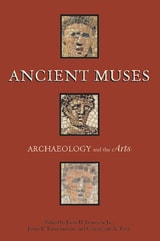
cover of Ancient Muses: Archaeology and the Arts

Ancient Muses

Archaeology and the Arts

Edited by John H. Jameson Jr., John E. Ehrenhard, and Christine A. Finn

University of Alabama Press, 2003

Examines how information derived from archaeological investigations can be presented artistically to educate the general public
 
Known widely in Europe as “interpretive narrative archaeology,” the practice of using creative methods to interpret and present current knowledge of the past is gaining popularity in North America. This book is the first compilation of international case studies of the various artistic methods used in this new form of education—one that makes archaeology “come alive” for the nonprofessional. Plays, opera, visual art, stories, poetry, performance dance, music, sculpture, digital imagery—all can effectively communicate archaeological processes and cultural values to public audiences.

The contributors to this volume are a diverse group of archaeologists, educators, and artisans who have direct experience in schools, museums, and at archaeological sites. Citing specific examples, such as the film The English Patient, science fiction mysteries, and hypertext environments, they explain how creative imagination and the power of visual and audio media can personalize, contextualize, and demystify the research process. A 16-page color section illuminates their examples, and an accompanying CD includes relevant videos, music, web sites, and additional color images.
*

[more]
cover of Andy Warhol, Publisher

Andy Warhol, Publisher

Lucy Mulroney

University of Chicago Press, 2018

Although we know him best as a visual artist and filmmaker, Andy Warhol was also a publisher. Distributing his own books and magazines, as well as contributing to those of others, Warhol found publishing to be one of his greatest pleasures, largely because of its cooperative and social nature.

Journeying from the 1950s, when Warhol was starting to make his way through the New York advertising world, through the height of his career in the 1960s, to the last years of his life in the 1980s, Andy Warhol, Publisher unearths fresh archival material that reveals Warhol’s publications as complex projects involving a tantalizing cast of collaborators, shifting technologies, and a wide array of fervent readers.

Lucy Mulroney shows that whether Warhol was creating children’s books, his infamous “boy book” for gay readers, writing works for established houses like Grove Press and Random House, helping found Interview magazine, or compiling a compendium of photography that he worked on to his death, he readily used the elements of publishing to further and disseminate his art. Warhol not only highlighted the impressive variety in our printed culture but also demonstrated how publishing can cement an artistic legacy.
[more]
cover of Another Aesthetics Is Possible: Arts of Rebellion in the Fourth World War

Another Aesthetics Is Possible

Arts of Rebellion in the Fourth World War

Jennifer Ponce de León

Duke University Press, 2021
In Another Aesthetics Is Possible Jennifer Ponce de León examines the roles that art can play in the collective labor of creating and defending another social reality. Focusing on artists and art collectives in Argentina, Mexico, and the United States, Ponce de León shows how experimental practices in the visual, literary, and performing arts have been influenced by and articulated with leftist movements and popular uprisings that have repudiated neoliberal capitalism and its violence. Whether enacting solidarity with Zapatista communities through an alternate reality game or using surrealist street theater to amplify the more radical strands of Argentina's human rights movement, these artists fuse their praxis with forms of political mobilization from direct-action tactics to economic resistance. Advancing an innovative transnational and transdisciplinary framework of analysis, Ponce de León proposes a materialist understanding of art and politics that brings to the fore the power of aesthetics to both compose and make visible a world beyond capitalism.
[more]
cover of Art Management: Entrepreneurial Style

Art Management

Entrepreneurial Style

Giep Hagoort

Eburon Academic Publishers, 2003
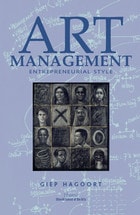
Much has been written about how to successfully manage commercial businesses, but the literature on managing cultural organizations is comparatively scarce. In this unique book, Giep Hagoort draws on more than fifteen years experience at the Utrecht School of the Arts to help students, teachers, artists, and managers apply management theory to the creation of successful cultural institutions. Utilizing case histories and practical exercises, this book teaches skills for building effective institutions of cultural production and preservation.
[more]
cover of Art and Freedom

Art and Freedom

E. E. Sleinis

University of Illinois Press, 2002

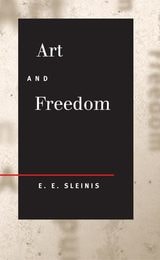
What does a life with art offer that a life without art does not? Art and Freedom asserts that the fundamental point of the enterprise of art is the creation and delivery of values that are not singularly available in the nonart world.

E. E. Sleinis discusses visual art, literature, music, theater, and other art forms, arguing that as art both liberates and provides new points of focus and awareness, the art enterprise depends on a positive freeing from the nonart world, rather than on mere addition to it.

Art and Freedom introduces a novel classificatory system for representation, expression, and formalist theories of art. Sleinis argues that a characteristic defect of contemporary theories of art is their neglect of the issue of value. Challenging these reductive, formalist notions of art, he emphasizes the potential, and the need, for art to evolve and make progress in ways comparable to the sciences, albeit on a very different model.

A smart blend of incisive commentary and illuminating philosophy, Art and Freedom provides a useful context for transforming a sometimes baffling medium into a means of fostering personal growth and creating and sharing values.
[more]
cover of Art and Postcapitalism: Aesthetic Labour, Automation and Value Production

Art and Postcapitalism

Aesthetic Labour, Automation and Value Production

Dave Beech

Pluto Press, 2019

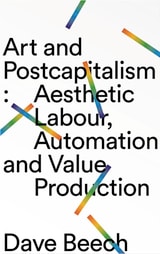
Artistic labour was exemplary for Utopian Socialist theories of 'attractive labour', and Marxist theories of 'nonalienated labour', but the rise of the anti-work movement and current theories of 'fully automated luxury communism' have seen art topple from its privileged place within the left's political imaginary as the artist has been reconceived as a prototype of the precarious 24/7 worker. Art and Postcapitalism argues that art remains essential for thinking about the intersection of labour, capitalism and postcapitalism not insofar as it merges work and pleasure but as an example of noncapitalist production. Reassessing the contemporary politics of work by revisiting debates about art, technology and in the nineteenth and twentieth century, Dave Beech challenges the aesthetics of labour in John Ruskin, William Morris and Oscar Wilde with a value theory of the supersession of capitalism that sheds light on the anti-work theory by Silvia Federici, Andre Gorz, Kathi Weeks and Maurizio Lazzarato, as well as the technological Cockayne of Srnicek and Williams and Paul Mason. Formulating a critique of contemporary postcapitalism, and developing a new understanding of art and labour within the political project of the supersession of value production, this book is essential for activists, scholars and anyone interested in the real and imagined escape routes from capitalism.
[more]
cover of Art from Start to Finish: Jazz, Painting, Writing, and Other Improvisations

Art from Start to Finish

Jazz, Painting, Writing, and Other Improvisations

Edited by Howard S. Becker, Robert R. Faulkner, and Barbara Kirshenblatt-Gimblett

University of Chicago Press, 2006

When is an artistic work finished? When the copyeditor makes the final correction to a manuscript, when the composer writes the last note of a symphony, or when the painter puts the last brushstroke on the canvas? Perhaps it's even later, when someone reads the work, when an ensemble performs, or when the painting is hung on a gallery wall for viewing?

Art from Start to Finish gathers a unique group of contributors from the worlds of sociology, musicology, literature, and communications—many of them practicing artists in their own right—to discuss how artists from jazz musicians to painters work: how they coordinate their efforts, how they think, how they start, and, of course, how they finish their productions.

Specialists in the arts have much to say about the works themselves, which are often neglected by scholarsi n other fields. Art from Start to Finish takes a different tack by exploring the creative process itself and its social component. Any reader who makes art or has an interest in it will value this book.
[more]
cover of Art from a Fractured Past: Memory and Truth-Telling in Post-Shining Path Peru

Art from a Fractured Past

Memory and Truth-Telling in Post-Shining Path Peru

Cynthia E. Milton, ed.

Duke University Press, 2014

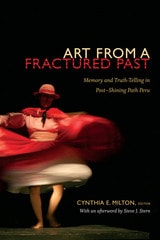
Peru's Truth and Reconciliation Commission not only documented the political violence of the 1980s and 1990s but also gave Peruvians a unique opportunity to examine the causes and nature of that violence. In Art from a Fractured Past, scholars and artists expand on the commission's work, arguing for broadening the definition of the testimonial to include various forms of artistic production as documentary evidence. Their innovative focus on representation offers new and compelling perspectives on how Peruvians experienced those years and how they have attempted to come to terms with the memories and legacies of violence. Their findings about Peru offer insight into questions of art, memory, and truth that resonate throughout Latin America in the wake of "dirty wars" of the last half century. Exploring diverse works of art, including memorials, drawings, theater, film, songs, painted wooden retablos (three-dimensional boxes), and fiction, including an acclaimed graphic novel, the contributors show that art, not constrained by literal truth, can generate new opportunities for empathetic understanding and solidarity.

Contributors. Ricardo Caro Cárdenas, Jesús Cossio, Ponciano del Pino, Cynthia M. Garza, Edilberto Jímenez Quispe, Cynthia E. Milton, Jonathan Ritter, Luis Rossell, Steve J. Stern, María Eugenia Ulfe, Víctor Vich, Alfredo Villar
 
[more]
cover of Art, Activism, and Oppositionality: Essays from Afterimage

Art, Activism, and Oppositionality

Essays from Afterimage

Grant Kester, ed.

Duke University Press, 1998

There is a common perception in the arts today that overtly activist art—often seen to sacrifice an aesthetic pleasure for a subversive one—is no longer in fashion. In bringing together sixteen of the most important essays on activist and community-based art from the pages of Afterimage—one of the most influential journals in the media and visual arts fields for more than twenty-five years—Grant H. Kester demonstrates that activist art, far from being antithetical to the true meaning of the aesthetic, can be its most legitimate expression.

Forging a style of criticism where aesthetic, critical, theoretical, and activist concerns converge, Afterimage has shaped American debates around the politics of visual production and arts education while offering a voice to politically involved artists and scholars. Art, Activism, and Oppositionality insists not only on the continuing relevance of an activist stance to contemporary art practice and criticism, but also on the significance of an engaged art practice that is aligned with social or political activism. With essays that span fifteen years—roughly from Ronald Reagan’s 1980 presidential win to the 1994 Republican victories in Congress, a period marked by waning public support for the arts and growing antagonism toward activist art—Art, Activism, and Oppositionality confronts issues ranging from arts patronage, pedagogy, and the very definitions of art and activism to struggles involving AIDS, reproductive rights, sexuality, and racial identity.

Contributors. Maurice Berger, Richard Bolton, Ann Cvetkovich, Coco Fusco, Brian Goldfarb, Mable Haddock, Grant H. Kester, Ioannis Mookas, Chiquita Mullins Lee, Darrell Moore, Lorraine O’Grady, Michael Renov, Martha Rosler, Patricia Thomson, David Trend, Charles A. Wright Jr., Patricia R. Zimmerman
[more]
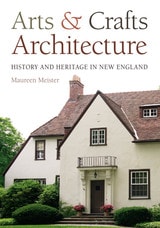
cover of Arts and Crafts Architecture: History and Heritage in New England

Arts and Crafts Architecture

History and Heritage in New England

Maureen Meister

University Press of New England, 2014
This book offers the first full-scale examination of the architecture associated with the Arts and Crafts movement that spread throughout New England at the turn of the twentieth century. Although interest in the Arts and Crafts movement has grown since the 1970s, the literature on New England has focused on craft production. Meister traces the history of the movement from its origins in mid-nineteenth-century England to its arrival in the United States and describes how Boston architects including H. H. Richardson embraced its tenets in the 1870s and 1880s. She then turns to the next generation of designers, examining buildings by twelve of the region’s most prominent architects, eleven men and a woman, who assumed leadership roles in the Society of Arts and Crafts, founded in Boston in 1897. Among them are Ralph Adams Cram, Lois Lilley Howe, Charles Maginnis, and H. Langford Warren. They promoted designs based on historical precedent and the region’s heritage while encouraging well-executed ornament. Meister also discusses revered cultural personalities who influenced the architects, notably Ralph Waldo Emerson and art historian Charles Eliot Norton, as well as contemporaries who shared their concerns, such as Louis Brandeis. Conservative though the architects were in the styles they favored, they also were forward-looking, blending Arts and Crafts values with Progressive Era idealism. Open to new materials and building types, they made lasting contributions, with many of their designs now landmarks honored in cities and towns across New England.
[more]
cover of Arts in Earnest: North Carolina Folklife

Arts in Earnest

North Carolina Folklife

Daniel W. Patterson and Charles G. Zugg, III, eds.

Duke University Press, 1990

Arts in Earnest explores the unique folklife of North Carolina from ruddy ducks to pranks in the mill. Traversing from Murphy to Manteo, these fifteen essays demonstrate the importance of North Carolina’s continually changing folklife. From decoy carving along the coast, to the music of tobacco chants and the blues of the Piedmont, to the Jack tales of the mountains, Arts in Earnest reflects the story of a people negotiating their rapidly changing social and economic environment.
Personal interviews are an important element in the book. Laura Lee, an elderly black woman from Chatham County, describes the quilts she made from funeral flower ribbons; witnesses and friends each remember varying details of the Duke University football player who single-handedly vanquished a gang of would-be muggers; Clyde Jones leads a safari through his backyard, which is filled with animals made of wood and cement that represent nontraditional folk art; the songs and sermon of a Primitive Baptist service flow together as one—“it tills you up all over”; Durham bluesman Willie Trice, one of a handful of Durham musicians who recorded in the 1930s and early 1940s, remembers when the active tobacco warehouses offered ready audiences—“They’d tip us a heap of change to play some music”; and Goldsboro tobacco auctioneer H. L. “Speed” Riggs chants 460 words per minute, five to six times faster than a normal conversational rate.
[more]
cover of Arts of Dying: Literature and Finitude in Medieval England

Arts of Dying

Literature and Finitude in Medieval England

D. Vance Smith

University of Chicago Press, 2020

People in the Middle Ages had chantry chapels, mortuary rolls, the daily observance of the Office of the Dead, and even purgatory—but they were still unable to talk about death. Their inability wasn’t due to religion, but philosophy: saying someone is dead is nonsense, as the person no longer is. The one thing that can talk about something that is not, as D. Vance Smith shows in this innovative, provocative book, is literature.

Covering the emergence of English literature from the Old English to the late medieval periods, Arts of Dying argues that the problem of how to designate death produced a long tradition of literature about dying, which continues in the work of Heidegger, Blanchot, and Gillian Rose. Philosophy’s attempt to designate death’s impossibility is part of a literature that imagines a relationship with death, a literature that intensively and self-reflexively supposes that its very terms might solve the problem of the termination of life. A lyrical and elegiac exploration that combines medieval work on the philosophy of language with contemporary theorizing on death and dying, Arts of Dying is an important contribution to medieval studies, literary criticism, phenomenology, and continental philosophy.
[more]
cover of Arts of Wonder: Enchanting Secularity - Walter De Maria, Diller + Scofidio, James Turrell, Andy Goldsworthy

Arts of Wonder

Enchanting Secularity - Walter De Maria, Diller + Scofidio, James Turrell, Andy Goldsworthy

Jeffrey L. Kosky

University of Chicago Press, 2012
“The fate of our times is characterized by rationalization and intellectualization and, above all, by ‘the disenchantment of the world.’” Max Weber’s statement remains a dominant interpretation of the modern condition: the increasing capabilities of knowledge and science have banished mysteries, leaving a world that can be mastered technically and intellectually. And though this idea seems empowering, many people have become disenchanted with modern disenchantment. Using intimate encounters with works of art to explore disenchantment and the possibilities of re-enchantment, Arts of Wonder addresses questions about the nature of humanity, the world, and God in the wake of Weber’s diagnosis of modernity.
 
Jeffrey L. Kosky focuses on a handful of artists—Walter De Maria, Diller + Scofidio, James Turrell, and Andy Goldsworthy—to show how they introduce spaces hospitable to mystery and wonder, redemption and revelation, and transcendence and creation. What might be thought of as religious longings, he argues, are crucial aspects of enchanting secularity when developed through encounters with these works of art. Developing a model of religion that might be significant to secular culture, Kosky shows how this model can be employed to deepen interpretation of the art we usually view as representing secular modernity. A thoughtful dialogue between philosophy and art, Arts of Wonder will catch the eye of readers of art and religion, philosophy of religion, and art criticism.
[more]
cover of Arts of a Cold Sun: POEMS

Arts of a Cold Sun

POEMS

G. E. Murray

University of Illinois Press, 2003

In these poems, G. E. Murray blends the colors of the soul with those of the world it brushes up against, exploring the ways in which art, both as possession and possessor, informs perception.

Viewing his subjects sometimes from airplane altitude, sometimes from the intimacy of a shared restaurant table, Murray crafts “true stories about color,” narratives of dislocation and belonging that invite readers to question their own relationship to art.

Included in this volume is a long sequential poem titled “The Seconds,” which Murray composed across the second days of thirteen months. The rhythms of this diary-as-poem seize the tensions of shifting times and locales, capturing the essences of moments that are at once chosen and arbitrary.

“Codes toward an Incidental City,” the sequence that closes the book, is a confederacy of forty poems that delve into the concrete familiarities and mythologies of urban landscapes, illuminating the ecstasies of city life.
 
[more]
cover of Arts of the Political: New Openings for the Left

Arts of the Political

New Openings for the Left

Ash Amin and Nigel Thrift

Duke University Press, 2013
In the West, "the Left," understood as a loose conglomeration of interests centered around the goal of a fairer and more equal society, still struggles to make its voice heard and its influence felt, even amid an overwhelming global recession. In Arts of the Political: New Openings for the Left, Ash Amin and Nigel Thrift argue that only by broadening the domain of what is considered political and what can be made into politics will the Left be able to respond forcefully to injustice and inequality. In particular, the Left requires a more imaginative and experimental approach to the politics of creating a better society. The authors propose three political arts that they consider crucial to transforming the Left: boosting invention, leveraging organization, and mobilizing affect. They maintain that successful Left political movements tend to surpass traditional notions of politics and open up political agency to these kinds of considerations. In other words, rather than providing another blueprint for the future, Amin and Thrift concentrate their attention on a more modest examination of the conduct of politics itself and the ways that it can be made more effective.
[more]
cover of Artwash: Big Oil and the Arts

Artwash

Big Oil and the Arts

Mel Evans

Pluto Press, 2015

As major oil companies face continual public backlash, many have found it helpful to engage in “art washing”—donating large sums to cultural institutions to shore up their good name. But what effect does this influx of oil money have on these institutions? Artwash explores the relationship between funding and the production of the arts, with particular focus on the role of big oil companies such as Chevron, ExxonMobil, BP, and Shell.
            Reflecting on the role and function of art galleries, Artwash considers how the association with oil money might impede these institutions in their cultural endeavors. Outside the gallery space, Mel Evans examines how corporate sponsorship of the arts can obscure the strategies of corporate executives to maintain brand identity and promote their public image through cultural philanthropy. Ultimately, Evans sounds a note of hope, presenting ways artists themselves have challenged the ethics of contemporary art galleries and examining how cultural institutions might change.
[more]
cover of Authentically African: Arts and the Transnational Politics of Congolese Culture

Authentically African

Arts and the Transnational Politics of Congolese Culture

Sarah Van Beurden

Ohio University Press, 2015

Together, the Royal Museum for Central Africa in Tervuren, Belgium, and the Institut des Musées Nationaux du Zaire (IMNZ) in the Congo have defined and marketed Congolese art and culture. In Authentically African, Sarah Van Beurden traces the relationship between the possession, definition, and display of art and the construction of cultural authenticity and political legitimacy from the late colonial until the postcolonial era. Her study of the interconnected histories of these two institutions is the first history of an art museum in Africa, and the only work of its kind in English.

Drawing on Flemish-language sources other scholars have been unable to access, Van Beurden illuminates the politics of museum collections, showing how the IMNZ became a showpiece in Mobutu’s effort to revive “authentic” African culture. She reconstructs debates between Belgian and Congolese museum professionals, revealing how the dynamics of decolonization played out in the fields of the museum and international heritage conservation. Finally, she casts light on the art market, showing how the traveling displays put on by the IMNZ helped intensify collectors’ interest and generate an international market for Congolese art.

The book contributes to the fields of history, art history, museum studies, and anthropology and challenges existing narratives of Congo’s decolonization. It tells a new history of decolonization as a struggle over cultural categories, the possession of cultural heritage, and the right to define and represent cultural identities.
[more]
cover of Autonomy: The Social Ontology of Art under Capitalism

Autonomy

The Social Ontology of Art under Capitalism

Nicholas Brown

Duke University Press, 2019

In Autonomy Nicholas Brown theorizes the historical and theoretical argument for art's autonomy from its acknowledged character as a commodity. Refusing the position that the distinction between art and the commodity has collapsed, Brown demonstrates how art can, in confronting its material determinations, suspend the logic of capital by demanding interpretive attention. He applies his readings of Marx, Hegel, Adorno, and Jameson to a range of literature, photography, music, television, and sculpture, from Cindy Sherman's photography and the novels of Ben Lerner and Jennifer Egan to The Wire and the music of the White Stripes. He demonstrates that through their attention and commitment to form, such artists turn aside the determination posed by the demand of the market, thereby defeating the foreclosure of meaning entailed in commodification. In so doing, he offers a new theory of art that prompts a rethinking of the relationship between art, critical theory, and capitalism.
[more]