Results by title

11 books match the query 'Balkans'
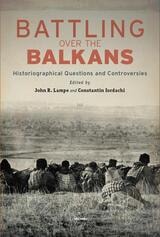
cover of Battling over the Balkans: Historiographical Questions and Controversies

Battling over the Balkans

Historiographical Questions and Controversies

John R. Lampe

Central European University Press, 2020
The tumultuous history of the Balkans has been subject to a plethora of conflicting interpretations, both local and external. In an attempt to help overcome the stereotypes that still pervade Balkan history, Battling over the Balkans concentrates on a set of five principal controversies from the precommunist period with which the region’s history and historiography must contend: the pre-1914 Ottoman and Eastern Christian Orthodox legacies; the post-1918 struggles for state-building; the range of European economic and cultural influences across the interwar period, as opposed to diplomatic or political intervention; the role of violence and paramilitary forces in challenging the interwar political regimes in the region; and the fate of ethnic minorities into and after World War II, particularly Jews, Muslims and Roma. In an attempt to give a voice to eminent local authors, the chapters provide samples of new regional scholarship exploring these contested issues—most of them translated into English for the first time—and are prefaced with historiographical overviews addressing the state of the debate on these specific controversies. These translations help bridge the language barriers that often separate scholarly traditions within Southeast Europe, as well as scholars in Southeast Europe and English-speaking academia. This volume will enable readers to identify common patterns and influences that characterize the writing of history in the region, and will stimulate new transnational and comparative approaches to the history of the Balkans.
[more]
cover of Beyond Mosque, Church, and State: Alternative Narratives of the Nation in the Balkans

Beyond Mosque, Church, and State

Alternative Narratives of the Nation in the Balkans

Yana Hashamova

Central European University Press, 2016

Journalists and policy-makers in the West have often assumed that the religious and ethno-national heterogeneity of the Balkans is the underlying reason for the numerous problems the area has faced throughout the twentieth century. The multiple and turbulent political transitions in the area, the dynamics of the interaction between Christianity and Islam, the contradictory and constantly shifting nationality policies, and the fluctuating identities of the diverse populations continue to be seen as major challenges to the stability of the region. By exploring the development of intricate religious, linguistic, and national dynamics in a variety of case studies throughout the Balkans, this volume demonstrates the existence of alternatives and challenges to nationalism in the area. The authors analyze a variety of national, non-national, and anti-national(ist) encounters in four areas—Bosnia, Bulgaria, Macedonia, and Albania—traditionally seen as “hot-beds” of nationalist agitation and tension resulting from their populations' religious or ethno-national diversity. In their entirety, the contributions in this volume chart a more complex picture of the national dynamics. The authors recognize the existence of national tensions both in historical perspective and in contemporary times, but also suggest the possibility of different paths to the nation that did not involve violence but allowed for national accommodation and reconciliation.
[more]
cover of Contesting Copyright: A History of Intellectual Property in East Central Europe and the Balkans

Contesting Copyright

A History of Intellectual Property in East Central Europe and the Balkans

Augusta Dimou

Central European University Press, 2026

The creative sector, including the cultural industry, is key for today’s economy. Copyright has the capacity to x the roles and tasks of the actors involved and determine the direction of cash ows within this sector. The study of the evolution of copyright helps understand and adjust the regulation and commercialization of creative labor. Augusta Dimou provides a thoroughly researched, interdisciplinary and comparative study of the historical development of copyright regimes in three countries – Czechoslovakia, Yugoslavia, and Bulgaria. She examines the function and signi cance of copyright in the institutionalization, development, and regulation of modern culture in East Central Europe and the Balkans during the diverse political regimes of the modern era, and at the interface between the various nationalization and globalization processes of the 20th century.
[more]
cover of Entangled Paths Toward Modernity: Contextualizing Socialism and Nationalism in the Balkans

Entangled Paths Toward Modernity

Contextualizing Socialism and Nationalism in the Balkans

Augusta Dimou

Central European University Press, 2009
The book is a study in comparative intellectual history and discusses how socialist ideology emerged as an option of political modernity in the Balkans of the late nineteenth and early twentieth century.Focusing on how technologies of ideological transfer and adaptation work, the book examines the introduction and contextualization of international socialist paradigms in the Southeast European periphery. At its core is the presentation of three case studies (Serbia, Bulgaria and Greece), intertwined at times through similar, but also divergent paths. Each case aspires to tell a different and yet complementary story with respect to the issue of modernity and socialism. The book analyses the introduction of socialism against the background and in conjunction to other prominent options of political modernity such as nationalism, liberalism and agrarianism.
[more]
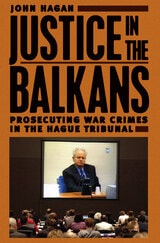
cover of Justice in the Balkans: Prosecuting War Crimes in the Hague Tribunal

Justice in the Balkans

Prosecuting War Crimes in the Hague Tribunal

John Hagan

University of Chicago Press, 2003

Called a fig leaf for inaction by many at its inception, the International Criminal Tribunal for the Former Yugoslavia has surprised its critics by growing from an unfunded U.N. Security Council resolution to an institution with more than 1,000 employees and a $100 million annual budget. With Slobodan Milosevic now on trial and more than forty fellow indictees currently detained, the success of the Hague tribunal has forced many to reconsider the prospects of international justice. John Hagan's Justice in the Balkans is a powerful firsthand look at the inner workings of the tribunal as it has moved from an experimental organization initially viewed as irrelevant to the first truly effective international court since Nuremberg.

Creating an institution that transcends national borders is a challenge fraught with political and organizational difficulties, yet, as Hagan describes here, the Hague tribunal has increasingly met these difficulties head-on and overcome them. The chief reason for its success, he argues, is the people who have shaped it, particularly its charismatic chief prosecutor, Louise Arbour. With drama and immediacy, Justice in the Balkans re-creates how Arbour worked with others to turn the tribunal's fortunes around, reversing its initial failure to arrest and convict significant figures and advancing the tribunal's agenda to the point at which Arbour and her colleagues, including her successor, Carla Del Ponte (nicknamed the Bulldog), were able to indict Milosevic himself. Leading readers through the investigations and criminal proceedings of the tribunal, Hagan offers the most original account of the foundation and maturity of the institution.

Justice in the Balkans brilliantly shows how an international social movement for human rights in the Balkans was transformed into a pathbreaking legal institution and a new transnational legal field. The Hague tribunal becomes, in Hagan's work, a stellar example of how individuals working with collective purpose can make a profound difference.

"The Hague tribunal reaches into only one house of horrors among many; but, within the wisely precise remit given to it, it has beamed the light of justice into the darkness of man's inhumanity, to woman as well as to man."—The Times (London)

[more]
cover of Opium in the Balkans: Cultivation, Processing, and Trade during the Interwar Period

Opium in the Balkans

Cultivation, Processing, and Trade during the Interwar Period

Vladan Jovanović

Central European University Press, 2025

Macedonian raw opium was a highly sought-after pharmaceutical raw material. This book focuses on its cultivation and production, and the trafficking of opium-based narcotics. Vladan Jovanović offers fresh insight into a neglected and marginalized subject, tracing and contextualizing both the licit and the illicit processing and trade of opium alkaloids from the Western Balkans through Turkey, and on to the rest of the world between the two World Wars. 

His approach is to explore the subject both from the top down, involving the League of Nations and politicians and diplomats, as well as from the bottom up, through the analysis of the activities of smugglers, police, and ordinary people who participated in the production and distribution of opium. The author describes the process of relocating the illegal processing industry from Turkey and Bulgaria to Yugoslavia. He insightfully shows the implicit continuity of relations between the former Ottoman Empire and the newly constituted Yugoslav state in the form of bilateral political agreements.

He pays special attention to the illegal activities within the legal pharmaceutical industry and also exposes the role of criminal networks, which he situates in the appropriate political and social context. The exploration of this sensitive historical subject extends to other Balkan countries, along with Turkey, Western Europe, and the United States.

[more]
cover of The Balkans: Mission Possible

The Balkans

Mission Possible

Maria Todorova

Central European University Press, 2026
In this incisive book, Maria Todorova revisits the region she famously theorized, asking not only what has changed in the past thirty years but whether the conceptual tools used to understand the Balkans still make sense. Treating the Balkans as a historically contingent and ultimately transient construct, Todorova traces their rise, transformations, and anticipated exhaustion, while confronting long-standing silences—especially around race. She then turns a critical eye to Balkan studies itself, examining its institutionalization and the allure, limits, and misapplications of post- and decolonial frameworks. The final section shifts scale dramatically, using brief biographies to reveal how individuals are shaped—and distorted—by scholarly and political frames. Subtle, unsparing, and deeply reflective, this book reopens the epistemological question of the Balkans at a moment when easy paradigms have become impossible to sustain.
[more]
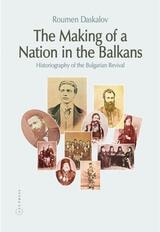
cover of The Making of a Nation in the Balkans

The Making of a Nation in the Balkans

Roumen Daskalov

Central European University Press, 2004

The nineteenth century was the epoch of nation building for the Bulgarians under Ottoman rule. In this book, comparisons and analogies are made between the Bulgarian Revival and other regions, epochs, ideological trends, and events. These latter are taken from two major areas—Western Europe ("Renaissance," "Enlightenment," "Romanticism," the French Revolution, and national liberation movements), and Russia (the "agrarian question," "populism" and "utopian socialism," "revolutionary democrats," and the Russian Revolution of 1905). Historical facts about the Revival were instrumentalized for political purposes, such as the fostering of national and state loyalties through the reproduction of identities, or, directly, as the legitimating/contesting of a current political regime under the guise of disputes over historical legacy. Ideological mobilization took place in the form of nationalism, right-wing authoritarianism (shading into fascism), and communism. The author sets in relief some of the mechanisms and logic of the two grand narratives under the sign of nationalism, and of Marxism.
[more]
cover of The Tamburitza Tradition: From the Balkans to the American Midwest

The Tamburitza Tradition

From the Balkans to the American Midwest

Richard March

University of Wisconsin Press, 2013
The Tamburitza Tradition is a lively and well-illustrated comprehensive introduction to a Balkan folk music that now also thrives in communities throughout Europe, the Americas, and Australia. Tamburitza features acoustic stringed instruments, ranging in size from tamburas as small as a ukulele to ones as large as a bass viol.
            Folklorist Richard March documents the centuries-old origins and development of the tradition, including its intertwining with nationalist and ethnic symbolism. The music survived the complex politics of nineteenth-century Europe but remains a point of contention today. In Croatia, tamburitza is strongly associated with national identity and supported by an artistic and educational infrastructure. Serbia is proud of its outstanding performers and composers who have influenced tamburitza bands on four continents. In the United States, tamburitza was brought by Balkan immigrants in the nineteenth century and has become a flourishing American ethnic music with its own set of representational politics.
            Combining historical research with in-depth interviews and extensive participant-observer description, The Tamburitza Tradition reveals a dynamic and expressive music tradition on both sides of the Atlantic and beyond, illuminating the cultures and societies from which it has emerged.
[more]
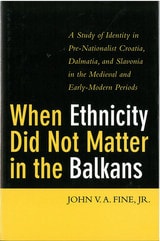
cover of When Ethnicity Did Not Matter in the Balkans: A Study of Identity in Pre-Nationalist Croatia, Dalmatia, and Slavonia in the Medieval and Early-Modern Periods

When Ethnicity Did Not Matter in the Balkans

A Study of Identity in Pre-Nationalist Croatia, Dalmatia, and Slavonia in the Medieval and Early-Modern Periods

John V. A. Fine, Jr.

University of Michigan Press, 2006

"This is history as it should be written. In When Ethnicity Did Not Matter in the Balkans, a logical advancement on his earlier studies, Fine has successfully tackled a fascinating historical question, one having broad political implications for our own times. Fine's approach is to demonstrate how ideas of identity and self-identity were invented and evolved in medieval and early-modern times. At the same time, this book can be read as a critique of twentieth-century historiography-and this makes Fine's contribution even more valuable. This book is an original, much-needed contribution to the field of Balkan studies."
-Steve Rapp, Associate Professor of Caucasian, Byzantine, and Eurasian History, and Director, Program in World History and Cultures Department of History, Georgia State University Atlanta


When Ethnicity Did Not Matter in the Balkans is a study of the people who lived in what is now Croatia during the Middle Ages (roughly 600-1500) and the early-modern period (1500-1800), and how they identified themselves and were identified by others. John V. A. Fine, Jr., advances the discussion of identity by asking such questions as: Did most, some, or any of the population of that territory see itself as Croatian? If some did not, to what other communities did they consider themselves to belong? Were the labels attached to a given person or population fixed or could they change? And were some people members of several different communities at a given moment? And if there were competing identities, which identities held sway in which particular regions?

In When Ethnicity Did Not Matter in the Balkans, Fine investigates the identity labels (and their meaning) employed by and about the medieval and early-modern population of the lands that make up present-day Croatia. Religion, local residence, and narrow family or broader clan all played important parts in past and present identities. Fine, however, concentrates chiefly on broader secular names that reflect attachment to a city, region, tribe or clan, a labeled people, or state.

The result is a magisterial analysis showing us the complexity of pre-national identity in Croatia, Dalmatia, and Slavonia. There can be no question that the medieval and early-modern periods were pre-national times, but Fine has taken a further step by demonstrating that the medieval and early-modern eras in this region were also pre-ethnic so far as local identities are concerned. The back-projection of twentieth-century forms of identity into the pre-modern past by patriotic and nationalist historians has been brought to light. Though this back-projection is not always misleading, it can be; Fine is fully cognizant of the danger and has risen to the occasion to combat it while frequently remarking in the text that his findings for the Balkans have parallels elsewhere.

John V. A. Fine, Jr. is Professor of History at the University of Michigan.

[more]
cover of Women, Violence and War: Wartime Victimization of Refugees in the Balkans

Women, Violence and War

Wartime Victimization of Refugees in the Balkans

Vesna Nikolic-Ristanovic

Central European University Press, 2000

Based on interviews with seventy women refugees, Women, Violence and War is a book about war as it is seen, lived and interpreted by women who were citizens of the former Yugoslavia.

Many of the accounts portray the horrific experiences the victims had to face and the book addresses issues of sexual, physical and psychological violence, as well as problems of confinement, upheaval and family separation. In a completely new insight the book dispels the myth that many of the women were peasants, and shows that in fact they were educated, middle-class women with independent careers. The study also depicts how some of the victims attempt to come to terms with the aftermath of wartime abuse.

This probing, accurate and unique investigation of victimization is an unparalleled volume that presents a completely new perspective maintaining that violence against women in war is not independent of peace-time victimization and the imbalance of power between sexes.

[more]