Results by title
46 books match the query 'Beauty'
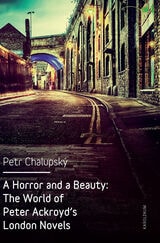
A Horror and a Beauty
The World of Peter Ackroyd's London NovelsPetr Chalupský
Karolinum Press, 2016
This idiosyncratic London construct is particularly prominent in Ackroyd’s novels, in which his ideas about the city’s nature and his connection to English literary sensibilities combine to create a distinct chronotope with its own spatial and temporal properties. A Horror and a Beauty explores this world through six defining aspects of the city as Ackroyd identifies them: the relationship between London’s past and present, its uncanny manifestations, its felonious tendencies, its inhabitants’ psychogeographic and antiquarian strategies, its theatricality, and its inherently literary character.
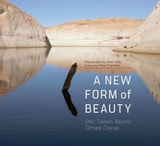
A New Form of Beauty
Glen Canyon Beyond Climate ChangePhotographs by Peter Goin, Essays by Peter Friederici
University of Arizona Press, 2016
In A New Form of Beauty photographer Peter Goin and writer Peter Friederici tackle science from the viewpoint of art, creating a lyrical exploration in words and photographs, setting Glen Canyon and Lake Powell as the quintessential example of the challenges of perceiving place in a new era of radical change. Through evocative photography and extensive reporting, the two document their visits to the canyon country over a span of many years. By motorboat and kayak, they have ventured into remote corners of the once-huge reservoir to pursue profound questions: What is this place? How do we see it? What will it become?
Goin’s full-color photographs are organized in three galleries—Flora and Fauna, Artifacts, and Low Water—interspersed with three essays by Friederici, and an epilogue gallery on Fire. The book includes two foldout photographs, which allow readers to fully see Lake Powell at high water and low water points
Contemplating humanity’s role in the world it is creating, Goin and Friederici ask if the uncertainties inherent in Glen Canyon herald an unpredictable new future for every place. They challenge us to question how we look at the world, how we live in it, and what the future will be.
A Rough Sort of Beauty
Reflections on the Natural Heritage of ArkansasDana Steward
University of Arkansas Press, 2002
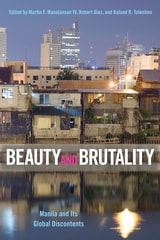
Beauty and Brutality
Manila and Its Global DiscontentsEdited by Martin F. Manalansan IV, Robert Diaz, and Roland B. Tolentino
Temple University Press, 2023
Beauty and Brutality provides an exciting, original, and critical encounter with this labyrinthine city’s imagined and material landscape. The authors and contributors investigate the “messy, fleshy, recalcitrant, mercurial, and immeasurable qualities of the city,” examining its urban space and smell: how it is represented in films, literature, music, and urban streetart; how it has endured the politics of colonialism, U.S. imperialism, neoliberalism, and globalization; as well as how its queer citizens engage with digital media platforms to communicate and connect with each other.
The first volume to offer a cultural and urban studies approach to Manila, Beauty and Brutality considers the tensions of the Filipino diaspora as they migrate and “re-turn,” as well as the citizens’ responses to the Marcos (and post-Marcos) dictatorship, President Duterte’s authoritarianism, and “Drug War.” Essays also map out of geographies of repression and resistance in the urban war of classes, genders and sexualities, ethnicities and races, and generations, along with the violence of urban life and growth. Ultimately, Beauty and Brutality frames Manila as a vibrant and ever-evolving metropolis that, even in the face of its difficulties, instills hope.
Contributors: Paul Michael Leonardo Atienza, Christine Bacareza Balance, Vanessa Banta, Rosa Cordillera A. Castillo, Roland Sintos Coloma, Gary C. Devilles, Faith R. Kares, John B. Labella, Raffy Lerma, Bliss Cua Lim, Ferdinand M. Lopez, Paul Nadal, Jema M. Pamintuan, Oscar Tantoco Serquiña, Jr., Louise Jashil R. Sonido, and the editors.
Beauty and the Beast
Michael Taussig
University of Chicago Press, 2012
Beauty and the Beast begins with the question: Is beauty destined to end in tragedy? Drawing on extensive fieldwork in Colombia, Michael Taussig scrutinizes the anxious, audacious, and sometimes destructive attempts people make to transform their bodies through cosmetic surgery and liposuction. He balances an examination of surgeries meant to enhance an individual’s beauty with an often overlooked counterpart, surgeries performed—often on high profile criminals—to disguise one’s identity. Situating this globally shared phenomenon within the economic, cultural, and political history of Colombia, Taussig links the country’s long civil war and its bodily mutilation and torture to the beauty industry at large, sketching Colombia as a country whose high aesthetic stakes make it a stage where some of the most important and problematic ideas about the body are played out.
Central to Taussig’s examination is George Bataille’s notion of depense, or “wasting.” While depense is often used as a critique, Taussig also looks at the exuberance such squandering creates and its position as a driving economic force. Depense, he argues, is precisely what these procedures are all about, and the beast on the other side of beauty should not be dismissed as simple recompense. At once theoretical and colloquial, public and intimate, Beauty and the Beast is a true-to-place ethnography—written in Taussig’s trademark voice—that tells a thickly layered but always accessible story about the lengths to which people will go to be physically remade.

Beauty and the Beast
Italianness in British CinemaElisabetta Girelli
Intellect Books, 2009
Scholarly interest in issues of national identity and representation has been increasing for years, and cinema is a major resource for that work, as it allows for cross-cultural dialogue and the portrayal of different layers of representation and cultural stereotypes. Beauty and the Beast takes a look at the depictions of Italy and the Italians in British cinema.
Elisabetta Girelli draws upon cultural and social history to assess the ongoing representation of “Italianness” in British film, and its crucial role in defining and challenging British national identity. Girelli provides an original survey of archival material such as World War II footage, and an analysis of significant British films like Summer Madness and A Room With A View. Drawing on British literary and filmic tradition to analyze the rise of specific images of the Italian other, Beauty and the Beast is a noteworthy and unique contribution to film and cultural studies.
Beauty and the Beast
The Original StoryGabrielle-Suzanne Barbot de Villeneuve
Iter Press, 2020
The Other Voice in Early Modern Europe: The Toronto Series volume 74
Beauty and the Bible
Toward a Hermeneutics of Biblical AestheticsRichard J. Bautch
SBL Press, 2013
Beauty and the Brain
The Science of Human Nature in Early AmericaRachel E. Walker
University of Chicago Press, 2023
Between the 1770s and the 1860s, people all across the globe relied on physiognomy and phrenology to evaluate human worth. These once-popular but now-discredited disciplines were based on a deceptively simple premise: that facial features or skull shape could reveal a person’s intelligence, character, and personality. In the United States, these were culturally ubiquitous sciences that both elite thinkers and ordinary people used to understand human nature.
While the modern world dismisses phrenology and physiognomy as silly and debunked disciplines, Beauty and the Brain shows why they must be taken seriously: they were the intellectual tools that a diverse group of Americans used to debate questions of race, gender, and social justice. While prominent intellectuals and political thinkers invoked these sciences to justify hierarchy, marginalized people and progressive activists deployed them for their own political aims, creatively interpreting human minds and bodies as they fought for racial justice and gender equality. Ultimately, though, physiognomy and phrenology were as dangerous as they were popular. In addition to validating the idea that external beauty was a sign of internal worth, these disciplines often appealed to the very people who were damaged by their prejudicial doctrines. In taking physiognomy and phrenology seriously, Beauty and the Brain recovers a vibrant—if largely forgotten—cultural and intellectual universe, showing how popular sciences shaped some of the greatest political debates of the American past.

Beauty and the Brain
The Science of Human Nature in Early AmericaRachel E. Walker
University of Chicago Press, 2023
Examining the history of phrenology and physiognomy, Beauty and the Brain proposes a bold new way of understanding the connection between science, politics, and popular culture in early America.
Between the 1770s and the 1860s, people all across the globe relied on physiognomy and phrenology to evaluate human worth. These once-popular but now discredited disciplines were based on a deceptively simple premise: that facial features or skull shape could reveal a person’s intelligence, character, and personality. In the United States, these were culturally ubiquitous sciences that both elite thinkers and ordinary people used to understand human nature.
While the modern world dismisses phrenology and physiognomy as silly and debunked disciplines, Beauty and the Brain shows why they must be taken seriously: they were the intellectual tools that a diverse group of Americans used to debate questions of race, gender, and social justice. While prominent intellectuals and political thinkers invoked these sciences to justify hierarchy, marginalized people and progressive activists deployed them for their own political aims, creatively interpreting human minds and bodies as they fought for racial justice and gender equality. Ultimately, though, physiognomy and phrenology were as dangerous as they were popular. In addition to validating the idea that external beauty was a sign of internal worth, these disciplines often appealed to the very people who were damaged by their prejudicial doctrines. In taking physiognomy and phrenology seriously, Beauty and the Brain recovers a vibrant—if largely forgotten—cultural and intellectual universe, showing how popular sciences shaped some of the greatest political debates of the American past.
Beauty and the Good
Recovering the Classical Tradition from Plato to Duns ScotusAlice M. Ramos
Catholic University of America Press, 2021
Being is Better Than Not Being
The Metaphysics of Goodness and Beauty in AristotleChristopher V. Mirus
Catholic University of America Press, 2022
Citizens of Beauty
Poems of Jean SénacJean Sénac
Michigan State University Press, 2016
Drag Queens and Beauty Queens
Contesting Femininity in the World's PlaygroundLaurie Greene
Rutgers University Press, 2021
Drag Queens and Beauty Queens presents a vivid ethnography of the Miss’d America pageant and the gay neighborhood from which it emerged in the early 1990s as a moment of campy celebration in the midst of the AIDS crisis. It examines how the pageant strengthened community bonds and activism, as well as how it has changed now that Rupaul’s Drag Race has brought many of its practices into the cultural mainstream. Comparing the Miss’d America pageant with its glitzy cisgender big sister, anthropologist Laurie Greene discovers how the two pageants have influenced each other in unexpected ways.
Drag Queens and Beauty Queens deepens our understanding of how femininity is performed at pageants, exploring the various ways that both the Miss’d America and Miss America pageants have negotiated between embracing and critiquing traditional gender roles. Ultimately, it celebrates the rich tradition of drag performance and the community it engenders.
Dynamic Transcendentals
Truth, Goodness, and Beauty from a Thomistic PerspectiveAlice M. Ramos
Catholic University of America Press, 2012
Experiments in Skin
Race and Beauty in the Shadows of VietnamThuy Linh Nguyen Tu
Duke University Press, 2021
Fashion and Ethics
Critical Studies in Fashion and Beauty, Volume IIEdited by Efrat Tseëlon
Intellect Books, 2014
With essays that problematize issues such as ethical fashion’s self-appointed morality, the first-world notion that the environment should take priority over human development, the conflict between business profit and ethics, the unintended agendas involved in consuming green cosmetics or ethical culinary trends, and the discursive strategies of denial of the extreme cruelty in the procurement of animal skin and fur for use in fashion, Fashion and Ethics applies its uncompromising scrutiny to all areas of fashion. Throughout, the volume forces readers to confront the question: Does ethical fashion go deep enough into challenging unethical behavior or is it just a charade of good intentions?
Fashioning Diaspora
Beauty, Femininity, and South Asian American CultureVanita Reddy
Temple University Press, 2015
One of the first books to consider beauty and fashion as a point of entry into an examination of South Asian diasporic public cultures, Fashioning Diaspora examines a range of literature, visual art, and live performance. Through careful analyses of novels by Bharati Mukherjee and Jhumpa Lahiri, young adult literature, performance art by Shailja Patel, as well as objects of popular culture including an Indian American fashion doll, and beauty and adornment practices, Reddy challenges fashion and beauty as a set of dematerialized, overly commodified cultural practices. She argues instead that beauty and fashion structure South Asian Americans’ uneven access to social mobility, capital, and citizenship, and demonstrates their varying capacities to produce social attachments across national, class, racial, gender, and generational divides.
Formal Objects
On Beauty and SustainabilityRobert Hariman
University of Chicago Press, 2027
A bold invitation to learn sustainability from the aesthetic forms that pattern our world.
If we are to survive the ecological crisis, we must develop a new orientation to the world that draws us into better relationships with nature and one another. Robert Hariman believes that, as a first step, we must cultivate a renewed appreciation for the beauty at the center of reality. We must learn again, he argues, to see forms: the rhythms, shapes, and textures that evoke connection and pleasure. To that end, Formal Objects applies literary, philosophical, and art historical concepts to reimagine an often-ignored theory called formalism. This perspective is developed through visual motifs that are found in nature and the decorative arts, and it invites us to become attuned to rich patterns of reciprocity. Once we recognize the beauty in the world, we can move in step with its abundance to design more just and sustainable communities.
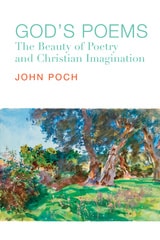
God's Poems
The Beauty of Poetry and the Christian ImaginationJohn Poch
St. Augustine's Press, 2021
But that is not all. Poch as a well-established and regarded poet, turns his eye to contemporary poetry and vindicates its function in a “created and creative world.” Today many have abandoned the genre as a wasteland of misguided voice that really has nothing to say. The poet is a truth-teller, and Poch as devoted writer, teacher, and believer sends out a renewed call to turn to verse as a means of seeing oneself as God’s poeima, or poem (Letter to Ephesians). The depth of self-knowing relates directly to an aptitude to engage the category of poetry at some level. A tragic void is filled with Poch’s effort to exhort the reader to patiently reconnect with poetry even though it has been hijacked by persons who want to be heard more than speak well. (This book is essential, therefore, for aspiring poets.)
For faithful readers or those seeking to return, Poch is a place to begin to understand contemporary writers worth knowing and which poets of the past must remain with us. In Virgilian fashion, he can see the panorama behind him and that which lies immediately ahead and instills a recovered love of an eternal medium that will be restored to a state of coherency and enlightened perspective. If Poch has faith in poetry it is because poetry is indeed a source of faith. If Justin Martyr claimed that everything that is true belongs to Christians, Poch shows us that everyone who speaks truth is to some degree a poet. Even God with his revealed wisdom chooses poetry as medium par excellence. It is essential to know how poetry works. “Great poems that we consider literature give us what we never expected. They go beyond the usefulness of conveying a feeling and unveiling beauty; and they tell us who we are.”
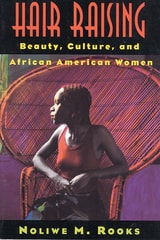
Hair Raising
Beauty, Culture, and African American WomenRooks, Noliwe M
Rutgers University Press, 1996
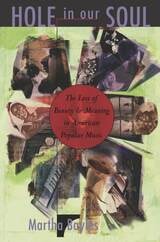
Hole in Our Soul
The Loss of Beauty and Meaning in American Popular MusicMartha Bayles
University of Chicago Press, 1996
Bayles defends the tough, affirmative spirit of Afro-American music against the strain of artistic modernism she calls 'perverse.' She describes how perverse modernism was grafted onto popular music in the late 1960s, and argues that the result has been a cult of brutality and obscenity that is profoundly anti-musical.
Unlike other recent critics of popular music, Bayles does not blame the problem on commerce. She argues that culture shapes the market and not the other way around. Finding censorship of popular music "both a practical and a constitutional impossibility," Bayles insists that "an informed shift in public tastes may be our only hope of reversing the current malignant mood."

I Was Thinking of Beauty
Sydney Lea
Four Way Books, 2013
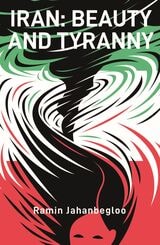
Iran
Beauty and TyrannyRamin Jahanbegloo
Gingko, 2026
Ramin Jahanbegloo turns to ancient philosophy as an antidote to contemporary authoritarianism in Iran.
From the rule of Cyrus the Great to the present day, Iran has been plagued by a recurrent syndrome of tyranny. For Ramin Jahanbegloo, the cure for this persistent cycle lies in a reengagement with the idea of a beautiful society. He presents beauty as an antidote to authoritarianism and as a methodology of freedom: one first taught by the philosophers of ancient Greece, who bound beauty and goodness together in the principle of kalokagathia, and later revived by the German Enlightenment.
A work of hope and faith in the people of Iran, this provocative and timely intervention from the author of The Idea of Persia turns to the past in order to imagine a way forward. Drawing on Hegel, Schiller, Arendt, Camus, and more, Jahanbegloo lays out a vision of how Iran and Iranians might come to live in beautiful freedom.
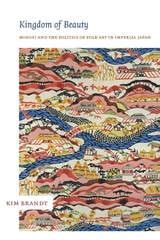
Kingdom of Beauty
Mingei and the Politics of Folk Art in Imperial JapanKim Brandt
Duke University Press, 2007
Kingdom of Beauty shows that the discovery of mingei (folk art) by Japanese intellectuals in the 1920s and 1930s was central to the complex process by which Japan became both a modern nation and an imperial world power. Kim Brandt’s account of the mingei movement locates its origins in colonial Korea, where middle-class Japanese artists and collectors discovered that imperialism offered them special opportunities to amass art objects and gain social, cultural, and even political influence. Later, mingei enthusiasts worked with (and against) other groups—such as state officials, fascist ideologues, rival folk art organizations, local artisans, newspaper and magazine editors, and department store managers—to promote their own vision of beautiful prosperity for Japan, Asia, and indeed the world. In tracing the history of mingei activism, Brandt considers not only Yanagi Muneyoshi, Hamada Shōji, Kawai Kanjirō, and other well-known leaders of the folk art movement but also the often overlooked networks of provincial intellectuals, craftspeople, marketers, and shoppers who were just as important to its success. The result of their collective efforts, she makes clear, was the transformation of a once-obscure category of pre-industrial rural artifacts into an icon of modern national style.
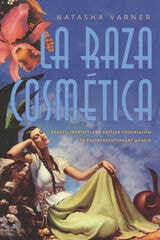
La Raza Cosmética
Beauty, Identity, and Settler Colonialism in Postrevolutionary MexicoNatasha Varner
University of Arizona Press, 2020
Critically examining beauty pageants, cinema, tourism propaganda, photography, murals, and more, Natasha Varner shows how postrevolutionary understandings of mexicanidad were fundamentally structured by legacies of colonialism, as well as shifting ideas about race, place, and gender. This interdisciplinary study smartly weaves together cultural history, Indigenous and settler colonial studies, film and popular culture analysis, and environmental and urban history. It also traces a range of Indigenous interventions in order to disrupt top-down understandings of national identity construction and to “people” this history with voices that have all too often been entirely ignored.
Listening to Beauty
Rhetorics of Science in Sea and SoundMegan Poole
University of Chicago Press, 2025
Our attempts to understand the world are always more than simply rational. Our bodies learn through lived experience, our natural environments challenge what we think we know, and we take lessons from our nonhuman kin. Even scientists, often considered paragons of rationality, frequently describe their findings in the language of beauty. For rhetorician Megan Poole, beauty is integral to how scientific research works.
Drawing on interviews with leading biologists, Poole explores what happens when scientists set aside objectivity and listen for beauty around them. The wonder we feel at the plumage of birds, the melodies of whales, or the caretaking of elephants may not help us (on its own) to isolate a given fact, but such encounters may teach us to open ourselves to a different way of knowing entirely. Through stories about researchers’ encounters with wonder, Listening to Beauty reveals how scientific discovery happens sometimes unsystematically, sometimes incoherently, often beautifully.
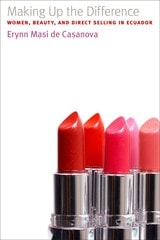
Making Up the Difference
Women, Beauty, and Direct Selling in EcuadorBy Erynn Masi de Casanova
University of Texas Press, 2011
Globalization and economic restructuring have decimated formal jobs in developing countries, pushing many women into informal employment such as direct selling of cosmetics, perfume, and other personal care products as a way to "make up the difference" between household income and expenses. In Ecuador, with its persistent economic crisis and few opportunities for financially and personally rewarding work, women increasingly choose direct selling as a way to earn income by activating their social networks. While few women earn the cars and trips that are iconic prizes in the direct selling organization, many use direct selling as part of a set of household survival strategies.
In this first in-depth study of a cosmetics direct selling organization in Latin America, Erynn Masi de Casanova explores women's identities as workers, including their juggling of paid work and domestic responsibilities, their ideas about professional appearance, and their strategies for collecting money from customers. Focusing on women who work for the country's leading direct selling organization, she offers fascinating portraits of the everyday lives of women selling personal care products in Ecuador's largest city, Guayaquil. Addressing gender relations (including a look at men's direct and indirect involvement), the importance of image, and the social and economic context of direct selling, Casanova challenges assumptions that this kind of flexible employment resolves women's work/home conflicts and offers an important new perspective on women's work in developing countries.
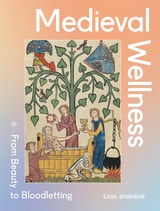
Medieval Wellness
From Beauty to BloodlettingLarisa Grollemond
J. Paul Getty Trust, The, 0
Dispelling myths of a dirty, superstitious Middle Ages, this entertaining volume explores medieval approaches to health and wellness.
Often maligned as an era of darkness and superstition, the Middle Ages in Europe have been stereotyped as lacking standards for basic hygiene, or, at the very least, for having a laughably simplistic approach to self-care and medicine. With wit and expert analysis, medievalist Larisa Grollemond explores everyday practices and beliefs of medieval life. She uncovers a world as nuanced and self-aware as our own while playfully connecting traditions from the Middle Ages to modern wellness culture.
- Challenges misconceptions of medieval Europe with engaging, evidence-based insights into hygiene and healthcare practices.
- Answers popular questions about daily life, including bathing, cosmetics, contraception, and the realities of medieval medical treatments.
- Features over 130 illustrations of illuminated manuscripts, medieval artifacts, and other art works that bring the past vividly to life.
- Connects medieval wellness practices to contemporary self-care trends, offering surprising parallels and fresh perspective.
If you think the Middle Ages were primitive and unsophisticated, this book will change your mind. With Medieval Wellness, you’ll discover a world of care, curiosity, and complexity that will feel familiar to your own.
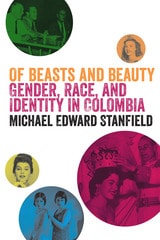
Of Beasts and Beauty
Gender, Race, and Identity in ColombiaBy Michael Edward Stanfield
University of Texas Press, 2013
All societies around the world and through time value beauty highly. Tracing the evolutions of the Colombian standards of beauty since 1845, Michael Edward Stanfield explores their significance to and symbiotic relationship with violence and inequality in the country. Arguing that beauty holds not only social power but also economic and political power, he positions it as a pacific and inclusive influence in a country “ripped apart by violence, private armies, seizures of land, and abuse of governmental authority, one hoping that female beauty could save it from the ravages of the male beast.” One specific means of obscuring those harsh realities is the beauty pageant, of which Colombia has over 300 per year. Stanfield investigates the ways in which these pageants reveal the effects of European modernity and notions of ethnicity on Colombian women, and how beauty for Colombians has become an external representation of order and morality that can counter the pathological effects of violence, inequality, and exclusion in their country.
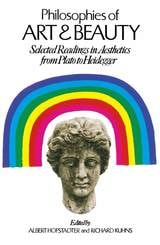
Philosophies of Art and Beauty
Selected Readings in Aesthetics from Plato to HeideggerAlbert Hofstadter and Richard Kuhns
University of Chicago Press, 1964
This anthology of primary texts gathers an incredibly large number of the most important philosophical writings on art and aesthetics from the ancient Greeks to contemporary thought. Albert Hofstadter and Richard Kuhns present English-language translations of works of
- Plato
- Aristotle
- Plotinus
- Augustine
- Marsilio Ficino
- Earl of Shaftesbury
- Kant
- Schelling
- Hegel
- Schopenhauer
- Nietzsche
- Benedetto Croce
- John Dewey
- Heidegger
Poetry, Beauty, and Contemplation
The Complete Aesthetics of Jacques MaritainJohn G. Trapani Jr.
Catholic University of America Press, 2011
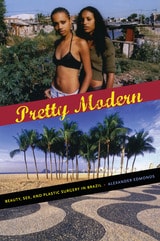
Pretty Modern
Beauty, Sex, and Plastic Surgery in BrazilAlexander Edmonds
Duke University Press, 2010
The Beauty of a Social Problem
Photography, Autonomy, EconomyWalter Benn Michaels
University of Chicago Press, 2015
Although he discusses well-known figures like Walker Evans and Jeff Wall, Michaels’s focus is on a group of younger artists, including Viktoria Binschtok, Phil Chang, Liz Deschenes, and Arthur Ou. All born after 1965, they have always lived in a world where, on the one hand, artistic ambition has been synonymous with the critique of autonomous form and intentional meaning, while, on the other, the struggle between capital and labor has essentially been won by capital. Contending that the aesthetic and political conditions are connected, Michaels argues that these artists’ new commitment to form and meaning is a way for them to depict the conditions that have taken US economic inequality from its lowest level, in 1968, to its highest level today. As Michaels demonstrates, these works of art, unimaginable without the postmodern critique of autonomy and intentionality, end up departing and dissenting from that critique in continually interesting and innovative ways.
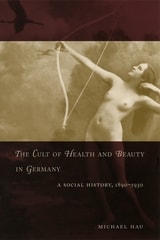
The Cult of Health and Beauty in Germany
A Social History, 1890-1930Michael Hau
University of Chicago Press, 2003
Hau argues that the obsession with personal health and fitness was often rooted in anxieties over professional and economic success, as well as fears that modern industrialized civilization was causing Germany and its people to degenerate. He also examines how different social groups gave different meanings to the same hygienic practices and aesthetic ideals. What results is a penetrating look at class formation in pre-Nazi Germany that will interest historians of Europe and medicine and scholars of culture and gender.
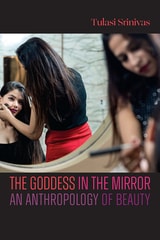
The Goddess in the Mirror
An Anthropology of BeautyTulasi Srinivas
Duke University Press, 2025
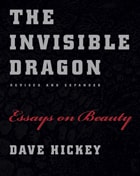
The Invisible Dragon
Essays on Beauty, Revised and ExpandedDave Hickey
University of Chicago Press, 2009
The Invisible Dragon made a lot of noise for a little book When it was originally published in 1993 it was championed by artists for its forceful call for a reconsideration of beauty—and savaged by more theoretically oriented critics who dismissed the very concept of beauty as naive, igniting a debate that has shown no sign of flagging.
With this revised and expanded edition, Hickey is back to fan the flames. More manifesto than polite discussion, more call to action than criticism, The Invisible Dragon aims squarely at the hyper-institutionalism that, in Hickey’s view, denies the real pleasures that draw us to art in the first place. Deploying the artworks of Warhol, Raphael, Caravaggio, and Mapplethorpe and the writings of Ruskin, Shakespeare, Deleuze, and Foucault, Hickey takes on museum culture, arid academicism, sclerotic politics, and more—all in the service of making readers rethink the nature of art. A new introduction provides a context for earlier essays—what Hickey calls his "intellectual temper tantrums." A new essay, "American Beauty," concludes the volume with a historical argument that is a rousing paean to the inherently democratic nature of attention to beauty.
Written with a verve that is all too rare in serious criticism, this expanded and refurbished edition of The Invisible Dragon will be sure to captivate a new generation of readers, provoking the passionate reactions that are the hallmark of great criticism.
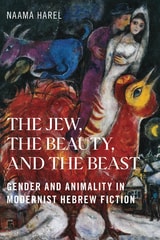
The Jew, the Beauty, and the Beast
Gender and Animality in Modernist Hebrew FictionNaama Harel
Rutgers University Press, 2026
The Jew, the Beauty, and the Beast critically explores the tangled interplay between Jewishness, gender, and animality and its manifestation in modernist Hebrew fiction. Through interdiscursive analysis and close readings, the effeminate Jew is examined vis-à-vis the animalized woman. Intertwining cutting-edge theoretical frameworks of posthumanism and animal studies with established scholarship of Hebrew literature, Jewish studies, and gender studies, Naama Harel offers new Hebrew literary historiography and innovative perspectives on canonical works by Shmuel Yosef Agnon, Devorah Baron, Micha Yosef Berdichevsky, Yosef Haim Brenner, Uri Nissan Gnessin, and David Vogel.

The Last Cheater's Waltz
Beauty and Violence in the Desert SouthwestEllen Meloy
University of Arizona Press, 1999
The Promise of Beauty
Mimi Thi Nguyen
Duke University Press, 2024
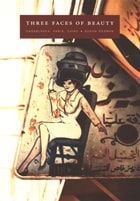
Three Faces of Beauty
Casablanca, Paris, CairoSusan Ossman
Duke University Press, 2002
By examining how images from fashion magazines, film, and advertising are enacted in beauty salons, Ossman demonstrates how embodiment is able to display and rework certain hierarchies. While offering the possibility of freedom from the tethers of status, nation, religion, and nature, beauty is created by these very categories and values, Ossman shows. Drawing on hundreds of interviews, she documents the various rituals of welcome, choice-making, pricing practices, and spatial arrangements in multiple salons . She also reveals ways in which patrons in all three cities imagine and co-opt looks they believe are fashionable in the other cities. By observing salons as scenes of instruction, Ossman reveals that beautiful bodies evolve within the intertwining contexts of media, modernity, location, time, postcolonialism, and male expectation.
Time of Beauty, Time of Fear
The Romantic Legacy in the Literature of ChildhoodJames Holt McGavran, Jr.
University of Iowa Press, 2012
Truth and Beauty
Aesthetics and Motivations in ScienceS. Chandrasekhar
University of Chicago Press, 1987
The late S. Chandrasekhar was best known for his discovery of the upper
limit to the mass of a white dwarf star, for which he received the Nobel
Prize in Physics in 1983. He was the author of many books, including
The Mathematical Theory of Black Holes and, most recently,
Newton's Principia for the Common Reader.
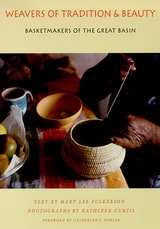
Weavers of Tradition and Beauty
Basketmakers of the Great BasinMary Lee Fulkerson
University of Nevada Press, 1995
Weavers of Tradition and Beauty presents new information on contemporary Native American basketry of the Great Basin, largely from the viewpoint of the weavers themselves. In collecting their stories, Kathleen Curtis and Mary Lee Fulkerson traveled throughout Nevada, never dreaming their odyssey over back-roads and to reservations would stretch into years. Finding a deep connection to the people of the sage, the authors accompanied the weavers as they gathered and prepared their special willow, dyed the bracken fern root, and wove their baskets. Baskets—and the people who weave them—have always been revered and honored by Native Americans. Fulkerson and Curtis depict, in text and full color and black and white photographs, how their art prevails—even over adverse environmental, social, and economic conditions. Today, contemporary weavers continue their work by creating baskets in the manner of their ancestors. Teaching their children and grandchildren how to weave baskets, these artisans carry on a long and strong tradition. By documenting the basketry of Nevada's native people, the authors make a significant contribution in preserving this ancient and beautiful craft. Foreword by Catherine S. Fowler.

Working on the Railroad, Walking in Beauty
Navajos, Hozho, and Track WorkJay Youngdahl
Utah State University Press, 2011
For over one hundred years, Navajos have gone to work in significant numbers on Southwestern railroads. As they took on the arduous work of laying and anchoring tracks, they turned to traditional religion to anchor their lives.
Jay Youngdahl, an attorney who has represented Navajo workers in claims with their railroad employers since 1992 and who more recently earned a master's in divinity from Harvard, has used oral history and archival research to write a cultural history of Navajos' work on the railroad and the roles their religious traditions play in their lives of hard labor away from home.
Wrapped in Beauty
The Koelz Collection of Kashmiri ShawlsGrace Beardsley in collaboration with Carla M. Sinopoli
University of Michigan Press, 2005