Results by title
13 books match the query 'Bourdieu, Pierre'

An Invitation to Reflexive Sociology
Pierre Bourdieu and Loïc J. D. Wacquant
University of Chicago Press, 1992
Over the last three decades, the French sociologist Pierre Bourdieu has produced one of the most imaginative and subtle bodies of social theory and research of the postwar era. Yet, despite the influence of his work, no single introduction to his wide-ranging oeuvre is available. This book, intended for an English-speaking audience, offers a systematic and accessible overview, providing interpretive keys to the internal logic of Bourdieu's work by explicating thematic and methodological principles underlying his work.
The structure of Bourdieu's theory of knowledge, practice, and society is first dissected by Loic Wacquant; he then collaborates with Bourdieu in a dialogue in which they discuss central concepts of Bourdieu's work, confront the main objections and criticisms his work has met, and outline Bourdieu's views of the relation of sociology to philosophy, economics, history, and politics. The final section captures Bourdieu in action in the seminar room as he addresses the topic of how to practice the craft of reflexive sociology. Throughout, they stress Bourdieu's emphasis on reflexivity—his inclusion of a theory of intellectual practice as an integral component of a theory of society—and on method—particularly his manner of posing problems that permits a transfer of knowledge from one area of inquiry into another.
Amplified by notes and an extensive bibliography, this synthetic view is essential reading for both students and advanced scholars.

Bourdieu and Historical Analysis
Philip S. Gorski, ed.
Duke University Press, 2012
The contributors to Bourdieu and Historical Analysis explore this expanded understanding of Bourdieu's thought and its potential contributions to analyses of large-scale social change and historical crisis. Their essays offer a primer on his concepts and methods and relate them to alternative approaches, including rational choice, Lacanian psychoanalysis, pragmatism, Latour's actor-network theory, and the "new" sociology of ideas. Several contributors examine Bourdieu's work on literature and sports. Others extend his thinking in new directions, applying it to nationalism and social policy. Taken together, the essays initiate an important conversation about Bourdieu's approach to sociohistorical change.
Contributors. Craig Calhoun, Charles Camic, Christophe Charle, Jacques Defrance, Mustafa Emirbayer, Ivan Ermakoff, Gil Eyal, Chad Alan Goldberg, Philip S. Gorski, Robert A. Nye, Erik Schneiderhan, Gisele Shapiro, George Steinmetz, David Swartz
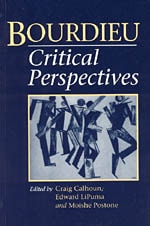
Bourdieu
Critical PerspectivesEdited by Craig Calhoun, Edward LiPuma, and Moishe Postone
University of Chicago Press, 1993
American reception of his works, however, has lacked a full understanding of their place within the broad context of French human science. His individual works separated by distinct boundaries between social science fields in American academia, Bourdieu's cohesive thought has come to this country in fragments.
Bourdieu: Critical Perspectives provides a unified and balanced appraisal of Bourdieu's varied works by both proponents and skeptics. The essays are written from the varied viewpoints of cultural anthropology, ethnomethodology and other varieties of sociology, existential and Wittgensteinian philosophies, linguistics, media studies, and feminism. They work around three main themes: Bourdieu's effort to transcend gaps between practical knowledge and universal structures, his central concept of "reflexivity," and the relations between social structure, systems of classification, and language.
Ultimately, the contributors raise a variety of crucial theoretical questions and address problems that are important not only to understanding Bourdieu but to advancing empirical work of the kind he has pioneered. In an essay written especially for this volume, Bourdieu describes his own "mode of intellectual production" and the reasons he sees for its common misunderstanding.
The contributors are Hubert Dreyfus, Paul Rabinow, Charles Taylor, Aaron Cicourel, James Collins, William Hanks, Beate Krais, Nicholas Garnham, Scott Lash, Roger Brubaker, and Loic Wacquant, and the editors.

Culture and Power
The Sociology of Pierre BourdieuDavid Swartz
University of Chicago Press, 1997
David Swartz focuses on a central theme in Bourdieu's work—the complex relationship between culture and power—and explains that sociology for Bourdieu is a mode of political intervention. Swartz clarifies Bourdieu's difficult concepts, noting where they have been misinterpreted by critics and where they have fallen short in resolving important analytical issues. The book also shows how Bourdieu has synthesized his theory of practices and symbolic power from Durkheim, Marx, and Weber, and how his work was influenced by Sartre, Levi-Strauss, and Althusser.
Culture and Power is the first book to offer both a sympathetic and critical examination of Bourdieu's work and it will be invaluable to social scientists as well as to a broader audience in the humanities.
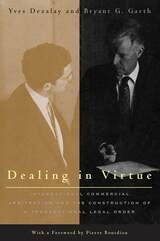
Dealing in Virtue
International Commercial Arbitration and the Construction of a Transnational Legal OrderYves Dezalay and Bryant G. Garth
University of Chicago Press, 1996
Building on Pierre Bourdieu's structural approach, the authors show how an informal, settlement-oriented system became formalized and litigious. Integral to this new legal field is the intense personal competition among arbitrators to gain a reputation for virtue, hoping to be selected for arbitration panels. Since arbitration fees have skyrocketed, this is a high-stakes game.
Using multiple examples, Yves Dezalay and Bryant G. Garth explore how international developments can transform domestic methods for handling disputes and analyze the changing prospects for international business dispute resolution given the growing presence of such international market and regulatory institutions as the EEC, the WTO, and NAFTA.

On Television and Journalism
Pierre Bourdieu
Pluto Press, 1998
Pierre Bourdieu's Political Economy of Being
Ghassan Hage
Duke University Press, 2025

Reinventing Practice in a Disenchanted World
Bourdieu and Urban Poverty in Oaxaca, MexicoBy Cheleen Ann-Catherine Mahar
University of Texas Press, 2010
Colonia Hermosa, now considered a suburb of Oaxaca, began as a squatter settlement in the 1950s. The original residents came in search of transformation from migrants to urban citizens, struggling from rural poverty for the chance to be part of the global economy in Oaxaca.
Cheleen Ann-Catherine Mahar charts the lives of a group of residents in Colonia Hermosa over a period of thirty years, as Mexico became more closely tied into the structures of global capital, and the residents of Colonia Hermosa struggled to survive. Residents shape their discussions within a larger narrative, and their talk is the language of the heroic individual, so necessary to the ideology and the functioning of capital. However, this logic only tenuously connects to the actual material circumstances of their lives.
Mahar applies the theories of French sociologist Pierre Bourdieu to her data from Mexico in order to examine the class trajectories of migrant families over more than three decades. Through this investigation, Mahar adds an important intergenerational study to the existing body of literature on Oaxaca, particularly concerning the factors that have reshaped the lives of urban working poor families and have created a working-class fraction of globalized citizenship.

Science of Science and Reflexivity
Pierre Bourdieu
University of Chicago Press, 2004
Science of Science and Reflexivity will be welcomed as a companion volume to Bourdieu's now seminal An Invitation to Reflexive Sociology. In this posthumous work, Bourdieu declares that science is in danger of becoming a handmaiden to biotechnology, medicine, genetic engineering, and military research—that it risks falling under the control of industrial corporations that seek to exploit it for monopolies and profit.
Science thus endangered can become detrimental to mankind. The line between pure and applied science, therefore, must be subjected to intense theoretical scrutiny. Bourdieu's goals in Science of Science and Reflexivity are to identify the social conditions in which science develops in order to reclaim its objectivity and to rescue it from relativism and the forces that might exploit it. In the grand tradition of scientific reflections on science, Bourdieu provides a sociological analysis of the discipline as something capable of producing transhistorical truths; he presents an incisive critique of the main currents in the study of science throughout the past half century; and he offers a spirited defense of science against encroaching political and economic forces.
A masterful summation of the principles underlying Bourdieu's oeuvre and a memoir of his own scientific journey, Science of Science and Reflexivity is a capstone to one of the most important and prodigious careers in the field of sociology.
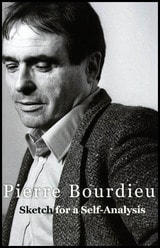
Sketch for a Self-Analysis
Pierre Bourdieu
University of Chicago Press, 2008
Sketch for a Self-Analysis is the ultimate outcome of Bourdieu’s lifelong preoccupation with reflexivity. Vehemently not an autobiography, this unique book is instead an application of Bourdieu’s theories to his own life and intellectual trajectory; along the way it offers compelling and intimate insights into the most important French intellectuals of the time—including Foucault, Sartre, Aron, Althusser, and de Beauvoir—as well as Bourdieu’s own formative experiences at boarding school and his moral outrage at the colonial war in Algeria.

Symbolic Power, Politics, and Intellectuals
The Political Sociology of Pierre BourdieuDavid L. Swartz
University of Chicago Press, 2013
Symbolic Violence
Conversations with BourdieuMichael Burawoy
Duke University Press, 2019

The Bachelors' Ball
The Crisis of Peasant Society in BéarnPierre Bourdieu
University of Chicago Press, 2008