Results by title
5 books match the query 'Brook, Timothy'
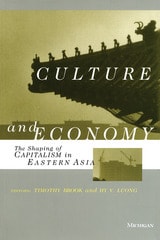
Culture and Economy
The Shaping of Capitalism in Eastern AsiaTimothy Brook and Hy Van Luong, Editors
University of Michigan Press, 1999
In recent years, most of the economies of Eastern Asia have been absorbed into global capitalism. Capitalism has transformed these economies, but the process has not been one-way. The cultures of Eastern Asia have in turn shaped how capitalism organizes labor, capital, and markets in ways that could not have been anticipated even ten years ago. On the basis of rich empirical analyses of East and Southeast Asia, and with theoretical insights from different approaches in the social sciences, Culture and Economy addresses these issues in both macroscopic and microscopic terms. Specific topics discussed range from the use and reinvention of Confucian and Islamic legacies in South Korea and Malaysia to promote a particular vision of the economy, to the role of family- and network-structured firms and the reliance on trust-based personal networks in Southeast Asia, to the cultures of labor and management in Chinese village enterprises and Vietnamese ceramics firms, as well as in South Korean export processing zones and the current Chinese labor market. These careful case studies suggest that it is inevitable that Eastern Asia will shape, even remake, capitalism into a system of production and consumption beyond its original definition. Timothy Brook is Professor of History, Stanford University. Hy V. Luong is Professor of Anthropology, University of Toronto.
[more]
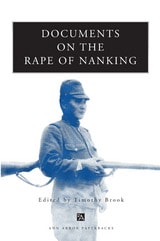
Documents on the Rape of Nanking
Timothy Brook, Editor
University of Michigan Press, 1999
The Japanese Army's invasion of China in 1937 was the first step toward a hemispheric war that would last until the atomic bombing of Hiroshima and Nagasaki in 1945. What ended in one atrocity began with another: the savage military takeover of China's capital city, which quickly became known as the Rape of Nanking. The Japanese Army's conduct from December 1937 to February 1938 constitutes one of the most barbarous events not just of the war but of the century. The violence was documented at the time and then redocumented during the war crimes trial in Tokyo after the war. This book brings together materials from both moments to provide the first comprehensive dossier of primary sources on the Rape.
Part 1, "The Records," includes two sources written as the Rape was underway. The first is a long set of documents produced by the International Committee for the Nanking Safety Zone, a group of foreigners who strove to protect the Chinese residents. The second is a series of letters that American surgeon Dr. Robert Wilson wrote for his family during the same period. These letters are published here for the first time.
The evidence compiled by the International Committee and its members would be decisive for the indictments against Japanese leaders at the International Military Tribunal for the Far East in Tokyo. Part 2, "The Judgments," reprints portions of the tribunal's 1948 judgment dealing with the Rape of Nanking, its judicial consequences, and sections of the dissenting judgment of Justice Radhabinod Pal.
These contemporary records and judgments create an intimate firsthand account of the Rape of Nanking. Together they are intended to stimulate deeper reflection than previously possible on how and why we assess and assign the burden of war guilt.
Timothy Brook is Professor of Chinese History and Associate Director of the Joint Centre for Asia Pacific Studies, University of Toronto, and is coeditor of Nation Work: Asian Elites and National Identities and Cultureand Economy: The Shaping of Capitalism in Eastern Asia, both published by the University of Michigan Press.
[more]
Geographical Sources of Ming-Qing History
Timothy Brook
University of Michigan Press, 2002
First published in 1988 in response to the growing need for documentation concerning local history in the late imperial period, Geographical Sources provides bibliographical data regarding two distinct genres: route books, and topographical and institutional gazetteers. In its second edition, this essential research tool has been completely revised and expanded with close to one hundred new entries, which provide complete coverage of these important sources for research in Chinese social, cultural, and religious history. The separate introductions to the two genres introduce the student to the history and uses of these materials. In addition to providing bibliographic data and noting variant editions, each entry provides locations where a work or its later editions can be found, whether in North America, Europe, China, or Japan.
[more]
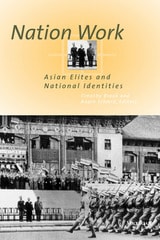
Nation Work
Asian Elites and National IdentitiesTimothy Brook and Andre Schmid, Editors
University of Michigan Press, 2000
As increasing attention is drawn to globalization, questions arise about the fate of "the nation," a political and social unit that for centuries has seemed the common-sense way to organize the world. In Nation Work, Timothy Brook and André Schmid draw together eight essays that use historical examples from Asian countries--China, India, Korea, and Japan--to enrich our understandings of the origin and growth of nations.
Asia provides fertile ground for this inquiry, the volume argues, because in Asia the history of the modern nation has been inseparable from global influences in the form of Western imperialism. Yet, while the impetus for building a modern national identity may have come from the need to fashion a favorable place in a world system dominated by Western nations, those engaged in nationalist enterprises found their particular voices more often in relation to tensions within Asia than in relation to more generic tensions between Asia and the West.
With topics ranging from public health measures in nineteenth-century Japan through textual scholarship of Tamil intellectuals, the willful division of Korea's history from China's, the development of China's cotton industry, and the meaning of "postnational-ism" for Chinese artists, the essays reveal the fascinating array of sites at which nation work can take place.
This will be essential reading for historians and social scientists interested in Asia.
Timothy Brook is Professor of History, Stanford University. André Schmid is Assistant Professor of East Asian Studies, University of Toronto.
[more]
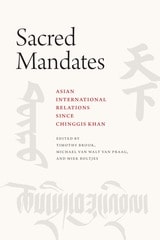
Sacred Mandates
Asian International Relations since Chinggis KhanEdited by Timothy Brook, Michael van Walt van Praag, Miek Boltjes
University of Chicago Press, 2018
Contemporary discussions of international relations in Asia tend to be tethered in the present, unmoored from the historical contexts that give them meaning. Sacred Mandates, edited by Timothy Brook, Michael van Walt van Praag, and Miek Boltjes, redresses this oversight by examining the complex history of inter-polity relations in Inner and East Asia from the thirteenth century to the twentieth, in order to help us understand and develop policies to address challenges in the region today.
This book argues that understanding the diversity of past legal orders helps explain the forms of contemporary conflict, as well as the conflicting historical narratives that animate tensions. Rather than proceed sequentially by way of dynasties, the editors identify three “worlds”—Chingssid Mongol, Tibetan Buddhist, and Confucian Sinic—that represent different forms of civilization authority and legal order. This novel framework enables us to escape the modern tendency to view the international system solely as the interaction of independent states, and instead detect the effects of the complicated history at play between and within regions. Contributors from a wide range of disciplines cover a host of topics: the development of international law, sovereignty, state formation, ruler legitimacy, and imperial expansion, as well as the role of spiritual authority on state behavior, the impact of modernization, and the challenges for peace processes. The culmination of five years of collaborative research, Sacred Mandates will be the definitive historical guide to international and intrastate relations in Asia, of interest to policymakers and scholars alike, for years to come.
This book argues that understanding the diversity of past legal orders helps explain the forms of contemporary conflict, as well as the conflicting historical narratives that animate tensions. Rather than proceed sequentially by way of dynasties, the editors identify three “worlds”—Chingssid Mongol, Tibetan Buddhist, and Confucian Sinic—that represent different forms of civilization authority and legal order. This novel framework enables us to escape the modern tendency to view the international system solely as the interaction of independent states, and instead detect the effects of the complicated history at play between and within regions. Contributors from a wide range of disciplines cover a host of topics: the development of international law, sovereignty, state formation, ruler legitimacy, and imperial expansion, as well as the role of spiritual authority on state behavior, the impact of modernization, and the challenges for peace processes. The culmination of five years of collaborative research, Sacred Mandates will be the definitive historical guide to international and intrastate relations in Asia, of interest to policymakers and scholars alike, for years to come.
[more]