Results by title
5 books match the query 'Buddha'
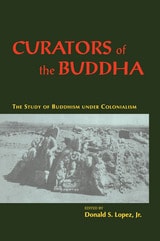
Curators of the Buddha
The Study of Buddhism under ColonialismEdited by Donald S. Lopez Jr.
University of Chicago Press, 1995
Curators of the Buddha is the first critical history of the study of Buddhism in the West and the first work to bring the insights of colonial and postcolonial cultural studies to bear on this field.
After an overview of the origins of Buddhist studies in the early nineteenth century, the essays focus on important "curators of the Buddha," such as Aurel Stein, D. T. Suzuki, and Carl Jung, who, as they created and maintained the discipline, played a significant role in disseminating knowledge about Buddhism in the West. The essays bring to life many of the important but unexamined social, political, and cultural conditions that have shaped the course of Buddhist studies for more than a century—and have frequently distorted the understanding of a complex set of traditions. Contributors Charles Hallisey, Gustavo Benavides, Stanley Abe, Luis Gómez, Robert Sharf, and Donald Lopez challenge some of the most enduring ideas in Buddhist studies: that Zen Buddhism is, above all, an experience; that Tibetan Buddhism is polluted, or pristine; that the Buddha image is of Greek or Roman origin; that the classical text supersedes the vernacular, as the manuscript supersedes the informant; and many others.
After an overview of the origins of Buddhist studies in the early nineteenth century, the essays focus on important "curators of the Buddha," such as Aurel Stein, D. T. Suzuki, and Carl Jung, who, as they created and maintained the discipline, played a significant role in disseminating knowledge about Buddhism in the West. The essays bring to life many of the important but unexamined social, political, and cultural conditions that have shaped the course of Buddhist studies for more than a century—and have frequently distorted the understanding of a complex set of traditions. Contributors Charles Hallisey, Gustavo Benavides, Stanley Abe, Luis Gómez, Robert Sharf, and Donald Lopez challenge some of the most enduring ideas in Buddhist studies: that Zen Buddhism is, above all, an experience; that Tibetan Buddhism is polluted, or pristine; that the Buddha image is of Greek or Roman origin; that the classical text supersedes the vernacular, as the manuscript supersedes the informant; and many others.
[more]
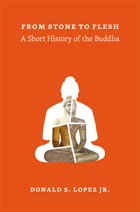
From Stone to Flesh
A Short History of the BuddhaDonald S. Lopez Jr.
University of Chicago Press, 2013
We have come to admire Buddhism for being profound but accessible, as much a lifestyle as a religion. The credit for creating Buddhism goes to the Buddha, a figure widely respected across the Western world for his philosophical insight, his teachings of nonviolence, and his practice of meditation. But who was this Buddha, and how did he become the Buddha we know and love today?
Leading historian of Buddhism Donald S. Lopez Jr. tells the story of how various idols carved in stone—variously named Beddou, Codam, Xaca, and Fo—became the man of flesh and blood that we know simply as the Buddha. He reveals that the positive view of the Buddha in Europe and America is rather recent, originating a little more than a hundred and fifty years ago. For centuries, the Buddha was condemned by Western writers as the most dangerous idol of the Orient. He was a demon, the murderer of his mother, a purveyor of idolatry.
Lopez provides an engaging history of depictions of the Buddha from classical accounts and medieval stories to the testimonies of European travelers, diplomats, soldiers, and missionaries. He shows that centuries of hostility toward the Buddha changed dramatically in the nineteenth century, when the teachings of the Buddha, having disappeared from India by the fourteenth century, were read by European scholars newly proficient in Asian languages. At the same time, the traditional view of the Buddha persisted in Asia, where he was revered as much for his supernatural powers as for his philosophical insights. From Stone to Flesh follows the twists and turns of these Eastern and Western notions of the Buddha, leading finally to his triumph as the founder of a world religion.
[more]
If You See the Buddha
Studies in the Fiction of Ivan BuninThomas Gaiton Marullo
Northwestern University Press, 1999
In a 1994 American Scholar article, Andrew Wachtel wrote of Ivan Bunin: "[He] is undoubtedly the greatest Russian writer whom no one reads." With the collapse of communism, however, Bunin's works are undergoing a revival in both Russia and the West. As enthusiastic as readers and publishers have been, scholarship has not kept pace with this "rediscovery," in part due to the many contradictions in Bunin's writing, in part because much past criticism has been used to advanced the critic's own view of what they love or hate about "modern" life.
In If You See the Buddha, Thomas Gaiton Marullo begins addressing the lack of scholarship by establishing that Bunin was a thoroughly modern writer whose images and ideas were rooted more in the twentieth century than in the nineteenth. But beyond that point, Marullo states that, of all the systems of belief that Bunin adopted and adapted throughout his career, it was his interest in Buddhism that best elucidates the dynamics of his writing. Key Buddhistic concepts figured prominently in Bunin's work. These ideas enabled him to make sense of his world and serves as the catalyst for an ars poetica that tempered his philosophical and aesthetic restiveness and contributed a sense of timelessness to work from both his prerevolutionary and émigré periods.
In If You See the Buddha, Thomas Gaiton Marullo begins addressing the lack of scholarship by establishing that Bunin was a thoroughly modern writer whose images and ideas were rooted more in the twentieth century than in the nineteenth. But beyond that point, Marullo states that, of all the systems of belief that Bunin adopted and adapted throughout his career, it was his interest in Buddhism that best elucidates the dynamics of his writing. Key Buddhistic concepts figured prominently in Bunin's work. These ideas enabled him to make sense of his world and serves as the catalyst for an ars poetica that tempered his philosophical and aesthetic restiveness and contributed a sense of timelessness to work from both his prerevolutionary and émigré periods.
[more]
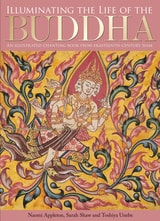
Illuminating the Life of the Buddha
An Illustrated Chanting Book from Eighteenth-Century SiamNaomi Appleton, Sarah Shaw, and Toshiya Unebe
Bodleian Library Publishing, 2013
Illuminating the Life of the Buddha investigates an outstanding eighteenth-century samut khoi, a type of beautifully illustrated, folded book found in Southeast Asia and popular as a repository for the Buddha’s teachings. Written in Pali and produced in Siam, the samut khoi features finely executed paintings on khoi paper portraying key stories from the Buddha’s past lives. These stories, known as the Jatakas, were the principal means by which Buddhist teachings were communicated and were thus a favored theme for samut khoi. However, this samut khoi stands out for its extensive series of paintings from the last life of the Buddha, including his final awakening and teaching, which are distinctive to the region.
Affording readers immense insight into a spectacular eighteenth-century manuscript, and Thai Buddhist manuscripts and temple culture as a whole, this book will be of great interest to art historians and scholars of Buddhism and Southeast Asia.
Affording readers immense insight into a spectacular eighteenth-century manuscript, and Thai Buddhist manuscripts and temple culture as a whole, this book will be of great interest to art historians and scholars of Buddhism and Southeast Asia.
[more]
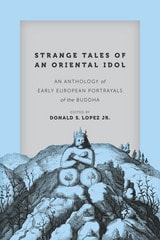
Strange Tales of an Oriental Idol
An Anthology of Early European Portrayals of the BuddhaEdited by Donald S. Lopez Jr.
University of Chicago Press, 2016
We tend to think that the Buddha has always been seen as the compassionate sage admired around the world today, but until the nineteenth century, Europeans often regarded him as a nefarious figure, an idol worshipped by the pagans of the Orient. Donald S. Lopez Jr. offers here a rich sourcebook of European fantasies about the Buddha drawn from the works of dozens of authors over fifteen hundred years, including Clement of Alexandria, Marco Polo, St. Francis Xavier, Voltaire, and Sir William Jones.
Featuring writings by soldiers, adventurers, merchants, missionaries, theologians, and colonial officers, this volume contains a wide range of portraits of the Buddha. The descriptions are rarely flattering, as all manner of reports—some accurate, some inaccurate, and some garbled—came to circulate among European savants and eccentrics, many of whom were famous in their day but are long forgotten in ours. Taken together, these accounts present a fascinating picture, not only of the Buddha as he was understood and misunderstood for centuries, but also of his portrayers.
Featuring writings by soldiers, adventurers, merchants, missionaries, theologians, and colonial officers, this volume contains a wide range of portraits of the Buddha. The descriptions are rarely flattering, as all manner of reports—some accurate, some inaccurate, and some garbled—came to circulate among European savants and eccentrics, many of whom were famous in their day but are long forgotten in ours. Taken together, these accounts present a fascinating picture, not only of the Buddha as he was understood and misunderstood for centuries, but also of his portrayers.
[more]