Results by title
198 books match the query 'Campaigns' and 20 start with a
A Confederate Chronicle
The Life of a Civil War SurvivorPamela Chase Hain
University of Missouri Press, 2005
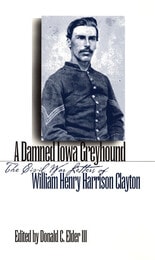
A Damned Iowa Greyhound
The Civil War Letters of William Henry Harrison ClaytonDonald C. Elder, III
University of Iowa Press, 1998
William Henry Harrison Clayton was one of nearly 75,000 soldiers from Iowa to join the Union ranks during the Civil War. Possessing a high school education and superior penmanship, Clayton served as a company clerk in the 19th Infantry, witnessing battles in the Trans-Mississippi theater. His diary and his correspondence with his family in Van Buren County form a unique narrative of the day-to-day soldier life as well as an eyewitness account of critical battles and a prisoner-of-war camp.
Clayton participated in the siege of Vicksburg and took part in operations against Mobile, but his writings are unique for the descriptions he gives of lesser-known but pivotal battles of the Civil War in the West. Fighting in the Battle of Prairie Grove, the 19th Infantry sustained the highest casualties of any federal regiment on the field. Clayton survived that battle with only minor injuries, but he was later captured at the Battle of Stirling's Plantation and served a period of ten months in captivity at Camp Ford, Texas.
Clayton's writing reveals the complicated sympathies and prejudices prevalent among Union soldiers and civilians of that period in the country's history. He observes with great sadness the brutal effects of war on the South, sympathizing with the plight of refugees and lamenting the destruction of property. He excoriates draft evaders and Copperheads back home, conveying the intra-sectional acrimony wrought by civil war. Finally, his racist views toward blacks demonstrate a common but ironic attitude among Union soldiers whose efforts helped lead to the abolition of slavery in the United States.

A Machine-Gunner in France
The Memoirs of Ward Schrantz, 35th Division, 1917-1919Ward Schrantz
University of North Texas Press, 2019
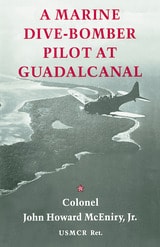
A Marine Dive-bomber Pilot at Guadalcanal
John Howard McEniry
University of Alabama Press, 1987
This book chronicles the World War II experiences of the author, who served as a Marine Corps pilot in the South Pacific. Colonel McEniry describes the organization and deployment of a Marine dive-bombing squadron (VMSB-132) in the early days of the war and follows the squadron through its actions in November and December of 1942.
The participation by the squadron in the naval battle of Guadalcanal, November 12-15, 1942, is related in detail and includes the personal experiences of the author on several bombing missions. This battle, described by Admiral Ernest J. King, the Chief of Naval Operations, as “the fiercest naval battle ever fought,” resulted in the loss by the Japanese of two battleships, ten transport ships, and numerous cruisers and destroyers.

A Morning in June
Defending Outpost HarryJames W. Evans, with a foreword by John S. D. Eisenhower
University of Alabama Press, 2010
Exploring the strategic and human dimensions of the defense of Outpost Harry.
By June 1953 the Korean War, marked at the outset by extremely fluid advances and retreats up and down the peninsula, had settled into position warfare very near the original pre-war demarcation line between North and South Korea. At this point both sides were fighting to win a peace, to achieve incremental advantages that could be translated into gains at the peace negotiations in Panmunjom. The battle at Outpost Harry devolved into hand-to-hand combat during a period of constant, intense fighting that lasted two days. The author, although seriously wounded that night, refused evacuation and remained on the hill to successfully lead his company in defense of the outpost. It wasn’t romantic; it wasn’t chivalrous; and many died or were badly wounded. Some of the survivors never fully overcame the mental and physical damage they suffered during the nightmare.
With this book, one of those scarred by that experience recounts the events of the battle and his lifelong efforts to deal with the residual horrors. The Korean Conflict may be called "the forgotten war" by some, but not by those who were on the front lines.

A People Numerous and Armed
Reflections on the Military Struggle for American IndependenceJohn Shy
University of Michigan Press, 1990
A Prussian Observes the American Civil War
The Military Studies of Justus ScheibertEdited & Translated by Frederic Trautmann
University of Missouri Press, 2001
Prussia, like much of nineteenth-century Germany, was governed by the belief that knowledge, and thus understanding, was best derived from direct observation and communicated through documentation. Justus Scheibert, an officer in the Royal Prussian Engineers, was therefore sent to the United States for seven months to observe the Civil War and report the effects of artillery on fortifications. His interests, however, surpassed that limited assignment, and his observations, as well as the writings translated in this work, went on to include tactics, strategy, logistics, intelligence, combined operations, and the medical service.
Scheibert, an expert on warfare, had access to the Confederate high command, including such luminaries as Robert E. Lee, J. E. B. Stuart, and Stonewall Jackson. He brought to the war not only the fresh perspective of a foreigner, but also the insightful eye of a career military officer and a skillful author and correspondent. Although he was personally sympathetic to the South, Scheibert researched both sides of the conflict in order to write unbiased, informed commentary for his fellow Prussian officers. His firsthand account of many aspects of the Civil War included a theoretical discussion of every branch of service and the Confederate high command, illustrated with his personal observations.
Sheibert's narrative portrays soldiers, weaponry, and battles, including the first, and one of the few, studies of combined operations in the Civil War. Trautmann combines two of Scheibert's publications, The Civil War in the North American States: A Military Study for the German Officer (1874) and Combined Operations by Army and Navy: A Study Illustrated by the War on the Mississippi, 1861-1863 (ca. 1887), which for decades influenced German military writing. Trautmann's translations evince the grace and achieve the readability of Scheibert's intricate and complex works.
A Prussian Observes the American Civil War makes an important addition to Civil War studies and will appeal greatly to professional historians and those interested in, and dedicated to, Civil War and military studies.
A Small but Spartan Band
The Florida Brigade in Lee's Army of Northern VirginiaZack C. Waters
University of Alabama Press, 2013
A Soldier in World War I
The Diary of Elmer W. SherwoodRobert H. Ferrell
Indiana Historical Society Press, 2004
A Thrilling Narrative
The Memoir of a Southern UnionistDennis E. Haynes
University of Arkansas Press, 2006
A Young General and the Fall of Richmond
The Life and Career of Godfrey WeitzelG. William Quatman
Ohio University Press, 2015
A History Book Club Reading Selection
Despite his military achievements and his association with many of the great names of American history, Godfrey Weitzel (1835–1884) is perhaps the least known of all the Union generals. After graduating from West Point, Weitzel, a German immigrant from Cincinnati, was assigned to the Army Corps of Engineers in New Orleans. The secession of Louisiana in 1861, with its key port city of New Orleans, was the first of a long and unlikely series of events that propelled the young Weitzel to the center of many of the Civil War’s key battles and brought him into the orbit of such well-known personages as Lee, Beauregard, Butler, Farragut, Porter, Grant, and Lincoln. Weitzel quickly rose through the ranks and was promoted to brigadier general and, eventually to commander of Twenty-Fifth Corps, the Union Army’s only all-black unit. After fighting in numerous campaigns in Louisiana and Virginia, on April 3, 1865, Weitzel marched his troops into Richmond, the capital of the Confederacy, capturing the city for the Union and precipitating the eventual collapse of the Southern states’ rebellion.
G. William Quatman’s minute-by-minute narrative of the fall of Richmond lends new insight into the war’s end, and his keen research into archival sources adds depth and nuance to the events and the personalities that shaped the course of the Civil War.
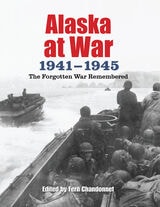
Alaska at War, 1941-1945
The Forgotten War RememberedEdited by Fern Chandonnet
University of Alaska Press, 2007
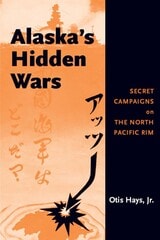
Alaska's Hidden Wars
Secret Campaigns on the North Pacific RimOtis Hays Jr.
University of Alaska Press, 2004
Alaska's Hidden Wars tells the story of the war in the North Pacific, a story of savage weather, isolation, and sacrifice.
Two island chains, the Aleutians and the Kuriles, became the focus of a series of major campaigns that pitted the Americans against the Japanese. Alaska's Hidden Wars chronicles the role of Japanese-American intelligence specialists and reveals a Japanese eyewitness account of the defense of Attu. Two virtually unknown aspects of the North Pacific war are also exposed: the brutal North Pacific weather and the imprisonment of American airmen in Kamchatka.
In 1942, the Japanese raided Dutch Harbor in the Aleutian Islands and occupied the islands of Kiska and Attu. The Americans mounted a vigorous campaign, and the Japanese retreated to the Kuriles. For the next two years, the Americans launched air raids and fleet bombardments, while American soldiers maintained lonely outposts along Aleutian coasts. But in 1945, when Japan finally surrendered, the Kuriles were taken, not by the waiting Americans, but by the Soviets.
Alaska's Hidden Wars is a fast-moving history that brings declassified archival sources to light and draws the reader into the lonely, bitter war fought in the North Pacific.

Alexander William Doniphan
Portrait of a Missouri ModerateRoger D. Launius
University of Missouri Press, 1997
Alexander William Doniphan (1808-1887)--Missouri attorney, military figure, politician, and businessman--is one of the most significant figures in antebellum Missouri. From the 1830s to the 1880s, Doniphan was active in a variety of affairs in Missouri and held firm to several underlying principles, including loyalty, hard work, the sanctity of the republic, and commitment to Christian charity. However, the key to Doniphan's importance was his persistent moderation on the critical issues of his day.
Doniphan became a household name when he served as the commanding officer of the famed First Missouri Mounted Volunteers during the Mexican-American War. It was during this time that he won two battles, established an Anglo-American-based democracy in New Mexico, and paved the way for the annexation of the territory that became New Mexico and Arizona. He is also recognized by the Mormons for his assistance to their beleaguered church during Missouri's "Mormon War" and for his refusal to execute Joseph Smith when ordered to do so by his commanding officer.
Although Doniphan was a slaveholding unionist, he sought a middle ground to stave off war in the 1850s and early 1860s and served as a delegate to the Washington Peace Conference in 1861. When conflict escalated along the western border of Missouri in 1862, Doniphan moved to St. Louis, where he worked as a lawyer with the Missouri Claims Commission, seeking pensions for refugees.
Doniphan early adopted the Whig ideal of the "positive liberal state" and sought to use the power of government to remake society into something better. Once he saw the heavy-handed use of state power during Reconstruction, however, Doniphan reversed his views on the role of the government in society. For the rest of his life, he resisted government incursions into the lives of the people and sought to restore a healthy Union.
Alexander William Doniphan will be of interest to academic specialists and general readers alike, especially those interested in Mormon studies, Missouri history, military history, and Western history.
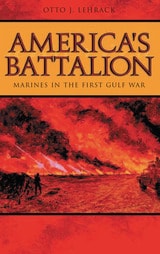
America's Battalion
Marines in the First Gulf WarOtto J. Lehrack
University of Alabama Press, 2008
Building from interviews with the members of the battalion, Otto Lehrack examines the nature of warfare in the Persian Gulf. The terrain of the Arabian Peninsula and the disposition of the enemy dictated conventional warfare requiring battalion and regimental assaults coordinated at the division level, so interviewees are primarily the officers and senior non-commissioned officers concerned.
The 3rd of the 3rd, also known as “America’s Battalion,” had just returned from deployment in the summer of 1990 when they were required to immediately re-deploy to a strange land to face a battle-hardened enemy after Iraq invaded Kuwait. Theirs was only the second Marine battalion to arrive in Saudi Arabia. They participated in the first allied ground operation of the war, played a key role in the battle for the city of Khafji, and were the first to infiltrate the Iraqi wire and minefield barrier in order to provide flank security for the beginning of the allied offensive.
Facing an enemy that had used some of the most fearsome weapons of mass destruction—chemical and biological agents—against its former opponents and against its own people, the Marines had been prepared for the worst. Lehrack has documented this unit’s remarkable performance through the accounts of those who participated in the historic events in the Persian Gulf and returned home to tell of them.
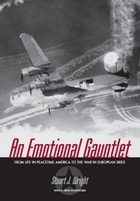
An Emotional Gauntlet
From Life in Peacetime America to the War in European SkiesStuart J. Wright
University of Wisconsin Press, 2008
In recounting the harrowing conditions and horrors of bombing missions over Europe, An Emotional Gauntlet emphasizes the interpersonal relationships within the crew and the spirit these men shared. Corky's crew served under Operations Officer Major James Stewart (the Hollywood movie star.) They often returned from arduous bombing missions to sleep in half-empty huts—their friends in other planes had not been so lucky. Pilot Jack Nortridge regularly assured his crew, "If you fly with me, I'm going to bring you home." This book is a testament to their strength and determination.
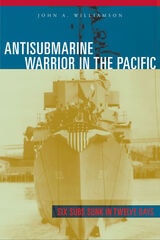
Antisubmarine Warrior in the Pacific
Six Subs Sunk in Twelve DaysJohn A. Williamson
University of Alabama Press, 2005
A commanding firsthand account of the most successful antisubmarine campaign in U.S. Naval History.
The USS England was a 1200-ton, 306-foot, long-hull destroyer escort. Commissioned into service in late 1943 and dispatched to the Pacific the following February, the England and its crew, in one 12-day period in 1944, sank more submarines than any other ship in U.S. naval history: of the six targets attacked, all six were destroyed. For this distinction, legendary in the annals of antisubmarine warfare, the ship and her crew were honored with the Presidential Unit Citation.
After convoying in the Atlantic, John A. Williamson was assigned to the England—first as its executive officer, then as its commanding officer—from the time of her commissioning until she was dry-docked for battle damage repairs in the Philadelphia Naval Yard fifteen months later. Besides being a key participant in the remarkable antisubmarine actions, Williamson commanded the England in the battle of Okinawa, where she was attacked by kamikaze planes.
Williamson narrates his memoir with authority and authenticity, describes naval tactics and weaponry precisely, and provides information gleaned from translations of the orders from the Japanese high command to Submarine Squadron 7. The author details the challenges of communal life aboard ship and explains the intense loyalty that bonds crew members for life. Ultimately, Williamson offers a compelling portrait of himself, an inexperienced naval officer who, having come of age in Alabama during the Depression, rose to become the most successful World War II antisubmarine warfare officer in the Pacific.
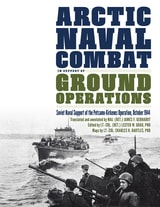
Arctic Naval Combat in Support of Ground Operations
Soviet Naval Support of the Petsamo-Kirkenes Operation, October 1944James F Gebhardt
University of Alaska Press, 2025
The largest Arctic battle on record, involving 133,500 Soviets and 45,000 Germans and Quisling Norwegians, the Petsamo-Kirkenes Operation sought to liberate the northernmost part of Norway from German occupation during World War II. The Soviet navy played a previously unrecognized crucial role in the operation by providing fire support and transportation, as well as conducting raids and combat landings on the enemy-held coast. The harsh Arctic environment, including extreme cold, ice, and limited daylight, posed significant challenges to the Soviet and German forces. Despite these hardships, the Soviet forces achieved their objectives, defeated the German Army, and successfully liberated the area.
Arctic Naval Combat in Support of Ground Operations is a powerful companion to Gebhardt’s previous translation, The Petsamo-Kirkenes Operation: Soviet Breakthrough and Pursuit in the Arctic, October 1944, which details this operation’s ground offensive. Providing a starting point for the study and understanding of combined arms and services combat in the Arctic, an increasingly important and accessible part of the planet where military concerns are rapidly expanding, this work is a valuable addition to the literature of World War II military history and a significant additional perspective on the Soviet military.
Army Of Israel
David Bigler
Utah State University Press, 2000
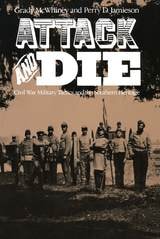
Attack and Die
Civil War Military Tactics and the Southern HeritageGrady McWhiney
University of Alabama Press, 1984
Why did the Confederacy lose so many men? The authors contend that the Confederates bled themselves nearly to death in the first three years of the war by making costly attacks more often than the Federals. Offensive tactics, which had been used successfully by Americans in the Mexican War, were much less effective in the 1860s because an improved weapon—the rifle—had given increased strength to defenders. This book describes tactical theory in the 1850s and suggests how each related to Civil War tactics. It also considers the development of tactics in all three arms of the service during the Civil War.
In examining the Civil War the book separates Southern from Northern tactical practice and discusses Confederate military history in the context of Southern social history. Although the Southerners could have offset their numerical disadvantage by remaining on the defensive and forcing the Federals to attack, they failed to do so. The authors argue that the Southerners’ consistent favoring of offensive warfare was attributable, in large measure, to their Celtic heritage: they fought with the same courageous dash and reckless abandon that had characterized their Celtic forebears since ancient times. The Southerners of the Civil War generation were prisoners of their social and cultural history: they attacked courageously and were killed—on battlefields so totally defended by the Federals that “not even a chicken could get through.”