Results by title
37 books match the query 'Canon (Literature)'
Abandoned Women and Poetic Tradition
Lawrence Lipking
University of Chicago Press, 1988
Aberrations In Black
Toward a Queer of Color CritiqueRoderick A. Ferguson
University of Minnesota Press, 2003
A hard-hitting look at the regulation of sexual difference and its role in circumscribing African American culture
The sociology of race relations in America typically describes an intersection of poverty, race, and economic discrimination. But what is missing from the picture—sexual difference—can be as instructive as what is present. In this ambitious work, Roderick A. Ferguson reveals how the discourses of sexuality are used to articulate theories of racial difference in the field of sociology. He shows how canonical sociology—Gunnar Myrdal, Ernest Burgess, Robert Park, Daniel Patrick Moynihan, and William Julius Wilson—has measured African Americans’s unsuitability for a liberal capitalist order in terms of their adherence to the norms of a heterosexual and patriarchal nuclear family model. In short, to the extent that African Americans’s culture and behavior deviated from those norms, they would not achieve economic and racial equality.
Aberrations in Black tells the story of canonical sociology’s regulation of sexual difference as part of its general regulation of African American culture. Ferguson places this story within other stories—the narrative of capital’s emergence and development, the histories of Marxism and revolutionary nationalism, and the novels that depict the gendered and sexual idiosyncrasies of African American culture—works by Richard Wright, Ralph Ellison, James Baldwin, Audre Lorde, and Toni Morrison. In turn, this book tries to present another story—one in which people who presumably manifest the dysfunctions of capitalism are reconsidered as indictments of the norms of state, capital, and social science. Ferguson includes the first-ever discussion of a new archival discovery—a never-published chapter of Invisible Man that deals with a gay character in a way that complicates and illuminates Ellison’s project.
Unique in the way it situates critiques of race, gender, and sexuality within analyses of cultural, economic, and epistemological formations, Ferguson’s work introduces a new mode of discourse—which Ferguson calls queer of color analysis—that helps to lay bare the mutual distortions of racial, economic, and sexual portrayals within sociology.
American Culture, Canons, and the Case of Elizabeth Stoddard
Robert McClure Smith
University of Alabama Press, 2003
Elizabeth Stoddard was a gifted writer of fiction, poetry, and journalism; successfully published within her own lifetime; esteemed by such writers as William Dean Howells and Nathaniel Hawthorne; and situated at the epicenter of New York’s literary world. Nonetheless, she has been almost excluded from literary memory and importance. This book seeks to understand why. By reconsidering Stoddard’s life and work and her current marginal status in the evolving canon of American literary studies, it raises important questions about women’s writing in the 19th century and canon formation in the 20th century.
Essays in this study locate Stoddard in the context of her contemporaries, such as Dickinson and Hawthorne, while others situate her work in the context of major 19th-century cultural forces and issues, among them the Civil War and Reconstruction, race and ethnicity, anorexia and female invalidism, nationalism and localism, and incest. One essay examines the development of Stoddard’s work in the light of her biography, and others probe her stylistic and philosophic originality, the journalistic roots of her voice, and the elliptical themes of her short fiction. Stoddard’s lifelong project to articulate the nature and dynamics of woman’s subjectivity, her challenging treatment of female appetite and will, and her depiction of the complex and often ambivalent relationships that white middle-class women had to their domestic spaces are also thoughtfully considered.
The editors argue that the neglect of Elizabeth Stoddard’s contribution to American literature is a compelling example of the contingency of critical values and the instability of literary history. This study asks the question, “Will Stoddard endure?” Will she continue to drift into oblivion or will a new generation of readers and critics secure her tenuous legacy?

Being a Minor Writer
Gail Gilliland
University of Iowa Press, 1994
There are countless theoretical arguments that attempt to define “major” and “minor” literatures, but this lively and deeply felt work is one of the first to speak from the authority of the experience of being minor—of being the “minor writer” who, according to the definition of “author” given by Michel Foucault, does not possess a “name.” This book, then, is an impassioned critical and ethical defense of the act of writing for purposes other than critical acclaim.
In the tradition of Horace's
Ars Poetica,Gilliland uses comments by a broad range of writers, as well as her own experience as a minor woman writer, to consider the basic Horatian questions of purpose, choice of subject matter and genre, diction, characterization, setting, and style. She points out that in the absence of major recognition, the minor writer is continually confronted by the existential question, why do I (still) write? This book offers not only a challenge to existing critical theories but an argument in favor of being—for
stillbeing, for continuing
anywaywith one's life and art
Belated Modernity and Aesthetic Culture
Inventing National LiteratureGregory Jusdanis
University of Minnesota Press, 1991
How does literature function in the formation of a nation-state? What are its pivotal contributions to national discourse and the production of ideological collective will? And, ultimately, how is literature institutionalized and aestheticized?
Belated Modernity and Aesthetic Culture: Inventing National Literature addresses these questions and considers the role literature plays in the construction of a national cultural. Gregory Jusdanis examines the emergence of art and literature in Western Europe in the eighteenth century and traces their introduction to Greece, a stratified, noncapitalist society that was hostile to Enlightenment and secularism. This groundbreaking work explores the importation of national literatures into a largely non-Western society and the inherent resistance they faced.Arguing for the literary status of national culture at its inception, Jusdanis brilliantly demonstrates that in literature, the specific meanings in narratives and fiction form the process of nation building. Culture, history, and literature, he says, merge in those narratives, which in turn provide the imaginary mirror in which a nation reflects itself.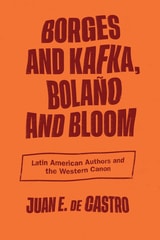
Borges and Kafka, Bolaño and Bloom
Latin American Authors and the Western CanonJuan E. De Castro
Vanderbilt University Press, 2022
Borges and Kafka, Bolaño and Bloom is a parsing not simply of these authors' reactions to a canon, but of the notion of canon writ large and the inequities and erasures therein. It concludes with a look at the testimonial and autobiographical writings of Rigoberta Menchú and Lurgio Gavilán, who arguably represent the trajectory of Indigenous testimonial and autobiographical writing during the last forty years, noting how their texts represent alternative ways of relating to national and, on occasion, Western cultures. This study is a new attempt to map writers' diverse ways of thinking about locality and universality from within and without what is known as the canon.
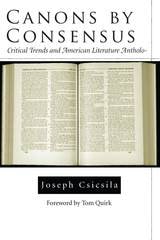
Canons by Consensus
Critical Trends and American Literature AnthologiesJoseph Csicsila, with a foreword by Tom Quirk
University of Alabama Press, 2004
The first systematic analysis of American literature textbooks used by college instructors in the last century
Scholars have long noted the role that college literary anthologies play in the rising and falling reputations of American authors. Canons by Consensus examines this classroom fixture in detail to challenge and correct a number of assumptions about the development of the literary canon throughout the 20th century.
Joseph Csicsila analyzes more than 80 anthologies published since 1919 and traces not only the critical fortunes of individual authors, but also the treatment of entire genres and groupings of authors by race, region, gender, and formal approach. In doing so, he calls into question accusations of deliberate or inadvertent sexism and racism. Selections by anthology editors, Csicsila demonstrates, have always been governed far more by prevailing trends in academic criticism than by personal bias.
Academic anthologies are found to constitute a rich and often overlooked resource for studying American literature, as well as an irrefutable record of the academy’s changing literary tastes throughout the last century.

Citizen Critics
Literary Public SpheresRosa A. Eberly
University of Illinois Press, 2000
The condition of our public discussions about literary and cultural works has much to say about the state of our democracy. Classrooms, newspapers, magazines, Internet forums, and many other places grant citizens a place to hold public discourses—and claim a voice on national artistic matters.
Rosa A. Eberly looks at four censorship controversies where professionals asserted their authority to deny citizen critics a voice—and effectively removed discussion of literature from the public sphere. Eberly compares the outrage sparked by the publication of James Joyce's Ulysses and Henry Miller's Tropic of Cancer with the relative quiescence that greeted the much more violent and sexually explicit content of Bret Easton Ellis's American Psycho and Andrea Dworkin's Mercy. Through a close reading of letters to the editor, reviews, media coverage, and court cases, Eberly shows how literary critics and legal experts defused censorship debates—and undercut the authority of citizen critics—by shifting the focus from content to aesthetics and from social values to publicity.

Classics in Film and Fiction
Edited by Deborah Cartmell, Heidi Kaye, I. Q. Hunter, and Imelda Whelehan
Pluto Press, 2000
Classics in Film and Fiction looks at a wide range of texts and their adaptations. Authors discussed are Shakespeare, Charlotte Bronte, Henry James, Franz Kafka, Thomas Mann, Virginia Woolf, Nathaniel Hawthorne, Arthur Miller, Truman Capote and Lewis Carroll. Book to film adaptations analysed include Jane Eyre, The Crucible, The Tempest and Alice in Wonderland. The collection also evaluates the term 'classic' in a wider context, including a comparison of Joyce's Ulysses with Hitchcock's Rear Window. Throughout, the contributors challenge the dichotomy between high culture and pop culture.
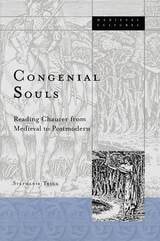
Congenial Souls
Reading Chaucer from Medieval to PostmodernStephanie Trigg
University of Minnesota Press, 2001
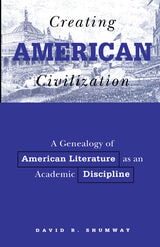
Creating American Civilization
A Genealogy of American Literature as an Academic DisciplineDavid Shumway
University of Minnesota Press, 1994
“Shumway has written a penetrating and provocative account of the making of American civilization as an academic field.”
Gerald GraffUniversity of ChicagoDavid R. Shumway contends that American literature is the product of study - the deliberate invention of a discipline seeking to define the character and legitimate the existence of a specifically American civilization. He traces the various reconstitutions of American literature by examining the discipline’s practices and techniques, discourses and structures, paradigms and unstated assumptions.This genealogy begins around 1890, when American literature as defined by institutions outside the academy, such as magazines and publishing houses, acquired much of the ideology it would display in later phases, including sexism, racism, and class bias. Singular in its treatment of American literary study as a discipline rather than as criticism and in its insistence on the cultural and political work carried on by this discipline, Creating American Civilization will engage literary theorists and historians as well as individuals with an interest in American literature.
Cuir Dissidence
Tracing Restorative Criticism and Breaking Bonds with the Mexican CanonFrancesca Dennstedt
Vanderbilt University Press, 2025
Cultural Capital
The Problem of Literary Canon FormationJohn Guillory
University of Chicago Press, 1993
Cultural Capital
The Problem of Literary Canon FormationJohn Guillory
University of Chicago Press, 2023
Since its publication in 1993, John Guillory’s Cultural Capital has been a signal text for understanding the codification and uses of the literary canon. Cultural Capital reconsiders the social basis for aesthetic judgment and exposes the unequal distribution of symbolic and linguistic knowledge on which culture has long been based. Drawing from Pierre Bourdieu’s sociology, Guillory argues that canon formation must be understood less as a question of the representation of social groups and more as a question of the distribution of cultural capital in schools, which regulate access to literacy, to the practices of reading and writing.
Now, as the crisis of the canon has evolved into the so-called crisis of the humanities, Guillory’s groundbreaking, incisive work has never been more urgent. As scholar and critic Merve Emre writes in her introduction to this enlarged edition: “Exclusion, selection, reflection, representation—these are the terms on which the canon wars of the last century were fought, and the terms that continue to inform debates about, for instance, decolonizing the curriculum and the rhetoric of antiracist pedagogy.”
Discourse and the Other
The Production of the Afro-American TextW. Lawrence Hogue
Duke University Press, 1986
Hogue presents an illuminating discussion of the publication and review history of "major" and neglected texts. He illustrates the acceptance of texts as exotica, as sociological documents, or as carriers of sufficient literary conventions to receive approbation. Although the sixties movement allowed the text to move to the periphery of the dominant ideology, providing some new myths about the Afro-American historical past, this marginal position was subsequently sabotaged, co-opted, or appropriated (Afros became a fad; presidents gave the soul handshake; the hip-talking black was dressing one style and talking another.)
This study includes extended discussion of four works; Ernest J. Gaines's The Autobiography of Miss Jane Pittman, Alice Walker's The Third Life of Grange Copeland, Albert Murray's Train Whistle Guitar, and Toni Morrison's Sula. Hogue assesses the informing worldviews of each and the extent and nature of their acceptance by the dominant American cultural apparatus.
Disforming The American Canon
African-Arabic Slave Narratives and the VernacularRonald A.T. Judy
University of Minnesota Press, 1993
Feminist Fabulation
Space/Postmodern FictionMarleen S. Barr
University of Iowa Press, 1992
From Outlaw to Classic
Canons in American PoetryAlan Golding
University of Wisconsin Press, 1995
From Outlaw to Classic presents a sweeping history of the forces that have shaped, and continue to shape, the American poetry canon. Students, scholars, critics, and poets will welcome this enlightening and impressively documented book.
Recent writings by critics and theorists on literary canons have dealt almost exclusively with prose; Alan Golding shows that, like all canons, those of American poetry are characterized by conflict. Choosing a series of varied but representative instances, he analyzes battles and contentions among poets, anthologists, poetry magazine editors, and schools of thought in university English departments. The chapters:
• present a history of American poetry anthologies
• compare competing models of canon-formation, the aesthetic (poet-centered) and the institutional (critic-centered)
• discuss the influence of the New Critics, emphasizing their status as practicing poets, their anti-nationalist reading of American poetry, and the landmark textbook, Understanding Poetry by Cleanth Brooks and Robert Penn Warren
• examine the canonizing effects of an experimental “little magazine,” Origin
• trace how the Language poets address, in both their theory and their method, the canonizing institutions and canonical assumptions of the age.

Genealogy and Literature
Lee Quinby, Editor
University of Minnesota Press, 1995
Genealogy and Literature was first published in 1995. Minnesota Archive Editions uses digital technology to make long-unavailable books once again accessible, and are published unaltered from the original University of Minnesota Press editions.
Traditionalists insist that literature transcends culture. Others counter that it is subversive by nature. By challenging both claims, Genealogy and Literature reveals the importance of literature for understanding dominant and often violent power/knowledge relations within a given society.
The authors explore the ways in which literature functions as a cultural practice, the links between death and literature as a field of discourse, and the possibilities of dismantling modes of bodily regulation. Through wide-ranging investigations of writing from England, France, Nigeria, Peru, Japan, and the United States, they reinvigorate the study of literature as a means of understanding the complexities of everyday experience.
Contributors: Claudette Kemper Columbus, Lennard J. Davis, Simon During, Michel Foucault, Ellen J. Goldner, Tom Hayes, Kate Mehuron, Donald Mengay, Imafedia Okhamafe, Lee Quinby, José David Saldivar, Malini Johar Schueller.
Lee Quinby is professor of English and American studies at Hobart and William Smith Colleges. She is the author of Anti-Apocalypse: Exercises in Genealogical Criticism (Minnesota, 1994).
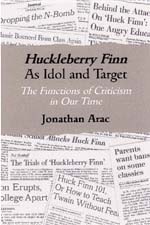
Huckleberry Finn as Idol and Target
The Functions of Criticism in Our TimeJonathan Arac
University of Wisconsin Press, 1997
If racially offensive epithets are banned on CNN air time and in the pages of USA Today, Jonathan Arac asks, shouldn’t a fair hearing be given to those who protest their use in an eighth-grade classroom? Placing Mark Twain’s comic masterpiece, Huckleberry Finn, in the context of long-standing American debates about race and culture, Jonathan Arac has written a work of scholarship in the service of citizenship.
Huckleberry Finn, Arac points out, is America’s most beloved book, assigned in schools more than any other work because it is considered both the “quintessential American novel” and “an important weapon against racism.” But when some parents, students, and teachers have condemned the book’s repeated use of the word “nigger,” their protests have been vehemently and often snidely countered by cultural authorities, whether in the universities or in the New York Times and the Washington Post. The paradoxical result, Arac contends, is to reinforce racist structures in our society and to make a sacred text of an important book that deserves thoughtful reading and criticism. Arac does not want to ban Huckleberry Finn, but to provide a context for fairer, fuller, and better-informed debates.
Arac shows how, as the Cold War began and the Civil Rights movement took hold, the American critics Lionel Trilling, Henry Nash Smith, and Leo Marx transformed the public image of Twain’s novel from a popular “boy’s book” to a central document of American culture. Huck’s feelings of brotherhood with the slave Jim, it was implied, represented all that was right and good in American culture and democracy. Drawing on writings by novelists, literary scholars, journalists, and historians, Arac revisits the era of the novel’s setting in the 1840s, the period in the 1880s when Twain wrote and published the book, and the post–World War II era, to refute many deeply entrenched assumptions about Huckleberry Finn and its place in cultural history, both nationally and globally. Encompassing discussion of Harriet Beecher Stowe, Frederick Douglass, Ralph Ellison, Archie Bunker, James Baldwin, Shelley Fisher Fishkin, and Mark Fuhrman, Arac’s book is trenchant, lucid, and timely.
Inscribing the Daily
Critical Essays on Women's DiariesSuzanne L. Bunkers
University of Massachusetts Press, 1996
Invisible Criticism
Ralph Ellison and the American CanonAlan Nadel
University of Iowa Press, 1991
In 1952 Ralph Ellison won the National Book Award for his Kafkaesque and claustrophobic novel about the life of a nameless young black man in New York City. Although Invisible Man has remained the only novel that Ellison published in his lifetime, it is generally regarded as one of the most important works of fiction in our century.
This new reading of a classic work examines Ellison's relation to and critique of the American literary canon by demonstrating that the pattern of allusions in Invisible Man forms a literary-critical subtext which challenges the accepted readings of such major American authors as Emerson, Melville, and Twain.
Modeling his argument on Foucault's analysis of the asylum, Nadel analyzes the institution of the South to show how it moved blacks from "enslavement" to "slavery" to "invisibility"—all in the interest of maintaining an organization of power based on racial caste. He then demonstrates the ways Ellison wrote in the modernist/surreal tradition to trace symbolically the history of blacks in America as they moved not only from the nineteenth century to the twentieth, and from the rural South to the urban North, but as they moved (sometimes unnoticed) through American fiction.
It is on this latter movement that Nadel focuses his criticism, first demonstrating theoretically that allusions can impel reconsideration of the alluded-to text and thus function as a form of literary criticism, and then reading the specific criticism implied by Ellison's allusions to Emerson's essays and Lewis Mumford's The Golden Days, as well as to "Benito Cereno" and The Adventures of Huckleberry Finn. Nadel also considers Ellison's allusions to Whitman, Eliot, Joyce, and the New Testament.
Invisible Criticism will be of interest not only to students of American and Afro-American literature but also to those concerned about issues of literary theory, particularly in the areas of intertextual relationships, canonicity, and rehistoricism.
Lost in the Customhouse
Authorship in the American RenaissanceJerome Loving
University of Iowa Press, 1993
Making the Radical University
Identity and Politics on the American College Campus, 1966–1991Elizabeth M. Kalbfleisch
University of Massachusetts Press, 2024
In the 1960s, professors, students, and activists on the political Left viewed college curricula as useful sites for political transformation. They coordinated efforts to alter general education requirements at the college level to foster change in American thought, with greater openness toward people who had previously been excluded, including women, people of color, the poor and working classes, people with disabilities, and members of the LGBTQ community. Their work reshaped American culture and politics, while prompting a significant backlash from conservatives attempting to, in their view, protect classical education from modern encroachment.
Elizabeth M. Kalbfleisch details how American universities became a battleground for identity politics from the 1960s through the 1980s. Focusing on two case studies at Stanford University and the University of Texas at Austin, Making the Radical University examines how curricular changes led to polarizing discussions nationwide around academic standards and identity politics, including the so-called canon wars. Today, these debates have only become more politically charged, complex, and barbed.
Manufacturing Modern Japanese Literature
Publishing, Prizes, and the Ascription of Literary ValueEdward Mack
Duke University Press, 2010
Marketing Modernisms
Self-Promotion, Canonization, RereadingKevin J.H. Dettmar and Stephen Watt, Editors
University of Michigan Press, 1996
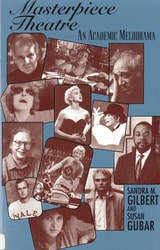
Masterpiece Theatre
An Academic MelodramaSandra M Gilbert and Susan Gubar
Rutgers University Press, 1995
Is there a plot against the life of letters today?!!!! A mysterious assailant has tied a nameless text to a railroad track near Boondock State University. While young untenured English professor Jane Marple enlists a group of odd and oddly rivalrous academicians to help her identify and save the text, a coalition of powerful conservatives begins to suspect and rally against a left-wing conspiracy. But all are foiled when the amnesiac text is abducted on the Euro-Centric Express, where Ms. Marple encounters a number of suspiciously eccentric theorists temporarily set loose from their usual haunts in Marxist, deconstructionist, new historicist, and postcolonial circles. You'll laugh with our heroine, you'll cry with her, but you'll never guess how--using the very latest technology and in the midst of sometimes sinister stage and screen celebrities--she brings the last of three thrilling episodes in the canon wars to an end at a WOW (Writers of the World) conference set in the heart of the Big Apple.
In this hilarious romp through the culture wars, Sandra M. Gilbert and Susan Gubar send up everyone including, sometimes, themselves, while at the same time they speculate seriously on the future of literature and literacy in a society where both are increasingly endangered. The cast includes well-known critics, politicians, writers, pop stars, media personalities, and a juicy assortment of technocrats, CEOs, and other culture vultures. Any similarities you find between these characters and actual persons, living or dead, are probably glaring. So, hum the opening notes of Masterpiece Theatre as you sit back, relax, and consider (yes!) the fate of the printed word in Western civilization.
Masterpiece Theatre is the latest--and funniest--round in the culture wars. No member of Modern Language Association, lover of literature and literacy, cultural pundit, or talking head should be without a copy.
Our Joyce
From Outcast to IconBy Joseph Kelly
University of Texas Press, 1997
James Joyce began his literary career as an Irishman writing to protest the deplorable conditions of his native country. Today, he is an icon in a field known as "Joyce studies." Our Joyce explores this amazing transformation of a literary reputation, offering a frank look into how and for whose benefit literary reputations are constructed.
Joseph Kelly looks at five defining moments in Joyce's reputation. Before 1914, when Joyce was most in control of his own reputation, he considered himself an Irish writer speaking to the Dublin middle classes. When T. S. Eliot and Ezra Pound began promoting Joyce in 1914, however, they initiated a cult of genius that transformed Joyce into a prototype of the "egoist," a writer talking only to other writers.
This view served the purposes of Morris Ernst in the 1930s, when he defended Ulysses against obscenity charges by arguing that geniuses were incapable of obscenity and that they wrote only for elite readers. That view of Joyce solidified in Richard Ellmann's award-winning 1950s biography, which portrayed Joyce as a self-centered genius who cared little for his readers and less for the world at war around him. The biography, in turn, led to Joyce's canonization by the academy, where a "Joyce industry" now flourishes within English departments.
Proofs of Genius
Collected Editions from the American Revolution to the Digital AgeAmanda Gailey
University of Michigan Press, 2015
Revisionary Interventions into the Americanist Canon
Donald E. Pease
Duke University Press, 1994
Originally published as a special issue of boundary 2, the essays gathered here discuss writers as diverse as Kate Chopin, Frederick Douglass, Emerson, Melville, W. D. Howells, Henry James, W. E. B. DuBois, and Mark Twain, plus the historical figure John Brown. Two major sections devoted to the theory of romance and to cultural-historical analyses emphasize the political perspective of "New Americanist" literary and cultural study.
Contributors. William E. Cain, Wai-chee Dimock, Howard Horwitz, Gregory S. Jay, Steven Mailloux, John McWilliams, Susan Mizruchi, Donald E. Pease, Ivy Schweitzer, Priscilla Wald, Michael Warner, Robert Weimann
Soft Canons
American Women WritersKaren L. Kilcup
University of Iowa Press, 1999
Street Smarts and Critical Theory
Listening to the VernacularThomas McLaughlin
University of Wisconsin Press, 1996
Everybody’s got a theory . . . or do they?
Thomas McLaughlin argues that critical theory—raising serious, sustained questions about cultural practice and ideology—is practiced not only by an academic elite but also by savvy viewers of sitcoms and TV news, by Elvis fans and Trekkies, by labor organizers and school teachers, by the average person in the street.
Like academic theorists, who are trained in a tradition of philosophical and political skepticism that challenges all orthodoxies, the vernacular theorists McLaughlin identifies display a lively and healthy alertness to contradiction and propaganda. They are not passive victims of ideology but active questioners of the belief systems that have power over their lives. Their theoretical work arises from the circumstances they confront on the job, in the family, in popular culture. And their questioning of established institutions, McLaughlin contends, is essential and healthy, for it energizes other theorists who clarify the purpose and strategies of institutions and justify the existence of cultural practices.
Street Smarts and Critical Theory leads us through eye-opening explorations of social activism in the Southern Christian anti-pornography movement, fan critiques in the ‘zine scene, New Age narratives of healing and transformation, the methodical manipulations of the advertising profession, and vernacular theory in the whole-language movement. Emphasizing that theory is itself a pervasive cultural practice, McLaughlin calls on academic institutions to recognize and develop the theoretical strategies that students bring into the classroom.
“This book demystifies the idea of theory, taking it out of the hands of a priestly caste and showing it as the democratic endowment of the people.”—Daniel T. O’Hara, Temple University, author of Radical Parody: American Culture and Critical Agency after Foucault and Lionel Trilling: The Work of Liberation.
“McLaughlin takes seriously the critical and theoretical activity of everyday people and does so in a way that will empower these very populations to take seriously their own activities as theorists. . . . A manifesto that is sure to be heard by the younger generation of thinkers in American cultural studies.”—Henry Jenkins, MIT, author of Textual Poachers: Television Fans and Participatory Culture
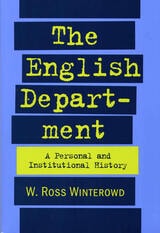
The English Department
A Personal and Institutional HistoryW. Ross Winterowd
Southern Illinois University Press, 1998
Tounderstand the history of "English," Ross Winterowd insists, one must understand how literary studies, composition-rhetoric studies, and influential textbooks interrelate. Stressing the interrelationship among these three forces, Winterowd presents a history of English studies in the university since the Enlightenment.
Winterowd’s history is unique in three ways. First, it tells the whole story of English studies: it does not separate the history of literary studies from that of composition-rhetoric studies, nor can it if it is going to be an authentic history. Second, it traces the massive influence on English studies exerted by textbooks such as Adventures in Literature, Understanding Poetry, English in Action, and the Harbrace College Handbook. Finally, Winterowd himself is very much a part of the story, a partisan with more than forty years of service to the discipline, not simply a disinterested scholar searching for the truth.
After demonstrating that literary studies and literary scholars are products of Romantic epistemology and values, Winterowd further invites controversy by reinterpreting the Romantic legacy inherited by English departments. His reinterpretation of major literary figures and theory, too, invites discussion, possibly argument. And by directly contradicting current histories of composition-rhetoric that allow for no points of contact with literature, Winterowd intensifies the argument by explaining the development of composition-rhetoric from the standpoint of literature and literary theory.
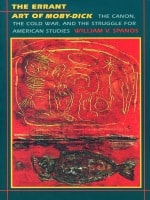
The Errant Art of Moby-Dick
The Canon, the Cold War, and the Struggle for American StudiesWilliam V. Spanos
Duke University Press, 1995
Combining Heideggerian ontology with a sociopolitical perspective derived primarily from Foucault, the reading of Moby-Dick that forms the center of this book demonstrates that the traditional identification of Melville’s novel as a "romance" renders it complicitous in the discourse of the Cold War. At the same time, Spanos shows how New Americanist criticism overlooks the degree to which Moby-Dick anticipates not only America’s self-representation as the savior of the world against communism, but also the emergent postmodern and anti-imperial discourse deployed against such an image. Spanos’s critique reveals the extraordinary relevance of Melville’s novel as a post-Cold War text, foreshadowing not only the self-destructive end of the historical formation of the American cultural identity in the genocidal assault on Vietnam, but also the reactionary labeling of the current era as "the end of history."
This provocative and challenging study presents not only a new view of the development of literary history in the United States, but a devastating critique of the genealogy of ideology in the American cultural establishment.
The Myths of Fiction
Studies in the Canonical Greek NovelsEdmund P. Cueva
University of Michigan Press, 2004
The tradition of historical literature begun by Herodotus and Thucydides molded the early Greek novel. As the genre evolved, however, Greek novels moved away from their historical roots to become more heavily influenced by mythological traditions. Edmund Cueva's new book examines the literary uses to which the ancient novelists put their mythological material. His work offers a stimulating discussion of myths and their rise to prominence as the key feature of the fully developed Greek novel. He also takes into account the impact of the Roman conquest on the development of the Greek novel, the last true literary creation of the Greek world. The Myths of Fiction will interest scholars of Greek literarure, imperial history, literary myth, intertextuality, and comparative literature.
Edmund Cueva is Associate Professor and Chair of Classics at Xavier University.

The Rhetoric of the "Other" Literature
W. Ross Winterowd
Southern Illinois University Press, 1990
Using traditional and contemporary rhetorical theory, Winterowd argues that the fiction-nonfiction division of literature is unjustified and destructive.
He would bridge the gap between literary scholars and rhetoricians by including both fiction (imaginative literature) and nonfiction (literature of fact) in the canon. The actual difference in literary texts, he notes, lies not in their factuality but in their potential for eliciting an aesthetic response.
With speech act and rhetorical theory as a basis, Winterowd argues that presentational literature gains its power on the basis of its ethical and pathetic appeal, not because of its assertions or arguments.
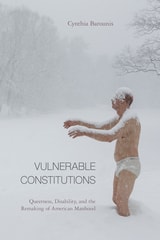
Vulnerable Constitutions
Queerness, Disability, and the Remaking of American ManhoodCynthia Barounis
Temple University Press, 2019
Amputation need not always signify castration; indeed, in Jack London’s fiction, losing a limb becomes part of a process through which queerly gendered men become properly masculinized. In her astute book, Vulnerable Constitutions, Cynthia Barounis explores the way American writers have fashioned alternative—even resistant—epistemologies of queerness, disability, and masculinity. She seeks to understand the way perverse sexuality, physical damage, and bodily contamination have stimulated—rather than created a crisis for—masculine characters in twentieth- and early twenty-first-century literature.
Barounis introduces the concept of “anti-prophylactic citizenship”—a mode of political belonging characterized by vulnerability, receptivity, and risk—to examine counternarratives of American masculinity. Investigating the work of authors including London, William Faulkner, James Baldwin, and Eli Clare, she presents an evolving narrative of medicalized sexuality and anti-prophylactic masculinity. Her literary readings interweave queer theory, disability studies, and the history of medicine to demonstrate how evolving scientific conversations around deviant genders and sexualities gave rise to a new model of national belonging—ultimately rewriting the story of American masculinity as a story of queer-crip rebellion.