Results by title
10 books match the query 'Casas Grandes Site (Mexico)'
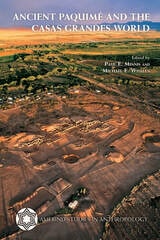
Ancient Paquimé and the Casas Grandes World
Edited by Paul E. Minnis and Michael E. Whalen
University of Arizona Press, 2015
The Joint Casas Grandes Expedition revealed the extraordinary nature of this site: monumental architecture, massive ball courts, ritual mounds, over a ton of shell artifacts, hundreds of skeletons of multicolored macaws and their pens, copper from west Mexico, and rich political and religious life with Mesoamerican-related images and rituals. Paquimé was not one sole community but was surrounded by hundreds of outlying villages in the region, indicating a zone that sustained thousands of inhabitants and influenced groups much farther afield.
In celebration of the Amerind Foundation’s seventieth anniversary, sixteen scholars with direct and substantial experience in Casas Grandes archaeology present nine chapters covering its economy, chronology, history, religion, regional organization, and importance. The two final chapters examine Paquimé in broader geographic perspectives. This volume sheds new light on Casas Grandes/Paquimé, a great town well-adapted to its physical and economic environment that disappeared just before Spanish contact.

Casas Grandes and Its Hinterlands
Prehistoric Regional Organization in Northwest MexicoMichael E. Whalen and Paul E. Minnis
University of Arizona Press, 2001
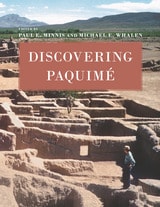
Discovering Paquimé
Edited by Paul E. Minnis and Michael E. Whalen
University of Arizona Press, 2016
". . . many houses of great size, strength, and height . . . six and seven stories, with towers and walls like fortresses for protection and defense against the enemies who undoubtedly used to make war on its inhabitants . . . large and magnificent patios paved with enormous and beautiful stones resembling jasper . . ."
Casas Grandes, now a UNESCO World Heritage Site, is under the purview of the Instituto Nacional de Antropología e Historia, which oversees a world-class museum near the ruins. Paquimé visitors can learn about the site’s history and its excavations, which were conducted under the pioneering research of Charles Di Peso and Eduardo Contreras Sánchez and their colleagues from INAH and the Amerind Foundation.
Based on a half century of modern research since the Joint Casas Grandes Project, this book explores the recent discoveries about important site and its neighbors. Drawing the expertise of fourteen scholars from the United States, Mexico, and Canada, who have long worked in the region, the chapters revel new insights about Paquimé and its influence, bringing this fascinating place and its story to light.
Mortuary Practices and Social Differentiation at Casas Grandes, Chihuahua, Mexico
John C. Ravesloot
University of Arizona Press, 1988
Not so Far from Paquimé
Essays on the Archaeology of Chihuahua, MexicoEdited by Jane Holden Kelley and David A. Phillips Jr.
University of Utah Press, 2017
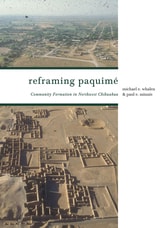
Reframing Paquimé
Community Formation in Northwest ChihuahuaMichael E. Whalen and Paul E. Minnis
University of Arizona Press, 2025
Reframing Paquimé: Community Formation in Northwest Chihuahua is a groundbreaking reinterpretation of the Casas Grandes region by scholars Michael E. Whalen and Paul E. Minnis. This final installment in their comprehensive study challenges the dominant view of Paquimé as a hierarchical society founded by outsiders, presenting instead a compelling case for a largely locally organized society with Mesoamerican and Puebloan characteristics. Drawing on twenty-five years of extensive survey and excavation data, the authors offer a fresh perspective that reframes our understanding of this remarkable archaeological site.
Whalen and Minnis bring forth significant new data that illuminates the cultural and ecological history of Paquimé and its neighboring communities. The book features more than fifty new radiocarbon dates, hundreds of analyzed archaeobotanical and faunal samples, plus tens of thousands of other artifacts. The data reveal a network of settlements characterized by corporate and ritual-based authority, challenging traditional models of the center’s rise, collapse, and subsequent regional abandonment and arguing that aspects of the Paquimé culture continued to exist up to the Spanish Colonial period.
Reframing Paquimé is poised to become an essential reference for archaeologists interested in Northwest Mexico and the U.S. Southwest. By addressing the complex dynamics of community formation and dissolution, Whalen and Minnis provide invaluable insights that will ignite scholarly debate and inspire future research. This meticulously researched volume, authored by leading experts with decades of fieldwork experience, is a vital addition to any collection on the archaeology and ethnobotany of ancient North American societies.
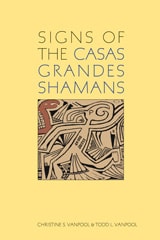
Signs of the Casas Grandes Shamans
VanPool Christine & Todd
University of Utah Press, 2007
Looking through this window, authors Christine and Todd VanPool find a world centered on shamans who took spiritual journeys to consort with supernatural creatures. The shamans called upon horned serpents to bring rain, the lifeblood for farmers living in the Chihuahuan desert; dealt with snakes that held powers more potent than their bites; and raised, sacrificed, and buried macaws as ritual offerings to ensure water and fertility.
These findings challenge long-held beliefs about Southwestern religion and force a reconsideration of the importance of shamanism in the development of social differentiation in societies around the world.
Surveying The Archaeology Of Northwest Mexico
Gilliam E Newell
University of Utah Press, 2003
Archaeology in the Southwest is increasingly directing its attention south of the international border as it becomes clear that a picture of the pre-hispanic Southwest is incomplete without taking the Mexican Northwest into account.
Surveying the Archaeology of Northwest Mexico presents an overview of recent work in Sonora and Chihuahua, comprising a sort of professional tour of the area. The chapters offer fresh insights into the formation of centers such as Paquimé, Cerro de Trincheras, and the Rio Sonora cabaceras. Contributors explore relations between these centers, individual internal organization of the various identifiable polities, and the relation of the whole northwest Mexican region to better-known adjacent ones. The volume underscores that northwest Mexico was not a dependent hinterland but was inhabited by many independent groups throughout prehistory.
The Casas Grandes World
Curtis Schaafsma
University of Utah Press, 1999
The Casas Grandes World focuses on a remarkable prehistoric culture that extended through parts of present-day Chihuahua, Sonora, New Mexico, Texas, and Arizona, centering on the large Mexican site of Casas Grandes. The thousands of prehistoric sites in this vast area have only recently been considered related to each other, yet it now appears that for more than 200 years, from about AD 1200 to 1425, the people of the region traded with each other, made coursed-adobe pueblos in the desert country, manufactured magnificent pottery, and produced some of the most extraordinary rock art in North America. Casas Grandes was recently designated a World Heritage Site by the United Nations.
During is florescence Casas Grandes served as a conduit or nexus between the Anasazi of the ancient American Southwest and the Mexican civilizations to the south. Using the seminal work of Charles Di Peso as a touchstone, and drawing on significant new archaeological work, this volume offers a reevaluation of the extent, history, and meaning of the great site and its far-reaching connections. It also considers influences on the Hohokam of Arizona and the peoples of west Mexico, positing the existence of a vast sphere of Casas Grandes cultural influence.
The Prehispanic Ethnobotany of Paquimé and Its Neighbors
Paul E. Minnis and Michael E. Whalen
University of Arizona Press, 2020
This volume is the first large-scale investigation of the prehispanic ethnobotany of this important ancient site and its neighbors. The authors examine ethnobotanical relationships during Medio Period, AD 1200–1450, when Paquimé was at its most influential. Based on two decades of archaeological research, this book examines uses of plants for food, farming strategies, wood use, and anthropogenic ecology. The authors show that the relationships between plants and people are complex, interdependent, and reciprocal. This volume documents ethnobotanical relationships and shows their importance to the development of the Paquimé polity.
How ancient farmers made a living in an arid to semi-arid region and the effects their livelihood had on the local biota, their relations with plants, and their connection with other peoples is worthy of serious study. The story of the Casas Grandes tradition holds valuable lessons for humanity.