Results by title
10 books match the query 'Central-local government relations'

After the Deluge
Regional Crises and Political Consolidation in RussiaDaniel S. Treisman
University of Michigan Press, 2001
Yet, by mid-decade, a fragile equilibrium had emerged out of the apparently chaotic brinkmanship of central and regional officials. Based on extensive statistical analysis of previously unpublished data as well as interviews with numerous central and regional policymakers, After the Deluge suggests an original and counterintuitive interpretation of this experience.
In most cases, confrontations between regions and Moscow constituted a functional kind of drama. Regional leaders signaled just how much they were willing to risk to secure particular benefits. With a policy of "selective fiscal appeasement," federal officials directed subsidies, tax breaks, and other benefits to the most protest-prone regions, which in turn engendered a shift in local public opinion. By buying off potential regional dissenters, Moscow halted what might have become an accelerating bandwagon.
Besides offering insight into Russia's emerging politics, After the Deluge suggests a range of parallels to other cases of territorially divided states and empires--from contemporary China to Ottoman Turkey. It should appeal to a broad audience of scholars in political science, economics, history, geography, and policy studies.
Daniel S. Treisman is Assistant Professor of Political Science, University of California, Los Angeles.

Conservative Innovators
How States Are Challenging Federal PowerBen Merriman
University of Chicago Press, 2019
Conservative Innovators traces the activity of far-right conservatives in Kansas who have in the past decade used the powers of state-level offices to fight federal regulation on a range of topics from gun control to voting processes to Medicaid. Telling their story, Ben Merriman then expands the scope of the book to look at the tactics used by conservative state governments across the country to resist federal regulations, including coordinated lawsuits by state attorneys general, refusals to accept federal funds and spending mandates, and the creation of programs designed to restrict voting rights. Through this combination of state-initiated lawsuits and new administrative practices, these state officials weakened or halted major parts of the Obama Administration’s healthcare, environmental protection, and immigration agendas and eroded federal voting rights protections. Conservative Innovators argues that American federalism is entering a new, conflict-ridden era that will make state governments more important in American life than they have been at any time in the past century.
Decentering the Regime
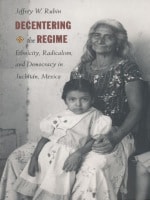
Ethnicity, Radicalism, and Democracy in Juchitán, MexicoJeffrey W. Rubin
Duke University Press, 1997
Employing an interdisciplinary approach, Rubin shows that the Juchitecos’ ability to organize and sustain a radical political movement grew out of a century-long history of negotiation of political rule. He argues that factors outside the realm of formal politics—such as ethnicity, language, gender, and religion—play an important part in the dynamics of regional political struggles and relationships of power. While offering a detailed view of the Zapotec community and its interactions, Rubin reconceptualizes democracy by considering the question of how meaningful autonomy, self-government, cultural expression, and material well-being can be forged out of violence and repression.
Decentralization and Popular Democracy
Governance from Below in BoliviaJean-Paul Faguet
University of Michigan Press, 2013
Bolivia decentralized in an effort to deepen democracy, improve public services, and make government more accountable. Unlike many countries, Bolivia succeeded. Over the past generation, public investment shifted dramatically toward primary services and resource distribution became far more equitable, partly due to the creation of new local governments. Many municipalities responded to decentralization with transparent, accountable government, yet others suffered ineptitude, corruption, or both. Why? Jean-Paul Faguet combines broad econometric data with deep qualitative evidence to investigate the social underpinnings of governance. He shows how the interaction of civic groups and business interests determines the quality of local decision making.
In order to understand decentralization, Faguet argues, we must understand governance from the ground up. Drawing on his findings, he offers an evaluation of the potential benefits of decentralization and recommendations for structuring successful reform.
Kalmykia in Russia's Past and Present National Policies and Administrative System
Konstantin N. Maksimov
Central European University Press, 2008
Networked
Business and Politics in Decentralizing Indonesia, 1998-2004Wahyu Prasetyawan
National University of Singapore Press, 2018
Networked Business and Politics in Decentralizing Indonesia evaluates three cases of deep-seated political conflict and intrigue including central government, local governments, and multinational companies. It looks at how the structure of the national political economy has changed as the result of local politicians becoming involved in disputes with the national government over control of natural resources. It also analyzes how these changes will affect the distribution of wealth in the country as well as Indonesia’s evolving democratic politics and modes of governance.

Policing Immigrants
Local Law Enforcement on the Front LinesDoris Marie Provine, Monica W. Varsanyi, Paul G. Lewis, and Scott H. Decker
University of Chicago Press, 2016
Policing Immigrants traces the transition of immigration enforcement from a traditionally federal power exercised primarily near the US borders to a patchwork system of local policing that extends throughout the country’s interior. Since federal authorities set local law enforcement to the task of bringing suspected illegal immigrants to the federal government’s attention, local responses have varied. While some localities have resisted the work, others have aggressively sought out unauthorized immigrants, often seeking to further their own objectives by putting their own stamp on immigration policing. Tellingly, how a community responds can best be predicted not by conditions like crime rates or the state of the local economy but rather by the level of conservatism among local voters. What has resulted, the authors argue, is a system that is neither just nor effective—one that threatens the core crime-fighting mission of policing by promoting racial profiling, creating fear in immigrant communities, and undermining the critical community-based function of local policing.
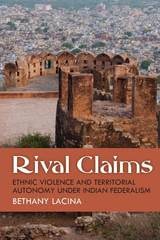
Rival Claims
Ethnic Violence and Territorial Autonomy under Indian FederalismBethany Lacina
University of Michigan Press, 2017
Using new data on ethnicity and sub-national discrimination in India, national and state archives, parliamentary records, cross-national analysis and her original fieldwork, Lacina explains ethnoterritorial politics as a three-sided interaction of the center and rival interests in the periphery. Ethnic entrepreneurs use militancy to create national political pressure in favor of their goals when the prime minister lacks clear electoral reasons to court one regional group over another. Second, ethnic groups rarely win autonomy or mobilize for violence in regions home to electorally influential anti-autonomy interests. Third, when a regional ethnic majority is politically important to the prime minister, its leaders can deter autonomy demands within their borders, while actively discriminating against minorities.
Rival Claims challenges the conventional beliefs that territorial autonomy demands are a reaction to centralized power and that governments resist autonomy to preserve central prerogatives. The center has allegiances in regional politics, and ethnoterritorial violence reflects the center’s entanglement with rival interests in the periphery.

The Increasingly United States
How and Why American Political Behavior NationalizedDaniel J. Hopkins
University of Chicago Press, 2018
With The Increasingly United States, Daniel J. Hopkins explores this trend and its implications for the American political system. The change is significant in part because it works against a key rationale of America’s federalist system, which was built on the assumption that citizens would be more strongly attached to their states and localities. It also has profound implications for how voters are represented. If voters are well informed about state politics, for example, the governor has an incentive to deliver what voters—or at least a pivotal segment of them—want. But if voters are likely to back the same party in gubernatorial as in presidential elections irrespective of the governor’s actions in office, governors may instead come to see their ambitions as tethered more closely to their status in the national party.
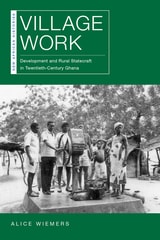
Village Work
Development and Rural Statecraft in Twentieth-Century GhanaAlice Wiemers
Ohio University Press, 2021
A robust historical case study that demonstrates how village development became central to the rhetoric and practice of statecraft in rural Ghana.
Combining oral histories with decades of archival material, Village Work formulates a sweeping history of twentieth-century statecraft that centers on the daily work of rural people, local officials, and family networks, rather than on the national governments and large-scale plans that often dominate development stories. Wiemers shows that developmentalism was not simply created by governments and imposed on the governed; instead, it was jointly constructed through interactions between them.
The book contributes to the historiographies of development and statecraft in Africa and the Global South by
- emphasizing the piecemeal, contingent, and largely improvised ways both development and the state are comprised and experienced
- providing new entry points into longstanding discussions about developmental power and discourse
- unsettling common ideas about how and by whom states are made
- exposing the importance of unpaid labor in mediating relationships between governments and the governed
- showing how state engagement could both exacerbate and disrupt inequities
Despite massive changes in twentieth-century political structures—the imposition and destruction of colonial rule, nationalist plans for pan-African solidarity and modernization, multiple military coups, and the rise of neoliberal austerity policies—unremunerated labor and demonstrations of local leadership have remained central tools by which rural Ghanaians have interacted with the state. Grounding its analysis of statecraft in decades of daily negotiations over budgets and bureaucracy, the book tells the stories of developers who decided how and where projects would be sited, of constituents who performed labor, and of a chief and his large cadre of educated children who met and shaped demands for local leaders. For a variety of actors, invoking “the village” became a convenient way to allocate or attract limited resources, to highlight or downplay struggles over power, and to forge national and international networks.