Results by title
9 books match the query 'Children with social disabilities'
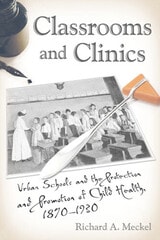
Classrooms and Clinics
Urban Schools and the Protection and Promotion of Child Health, 1870-1930Meckel, Richard A
Rutgers University Press, 2013
Classrooms and Clinics is the first book-length assessment of the development of public school health policies from the late nineteenth century through the early years of the Great Depression. Richard A. Meckel examines the efforts of early twentieth-century child health care advocates and reformers to utilize urban schools to deliver health care services to socioeconomically disadvantaged and medically underserved children in the primary grades. Their goal, Meckel shows, was to improve the children’s health and thereby improve their academic performance.
Meckel situates these efforts within a larger late nineteenth- and early twentieth-century public discourse relating schools and schooling, especially in cities and towns, to child health. He describes and explains how that discourse and the school hygiene movement it inspired served as critical sites for the constructive negotiation of the nature and extent of the public school’s—and by extension the state’s—responsibility for protecting and promoting the physical and mental health of the children for whom it was providing a compulsory education.
Tracing the evolution of that negotiation through four overlapping stages, Meckel shows how, why, and by whom the health of schoolchildren was discursively constructed as a sociomedical problem and charts and explains the changes that construction underwent over time. He also connects the changes in problem construction to the design and implementation of various interventions and services and evaluates how that design and implementation were affected by the response of the civic, parental, professional, educational, public health, and social welfare groups that considered themselves stakeholders and took part in the discourse. And, most significantly, he examines the responses called forth by the question at the heart of the negotiations: what services are necessitated by the state’s and school’s taking responsibility for protecting and promoting the health and physical and mental development of schoolchildren. He concludes that the negotiations resulted both in the partial medicalization of American primary education and in the articulation and adoption of a school health policy that accepted the school’s responsibility for protecting and promoting the health of its students while largely limiting the services called for to the preventive and educational.

Damaged Parents
An Anatomy of Child NeglectNorman A. Polansky, Mary Ann Chalmers, Elizabeth Werthan Buttenwieser, and David P. Williams
University of Chicago Press, 1983
"Norman Polansky and his colleagues have produced a truly remarkable book. . . . One of the consequences of [the] relative invisibility of child neglect is that we also know less about it. But this book will help to correct that for it contains reports of findings from two systematic efforts to define, measure, classify, and understand child neglect."—Thomas M. Young, Social Service Review
Discovering Successful Pathways in Children's Development
Mixed Methods in the Study of Childhood and Family LifeEdited by Thomas S. Weisner
University of Chicago Press, 2005
This volume includes new studies of minority and immigrant families, school achievement, culture, race and gender, poverty, identity, and experiments and interventions meant to improve family and child contexts. Discovering Successful Pathways in Children's Development will be of enormous value to everyone interested in the issues of human development, education, and social welfare, and among professionals charged with the task of improving the lives of children in our communities.

Family Trouble
Middle-Class Parents, Children's Problems, and the Disruption of Everyday LifeFrancis, Ara
Rutgers University Press, 2015
Francis interviewed the mothers and fathers of children with such problems as depression, bi-polar disorder, autism, learning disabilities, drug addiction, alcoholism, fetal alcohol syndrome, and cerebral palsy. Children’s problems, she finds, profoundly upset the foundations of parents’ everyday lives, overturning taken-for-granted expectations, daily routines, and personal relationships. Indeed, these problems initiated a chain of disruption that moved through parents’ lives in domino-like fashion, culminating in a crisis characterized by uncertainty, loneliness, guilt, grief, and anxiety. Francis looks at how mothers and fathers often differ in their interpretation of a child’s condition, discusses the gendered nature of child rearing, and describes how parents struggle to find effective treatments and to successfully navigate medical and educational bureaucracies. But above all, Family Trouble examines how children’s problems disrupt middle-class dreams of the “normal” family. It captures how children’s problems “radiate” and spill over into other areas of parents’ lives, wreaking havoc even on their identities, leading them to reevaluate deeply held assumptions about their own sense of self and what it means to achieve the good life.
Engagingly written, Family Trouble offers insight to professionals and solace to parents. The book offers a clear message to anyone in the throes of family trouble: you are in good company, and you are not as different as you might feel...
Mothering Inner-City Children
The Early School YearsKatherine Brown Rosier
Rutgers University Press, 2000
There are few groups more stereotyped and demonized than "welfare mothers," particularly low-income, African American women raising children in the inner city. But what are the day-to-day stories behind the stereotypes? How do African American mothers (both single women and those living with a partner) in poor families handle their roles as parents? What support networks do they rely on to help raise their children? How do their personal histories affect their parenting styles?
Sociologist Katherine Brown Rosier spent three years interviewing and observing Indianapolis mothers as their children made the transition from a Head Start program to kindergarten and through second grade, analyzing the families in their homes, schools, and other social settings. She brings forth the voices of the mothers, children, and their teachers, providing a multifaceted picture of how low-income African American families cope with the daily pressures and responsibilities of child rearing.
Rosier also examines how larger socio-economic factors influence these families' specific circumstances and histories. What child-rearing strategies do these mothers employ, she asks, to promote a smooth transition into school despite complex discontinuities among their homes, schools, and communities? How are these strategies viewed and supported or impeded by teachers, family, friends, and neighbors?
Until now, most research on poor African American families has focused so intently on the problems confronted by this seemingly homogenous group that the routine practices of every day life have been ignored. In this unique project, Rosier allows the families' individual experiences and thoughts to contribute to and complicate current research.
Schools & Social Justice
R. W. Connell
Temple University Press, 1993
Social justice, R.W. Connell contends, is an inextricable part of any educational system, and democratic societies should give priority to the educational needs of the disadvantaged. In this remarkable manifesto, one of education's most distinguished voices cautions that school systems dealing unjustly with their disadvantaged students degrade the quality of education for all.
The book's compelling, well-reasoned arguments call for new social policies. Drawing on research experience in the United States, Canada, Britain, and Australia, Connell demonstrates the weakness in programs that attempt merely to establish equal opportunity. He observes that scholarships, compensatory education, desegregation, and affirmative action focus on distributive justice, rather than on the nature of the education.
Curricular justice, Connell argues, is just as crucial as distributive justice. Considering race, class, and gender issues, he examines the relation between knowledge and its social content. He describes how curricular content, presentation, and means of student assessment can perpetuate social injustice. Tracing the elitist sources of various curricula, Schools and Social Justice urges reconceptualizing the curriculum from the point of view of the disadvantaged and offers examples of successful efforts to do this.
State of Empowerment
Low-Income Families and the New Welfare StateCarolyn Barnes
University of Michigan Press, 2020
On weekday afternoons, dismissal bells signal not just the end of the school day but also the beginning of another important activity: the federally funded after-school programs that offer tutoring, homework help, and basic supervision to millions of American children. Nearly one in four low-income families enroll a child in an after-school program. Beyond sharpening students’ math and reading skills, these programs also have a profound impact on parents. In a surprising turn—especially given the long history of social policies that leave recipients feeling policed, distrusted, and alienated—government-funded after-school programs have quietly become powerful forces for political and civic engagement by shifting power away from bureaucrats and putting it back into the hands of parents. In State of Empowerment Carolyn Barnes uses ethnographic accounts of three organizations to reveal how interacting with government-funded after-school programs can enhance the civic and political lives of low-income citizens.
Unequal Choices
How Social Class Shapes Where High-Achieving Students Apply to CollegeYang Va Lor
Rutgers University Press, 2023
Whither Opportunity?
Rising Inequality, Schools, and Children's Life ChancesGreg J. Duncan
Russell Sage Foundation, 2012