Results by title

21 books match the query 'Christian Education'
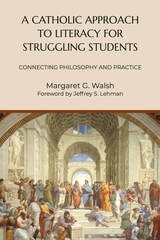
cover of A Catholic Approach to Literacy for Struggling Students: Connecting Philosophy and Practice

A Catholic Approach to Literacy for Struggling Students

Connecting Philosophy and Practice

Margaret G. Walsh

Catholic University of America Press, 2025
Discover effective literacy methods that align with a Christian anthropological view of the human person, as described by Aquinas and Aristotle and joined to research-based strategies. Through this work you will learn the most important pieces to building the skills needed for literacy acquisition. The aim of this book is to provide parents and educators with the foundational understanding of how a person learns to read in order to equip them with the tools needed to effectively implement a full reading curriculum. Included are intervention methods that can be used in conjunction with reading curriculum to improve reading outcomes for students who struggle. The principles used in this book are research-based intervention methods that are blended with models of human development set out by Aristotle and St Thomas Aquinas. In the Summa Theologiae, St Thomas Aquinas writes about the faculties of the soul, relying on the foundational work of Aristotle in the De Anima. In Aquinas’ description of the powers of the soul, he outlines the way in which man comes to know, through the systematic use of his senses, imagination, memory, cogitative powers and finally his intellect and will. Effective intervention methods, as outlined in this work, align with the process Aquinas outlines. Understanding effective intervention strategies in light of the bigger picture of who man is and what he is made for, elevates learning and puts the development of literacy in a holistic perspective.
[more]
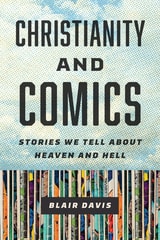
cover of Christianity and Comics: Stories We Tell about Heaven and Hell

Christianity and Comics

Stories We Tell about Heaven and Hell

Blair Davis

Rutgers University Press, 2024

The Bible has inspired Western art and literature for centuries, so it is no surprise that Christian iconography, characters, and stories have also appeared in many comic books. Yet the sheer stylistic range of these comics is stunning. They include books from Christian publishers, as well as underground comix with religious themes and a vast array of DC, Marvel, and Dark Horse titles, from Hellboy to Preacher.   
 
Christianity and Comics presents an 80-year history of the various ways that the comics industry has drawn from biblical source material. It explores how some publishers specifically targeted Christian audiences with titles like Catholic Comics, books featuring heroic versions of Oral Roberts and Billy Graham, and special religious-themed editions of Archie. But it also considers how popular mainstream comics like Daredevil, The Sandman, Ghost Rider, and Batman are infused with Christian themes and imagery. 
 
Comics scholar Blair Davis pays special attention to how the medium’s unique use of panels, word balloons, captions, and serialized storytelling have provided vehicles for telling familiar biblical tales in new ways. Spanning the Golden Age of comics to the present day, this book charts how comics have both reflected and influenced Americans’ changing attitudes towards religion.
[more]
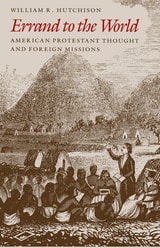
cover of Errand to the World: American Protestant Thought and Foreign Missions

Errand to the World

American Protestant Thought and Foreign Missions

William R. Hutchison

University of Chicago Press, 1987
In this comprehensive history of American foreign-mission thought from the colonial period to the current era, William R. Hutchinson analyzes the varied and changing expressions of an American "sense of mission" that was more than religious in its implications. His account illuminates the dilemmas intrinsic to any venture in which one culture attempts to apply its ideals and technology to the supposed benefit of another.
[more]
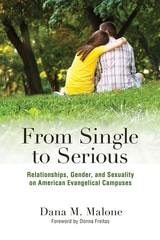
cover of From Single to Serious: Relationships, Gender, and Sexuality on American Evangelical Campuses

From Single to Serious

Relationships, Gender, and Sexuality on American Evangelical Campuses

Malone, Dana M.

Rutgers University Press, 2018

College students hook up and have sex. That is what many students expect to happen during their time at university—it is part of growing up and navigating the relationship scene on most American campuses today. But what do you do when you’re a student at an evangelical university? Students at these schools must negotiate a barrage of religiously imbued undercurrents that impact how they think about relationships, in addition to how they experience and evaluate them. As they work to form successful unions, students at evangelical colleges balance sacred ideologies of purity, holiness, and godliness, while also dealing with more mainstream notions of popularity, the online world, and the appeal of sexual intimacy. 

In From Single to Serious, Dana M. Malone shines a light on friendship, dating, and, sexuality, in both the ideals and the practical experiences of heterosexual students at U. S. evangelical colleges. She examines the struggles they have in balancing their gendered and religious presentations of self, the expectations of their campus community, and their desire to find meaningful romantic relationships. 
 
[more]
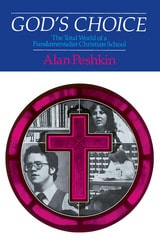
cover of God's Choice: The Total World of a Fundamentalist Christian School

God's Choice

The Total World of a Fundamentalist Christian School

Alan Peshkin

University of Chicago Press, 1988

Is Bethany Baptist Academy God's choice? Ask the fundamentalist Christians who teach there or whose children attend the academy, and their answer will be a yes as unequivocal as their claim that the Bible is God's inerrant, absolute word. Is this truth or arrogance?

In God's Choice, Alan Peshkin offers readers the opportunity to consider this question in depth. Given the outsider's rare chance to observe such a school firsthand, Peshkin spent eighteen months studying Bethany's high school—interviewing students, parents, and educators, living in the home of Bethany Baptist Church members, and participating fully in the church's activities. From this intimate research he has fashioned a rich account of Christian schooling and an informed analysis of a clear alternative to public education.
[more]
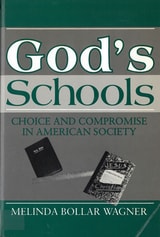
cover of God's Schools

God's Schools

Wagner, Melinda Bollar

Rutgers University Press, 1990

Many of us assume that Christian day schools foster a strict and conservative environment that is very different from the rest of the United States. Christian educators themselves foster this view when they say that following biblical strictures requires that they not always conform to this world. Melinda Wagner goes beyond this stereotype to portray the way these schools foster American popular culture and "professional education culture" as well as "Christian culture." In her participant observation study of a variety of Christian schools (sponsored by fundamentalist, evangelical, new charismatic, Holiness, and Pentecostal Christians), Wagner describes and interprets how such compromises are made.

In American culture, children are taught to meet challenges, to compete, and are rewarded for individual achievement. Conservative Christians label this individualism as "secular humanism," and find it antithetical to their view of the self. Instead, these Christians seek a culture of love, compassion, orderliness, non-competitiveness, and separation from the material trappings of this world.

But in reality, Wager finds that the schools mix Christian values with the values of American culture. She discovers that even in Christian schools students compete fiercely and are recognized for individual achievements. Christian schools incorporate norms and strategies from mainstream American education. Alternative Christian schools are not as alternative as they could be; they are walking the Christian walk the American way.

The Christian schools serve as a case study of the process of culture building. Conservative Christians are trying to revitalize their culture. Yet all along the way, they quite consciously compromise.
[more]
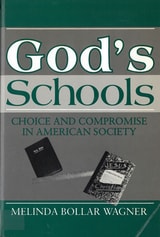
cover of God's Schools: Choice and Compromise in American Society

God's Schools

Choice and Compromise in American Society

Wagner, Melinda Bollar

Rutgers University Press, 1990

Many of us assume that Christian day schools foster a strict and conservative environment that is very different from the rest of the United States. Christian educators themselves foster this view when they say that following biblical strictures requires that they not always conform to this world. Melinda Wagner goes beyond this stereotype to portray the way these schools foster American popular culture and "professional education culture" as well as "Christian culture." In her participant observation study of a variety of Christian schools (sponsored by fundamentalist, evangelical, new charismatic, Holiness, and Pentecostal Christians), Wagner describes and interprets how such compromises are made.

In American culture, children are taught to meet challenges, to compete, and are rewarded for individual achievement. Conservative Christians label this individualism as "secular humanism," and find it antithetical to their view of the self. Instead, these Christians seek a culture of love, compassion, orderliness, non-competitiveness, and separation from the material trappings of this world.

But in reality, Wager finds that the schools mix Christian values with the values of American culture. She discovers that even in Christian schools students compete fiercely and are recognized for individual achievements. Christian schools incorporate norms and strategies from mainstream American education. Alternative Christian schools are not as alternative as they could be; they are walking the Christian walk the American way.

The Christian schools serve as a case study of the process of culture building. Conservative Christians are trying to revitalize their culture. Yet all along the way, they quite consciously compromise.
[more]
cover of Gratitude: Affirming One Another Through Stories

Gratitude

Affirming One Another Through Stories

Len Froyen

Parkhurst Brothers, Inc., 2013
Study of Gratitude, it's practice and impact are ideal for group discussion and personal study.
[more]
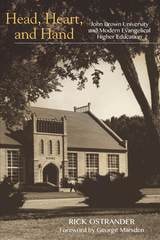
cover of Head, Heart, and Hand: John Brown University and Modern Evangelical Higher Education

Head, Heart, and Hand

John Brown University and Modern Evangelical Higher Education

Rick Ostrander

University of Arkansas Press, 2018
Traveling evangelist John Brown believed that conventional colleges had become elitist and morally suspect, so he founded a small utopian college in 1919 to better combine evangelical Christianity and higher education. Historian Rick Ostrander places John Brown University in the long tradition of Christian education, but he also shows that evangelicalism had largely separated from mainstream higher education by the twentieth century. This engaging and objective history explores how John Brown University has adapted to modern American culture while maintaining its evangelical character. Brown set out to educate the poor, rural children of the Ozarks who had no other opportunity for schooling. He wanted to instill in them not only religious zeal but also his conception of what constituted significant work, namely manual labor. His concern with practical work is evident today in programs for broadcasting, engineering, teacher education, and business. His sons made academic excellence an institutional priority and gradually transformed the school into an accredited, respected liberal arts college. Head, Heart, and Hand deftly connects the story of John Brown University to the larger currents of American education and religion.
[more]
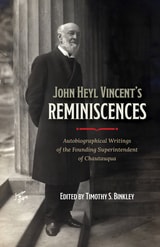
cover of John Heyl Vincent's Reminiscences: Autobiographical Writings of the Founding Superintendent of Chautauqua

John Heyl Vincent's Reminiscences

Autobiographical Writings of the Founding Superintendent of Chautauqua

Timothy S. Binkley

Bridwell Press, 2024
Chautauqua Institution co-founder Rev. John Heyl Vincent was a prolific writer on religion, education, and history. Among Vincent’s numerous published works were a few autobiographical writings. These essays describing family and personal history were forgotten soon after Vincent's death in 1920. More than a century later, thirty-three of his personal narratives have been gathered into a single volume. John Heyl Vincent’s Reminiscences invites readers to learn directly from Bishop Vincent about the experiences that shaped his life, his convictions, and the Chautauqua idea.
[more]
cover of Lost Classroom, Lost Community: Catholic Schools' Importance in Urban America

Lost Classroom, Lost Community

Catholic Schools' Importance in Urban America

Margaret F. Brinig and Nicole Stelle Garnett

University of Chicago Press, 2014

In the past two decades in the United States, more than 1,600 Catholic elementary and secondary schools have closed, and more than 4,500 charter schools—public schools that are often privately operated and freed from certain regulations—have opened, many in urban areas. With a particular emphasis on Catholic school closures, Lost Classroom, Lost Community examines the implications of these dramatic shifts in the urban educational landscape. 

More than just educational institutions, Catholic schools promote the development of social capital—the social networks and mutual trust that form the foundation of safe and cohesive communities. Drawing on data from the Project on Human Development in Chicago Neighborhoods and crime reports collected at the police beat or census tract level in Chicago, Philadelphia, and Los Angeles, Margaret F. Brinig and Nicole Stelle Garnett demonstrate that the loss of Catholic schools triggers disorder, crime, and an overall decline in community cohesiveness, and suggest that new charter schools fail to fill the gaps left behind.

This book shows that the closing of Catholic schools harms the very communities they were created to bring together and serve, and it will have vital implications for both education and policing policy debates.
[more]
cover of Religion, Education and the American Experience: Reflections on Religion and the American Public Life

Religion, Education and the American Experience

Reflections on Religion and the American Public Life

Edith L. Blumhofer

University of Alabama Press, 2002

This collection of provocative and timely essays addresses the ways in which religious and educational institutions have come to define one another and American culture and identity.

Education in America-public and private, from the elementary to the university level-is the subject of urgent, ongoing debates. School vouchers, home schooling, prayer in the classrooms, sex education in the schools, and evolution versus creationism are just a few of the touchstones and flashpoints that have ignited a national dialogue concerning the role of religion in U.S. educational institutions.

The ten major essays assembled here emerged from a series of conferences conducted by the Public Religion Project at the University of Chicago Divinity School, funded by a grant from The Pew Charitable Trust. Written by recognized leaders in the fields of education and religion, the essays address such issues as the role of religious studies programs in tax-supported public universities; the evolving role of the university chaplain; the impact of religious doctrine on literary scholarship and the natural sciences; the college president as a spiritual leader; the secularization of private colleges whose foundations rest in the spiritual mission of a specific church or denomination and, conversely, the obligations, if any, of colleges that have maintained distinct denominational identities toward pluralistic outreach and openness; and an examination of the home schooling movement.

A true "dialogue" designed to inspire readers to rethink, argue, act, and continually converse on the subject, Religion, Education, and the American Experience will appeal to educators, college and university administrators, and boards of trustees, as well as academic libraries and scholars of education and religious studies.


[more]
cover of Rock of Ages: Subcultural Religious Identity and Public Opinion among Young Evangelicals

Rock of Ages

Subcultural Religious Identity and Public Opinion among Young Evangelicals

Jeremiah J. Castle

Temple University Press, 2019

Evangelicals and Republicans have been powerful—and active—allies in American politics since the 1970s. But as public opinions have changed, are young evangelicals’ political identities and attitudes on key issues changing too? And if so, why? In Rock of Ages, Jeremiah Castle answers these questions to understand their important implications for American politics and society. 

Castle develops his own theory of public opinion among young evangelicals to predict and explain their political attitudes and voting behavior. Relying on both survey data and his own interviews with evangelical college students, he shows that while some young evangelicals may be more liberal in their attitudes on some issues, most are just as firmly Republican, conservative, and pro-life on abortion as the previous generation. 

Rock of Ages considers not only what makes young evangelicals different from the previous generation, but also what that means for both the church and American politics.
[more]
cover of Shared Mission: Religious Education in the Catholic Tradition, Revised Edition

Shared Mission

Religious Education in the Catholic Tradition, Revised Edition

Leonardo Franchi

Catholic University of America Press, 2023
This book is a contribution to scholarship in the field of religious education. Its aim is simple: to offer a critical perspective on the nature of religious education in the light of contemporary developments in Catholic thinking in catechesis and wider thinking in education. The issues raised in the book will provide ample material for fruitful dialogue and constructive debate in the world of Catholic education. Part One revolves around four historical contexts selected specifically to illuminate contemporary developments in the field. While these historical periods have porous boundaries, they offer a working structure in support of the core claims of the book. Part Two explores the complex genealogy of the relationship between catechesis and Religious Education. Key thematic frames of reference within which the relevant Magisterial documents and associated academic literature are set out and explored chronologically thus allowing for some cross-referencing across the themes: unsurprisingly the range of the issues for debate resists a neat packaging within specific time-frames but does provide a helpful working structure. Part Three proposes that a Spirituality of Communion should underpin the Church’s work in catechesis, education and Religious Education. Shared Mission seems to be a satisfactory articulation of the necessary dialogic relationship between both fields and offers a suitable space for both distinction and reciprocity. The revised edition contains an appendix on the Global Compact on Education.
[more]
cover of The Adeodatus Handbook on Catholic Education and Culture: Volume 1: From Jesus the Teacher to St. John Henry Newman

The Adeodatus Handbook on Catholic Education and Culture

Volume 1: From Jesus the Teacher to St. John Henry Newman

Alex E. Lessard

Catholic University of America Press, 2025
Catholic education stands in need of renewal, for it too has experienced the consequences of the rupture of faith and reason in the modern period. Secularism affects Catholic schools as well as public ones when faith remains confined solely to a religion class or the celebration of the Mass. Our past provides a model of integration: the unity of divine revelations and the liberal arts and a life of wisdom that pursues what is truly highest. Modern people too often settle for less—little comforts and distractions—while the theologians, philosophers, and educators of the past spur us on to stop at nothing less than God’s invitation to enter his divine life. This first volume of the Adeodatus Handbook seeks to provide inspiration to return to the central vision of Catholic education: an integrated approach to the liberal arts that flows from God’s initiative toward us and is ordered toward eternal union with him. The essays of this volume unfold the narrative offered in this introduction in more detail. We consider them to be the most essential figures who have established the Catholic approach to education. Two of them, Plato and Aristotle, were pagan authors who formed the philosophical basis of the Catholic approach. The others, flowing from the Incarnation of the Son of God, appropriated the truths of nature contemplated by philosophy and drew them into a sacramental synthesis with the truths of divine revelation. There can be no genuine Christian education that does help the student to contemplate the whole of reality and to live a life of wisdom, rooted in the virtues that perfect human nature while ultimately receptive of the gifts and fruits of the Holy Spirit. The majority of the figures addressed in this volume are canonized saints, pointing us to the priority of holiness in Catholic education. Education serves the ultimate aim of human life: our perfect happiness in the beatific vision. To reach this, we need the support of mentors and friends. This requires the concrete embodiment of Christian community within the home and school. It can also, however, flow from our communion with the great sainted educators of our heritage. We have inherited their legacy, and with their prayers and support, we have been tasked with continuing in our own age. We will not be able to replicate their efforts, but with the grace and inspiration of the Holy Spirit, we can make our contribution in educating the youth, young adults, seminarians, and lay people of the Church of God.
[more]
cover of The Antediluvian Librarians' Secrets for Success in Seminary and Theology School

The Antediluvian Librarians' Secrets for Success in Seminary and Theology School

Jane Lenz Elder, Duane Harbin, and David Schmersal. Designed and Illustrated by Rebecca Howdeshell.

Bridwell Press, 2022

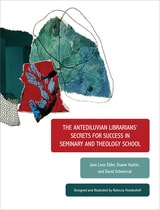
In The Antediluvian Librarians’ Secrets to Success, the authors draw on their combined experience and unique perspective as librarians to address the most common concerns they hear students express. Their light-hearted approach, combined with eye-catching illustrations, makes for a friendly work students can read from beginning to end or refer to as they move through their first anxious weeks of seminary.

In easy-to-digest segments, the book reveals the kind of strategies for being a graduate student that are seldom revealed in the classroom. Consisting of seven sections, The Antediluvian Librarians’ Secrets to Success offers guidance on such varied topics as reading strategically, asking questions, managing time, practicing self-care, staying organized, and tackling that first paper. It also offers lists for further reading and thoughtful pieces of advice. Although the authors are theological librarians, the recommendations they offer are just as practical for students beginning any graduate program in the humanities.

Deeply useful for anyone entering seminary or theology school both now and in the future, The Antediluvian Librarians’ Secrets to Success is the first work released from the new Bridwell Press. 
 
[more]
cover of The Crisis of Western Education (The Works of Christopher Dawson)

The Crisis of Western Education (The Works of Christopher Dawson)

Christopher Dawson

Catholic University of America Press, 2010

The Crisis of Western Education, originally published in 1961, served as a capstone of Christopher Dawson's thought on the Western educational system.
[more]
cover of The Stable Boy: The First Witness Tells His Story

The Stable Boy

The First Witness Tells His Story

Shirley A. Taylor

Parkhurst Brothers, Inc., 2012

In writing a nativity story from the point of view of a boy who lives in the stable, Shirley Taylor has given us a vivid account of Christ’s birth and a motivating experience to readers and hearers, alike.  Likely to become an ‘instant classic’ of Christian literature, this simple story will inspire thousands of retellings by pastors, Christian educators, parents and grandparents.

​"Shirley Taylor's story gives readers and hearers insight into the town of Bethlehem at the time of the birth of Christ. Wendell Hall's illustrations help us imagine that scene wonderfully. The young homeless boy touches our hearts and imaginations. Not just for children, this is a read aloud book for all ages." - Lauretta Phillips, Storyteller, Author, Radio & TV Host
[more]
cover of Thomas Shields and the Renewal of Catholic Education

Thomas Shields and the Renewal of Catholic Education

Leonardo Franchi

Catholic University of America Press, 2023
This book explores the contribution of the Rev Dr Thomas Shields (1862-1921) to Catholic education in the United States of America in the late 19th and early 20th century. Fr Shields was a pioneer in combining a career as an academic in Catholic University of America with the publication of many resources for schools. Given his pioneering role in aligning Catholic educational thought with emerging insights in the sciences, and his multi-layered commitment to Catholic education as scholar, author of textbooks and founder of initiatives in the field of Teacher Education, it seems fitting that his considerable body of work should be the subject of fresh scholarly investigation. The book is in five parts. Part 1, “Catholicism as an Educational Movement”, sets out the contours of the intellectual climate in which Shields operated and presents Catholicism as a dynamic educational movement. Part 2, “Responding to Progressive Thought”, explores the relationship between Progressivism and Catholic Education, showing how the Catholic Church responded to the challenges presented by Progressive thought. Part 3, “Shields and the Reform of Pedagogy”, examines both Shields’ general pedagogical principles and how they relate to Catholic education. Part 4, “Forming Teachers in Heart and Mind”, considers Shields’ ideas on Catholic Teacher Formation, exploring issues such as culture, vocation, method and curriculum. Part 5, “The Catholic Education Series”, explores selected examples from Shields’ Catholic Education Series to identify how his material for schools reflected, to a greater or lesser extent, his wider educational ideas. As the present age is also witness to considerable and deep-rooted challenges to Catholic education and, indeed to the Catholic understanding of the human person, Shields’ work will inspire contemporary reform-minded Catholic educators to reassess and develop the mission of Catholic education in light of the traditions of the Church.
[more]
cover of What We Hold in Trust: Rediscovering the Purpose of Catholic Higher Education

What We Hold in Trust

Rediscovering the Purpose of Catholic Higher Education

Don Briel

Catholic University of America Press, 2021
The specific concern in What We Hold in Trust comes to this: the Catholic university that sees its principal purpose in terms of the active life, of career, and of changing the world, undermines the contemplative and more deep-rooted purpose of the university. If a university adopts the language of technical and social change as its main and exclusive purpose, it will weaken the deeper roots of the university’s liberal arts and Catholic mission. The language of the activist, of changing the world through social justice, equality and inclusion, or of the technician through market-oriented incentives, plays an important role in university life. We need to change the world for the better and universities play an important role, but both the activist and technician will be co-opted by our age of hyper-activity and technocratic organizations if there is not first a contemplative outlook on the world that receives reality rather than constructs it. To address this need for roots What We Hold in Trust unfolds in four chapters that will demonstrate how essential it is for the faculty, administrators, and trustees of Catholic universities to think philosophically and theologically (Chapter One), historically (Chapter Two) and institutionally (Chapters Three and Four). What we desperately need today are leaders in Catholic universities who understand the roots of the institutions they serve, who can wisely order the goods of the university, who know what is primary and what is secondary, and who can distinguish fads and slogans from authentic reform. We need leaders who are in touch with their history and have a love for tradition, and in particular for the Catholic tradition. Without this vision, our universities may grow in size, but shrink in purpose. They may be richer but not wiser.
[more]
cover of Words Made Flesh: The Sacramental Mission of Catholic Education

Words Made Flesh

The Sacramental Mission of Catholic Education

R. Jared Staudt

Catholic University of America Press, 2024

Forming souls and building culture together form the sacramental mission of Catholic education. These profoundly related goals are laid out by the Church for education, following the general sacramental principle that permeates the whole of Catholic life. This approach seeks conformity to the Logos, the divine mind, that shapes the way disciples think, imagine, and pray. Guided by this approach, the student will be able to contemplate the truth of reality in a holistic and integrated fashion. As sacramental, it also leads to a concrete embodiment in the life of the Christian community and the daily actions of the disciple. A sacramental approach to education draws together the inner and outer life: mind and body, soul and culture, prayer and work, salvation and mission, the individual and community. For the future of society and renewal within the Church, we need nothing less than a reintegration of the person and our communities through the renewal of education, forming students deeply rooted in our heritage and prepared to hand it on in creative ways.
[more]