Results by title
6 books match the query 'Christian Right'

Globalizing Family Values
The Christian Right In International PoliticsDoris Buss
University of Minnesota Press, 2003
A timely exposé of the efforts of the religious right to influence global policy
With little fanfare and profound effect, “family values” have gone global, and the influence of the Christian Right is increasingly felt internationally. This is the first comprehensive study of the Christian Right’s global reach and its impact on international law and politics.
Doris Buss and Didi Herman explore tensions, contradictions, victories, and defeats for the Christian Right’s global project, particularly in the United Nations. The authors consult Christian Right materials, from pamphlets to novels; conduct interviews with people in the movement; and provide a firsthand account of the World Congress of Families II in 1999, a key event in formulating Christian Right global policy and strategy. The result is a detailed look at a new global player—its campaigns against women’s rights, population policy, and gay and lesbian rights; its efforts to build an alliance of orthodox faiths with non-Christians; and the tensions and strains as it seeks to negotiate a role for conservative Christianity in a changing global order.
History Repeating Itself
The Republication of Children's Historical Literature and the Christian RightGregory M. Pfitzer
University of Massachusetts Press, 2014
Recently publishers on the Christian Right have been reprinting nineteenth-century children's history books and marketing them to parents as “anchor texts” for homeschool instruction. Why, Gregory M. Pfitzer asks, would books written more than 150 years ago be presumed suitable for educating twenty-first-century children? The answer, he proposes, is that promoters of these recycled works believe that history as a discipline took a wrong turn in the early twentieth century, when progressive educators introduced social studies methodologies into public school history classrooms, foisting upon unsuspecting and vulnerable children ideologically distorted history books.
In History Repeating Itself, Pfitzer tests these assertions by scrutinizing and contextualizing the original nineteenth-century texts on which these republications are based. He focuses on how the writers borrowed from one another to produce works that were similar in many ways yet differed markedly in terms of pedagogical strategy and philosophy of history. Pfitzer demonstrates that far from being non-ideological, these works were rooted in intense contemporary debates over changing conceptions of childhood.
Pfitzer argues that the repurposing of antiquated texts reveals a misplaced resistance to the idea of a contested past. He also raises essential philosophical questions about how and why curricular decisions are shaped by the “past we choose to remember” on behalf of our children.
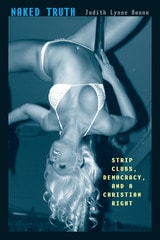
Naked Truth
Strip Clubs, Democracy, and a Christian RightBy Judith Lynne Hanna
University of Texas Press, 2012
Across America, strip clubs have come under attack by a politically aggressive segment of the Christian Right. Using plausible-sounding but factually untrue arguments about the harmful effects of strip clubs on their communities, the Christian Right has stoked public outrage and incited local and state governments to impose onerous restrictions on the clubs with the intent of dismantling the exotic dance industry. But an even larger agenda is at work, according to Judith Lynne Hanna. In Naked Truth, she builds a convincing case that the attack on exotic dance is part of the activist Christian Right’s “grand design” to supplant constitutional democracy in America with a Bible-based theocracy.
Hanna takes readers onstage, backstage, and into the community and courts to reveal the conflicts, charges, and realities that are playing out at the intersection of erotic fantasy, religion, politics, and law. She explains why exotic dance is a legitimate form of artistic communication and debunks the many myths and untruths that the Christian Right uses to fight strip clubs. Hanna also demonstrates that while the fight happens at the local level, it is part of a national campaign to regulate sexuality and punish those who do not adhere to Scripture-based moral values. Ultimately, she argues, the naked truth is that the separation of church and state is under siege and our civil liberties—free speech, women’s rights, and free enterprise—are at stake.
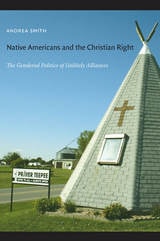
Native Americans and the Christian Right
The Gendered Politics of Unlikely AlliancesAndrea Smith
Duke University Press, 2008
Smith draws on archival research, interviews, and her own participation in Native struggles and Christian Right conferences and events. She considers American Indian activism within the Promise Keepers and new Charismatic movements. She also explores specific opportunities for building unlikely alliances. For instance, while evangelicals’ understanding of the relationship between the Bible and the state may lead to reactionary positions on issues including homosexuality, civil rights, and abortion, it also supports a relatively progressive position on prison reform. In terms of evangelical and Native American feminisms, she reveals antiviolence organizing to be a galvanizing force within both communities, discusses theories of coalition politics among both evangelical and indigenous women, and considers Native women’s visions of sovereignty and nationhood. Smith concludes with a reflection on the implications of her research for the field of Native American studies.
The Antigay Agenda
Orthodox Vision and the Christian RightDidi Herman
University of Chicago Press, 1997
"A penetrating analysis of the Christian Right's antigay agenda and of how that agenda is derived from the Christian Right's peculiar vision of American history and the Christian faith."—Rev. Peter J. Gomes, Boston Book Review
"Public intellectualism at its best. . . . A comprehensive summary of the conservative Protestant worldview."—Michael Joseph Gross, Boston Phoenix Literary Section
"Presents considerable information not previously part of the nation's political discourse. . . . [Herman] dissects the Christian Right's antigay stance dispassionately giving, as it were, the devil his due. For anyone on either side of this passionate and important conflict, that is an impressive accomplishment."—Hastings Wyman, Jr., Washington Post Book World
The Transformation of the Christian Right in the 1980s
Matthew C. Moen
University of Alabama Press, 2008
The Transformation of the Christian Right chronicles and analyzes the remarkable changes that have occurred in the Christian Right from its emergence in the late 1970s to the present. It documents the rapid turnover of Christian-Right organizations and explains the forces driving that kaleidoscopic change. Moen also traces the strategic shift of the movement’s leaders, away from lobbying the Congress and toward mobilizing conservative activists in the grass roots; he demonstrates the substitution of liberal language (with its emphasis on “equality, rights, and freedom”) for moralistic language (with its focus on “right and wrong”). Much has been written about the Christian Right’s impact on politics but little about how years of political activism have shaped and influenced the Christian Right. Moen addresses that neglected side of the issue.