Results by title
128 books match the query 'Church of Jesus Christ of Latter-day Saints' and 8 start with a
A Chosen People, a Promised Land
Mormonism and Race in Hawai’iHokulani K. Aikau
University of Minnesota Press, 2012
Christianity figured prominently in the imperial and colonial exploitation and dispossession of indigenous peoples worldwide, yet many indigenous people embrace Christian faith as part of their cultural and ethnic identities. A Chosen People, a Promised Land gets to the heart of this contradiction by exploring how Native Hawaiian members of the Church of Jesus Christ of Latter-Day Saints (more commonly known as Mormons) understand and negotiate their place in this quintessentially American religion.
Mormon missionaries arrived in Hawai‘i in 1850, a mere twenty years after Joseph Smith founded the church. Hokulani K. Aikau traces how Native Hawaiians became integrated into the religious doctrine of the church as a “chosen people”—even at a time when exclusionary racial policies regarding black members of the church were being codified. Aikau shows how Hawaiians and other Polynesian saints came to be considered chosen and how they were able to use their venerated status toward their own spiritual, cultural, and pragmatic ends.
Using the words of Native Hawaiian Latter-Day Saints to illuminate the intersections of race, colonization, and religion, A Chosen People, a Promised Land examines Polynesian Mormon articulations of faith and identity within a larger political context of self-determination.
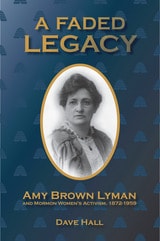
A Faded Legacy
Amy Brown Lyman and Mormon Women's Activism, 1872 - 1959Dave Hall
University of Utah Press, 2015
Placing Lyman’s story within a local and national context, award-winning author Dave Hall examines the roots and trajectory of Mormon women’s activism. Born into a polygamist family, Lyman entered the larger sphere of public life at the time when the practice of polygamy was ending and Mormonism had begun assimilating mainstream trends. The book follows her life as she prepared for a career, married, and sought meaning in a rapidly changing society. It recounts her involvement in the Relief Society, the Mormon women’s charity group that she led for many years and sought to transform into a force for social welfare, and it considers the influence of her connections with national and international women’s organizations. The final period of Lyman’s life, in which she resigned from the Relief Society amidst personal tragedy, offers insight into the reasons Mormon women abandoned their activist heritage for a more conservative role, a stance that is again evolving.
Winner of the Mormon History Association's Best First Book Award.
A Foreign Kingdom
Mormons and Polygamy in American Political Culture, 1852-1890Christine Talbot
University of Illinois Press, 2013
A Kingdom Transformed
Early Mormonism and the Modern LDS Church, New EditionGordon Shepherd and Gary Shepherd
University of Utah Press, 2015
The first edition showed how early twentieth century LDS leaders were fairly liberal in mainstreaming church doctrines and social teaching, but by mid-twentieth century, as the church became more stable, accepted, and successful, church authorities reversed several earlier modifications and began emphasizing a stricter, more conservative theology that coincided with an increasingly conservative political orientation. The new book adds current issues of concern, such as the role of women in the church and international growth versus member retention. It also introduces a new conceptual framework for interpreting findings.
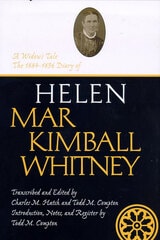
A Widow's Tale
1884-1896 Diary of Helen Mar Kimball WhitneyCharles M. Hatch and Todd Compton
Utah State University Press, 2003
Mormon culture has produced during its history an unusual number of historically valuable personal writings. Few such diaries, journals, and memoirs published have provided as rich and well rounded a window into their authors' lives and worlds as the diary of Helen Mar Kimball Whitney. Because it provides a rare account of the widely experienced situations and problems faced by widows, her record has relevance far beyond Mormon history though.
As a teenager Helen Kimball had been a polygamous wife of Mormon founder Joseph Smith. She subsequently married Horace Whitney. Her children included the noted Mormon author, religious authority, and politician Orson F. Whitney. She herself was a leading woman in her church and society and a writer known especially for her defense of plural marriage. Upon Horace's death, she began keeping a diary. In it, she recorded her economic, physical, and psychological struggles to meet the challenges of widowhood. Her writing was introspective and revelatory. She also commented on the changing society around her, as Salt Lake City in the last decades of the nineteenth century underwent rapid transformation, modernizing and opening up from its pioneer beginnings. She remained a well-connected member of an elite group of leading Latter-day Saint women, and prominent Utah and Mormon historical figures appear frequently in her daily entries. Above all, though, her diary is an unusual record of difficulties faced in many times and places by women, of all classes, whose husbands died and left them without sufficient means to carry on the types of lives to which they had been accustomed.
All Abraham's Children
Changing Mormon Conceptions of Race and LineageArmand L. Mauss
University of Illinois Press, 2003
Mauss describes a complex process of the broadening of these self-defined lineages during the last part of the twentieth century as the modern Mormon church continued its world-wide expansion through massive missionary work.
Mauss contends that Mormon constructions of racial identity have not necessarily affected actual behavior negatively and that in some cases Mormons have shown greater tolerance than other groups in the American mainstream.
Employing a broad intellectual historical analysis to identify shifts in LDS behavior over time, All Abraham’s Children is an important commentary on current models of Mormon historiography.
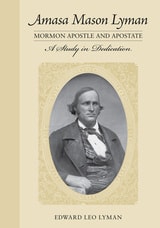
Amasa Mason Lyman, Mormon Apostle and Apostate
A Study in DedicationEdward Leo Lyman
University of Utah Press, 2009
Having spent more than thirty years in the service of his church, Lyman began to move away from its teachings after a series of conflicts with its second leader, Brigham Young. Lyman was one of the first Mormons to criticize the Mountain Meadows Massacre, which led to his dismissal as an apostle. He was excommunicated in 1870 and became one of the foremost spokesmen of the Godbeite Church of Zion movement before his death in 1877. Author Edward Leo Lyman chronicles Amasa Lyman’s life and interactions with Mormon history with an honesty true to his ancestor’s freethinking spirit.
Winner of the Francis Armstrong Madsen Best Utah History Book Award from the Utah Division of State History.
An Imperfect Book
What the Book of Mormon Tells Us about ItselfEarl M. Wunderli
Signature Books, 2013
Dale E. Luffman, Association for Mormon Letters