Results by title

13 books match the query 'Cicero, Marcus Tullius'
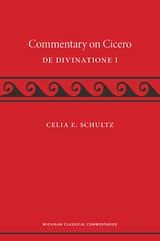
cover of A Commentary on Cicero, De Divinatione I

A Commentary on Cicero, De Divinatione I

Celia E. Schultz

University of Michigan Press, 2014
A Commentary on Cicero, De Divinatione I, is the first English-language commentary on the Latin text of Marcus Tullius Cicero’s dialogue in almost one hundred years. The defense of divination (the science of predicting the future) offered in Book 1 is illustrated with many entertaining anecdotes that make the argument more accessible to a wider range of readers than many of Cicero’s other philosophical works. De Divinatione also preserves many fragments of otherwise lost masterpieces of Roman Republican literature. It is a text important for the study of Roman religion, as well as Roman political and intellectual history.

This commentary aims to assist the reader in seeing De Divinatione as a cohesive whole, and to make it accessible—not only to classicists, but also to scholars of religion and to philosophers who may not be familiar with the historical and Roman intellectual background that are the focus here. The cases made for and against divination in De Divinatione closely follow arguments made by Greek philosophers, but many of the examples illustrating them reflect Cicero’s preferences in literature, his own poetic efforts and political experience, and his expertise as an augur. The result is a very personal work closely tied to Cicero’s own experience.

Celia Schultz’s volume contains the full Latin text of De Divinatione, Book 1, and accompanies it with commentary on points of grammar, history, prosopography, and ancient religious practice, among other topics. She includes a helpful bibliography for those interested in further study of points raised in the text or commentary.
[more]
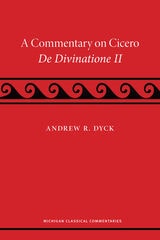
cover of A Commentary on Cicero, De Divinatione II

A Commentary on Cicero, De Divinatione II

Andrew R. Dyck

University of Michigan Press, 2020

Andrew R. Dyck ranks among the top Latinists in Ciceronian studies. In this new volume, he offers the first commentary on Cicero’s De Divinatione II in nearly a century. This commentary aims to equip students and scholars of Latin with the kinds of historical and philosophical background and linguistic and stylistic information needed to understand and appreciate Cicero’s text on Roman religion and divination. Dyck situates Cicero’s text in the context of Roman religion in antiquity, and he traces the subsequent reception of the text. The introduction reviews recent interpretations of De Divinatione. Dyck rejects the view that has recently been widespread in Anglophone studies that De Divinatione stages a debate between roughly equal opponents and without the emergence of a clear authorial point of view. Instead he argues that a careful reading shows that Cicero as author is invested in the argument, with the particular aim of countering superstition.

Celia Schultz’s earlier volume in this series presented the text and commentary for De Divinatione I. With Andrew Dyck’s companion volume on the second book of De Divinatione, students and teachers are well served with crucial texts from one of Rome’s most famous philosophers, as he considers important Roman practices and beliefs.
[more]
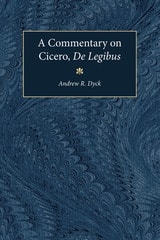
cover of A Commentary on Cicero, De Legibus

A Commentary on Cicero, De Legibus

Andrew R. Dyck

University of Michigan Press, 2004

Just as Plato drafted a vision of an ideal state in his Republic and followed that up with detailed provisions in his Laws, so Cicero -- after writing a Republic -- wanted to provide legislation for his ideal state and wrote de Legibus (the Laws) as a sequel. But while Cicero's Republic was set shortly before the death of its speaker, Scipio Africanus, in 129 b.c., his de Legibus was set in his own lifetime, thus enabling him to comment on current political events and trends. Written in the final years of the Roman Republic, de Legibus is as a work that gives Cicero's own diagnosis of the ills that had befallen the Roman state and what might be done to cure them. It is thus a document crucial to our understanding of one of the most turbulent periods of Roman history.
Surprisingly, de Legibus has been one of Cicero's most neglected works. Andrew R. Dyck's commentary is the first to appear on the complete work in well over one hundred years. Dyck provides a detailed interpretation and sets the essay into the context of the politics and philosophical thought of its time. While previous commentaries focused primarily on grammar and textual criticism, this one also seeks to relate Cicero's text to the political, philosophical, and religious trends of his day. The author identifies the influences on Cicero's thinking and analyzes the relation of this theoretical treatise to his other works. This commentary is based on a new text, worked out in consultations between the author and Jonathan Powell of Royal Holloway, London.
Andrew Dyck is Professor of Classics, University of California at Los Angeles.
[more]
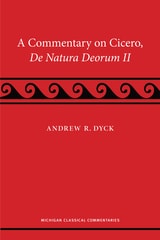
cover of A Commentary on Cicero, De Natura Deorum II

A Commentary on Cicero, De Natura Deorum II

Andrew R. Dyck

University of Michigan Press, 2025
Distinguished Latinist Andrew R. Dyck presents the first English commentary on Cicero’s De Natura Deorum II in over fifty years. This text is the only connected exposition of Stoic theology to survive from the ancient world. It includes an argument for the existence of the gods from the construction of the cosmos taken up by later thinkers, as well as an exposition of the world-order and divine providence according to Stoic doctrine. After a period in which Cicero’s philosophical works were treated mainly as sources for reconstructing the thought of earlier philosophers, they are now coming to be appreciated as intelligent and skillful works in their own right. This book will assist students and others studying Cicero’s De Natura Deorum II by providing its historical context, improved Latin text, and a detailed commentary with references to the latest literature on the subject.
[more]
cover of A Commentary on Cicero, De Officiis

A Commentary on Cicero, De Officiis

Andrew R. Dyck

University of Michigan Press, 1997

Toward the end of the last century Cicero's work came under attack from several angles. His political stance was sharply criticized for inconsistency by Theodor Mommsen and others, his philosophical works for lack of originality. Since then scholars have come to a better understanding of the political conditions that informed the views of Mommsen and his contemporaries about Caesar and Cicero, and as a result Cicero's writings have been restored to a more appropriate position in the literature and history of the Roman Republic. At the same time recent years have seen an intensive study of Hellenistic philosophy, and this has shown more clearly than before that, even while following Greek models, Cicero nonetheless pursued his own political and, in the ethical works, moralistic agenda.
Composed in haste shortly before Cicero's death, de Officiis has exercised enormous influence over the centuries. It is all the more surprising that Andrew R. Dyck's volume is the first detailed English commentary on the work written in this century. It deals with the problems of the Latin text (taking account of Michael Winterbottom's new edition), it delineates the work's structure and sometimes elusive train of thought, clarifies the underlying Greek and Latin concepts, and provides starting points for approaching the philosophical and historical problems that de Officiis raises.
A work of major importance for classicists, philosophers, and ancient historians, this Commentary will be an invaluable companion to all readers of Cicero's last philosophical work.
Andrew R. Dyck is Professor of Classics, University of California, Los Angeles.
Publication of this volume is supported by a grant from the National Endowment for the Humanities.
[more]
cover of Cicero on the Emotions: Tusculan Disputations 3 and 4

Cicero on the Emotions

Tusculan Disputations 3 and 4

Marcus Tullius Cicero

University of Chicago Press, 2002

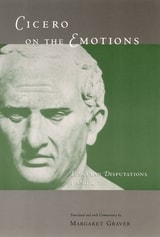
The third and fourth books of Cicero's Tusculan Disputations deal with the nature and management of human emotion: first grief, then the emotions in general. In lively and accessible style, Cicero presents the insights of Greek philosophers on the subject, reporting the views of Epicureans and Peripatetics and giving a detailed account of the Stoic position, which he himself favors for its close reasoning and moral earnestness. Both the specialist and the general reader will be fascinated by the Stoics' analysis of the causes of grief, their classification of emotions by genus and species, their lists of oddly named character flaws, and by the philosophical debate that develops over the utility of anger in politics and war.

Margaret Graver's elegant and idiomatic translation makes Cicero's work accessible not just to classicists but to anyone interested in ancient philosophy and psychotherapy or in the philosophy of emotion. The accompanying commentary explains the philosophical concepts discussed in the text and supplies many helpful parallels from Greek sources.
[more]
cover of Cicero's Use of Judicial Theater

Cicero's Use of Judicial Theater

Jon Hall

University of Michigan Press, 2014

In Cicero’s Use of Judicial Theater, Jon Hall examines Cicero's use of showmanship in the Roman courts, looking in particular at the nonverbal devices that he employs during his speeches as he attempts to manipulate opinion. Cicero's speeches in the law-courts often incorporate theatrical devices including the use of family relatives as props during emotional appeals, exploitation of tears and supplication, and the wearing of specially dirtied attire by defendants during a trial, all of which contrast strikingly with the practices of the modem advocate. Hall investigates how Cicero successfully deployed these techniques and why they played such a prominent part in the Roman courts. These "judicial theatrics" are rarely discussed by the ancient rhetorical handbooks, and Cicero’s Use of Judicial Theater argues that their successful use by Roman orators derives largely from the inherent theatricality of aristocratic life in ancient Rome—most of the devices deployed in the courts appear elsewhere in the social and political activities of the elite.

While Cicero’s Use of Judicial Theater will be of interest primarily to professional scholars and students studying the speeches of Cicero, its wider analyses, both of Roman cultural customs and the idiosyncratic practices of the courts, will prove relevant also to social historians, as well as historians of legal procedure.
[more]
cover of Cicero, Catullus, and the Language of Social Performance

Cicero, Catullus, and the Language of Social Performance

Brian A. Krostenko

University of Chicago Press, 2001

Charm, wit, and style were critical, but dangerous, ingredients in the social repertoire of the Roman elite. Their use drew special attention, but also exposed one to potential ridicule or rejection for valuing style over substance. Brian A. Krostenko explores the complexities and ambiguities of charm, wit, and style in Roman literature of the late Republic by tracking the origins, development, and use of the terms that described them, which he calls "the language of social performance."

As Krostenko demonstrates, a key feature of this language is its capacity to express both approval and disdain—an artifact of its origins at a time when the "style" and "charm" of imported Greek cultural practices were greeted with both enthusiasm and hostility. Cicero played on that ambiguity, for example, by chastising lepidus ("fine") boys in the "Second Oration against Catiline" as degenerates, then arguing in his De Oratore that the successful speaker must have a certain charming lepos ("wit"). Catullus, in turn, exploited and inverted the political subtexts of this language for innovative poetic and erotic idioms.
[more]
cover of Crime and Community in Ciceronian Rome

Crime and Community in Ciceronian Rome

By Andrew M. Riggsby

University of Texas Press, 1999

In the late Roman Republic, acts of wrongdoing against individuals were prosecuted in private courts, while the iudicia publica (literally "public courts") tried cases that involved harm to the community as a whole. In this book, Andrew M. Riggsby thoroughly investigates the types of cases heard by the public courts to offer a provocative new understanding of what has been described as "crime" in the Roman Republic and to illuminate the inherently political nature of the Roman public courts.

Through the lens of Cicero's forensic oratory, Riggsby examines the four major public offenses: ambitus (bribery of the electorate), de sicariis et veneficiis (murder), vis (riot), and repetundae (extortion by provincial administrators). He persuasively argues that each of these offenses involves a violation of the proper relations between the state and the people, as interpreted by orators and juries. He concludes that in the late Roman Republic the only crimes were political crimes.
[more]
cover of Ethics and the Orator: The Ciceronian Tradition of Political Morality

Ethics and the Orator

The Ciceronian Tradition of Political Morality

Gary A. Remer

University of Chicago Press, 2017

For thousands of years, critics have attacked rhetoric and the actual practice of politics as unprincipled, insincere, and manipulative. In Ethics and the Orator, Gary A. Remer disagrees, offering the Ciceronian rhetorical tradition as a rejoinder. He argues that the Ciceronian tradition is based on practical or “rhetorical” politics, rather than on idealistic visions of a politics-that-never-was—a response that is ethically sound, if not altogether morally pure.

Remer’s study is distinct from other works on political morality in that it turns to Cicero, not Aristotle, as the progenitor of an ethical rhetorical perspective. Contrary to many, if not most, studies of Cicero since the mid-nineteenth century, which have either attacked him as morally indifferent or have only taken his persuasive ends seriously (setting his moral concerns to the side), Ethics and the Orator demonstrates how Cicero presents his ideal orator as exemplary not only in his ability to persuade, but in his capacity as an ethical person. Remer makes a compelling case that Ciceronian values—balancing the moral and the useful, prudential reasoning, and decorum—are not particular only to the philosopher himself, but are distinctive of a broader Ciceronian rhetorical tradition that runs through the history of Western political thought post-Cicero, including the writings of Quintilian, John of Salisbury, Justus Lipsius, Edmund Burke, the authors of The Federalist, and John Stuart Mill.
[more]
cover of Ossium Carnes Multae e Marci Tullii Ciceronis Epistulis / The Bones’ Meats Abundant from the Epistles of Marcus Tullius Cicero

Ossium Carnes Multae e Marci Tullii Ciceronis Epistulis / The Bones’ Meats Abundant from the Epistles of Marcus Tullius Cicero

Reginaldus Thomas Foster

Catholic University of America Press, 2021
Beginners and experts alike will find a complete immersion into the workings and nature of the Latin language embodied in the incomparable, insuperable epistles of the great Marcus Tullius Cicero, something which other commentators pass over or scorn. This second volume puts “meat on the bones” of the Latin language presented in the first volume: Ossa Latinitatis Sola: The Mere Bones of Latin. The personal letters of Cicero provide ample meat to enflesh the skeletal structure of the language, thus the title: Ossium Carnes Multae: The Bones’ Meats Abundant from the epistles of Marcus Tullius Cicero. Part 1 presents 51 complete letters from the Tyrell-Purser text. Facing each letter is an image of its oldest manuscript edition as early as the ninth century, which are preserved and guarded in the Medicea Laurentiana library in Florence, Italy, witnessing to the human hand preserving this monument of world heritage for over two millennia. Part 2 follows with a most careful rendition into English of Tully’s living, telephone-like Latin discourse. A thorough treatment and explanation of noteworthy elements of his natural talk follows with numerous references to the Encounters in Volume I. All this has students, learners, teachers, experts of the Latin language in mind and is humbly designed to deepen the understanding and appreciation of specific expressions and peculiarities of Cicero’s language itself. Part 3 provides 500 sentences consisting of from 1 to 5 words and suited for the beginnings or continuation of Latin conversations: 200 declarations, 100 questions, 100 exclamations, 100 injunctions drawn from his letters. The volume is amply indexed. All this has been done to enhance the study and use of Latin, to popularize Cicero’s correspondence, to prepare the reader for Volume III which will deal again with the letters and their usefulness for Latin conversation.
[more]
cover of The Ciceronian Tradition in Political Theory

The Ciceronian Tradition in Political Theory

Edited by Daniel J. Kapust and Gary Remer

University of Wisconsin Press, 2021

Cicero is one of the most influential thinkers in the history of Western political thought, and interest in his work has been undergoing a renaissance in recent years. The Ciceronian Tradition in Political Theory focuses entirely on Cicero’s influence and reception in the realm of political thought.

Individual chapters examine the ways thinkers throughout history, specifically Augustine, John of Salisbury, Thomas More, Machiavelli, Montaigne, Hobbes, Locke, Adam Smith, and Edmund Burke, have engaged with and been influenced by Cicero. A final chapter surveys the impact of Cicero’s ideas on political thought in the second half of the twentieth century. By tracing the long reception of these ideas, the collection demonstrates not only Cicero’s importance to both medieval and modern political theorists but also the comprehensive breadth and applicability of his philosophy.
[more]
cover of The Gift of Correspondence in Classical Rome: Friendship in Cicero's Ad Familiares and Seneca's Moral Epistles

The Gift of Correspondence in Classical Rome

Friendship in Cicero's Ad Familiares and Seneca's Moral Epistles

Amanda Wilcox

University of Wisconsin Press, 2012

Amanda Wilcox offers an innovative approach to two major collections of Roman letters—Cicero’s Ad Familiares and Seneca’s Moral Epistles—informed by modern cross-cultural theories of gift-giving.
    By viewing letters and the practice of correspondence as a species of gift exchange, Wilcox provides a nuanced analysis of neglected and misunderstood aspects of Roman epistolary rhetoric and the social dynamics of friendship in Cicero’s correspondence. Turning to Seneca, she shows that he both inherited and reacted against Cicero’s euphemistic rhetoric and social practices, and she analyzes how Seneca transformed the rhetoric of his own letters from an instrument of social negotiation into an idiom for ethical philosophy and self-reflection. Though Cicero and Seneca are often viewed as a study in contrasts, Wilcox extensively compares their letters, underscoring Cicero’s significant influence on Seneca as a prose stylist, philosopher, and public figure.

[more]