Results by title
11 books match the query 'Civilization, Classical'
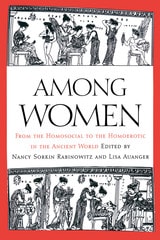
Among Women
From the Homosocial to the Homoerotic in the Ancient WorldEdited by Nancy Sorkin Rabinowitz and Lisa Auanger
University of Texas Press, 2002
Women's and men's worlds were largely separate in ancient Mediterranean societies, and, in consequence, many women's deepest personal relationships were with other women. Yet relatively little scholarly or popular attention has focused on women's relationships in antiquity, in contrast to recent interest in the relationships between men in ancient Greece and Rome. The essays in this book seek to close this gap by exploring a wide variety of textual and archaeological evidence for women's homosocial and homoerotic relationships from prehistoric Greece to fifth-century CE Egypt.
Drawing on developments in feminist theory, gay and lesbian studies, and queer theory, as well as traditional textual and art historical methods, the contributors to this volume examine representations of women's lives with other women, their friendships, and sexual subjectivity. They present new interpretations of the evidence offered by the literary works of Sappho, Ovid, and Lucian; Bronze Age frescoes and Greek vase painting, funerary reliefs, and other artistic representations; and Egyptian legal documents.
Ancient Pathways and Hidden Pursuits
Religion, Morals, and Magic in the Ancient WorldGeorg Luck
University of Michigan Press, 2000
The present volume includes the author's thoughts on Greek and Roman religions, early Christianity, Greek and Roman psychology and morals, and magic and the occult. Luck's main findings explore generally neglected areas of ancient civilization, locating magic and philosophy with religion as vehicles for moral and psychological guidance. Throughout this study, one finds meaning in "superstitious" and conflicting patterns of behavior and learns much about the nature of the human soul. This collection will serve as a valuable reference for those interested in the driving motivations of ancient man.
"The topics of the individual articles in this volume are very central and of great humanistic appeal, and they indeed form a thematic unity concerning man and religion in Greek and Roman society." --Ludwig Koenen, Herbert C. Youtie Distinguished University Professor of Papyrology, University of Michigan
Georg Luck is Professor of Classics, emeritus, The Johns Hopkins University.
Bakhtin and the Classics
R. Bracht Branham
Northwestern University Press, 2001
The authors, eminent classicists and distinguished critics of Bakhtin, put Bakhtin into dialogue with the classics--and classicists into dialogue with Bakhtin. Each essay offers a critical account of an important aspect of Bakhtin's thought and examines the value of his approach in the context of literary or cultural history. Beginning with an overview of Bakhtin's notion of carnival laughter, perhaps his central critical concept, the volume explores Bakhtin's thought and writing in relation to Homer's epic verse. Catullus's lyric poetry, ancient Roman novels, and Greek philosophy from Aristotle's theory of narrative to the work of Antiphon the Sophist. The results are of interest and importance to Bakhtinians, theorists, and classicists.
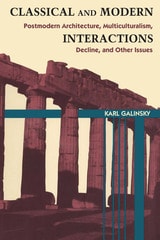
Classical and Modern Interactions
Postmodern Architecture, Multiculturalism, Decline, and Other IssuesBy Karl Galinsky
University of Texas Press, 1992
Postmodernism, multiculturalism, the alleged decline of the United States, deconstruction, leadership, and values—these topics have been at the forefront of contemporary intellectual and cultural debate and are likely to remain so for the near future. Participants in the debate can usefully enlarge the perspective to a comparison between the Greco-Roman world and contemporary society. In this thought-provoking work, a noted classics scholar tests the ancient-modern comparison, showing what it can add to the contemporary debates and what its limitations are.
Writing for intellectually adventurous readers, Galinsky explores Greece and Rome as multicultural societies, debates the merits of classicism in postmodern architecture, discusses the reign of Augustus in terms of modern leadership theories, and investigates the modern obsession with finding parallels between the supposed "decline and fall" of Rome and the "decay" of U.S. society.
Within these discussions, Galinsky shows the continuing vitality of the classical tradition in the contemporary world. The Greek and Roman civilizations have provided us not only with models for conscious adaptation but also points for radical departures. This ability to change and innovate from classical models is crucial, Galinsky maintains. It creates a reciprocal process whereby contemporary issues are projected into the past while aspects of the ancient world are redefined in terms of current approaches.
These essays result in a balanced assessment and stimulating restatement of some major issues in both contemporary U.S. society and the Greco-Roman world. The book, which speaks to a wide interdisciplinary audience, is based on a series of lectures that Galinsky gave as a national visiting scholar for Phi Beta Kappa. It concludes with a discussion of the role of classical studies in the United States today.

Dining in a Classical Context
William J. Slater, Editor
University of Michigan Press, 1991
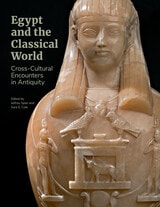
Egypt and the Classical World
Cross-Cultural Encounters in AntiquityJeffrey Spier
J. Paul Getty Trust, The, 2022
From Mycenaean weaponry found among the cargo of a Bronze Age shipwreck off the Turkish coast to the Egyptian-inspired domestic interiors of a luxury villa built in Greece during the Roman Empire, Egypt and the Classical World documents two millennia of cultural and artistic interconnectedness in the ancient Mediterranean. This volume gathers pioneering research from the Getty scholars' symposium that helped shape the major international loan exhibition Beyond the Nile: Egypt and the Classical World (J. Paul Getty Museum, 2018).
Generously illustrated essays consider a range of artistic and other material evidence, including archaeological finds, artworks, papyri, and inscriptions, to shed light on cultural interactions between Egypt, Greece, and Rome from the Bronze Age to the Late Period and Ptolemaic dynasty to the Roman Empire. The military's role as a conduit of knowledge and ideas in the Bronze Age Aegean, and an in-depth study of hieroglyphic Egyptian inscriptions found on Roman obelisks offer but two examples of scholarly lacunae addressed by this publication. Specialists across the fields of art history, archaeology, Classics, Egyptology, and philology will benefit from the volume's investigations into syncretic processes that enlivened and informed nearly twenty-five hundred years of dynamic cultural exchange.
The free online edition of this open-access publication is available at www.getty.edu/publications/egypt-classical-world/ and includes zoomable, high-resolution photography. Also available are free PDF, EPUB, and Kindle/MOBI downloads of the book.

From Abortion to Pederasty
Addressing Difficult Topics in the Classics ClassroomEdited by Nancy Sorkin Rabinowitz and Fiona McHardy
The Ohio State University Press, 2014
From Abortion to Pederasty: Addressing Difficult Topics in the Classics Classroom, edited by Nancy Sorkin Rabinowitz and Fiona McHardy, is committed to the proposition that it is important to continue to teach texts that raise these issues, not to avoid them. In this volume, classicists and ancient historians from around the world address how to teach such topics as rape, pederasty, and slavery in the classics classroom. The contributors present the concrete ways in which they themselves have approached such issues in their course planning and in their responses to students’ needs.
A main objective of From Abortion to Pederasty is to combat arguments, from both the left and the right, that the classics are elitist and irrelevant. Indeed, they are so relevant, and so challenging, as to be painful at times. Another objective is to show how Greco-Roman culture and history can provide a way into a discussion that might have been difficult or even traumatic in other settings. Thus it will provide teaching tools for dealing with uncomfortable topics in the classroom, including homophobia and racism.

Ireland and the Classical World
By Philip Freeman
University of Texas Press, 2000
On the boundary of what the ancient Greeks and Romans considered the habitable world, Ireland was a land of myth and mystery in classical times. Classical authors frequently portrayed its people as savages—even as cannibals and devotees of incest—and evinced occasional uncertainty as to the island's shape, size, and actual location. Unlike neighboring Britain, Ireland never knew Roman occupation, yet literary and archaeological evidence prove that Iuverna was more than simply terra incognita in classical antiquity.
In this book, Philip Freeman explores the relations between ancient Ireland and the classical world through a comprehensive survey of all Greek and Latin literary sources that mention Ireland. He analyzes passages (given in both the original language and English) from over thirty authors, including Julius Caesar, Strabo, Tacitus, Ptolemy, and St. Jerome. To amplify the literary sources, he also briefly reviews the archaeological and linguistic evidence for contact between Ireland and the Mediterranean world.
Freeman's analysis of all these sources reveals that Ireland was known to the Greeks and Romans for hundreds of years and that Mediterranean goods and even travelers found their way to Ireland, while the Irish at least occasionally visited, traded, and raided in Roman lands. Everyone interested in ancient Irish history or Classics, whether scholar or enthusiast, will learn much from this pioneering book.
Love, Sex & Tragedy
How the Ancient World Shapes Our LivesSimon Goldhill
University of Chicago Press, 2004
Marx, Clark Gable, George W. Bush, Oscar Wilde, and Freud—Goldhill's range here is enormous, and he takes great delight in tracing both follies and fundamental philosophical questions through the centuries and continents to the birthplace of Western civilization as we know it. Underlying his brisk and learned excursions through history and art is the foundational belief, following Cicero, that learning about the classics makes a critical difference to our self-understanding. Whether we are considering the role of religion in contemporary society, our expectations about the boundaries between public and private life, or even how we spend our free time, recognizing the role of the classics is integral to our comprehension of modern life and our place in it.
When Goldhill asks "Who do you think you are?" he presents us with the rarest of opportunities: the chance to let him lead us, firmly but with a wink, back two thousand years to where we are.
The Ancient Greek Roots of Human Rights
By Rachel Hall Sternberg
University of Texas Press, 2021
2022 PROSE Award Finalist in Classics
Although the era of the Enlightenment witnessed the rise of philosophical debates around benevolent social practice, the origins of European humane discourse date further back, to Classical Athens. The Ancient Greek Roots of Human Rights analyzes the parallel confluences of cultural factors facing ancient Greeks and eighteenth-century Europeans that facilitated the creation and transmission of humane values across history. Rachel Hall Sternberg argues that precursors to the concept of human rights exist in the ancient articulation of emotion, though the ancient Greeks, much like eighteenth-century European societies, often failed to live up to those values.
Merging the history of ideas with cultural history, Sternberg examines literary themes upholding empathy and human dignity from Thucydides’s and Xenophon’s histories to Voltaire’s Candide, and from Greek tragic drama to the eighteenth-century novel. She describes shared impacts of the trauma of war, the appeal to reason, and the public acceptance of emotion that encouraged the birth and rebirth of humane values.
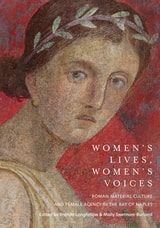
Women's Lives, Women's Voices
Roman Material Culture and Female Agency in the Bay of NaplesEdited by Brenda Longfellow and Molly Swetnam-Burland
University of Texas Press, 2021
Literary evidence is often silent about the lives of women in antiquity, particularly those from the buried cities of Pompeii and Herculaneum. Even when women are considered, they are often seen through the lens of their male counterparts. In this collection, Brenda Longfellow and Molly Swetnam-Burland have gathered an outstanding group of scholars to give voice to both the elite and ordinary women living on the Bay of Naples before the eruption of Vesuvius.
Using visual, architectural, archaeological, and epigraphic evidence, the authors consider how women in the region interacted with their communities through family relationships, businesses, and religious practices, in ways that could complement or complicate their primary social roles as mothers, daughters, and wives. They explore women-run businesses from weaving and innkeeping to prostitution, consider representations of women in portraits and graffiti, and examine how women expressed their identities in the funerary realm. Providing a new model for studying women in the ancient world, Women’s Lives, Women’s Voices brings to light the day-to-day activities of women of all classes in Pompeii and Herculaneum.