Results by title
6 books match the query 'Classical antiquities'
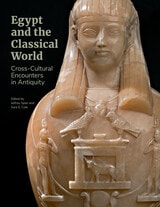
Egypt and the Classical World
Cross-Cultural Encounters in AntiquityJeffrey Spier
J. Paul Getty Trust, The, 2022
Presenting dynamic research, this publication explores two millennia of cultural interactions between Egypt, Greece, and Rome.
From Mycenaean weaponry found among the cargo of a Bronze Age shipwreck off the Turkish coast to the Egyptian-inspired domestic interiors of a luxury villa built in Greece during the Roman Empire, Egypt and the Classical World documents two millennia of cultural and artistic interconnectedness in the ancient Mediterranean. This volume gathers pioneering research from the Getty scholars' symposium that helped shape the major international loan exhibition Beyond the Nile: Egypt and the Classical World (J. Paul Getty Museum, 2018).
Generously illustrated essays consider a range of artistic and other material evidence, including archaeological finds, artworks, papyri, and inscriptions, to shed light on cultural interactions between Egypt, Greece, and Rome from the Bronze Age to the Late Period and Ptolemaic dynasty to the Roman Empire. The military's role as a conduit of knowledge and ideas in the Bronze Age Aegean, and an in-depth study of hieroglyphic Egyptian inscriptions found on Roman obelisks offer but two examples of scholarly lacunae addressed by this publication. Specialists across the fields of art history, archaeology, Classics, Egyptology, and philology will benefit from the volume's investigations into syncretic processes that enlivened and informed nearly twenty-five hundred years of dynamic cultural exchange.
The free online edition of this open-access publication is available at www.getty.edu/publications/egypt-classical-world/ and includes zoomable, high-resolution photography. Also available are free PDF, EPUB, and Kindle/MOBI downloads of the book.
[more]
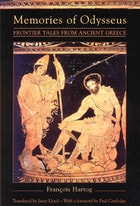
Memories of Odysseus
Frontier Tales From Ancient GreeceFrançois Hartog
University of Chicago Press, 2001
The conception of the Other has long been a problem for philosophers. Emmanuel Levinas, best known for his attention to precisely that issue, argued that the voyages of Ulysses represent the very nature of Western philosophy: "His adventure in the world is nothing but a return to his native land, a complacency with the Same, a misrecognition of the Other." In Memories of Odysseus, François Hartog examines the truth of Levinas' assertion and, in the process, uncovers a different picture. Drawing on a remarkable range of authors and texts, ancient and modern, Hartog looks at accounts of actual travelers, as well as the way travel is used as a trope throughout ancient Greek literature, and finds that, instead of misrecognition, the Other is viewed with doubt and awe in the Homeric tradition. In fact, he argues, the Odyssey played a crucial role in shaping this attitude in the Greek mind, serving as inspiration for voyages in which new encounters caused the Greeks to revise their concepts of self and other. Ambitious in scope, this book is a sophisticated exploration of ancient Greece and its sense of identity.
[more]
Provenance Research for Mediterranean Antiquities
Methods and ResourcesJudith Barr
J. Paul Getty Trust, The, 2026
This practical volume is the first to gather resources specific to the provenance of Mediterranean antiquities in an accessible, comprehensive guidebook.
The first of its kind, this book is an accessible, comprehensive primer of methods and resources for researching the provenance of Mediterranean (Greek, Roman, and Etruscan) antiquities. In addition to outlining effective strategies for documentation and investigation, the volume features an annotated guide to key archives, databases, and twentieth-century dealers to facilitate a broad spectrum of research endeavors. Building upon a decade-long review of the Getty Museum’s antiquities collection, it draws together instructive case studies, legal perspectives, and practical experience to provide an efficient reference for museum professionals, scholars, collectors, and students. The authors aim to emphasize the need for diligent provenance research and to shorten the learning curve for such projects.
The free online edition of this open-access publication is available at getty.edu/publications/provenance-research and includes zoomable illustrations. Also available are free PDF and EPUB downloads of the book.
[more]
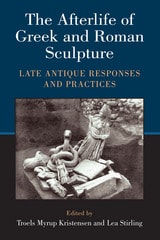
The Afterlife of Greek and Roman Sculpture
Late Antique Responses and PracticesTroels Myrup Kristensen and Lea Stirling, editors
University of Michigan Press, 2016
For centuries, statuary décor was a main characteristic of any city, sanctuary, or villa in the Roman world. However, from the third century CE onward, the prevalence of statues across the Roman Empire declined dramatically. By the end of the sixth century, statues were no longer a defining characteristic of the imperial landscape. Further, changing religious practices cast pagan sculpture in a threatening light. Statuary production ceased, and extant statuary was either harvested for use in construction or abandoned in place.
The Afterlife of Greek and Roman Sculpture is the first volume to approach systematically the antique destruction and reuse of statuary, investigating key responses to statuary across most regions of the Roman world. The volume opens with a discussion of the complexity of the archaeological record and a preliminary chronology of the fate of statues across both the eastern and western imperial landscape. Contributors to the volume address questions of definition, identification, and interpretation for particular treatments of statuary, including metal statuary and the systematic reuse of villa materials. They consider factors such as earthquake damage, late antique views on civic versus “private” uses of art, urban construction, and deeper causes underlying the end of the statuary habit, including a new explanation for the decline of imperial portraiture. The themes explored resonate with contemporary concerns related to urban decline, as evident in post-industrial cities, and the destruction of cultural heritage, such as in the Middle East.
[more]
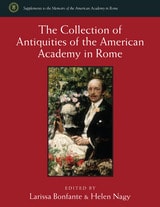
The Collection of Antiquities of the American Academy in Rome
Larissa Bonfante and Helen Nagy, editors
University of Michigan Press, 2016
The foundation of the American Academy in Rome dates back more than one hundred years to the early decades of the last century. Over the years, the Academy has acquired a study collection of material goods from antiquity, including coins, statues and figurines, lamps, stucco and other architectural fragments, jewelry, and inscriptions. While most are Roman in origin, some pieces are Greek or Etruscan. Some were gifts, others come from long-ago excavations, a few were bought. The Collection of Antiquities of the American Academy in Rome, the latest addition to the Supplements to the Memoirs of the American Academy in Rome series, focuses on highlights of the collection. Sections of the work are written by area specialists, with introductory material contributed by volume editors Larissa Bonfante and Helen Nagy, both of whom have published widely in archaeology and art history.
[more]
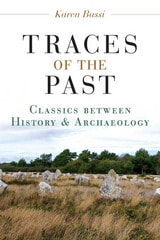
Traces of the Past
Classics between History and ArchaeologyKaren Bassi
University of Michigan Press, 2016
What are we doing when we walk into an archaeological museum or onto an archaeological site? What do the objects and features we encounter in these unique places mean and, more specifically, how do they convey to us something about the beliefs and activities of formerly living humans? In short, how do visible remains and ruins in the present give meaning to the human past? Karen Bassi addresses these questions through detailed close readings of canonical works spanning the archaic to the classical periods of ancient Greek culture, showing how the past is constituted in descriptions of what narrators and characters see in their present context. She introduces the term protoarchaeological to refer to narratives that navigate the gap between linguistic representation and empirical observation—between words and things—in accessing and giving meaning to the past. Such narratives invite readers to view the past as a receding visual field and, in the process, to cross the disciplinary boundaries that divide literature, history, and archaeology.
Aimed at classicists, literary scholars, ancient historians, cultural historians, and archaeological theorists, the book combines three areas of research: time as a feature of narrative structure in literary theory; the concept of “the past itself” in the philosophy of history; and the ontological status of material objects in archaeological theory. Each of five central chapters explores how specific protoarchaeological narratives—from the fate of Zeus’ stone in Hesiod’s Theogony to the contest between words and objects in Aristophanes’ Frogs—both expose and attempt to bridge this gap. Throughout, the book serves as a response to Herodotus’ task in writing the Histories, namely, to ensure that “the past deeds of men do not fade with time.”
Aimed at classicists, literary scholars, ancient historians, cultural historians, and archaeological theorists, the book combines three areas of research: time as a feature of narrative structure in literary theory; the concept of “the past itself” in the philosophy of history; and the ontological status of material objects in archaeological theory. Each of five central chapters explores how specific protoarchaeological narratives—from the fate of Zeus’ stone in Hesiod’s Theogony to the contest between words and objects in Aristophanes’ Frogs—both expose and attempt to bridge this gap. Throughout, the book serves as a response to Herodotus’ task in writing the Histories, namely, to ensure that “the past deeds of men do not fade with time.”
[more]