Results by title
7 books match the query 'Command of troops'
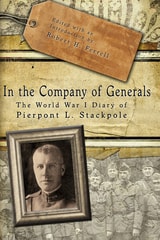
In the Company of Generals
The World War I Diary of Pierpont L. StackpoleEdited & Intro by Robert H. Ferrell
University of Missouri Press, 2009
Pierpont Stackpole was a Boston lawyer who in January 1918 became aide to Lieutenant General Hunter Liggett, soon to be commander of the first American corps in France. Stackpole’s diary, published here for the first time, is a major eyewitness account of the American Expeditionary Forces’ experience on the Western Front, offering an insider’s view into the workings of Liggett’s commands, his day-to-day business, and how he orchestrated his commands in trying and confusing situations.
Hunter Liggett did not fit John J. Pershing’s concept of the trim and energetic officer, but Pershing entrusted to him a corps and then an army command. Liggett assumed leadership of the U.S. First Army in mid-October of 1918, and after reorganizing, reinforcing, and resting, the battle-weary troops broke through the German lines in a fourth attack at the Meuse-Argonne—accomplishing what Pershing had failed to do in three previous attempts. The victory paved the way to armistice on November 11.
Liggett has long been a shadowy figure in the development of the American high command. He was “Old Army,” a veteran of Indian wars who nevertheless kept abreast of changes in warfare and more than other American officers was ready for the novelties of 1914–1918. Because few of his papers have survived, the diary of his aide—who rode in the general’s staff car as Liggett unburdened himself about fellow generals and their sometimes abysmal tactical notions—provides especially valuable insights into command within the AEF.
Stackpole’s diary also sheds light on other figures of the war, presenting a different view of the controversial Major General Clarence Edwards than has recently been recorded and relating the general staff’s attitudes about the flamboyant aviation figure Billy Mitchell. General Liggett built the American army in France, and the best measure of his achievement is this diary of his aide. That record stands here as a fascinating and authentic look at the Great War.
Lincoln's Political Generals
David Work
University of Illinois Press, 2012
As the war proceeded, the value of the political generals became a matter of serious dispute. Could politicians make the shift from a political campaign to a military one? Could they be trusted to fight? Could they avoid destructive jealousies and the temptations of corruption? And with several of the generals being Irish or German immigrants, what effect would ethnic prejudices have on their success or failure?
In this book, David Work examines Lincoln's policy of appointing political generals to build a national coalition to fight and win the Civil War. Work follows the careers of sixteen generals through the war to assess their contributions and to ascertain how Lincoln assessed them as commander-in-chief. Eight of the generals began the war as Republicans and eight as Democrats. Some commanded armies, some regiments. Among them were some of the most famous generals of the Union--such as Francis P. Blair Jr., John A. Dix, John A. Logan, James S. Wadsworth--and others whose importance has been obscured by more dramatic personalities.
Work finds that Lincoln's policy was ultimately successful, as these generals provided effective political support and made important contributions in military administration and on the battlefield. Although several of them proved to be poor commanders, others were effective in exercising influence on military administration and recruitment, slavery policy, and national politics.
No Band of Brothers
Problems of the Rebel High CommandSteven E. Woodworth
University of Missouri Press, 1999
The Civil War was barely over before Southerners and other students of the war began to examine the Confederate high command in search of an explanation for the South's failure. Although years of research failed to show that the South's defeat was due to a single, overriding cause, the actions of the Southern leaders during the war were certainly among the reasons the South lost the war.
In No Band of Brothers, Steven Woodworth explores, through a series of essays, various facets of the way the Confederacy waged its unsuccessful war for secession. He examines Jefferson Davis and some of his more important generals, including Pierre G. T. Beauregard, Leonidas Polk, Joseph E. Johnston, Robert E. Lee, James Longstreet, and Thomas J. "Stonewall" Jackson; the Confederacy's strategic plans; and the South's success in making competent officers out of men with very little military preparation.
Woodworth particularly looks at the personalities and personal relationships that affected the course and outcome of the war. What made a good general? What could make an otherwise able man a failure as a general? What role did personal friendships or animosities play in the Confederacy's top command assignments and decisions? How successful was the Confederacy in making competent generals out of its civilian leaders? In what ways did Jefferson Davis succeed or fail in maximizing the chances for the success of his cause?
In analyzing the Confederate leadership, Woodworth reveals some weaknesses, many strengths, and much new information. No Band of Brothers will be an important addition to Civil War scholarship and will be welcomed by professional historians, amateur historians, students, and the general reader alike.
Reflections of a Civil War Historian
Essays on Leadership, Society, and the Art of WarHerman Hattaway & Foreword by Frank E. Vandiver
University of Missouri Press, 2003
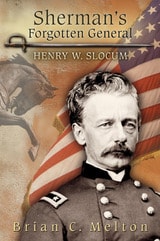
Sherman's Forgotten General
Henry W. SlocumBrian C. Melton
University of Missouri Press, 2007
Henry Warner Slocum, a Union major general who was a corps and army commander in the Civil War, served from the first call for troops until he stood with William Tecumseh Sherman to receive Joseph E. Johnston’s surrender after Appomattox. He saw action at Bull Run, Chancellorsville, and Gettysburg, and by the end of the war he had taken command of the Army of Georgia, yet historians have largely overlooked this key commander.
Brian Melton has written the first scholarly account of this important general—the first full-length biography in nearly a century—who as one of Sherman’s most trusted commanders exercised significant influence during the Civil War. Although Slocum is remembered primarily for his lackluster performance at Gettysburg, Melton discloses that there is more to him than current history credits, offering a holistic account of his life to show that his career was much more significant than has been supposed.
Slocum took on the characteristics of the leaders he served, and Melton reveals how Slocum’s attitudes and tactics changed dramatically between commanders to explain why he proved to be of little help to George McClellan and almost a liability while serving under “Fighting Joe” Hooker and yet was an effective commander under Sherman. Slocum became Sherman’s “left arm” and adapted so thoroughly to his style of generalship that he anticipated the general’s intentions on two important occasions, and Melton contends that Slocum was a much more important contributor to the success of Sherman’s later campaigns than has been acknowledged, becoming at times more aggressive and driving than Sherman himself.
Melton ultimately considers Slocum’s fate as one of the forgotten generals of the Civil War—brought on largely by his joining the Democratic Party in 1865—and demonstrates why previous simplistic depictions of Slocum miss the mark. By providing the first detailed look at this important second-tier commander, Sherman’s Forgotten General illuminates the influences, events, and individuals of Slocum’s career to show that, while he may not have changed the course of the war, he played a conspicuous and important role in its successful execution that has long deserved to be recognized.
The U.S. Army in the War of 1812
Robert Quimby
Michigan State University Press, 1997
This two-volume work by historian Robert Quimby presents a comprehensive and detailed analysis of military strategy, operations, and management during one of America’s most neglected and least understood military campaigns, the War of 1812. With causes that can be traced to the epic contest against Napoleon in Europe beginning in 1803, the war itself was the first conducted by the young Constitutional government of the United States. Quimby demonstrates that failed American initiatives at the beginning of hostilities shattered the unrealistic optimism of the war’s staunchest advocates; and while initial failures were followed by military success in 1813, whatever advantage might have been gained was soon lost to incompetent leadership. Major exceptions occurred in the Old Northwest, and in what was then the Southwest, where U.S. forces finally broke the strength of the long-successful Indian-British alliance.
In retrospect, what occurred during the War of 1812 demonstrated the necessity for gaining citizen support before committing the nation to armed conflict; it also provided a series of object lessons on how not to conduct a military campaign. Finally Quimby argues that, notwithstanding several victories at war’s end, including the fabled Battle of New Orleans, American perceptions that the United States "won" the war are erroneous; at best the struggle ended in a draw. The United States Army in the War of 1812 is an up-to-date and long overdue reassessment of military actions conducted during a pivotal conflict in American history, one that shaped U.S. military doctrine for a half century.
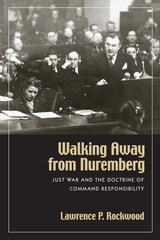
Walking Away from Nuremberg
Just War and the Doctrine of Command ResponsibilityLawrence P. Rockwood
University of Massachusetts Press, 2007
In September 1994, Lawrence P. Rockwood, then a counterintelligence officer with the U.S. Army's Tenth Mountain Division, was deployed to Haiti as part of Operation Restore Democracy, the American-led mission to oust the regime of Raoul Cedras and reinstall President Jean-Bertrand Aristide. Shortly after arriving in-country, Captain Rockwood began receiving reports of human rights abuses at the local jails, including the murder of political prisoners. He appealed to his superiors for permission to take action but was repeatedly turned down. Eventually, after filing a formal complaint with an army inspector general, he set off to inspect the jails on his own. The next day, Captain Rockwood found himself on a plane headed back to the United States, where he was tried by court-martial, convicted on several counts, and discharged from military service.
In this book, Rockwood places his own experience within the broader context of the American military doctrine of “command responsibility”—the set of rules that holds individual officers directly responsible for the commission of war crimes under their authority. He traces the evolution of this doctrine from the Civil War, where its principles were first articulated as the “Lieber Code,” through the Nuremberg trials following World War II, where they were reaffirmed and applied, to the present. Rockwood shows how in the past half-century the United States has gradually abandoned its commitment to these standards, culminating in recent Bush administration initiatives that in effect would shield American commanders and officials from prosecution for many war crimes. The Abu Ghraib and Guantánamo prison abuse scandals, the recently disclosed illegal CIA detention centers, the unprecedented policy of tolerating acts considered as torture by both international standards and U.S. military doctrine, and the recent cover-ups of such combat-related war crimes as the Haditha massacre of November 2005, all reflect an “official anti-humanitarian” trend, Rockwood argues, that is at odds with our nation's traditions and principles.