Results by title
18 books match the query 'Commons'

Aesthetics of the Commons
Edited by Cornelia Sollfrank, Felix Stalder, and Shusha Niederberger
Diaphanes, 2021
Aesthetics of the Commons examines a series of artistic and cultural projects—drawn from what can loosely be called the (post)digital—that take up this challenge in different ways. What unites them, however, is that they all have a double character. They are art in the sense that they place themselves in relation to (Western) cultural and art systems, developing discursive and aesthetic positions, but, at the same time, they are operational in that they create recursive environments and freely available resources whose uses exceed these systems. The first aspect raises questions about the kind of aesthetics that are being embodied, the second creates a relation to the larger concept of the commons. In Aesthetics of the Commons, the commons are understood not as a fixed set of principles that need to be adhered to in order to fit a definition, but instead as a thinking tool—in other words, the book’s interest lies in what can be made visible by applying the framework of the commons as a heuristic device.

Against the Commons
A Radical History of Urban PlanningÁlvaro Sevilla-Buitrago
University of Minnesota Press, 2022
An alternative history of capitalist urbanization through the lens of the commons
Characterized by shared, self-managed access to food, housing, and the basic conditions for a creative life, the commons are essential for communities to flourish and protect spaces of collective autonomy from capitalist encroachment. In a narrative spanning more than three centuries, Against the Commons provides a radical counterhistory of urban planning that explores how capitalism and spatial politics have evolved to address this challenge.
Highlighting episodes from preindustrial England, New York City and Chicago between the 1850s and the early 1900s, Weimar-era Berlin, and neoliberal Milan, Álvaro Sevilla-Buitrago shows how capitalist urbanization has eroded the egalitarian, convivial life-worlds around the commons. The book combines detailed archival research with provocative critical theory to illuminate past and ongoing struggles over land, shared resources, public space, neighborhoods, creativity, and spatial imaginaries.
Against the Commons underscores the ways urbanization shapes the social fabric of places and territories, lending particular awareness to the impact of planning and design initiatives on working-class communities and popular strata. Projecting history into the future, it outlines an alternative vision for a postcapitalist urban planning, one in which the structure of collective spaces is ultimately defined by the people who inhabit them.

Capturing the Commons
Devising Institutions to Manage the Maine Lobster IndustryJames M. Acheson
University Press of New England, 2004
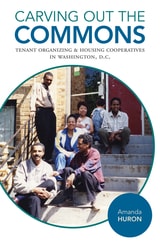
Carving Out the Commons
Tenant Organizing and Housing Cooperatives in Washington, D.C.Amanda Huron
University of Minnesota Press, 2018
An investigation of the practice of “commoning” in urban housing and its necessity for challenging economic injustice in our rapidly gentrifying cities
Provoked by mass evictions and the onset of gentrification in the 1970s, tenants in Washington, D.C., began forming cooperative organizations to collectively purchase and manage their apartment buildings. These tenants were creating a commons, taking a resource—housing—that had been used to extract profit from them and reshaping it as a resource that was collectively owned by them.
In Carving Out the Commons, Amanda Huron theorizes the practice of urban “commoning” through a close investigation of the city’s limited-equity housing cooperatives. Drawing on feminist and anticapitalist perspectives, Huron asks whether a commons can work in a city where land and other resources are scarce and how strangers who may not share a past or future come together to create and maintain commonly held spaces in the midst of capitalism. Arguing against the romanticization of the commons, she instead positions the urban commons as a pragmatic practice. Through the practice of commoning, she contends, we can learn to build communities to challenge capitalism’s totalizing claims over life.
Civil Society, Philanthropy, and the Fate of the Commons
Bruce R. Sievers
University Press of New England, 2010

Commons and Lords
A Short Anthropology of ParliamentEmma Crewe
Haus Publishing, 2015
Based on fieldwork within both Houses, this volume in the Haus Curiosities series provides a surprising twist in how relationships in each play out. The high social status of peers in the House of Lords gives the impression of hierarchy and, more specifically, patriarchy. In contrast, the House of Commons conjures impressions of equality and fairness between members. But actual observation reveals the opposite: while the House of Lords has an egalitarian and cooperative ethos that is also supportive of female members, the competitive and aggressive House of Commons is a far less comfortable place for women. Offering many surprises and secrets, this book exposes the sheer oddity of the British parliament system.
Curating the Commons
Socially Engaged Public ArtKatia Arfara
University of Michigan Press, 2025
By sharing critical insights, Arfara immerses the reader in the working processes of artists and collectives, showing how public art can address ecosocial concerns in aesthetic forms. Curating the Commons offers a grounded perspective on the making of cutting-edge, socially engaged public artworks and contributes to the larger effort to craft more-than-human narratives in response to global events.

Hydra Rising
The Enduring Struggle for Freedom, Mobility, and the CommonsBridget Anderson, Nandita Sharma, and Cynthia Wright, editors
Duke University Press, 2027
Mexico’s Community Forest Enterprises
Success on the Commons and the Seeds of a Good AnthropoceneDavid Barton Bray
University of Arizona Press, 2020
Mexico presents a unique case in which much of the nation’s forests were placed as commons in the hands of communities, who, with state support and their own entrepreneurial vigor, created community forest enterprises (CFEs). David Barton Bray, who has spent more than thirty years engaged with and researching Mexican community forestry, shows that this reform has transformed forest management in that country at a scale and level of maturity unmatched anywhere else in the world.
For decades Mexico has been conducting a de facto large-scale experiment in the design of a national social-ecological system (SES) focused on community forests. What happens when you give subsistence communities rights over forests, as well as training, organizational support, equipment, and financial capital? Do the communities destroy the forest in the name of economic development, or do they manage them sustainably, generating current income while maintaining intergenerational value as a resource for their children? Bray shares the scientific and social evidence that can now begin to answer these questions. This is an invaluable resource for students, researchers, and the interested public on the future of global forest resilience and the possibilities for a good Anthropocene.

Nature for Sale
The Commons versus CommoditiesGiovanna Ricoveri
Pluto Press, 2013
Nature for Sale uncovers the rich heritage of common ownership which existed before the dominance of capitalist property relations. Giovanna Ricoveri argues that the subsistence commons of the past can be reinvented today to provide an alternative to the current destructive economic order.
Ricoveri outlines the distinct features of common ownership as it has existed in history: cooperation, sustainable use of natural resources and decision-making through direct democracy. In doing so, she shows how it is possible to provide goods and services which are not commodities exchanged on the capitalistic market, something still demonstrated today in village communities across the global South.
Tracing the erosion of the commons from the European enclosures at the dawn of the Industrial Revolution to the new enclosures of modern capitalism, the book concludes by arguing that a new commons is needed today. It will be essential reading for activists as well as students and academics in history, politics, economics and development studies.
Oyster Wars and the Public Trust
Property, Law, and Ecology in New Jersey HistoryBonnie J. McCay
University of Arizona Press, 1998
Bonnie McCay now puts that doctrine in perspective by tracing the history of attempts to defend common resources against privatization. She tells of conflicts in New Jersey communities over the last two centuries: how fishermen dependent on common-use rights employed poaching, piracy, and test cases to protect their stake in tidal resources, and how oyster planters whose businesses depended on the enclosure of marine commons engineered test cases of their own to seek protection for their claims.
McCay presents some of the most significant cases relating to fishing and waterfront development, describing how the oyster wars were fought on the waters and in the court rooms—and how the public trust doctrine was sometimes reinterpreted to support private interests. She explores the events and people behind the proceedings and addresses the legal, social, and ecological issues these cases represent.
Oyster Wars and the Public Trust is an important study of contested property rights from an anthropological perspective that also addresses significant issues in political ecology, institutional economics, environmental history, and the evolution of law. It contributes to our understanding of how competing claims to resources have evolved in the United States and shows that making nature a commodity remains a moral problem even in a market-driven economy.

Publishing Beyond the Market
Open Access, Care, and the CommonsSamuel A. Moore
University of Michigan Press, 2025
Going forward, Publishing Beyond the Market explores the importance of collectivity and democratic governance within the transition to open access publishing. It suggests that developing a commons-based, scholar-led publishing landscape through a series of presses that are each managed by working academics could offer a productive counterpoint to marketised systems of open access and subscription publishing. In weaving themselves together in order to “scale small” these publishing initiatives would act as a counter-hegemonic project based on mutual reliance and care. By illustrating how these projects build toward a commons-based publishing future, and how they may complement other approaches to publishing within university presses and libraries, the book culminates in an argument for the infrastructures, policies, and forms of governance needed to nurture such a collective vision.

Recovering the Commons
Democracy, Place, and Global JusticeHerbert Reid and Betsy Taylor
University of Illinois Press, 2010
This penetrating work culls key concepts from grassroots activism to hold critical social theory accountable to the needs, ideas, and organizational practices of the global justice movement. The resulting critique of neoliberalism hinges on place-based struggles of groups marginalized by globalization and represents a brave rethinking of politics, economy, culture, and professionalism.
Providing new practical and conceptual tools for responding to human and environmental crises in Appalachia and beyond, Recovering the Commons radically revises the framework of critical social thought regarding our stewardship of the civic and ecological commons. Herbert Reid and Betsy Taylor ally social theory, field sciences, and local knowledge in search of healthy connections among body, place, and commons that form a basis for solidarity as well as a vital infrastructure for a reliable, durable world. Drawing particularly on the work of philosophers Maurice Merleau-Ponty, John Dewey, and Hannah Arendt, the authors reconfigure social theory by ridding it of the aspects that reduce place and community to sets of interchangeable components. Instead, they reconcile complementary pairs such as mind/body and society/nature in the reclamation of public space.
With its analysis embedded in philosophical and material contexts, this penetrating work culls key concepts from grassroots activism to hold critical social theory accountable to the needs, ideas, and organizational practices of the global justice movement. The resulting critique of neoliberalism hinges on place-based struggles of groups marginalized by globalization and represents a brave rethinking of politics, economy, culture, and professionalism.
Stealing Shining Rivers
Agrarian Conflict, Market Logic, and Conservation in a Mexican ForestMolly Doane
University of Arizona Press, 2012
What happens to indigenous people when their homelands are declared by well-intentioned outsiders to be precious environmental habitats? In this revelatory book, Molly Doane describes how a rain forest in Mexico’s southern state of Oaxaca was appropriated and redefined by environmentalists who initially wanted to conserve its biodiversity. Her case study approach shows that good intentions are not always enough to produce results that benefit both a habitat and its many different types of inhabitants.
Doane begins by showing how Chimalapas—translated as “shining rivers”—has been “produced” in various ways over time, from a worthless wasteland to a priceless asset. Focusing on a series of environmental projects that operated between 1990 and 2008, she reveals that environmentalists attempted to recast agrarian disputes—which actually stemmed from government-supported corporate incursions into community lands and from unequal land redistribution—as environmental problems.
Doane focuses in particular on the attempt throughout the 1990s to establish a “Campesino Ecological Reserve” in Chimalapas. Supported by major grants from the World Wildlife Foundation (WWF), this effort to foster and merge agrarian and environmental interests was ultimately unsuccessful because it was seen as politically threatening by the state. By 2000, the Mexican government had convinced the WWF to redirect its conservation monies to the state government and its agencies.
The WWF eventually abandoned attempts to establish an “enclosure” nature reserve in the region or to gain community acceptance for conservation. Instead, working from a new market-based model of conservation, the WWF began paying cash to individuals for “environmental services” such as reforestation and environmental monitoring.
The Question of the Commons
The Culture and Ecology of Communal ResourcesEdited by Bonnie J. McCay and James M. Acheson
University of Arizona Press, 1987

The Squatters' Movement in Europe
Commons and Autonomy as Alternatives to CapitalismEdited by Squatting Europe Kollective
Pluto Press, 2014
The Squatters' Movement in Europe is the first definitive guide to squatting as an alternative to capitalism. It offers a unique insider's view on the movement – its ideals, actions and ways of life. At a time of growing crisis in Europe with high unemployment, dwindling social housing and declining living standards, squatting has become an increasingly popular option.
The book is written by an activist-scholar collective, whose members have direct experience of squatting: many are still squatters today. There are contributions from the Netherlands, Spain, the USA, France, Italy, Germany, Switzerland and the UK.
In an age of austerity and precarity this book shows what has been achieved by this resilient social movement, which holds lessons for policy-makers, activists and academics alike.

Trespassing
An Inquiry into the Private Ownership of LandJohn Hanson Mitchell
University Press of New England, 2015

Understanding Self-Help/Mutual-Aid
Experiential Learning in the CommonsThomasina Jo Borkman
Rutgers University Press, 1999
Self-help groups have encountered fierce criticism as places where individuals join to share personal problems and to engage in therapeutic intervention without the aid of skilled professionals. These groups have flourished since the 1970s and continue to serve more people than professional therapy.
Yet these groups have been criticized as fostering a culture of whiners and victims, and not using professional help as needed. Thomasina Jo Borkman debunks this commonly held assessment, and also examines the reasons for these groups’ enduring popularity since the 1960s—more people attend these meetings (word?) than see professional therapists. What accounts for their success and popularity?
Understanding Self-Help / Mutual-Aid Groups is the first book to describe three stages of individual and group evolution that is part of this organization’s very structure; it also reconceptualizes participants’ interactions with professionals. The group as a whole, Borkman posits, draws on the life experiences of its membes to foster nurturing, support, and transformation through a “circle of sharing.” Groups create more positive and less stigmatizing “meaning perspectives” of the members’ problems than is available from professionals or lay folk culture.