Results by title
23 books match the query 'Communication in learning and scholarship'

Assessing Liaison Librarians
Documenting Impact ForDaniel Mack
American Library Association, 2014

Assessing Liaison Librarians
Documenting Impact for Positive ChangeDaniel C. Mack
Assoc of College & Research Libraries, 2014
Circulation, Writing, and Rhetoric
Laurie Gries
Utah State University Press, 2018
While it has long been understood that the circulation of discourse, bodies, artifacts, and ideas plays an important constitutive force in our cultures and communities, circulation, as a concept and a phenomenon, has been underexamined in studies of rhetoric and writing. In an effort to give circulation its rhetorical due, Circulation, Writing, and Rhetoric introduces a wide range of studies that foreground circulation in both theory and practice. Contributors to the volume specifically explore the connections between circulation and public rhetorics, urban studies, feminist rhetorics, digital communication, new materialism, and digital research.
Circulation is a cultural-rhetorical process that impacts various ecologies, communities, and subjectivities in an ever-increasing globally networked environment. As made evident in this collection, circulation occurs in all forms of discursive production, from academic arguments to neoliberal policies to graffiti to tweets and bitcoins. Even in the case of tombstones, borrowed text achieves only partial stability before it is recirculated and transformed again. This communicative process is even more evident in the digital realm, the underlying infrastructures of which we have yet to fully understand.
As public spaces become more and more saturated with circulating texts and images and as networked relations come to the center of rhetorical focus, Circulation, Writing, and Rhetoric will be a vital interdisciplinary resource for approaching the contemporary dynamics of rhetoric and writing.
Contributors: Aaron Beveridge, Casey Boyle, Jim Brown, Naomi Clark, Dànielle Nicole DeVoss, Rebecca Dingo, Sidney I. Dobrin, Jay Dolmage, Dustin Edwards, Jessica Enoch, Tarez Samra Graban, Byron Hawk, Gerald Jackson, Gesa E. Kirsch, Heather Lang, Sean Morey, Jenny Rice, Thomas Rickert, Jim Ridolfo, Nathaniel A. Rivers, Jacqueline Jones Royster, Donnie Johnson Sackey, Michele Simmons, Dale M. Smith, Patricia Sullivan, John Tinnell, Kathleen Blake Yancey
Classics from Papyrus to the Internet
An Introduction to Transmission and ReceptionBy Jeffrey M. Hunt, R. Alden Smith, and Fabio Stok
University of Texas Press, 2017
Winner, PROSE Award, Classics, Association of American Publishers (AAP), 2018
Writing down the epic tales of the Trojan War and the wanderings of Odysseus in texts that became the Iliad and the Odyssey was a defining moment in the intellectual history of the West, a moment from which many current conventions and attitudes toward books can be traced. But how did texts originally written on papyrus in perhaps the eighth century BC survive across nearly three millennia, so that today people can read them electronically on a smartphone?
Classics from Papyrus to the Internet provides a fresh, authoritative overview of the transmission and reception of classical texts from antiquity to the present. The authors begin with a discussion of ancient literacy, book production, papyrology, epigraphy, and scholarship, and then examine how classical texts were transmitted from the medieval period through the Renaissance and the Enlightenment to the modern era. They also address the question of reception, looking at how succeeding generations responded to classical texts, preserving some but not others. This sheds light on the origins of numerous scholarly disciplines that continue to shape our understanding of the past, as well as the determined effort required to keep the literary tradition alive. As a resource for students and scholars in fields such as classics, medieval studies, comparative literature, paleography, papyrology, and Egyptology, Classics from Papyrus to the Internet presents and discusses the major reference works and online professional tools for studying literary transmission.
Common Ground At The Nexus Of Information Literacy And
Merinda Hensley
Assoc of College & Research Libraries, 2013
Data Management for Libraries
Carly A. Strasser
American Library Association, 2013
Databrarianship
The Academic Data Librarian in Theory and PracticeLynda Kellam
Assoc of College & Research Libraries, 2016
Expanding the American Mind
Books and the Popularization of KnowledgeBeth Luey
University of Massachusetts Press, 2010
Expanding the American Mind begins by comparing fiction and nonfiction—their relative respectability in the eyes of reading experts and in the opinions of readers themselves. It then traces the roots of popularization from the Middle Ages to the present, examining changes in literacy, education, and university politics. Focusing on the period since World War II, it examines the ways that curricular reform has increased interest in popularization as well as the impact of specialization and professionalization among the faculty. It looks at the motivations of academic authors and the risks and rewards that come from writing for a popular audience. It also explains how experts write for nonexperts—the rhetorical devices they use and the voices in which they communicate.
Beth Luey also looks at the readers of popularizations—their motivations for reading, the ways they evaluate nonfiction, and how they choose what to read. This is the first book to use surveys and online reader responses to study nonfiction reading. It also compares the experience of reading serious nonfiction with that of reading other genres.
Using publishers' archives and editor-author correspondence, Luey goes on to examine what editors, designers, and marketers in this very competitive business do to create and sell popularizations to the largest audience possible. In a brief afterword she discusses popularization and the Web. The result is a highly readable and engaging survey of this distinctive genre of writing.
Graduate Writing Across the Disciplines
Identifying, Teaching, and SupportingMarilee Brooks-Gillies
University Press of Colorado, 2020
Hacking the Academy
New Approaches to Scholarship and Teaching from Digital HumanitiesDaniel J. Cohen and Tom Scheinfeldt, Editors
University of Michigan Press, 2013
On May 21, 2010, Daniel J. Cohen and Tom Scheinfeldt posted the following provocative questions online:
“Can an algorithm edit a journal? Can a library exist without books? Can students build and manage their own learning management platforms? Can a conference be held without a program? Can Twitter replace a scholarly society?”
As recently as the mid-2000s, questions like these would have been unthinkable. But today serious scholars are asking whether the institutions of the academy as they have existed for decades, even centuries, aren’t becoming obsolete. Every aspect of scholarly infrastructure is being questioned, and even more importantly, being hacked. Sympathetic scholars of traditionally disparate disciplines are canceling their association memberships and building their own networks on Facebook and Twitter. Journals are being compiled automatically from self-published blog posts. Newly minted PhDs are forgoing the tenure track for alternative academic careers that blur the lines between research, teaching, and service. Graduate students are looking beyond the categories of the traditional CV and building expansive professional identities and popular followings through social media. Educational technologists are “punking” established technology vendors by rolling out their own open source infrastructure.
Here, in Hacking the Academy, Daniel J. Cohen and Tom Scheinfeldt have gathered a sampling of the answers to their initial questions from scores of engaged academics who care deeply about higher education. These are the responses from a wide array of scholars, presenting their thoughts and approaches with a vibrant intensity, as they explore and contribute to ongoing efforts to rebuild scholarly infrastructure for a new millennium.
Libraries, Leadership, and Scholarly Communication
Essays by Rick AndersonRick Anderson
American Library Association, 2016
Meaningful Metrics
A 21St Century Librarian's Guide ToRobin Chin Roemer
Assoc of College & Research Libraries, 2015
Meaningful Metrics
A 21St Century Librarian's Guide to Bibliometrics, Altmetrics, and Research ImpactRobin Chin Roemer
Assoc of College & Research Libraries, 2015
Open And Equitable Scholarly Communication Creating A More
Nancy Maron
Assoc of College & Research Libraries, 2019
Open Praxis, Open Access
Digital Scholarship In ActionDarren Chase
American Library Association, 2020
Many in the world of scholarship share the conviction that open access will be the engine of transformation leading to more culture, more research, more discovery, and more solutions to small and big problems. This collection brings together librarians, scholars, practitioners, policymakers, and thinkers to take measure of the open access movement. The editors meld critical essays, research, and case studies to offer an authoritative exploration of
- the concept of openness in scholarship, with an overview of how it is evolving in the US, Canada, Europe, and Asia;
- open access publishing, including funding models and the future of library science journals;
- the state of institutional repositories;
- Open Educational Resources (OER) at universities and a consortium, in subject areas ranging from literary studies to textbooks; and
- open science, open data, and a pilot data catalog for raising the visibility of protected data.
Owning And Using Scholarship
An Ip Handbook For TeachersKevin Smith
Assoc of College & Research Libraries, 2014
Social Knowledge Creation in the Humanities
Volume 1Edited by Alyssa Arbuckle, Aaron Mauro, and Daniel Powell
Iter Press, 2017
The ubiquity of social media has transformed the scope and scale of scholarly communication in the arts and humanities. The consequences of this new participatory and collaborative environment for humanities research has allowed for fresh approaches to communicating research. Social Knowledge Creation takes up the norms and customs of online life to reorient, redistribute, and oftentimes flatten traditional academic hierarchies. This book discusses the implications of how humanists communicate with the world and looks to how social media shapes research methods. This volume addresses peer-review, open access publishing, tenure and promotion, mentorship, teaching, collaboration, and interdisciplinarity as a comprehensive introduction to these rapidly changing trends in scholarly communication, digital pedagogy, and educational technology. Collaborative structures are rapidly augmenting disciplinary focus of humanities curriculum and the public impact of humanities research teams with new organizational and disciplinary thinking. Social Knowledge Creation represents a particularly dynamic and growing field in which the humanities seeks to find new ways to communicate the legacy and traditions of humanities based inquiry in a 21st century context.
New Technologies in Medieval and Renaissance Studies Volume 7.
Edited by Alyssa Arbuckle, Aaron Mauro, and Daniel Powell
Switching Codes
Thinking Through Digital Technology in the Humanities and the ArtsEdited by Thomas Bartscherer and Roderick Coover
University of Chicago Press, 2011
Half a century into the digital era, the profound impact of information technology on intellectual and cultural life is universally acknowledged but still poorly understood. The sheer complexity of the technology coupled with the rapid pace of change makes it increasingly difficult to establish common ground and to promote thoughtful discussion.
Responding to this challenge, Switching Codes brings together leading American and European scholars, scientists, and artists—including Charles Bernstein, Ian Foster, Bruno Latour, Alan Liu, and Richard Powers—to consider how the precipitous growth of digital information and its associated technologies are transforming the ways we think and act. Employing a wide range of forms, including essay, dialogue, short fiction, and game design, this book aims to model and foster discussion between IT specialists, who typically have scant training in the humanities or traditional arts, and scholars and artists, who often understand little about the technologies that are so radically transforming their fields. Switching Codes will be an indispensable volume for anyone seeking to understand the impact of digital technology on contemporary culture, including scientists, educators, policymakers, and artists, alike.
Teaching Information Literacy Threshold Concepts
LessonPatricia Bravender
Assoc of College & Research Libraries, 2015
Teaching Information Literacy Threshold Concepts
Lesson Plans for LibrariansPatricia Bravender
Assoc of College & Research Libraries, 2015
The Culture of Digital Scholarship in Academic Libraries
Robin Chin Roemer
American Library Association, 2019
At the heart of digital scholarship are universal questions, lessons, and principles relating both to the mission of higher education and the shared values that make an academic library culture. But while global in aspirations, digital scholarship starts with local culture drawn from the community. Editors Chin Roemer and Kern invite you into their institutional workspace, the University of Washington, gathering voices from a range of positions that speak to the facets of digital scholarship. This mosaic of perspectives reveals the challenges, questions, and personalities that sit at the nexus of academic libraries and digital scholarship culture. Reflecting on UW’s approach, you’ll gain insights for your own institution on topics such as
- ways to create awareness of digital services through training;
- supporting students as creators of content;
- blending existing analog collections with ongoing digital initiatives using a media lab;
- creating a campus-wide, discipline agnostic, data repository service;
- how a popular digital storytelling workshop spawned digital scholarship across campus;
- digital scholarship consultations, viewed from an instructional technologist’s approach;
- the place of digital scholarship in the fabric of a revitalized urban community;
- four strategies for teaching research skills within an online-only bachelor’s degree program; and
- assessment findings from focus groups, surveys, digital pedagogy projects, and Omeka case studies.
By thoroughly exploring a single institution, this unique volume elucidates the many ways in which digital scholarship can express the values, priorities, opportunities, and challenges of the community’s intellectual and technical environment.
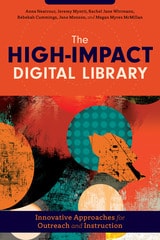
The High-Impact Digital Library
Innovative Approaches for Outreach and InstructionAnna Neatrour, Jeremy Myntti, Rachel Jane Wittmann, Rebekah Cummings, Jane Monson, and Megan Myres McMillan, in collaboration with Core Publishing
American Library Association, 2025
- discusses the results of a unique survey that provides new and structured information on digital library outreach and instruction;
- presents outreach case studies illustrating uses of social media promotion, integration of digital collections into teaching and instruction activities, partnerships with external campus units or community organizations, and other activities;
- explores many types of instruction, from drop-in class sessions and training to course-integrated instruction and ways that digital library practitioners can contribute to the Open Educational Resources (OER) and open pedagogy movements;
- details the digital humanities and digital scholarship programs developed at the University of Utah by many of the authors through cross-departmental collaboration;
- describes the ways in which the pandemic spurred many institutions to use rapid response collecting to practice community engagement; and
- speculates on future directions for outreach and instruction for digital libraries.
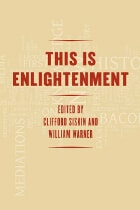
This Is Enlightenment
Edited by Clifford Siskin and William Warner
University of Chicago Press, 2010
Debates about the nature of the Enlightenment date to the eighteenth century, when Imanual Kant himself addressed the question, “What is Enlightenment?” The contributors to this ambitious book offer a paradigm-shifting answer to that now-famous query: Enlightenment is an event in the history of mediation. Enlightenment, they argue, needs to be engaged within the newly broad sense of mediation introduced here—not only oral, visual, written, and printed media, but everything that intervenes, enables, supplements, or is simply in between.
With essays addressing infrastructure and genres, associational practices and protocols, this volume establishes mediation as the condition of possibility for enlightenment. In so doing, it not only answers Kant’s query; it also poses its own broader question: how would foregrounding mediation change the kinds and areas of inquiry in our own epoch? This Is Enlightenment is a landmark volumewith the polemical force and archival depth to start a conversation that extends across the disciplines that the Enlightenment itself first configured.