Results by title
13 books match the query 'Contracts'

Butterfly, the Bride
Essays on Law, Narrative, and the FamilyCarol Weisbrod
University of Michigan Press, 2004
Butterfly, the Bride looks at law from the outside, using narrative to provide a fresh perspective on the issues of law and social structure---and individual responses to law. This book thoroughly explores relationships between inner and public lives by examining what is ordinarily classified as the sphere of private life---the world of family relationships.
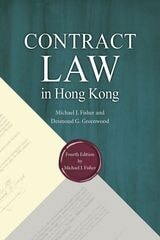
Contract Law in Hong Kong
Michael J. Fisher and Desmond G. Greenwood
Hong Kong University Press, 2024
This fourth edition of Contract Law in Hong Kong is the most comprehensive contemporary textbook on Hong Kong contract law written primarily for law students. The sixteen chapters of the book cover all basic contract concepts in a reader-friendly style and make ample use of case illustrations, including over 200 new cases since the third edition. The book deals with the core areas of contract law. The new legislative rules, such as the Contract Ordinance regarding the rights of third parties, have also been covered.
The first two chapters introduce the major themes and explain the multiple sources of law in Hong Kong. The subsequent thirteen chapters cover the formation of a valid contract, its contents, "vitiating" elements, the consequences of illegality, the termination of contracts, and remedies for breach of contract. The book concludes with an explanation of the doctrine of privity and the legislative reform of the operation of privity in Hong Kong. Particular attention is given to what makes Hong Kong law different from other common law jurisdictions, and to the continuing significance of English case law in Hong Kong.
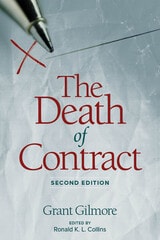
DEATH OF CONTRACT
SECOND EDITIONGrant Gilmore / Edited by Ronald K. L. Collins
The Ohio State University Press, 1995
The second edition, with an instructive and timely foreword by Ronald K. L. Collins, challenges anyone interested in the life of the law to think about where it has come from and where it is trending. A new bibliography of early reviews and contemporary responses reveals how considerable the interest was, and continues to be, in this modern anti-classic.

Institutional Foundations of Impersonal Exchange
Theory and Policy of Contractual RegistriesBenito Arruñada
University of Chicago Press, 2012
Benito Arruñada aims to avoid such failures by deepening our understanding of both the value of registries and the organizational requirements for constructing them. Presenting a theory of how registries strengthen property rights and reduce transaction costs, he analyzes the major trade-offs and proposes principles for successfully building registries in countries at different stages of development. Arruñada focuses on land and company registries, explaining the difficulties they face, including current challenges like the subprime mortgage crisis in the United States and the dubious efforts made in developing countries toward universal land titling. Broadening the account, he extends his analytical framework to other registries, including intellectual property and organized exchanges of financial derivatives. With its nuanced presentation of the theoretical and practical implications, Institutional Foundations of Impersonal Exchange significantly expands our understanding of how public registries facilitate economic growth.
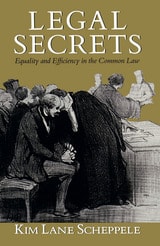
Legal Secrets
Equality and Efficiency in the Common LawKim Lane Scheppele
University of Chicago Press, 1988
Kim Lane Scheppele answers the question, Which secrets are legal secrets and what makes them so? She challenges the economic theory of law, which argues that judges decide cases in ways that maximize efficiency, and she shows that judges use equality as an important principle in their decisions. In the course of thinking about secrets, Scheppele also explores broader questions about judicial reasoning—how judges find meaning in legal texts and how they infuse every fact summary with the values of their legal culture. Finally, the specific insights about secrecy are shown to be consistent with a general moral theory of law that indicates what the content of law should be if the law is to be legitimate, a theory that sees legal justification as the opportunity to attract consent.
This is more than a book about secrets. It is also a book about the limits of an economic view of law. Ultimately, it is a work in constructive legal theory, one that draws on moral philosophy, sociology, economics, and political theory to develop a new view of legal interpretation and legal morality.

New Directions in Private Law Theory
Edited by Fabiana Bettini, Martin Fischer, Charles Mitchell, and Prince Saprai
University College London, 2023
New Directions in Private Law Theory brings together some of the best new work on private law theory, reflecting the breadth of this increasingly important field. The authors adopt a variety of different approaches and contribute to ongoing and important debates about the moral foundations of private law, the individuation of areas of private law, and the connections between private law and everyday moral experience. Questions addressed include: does the diversity identified among claims in unjust enrichment mean that the category is incoherent? Are claims in tort law always about compensating for wrongs? How should we understand the parties’ agreement in a contract? The contributions shed new light on these and other topics and the ways in which they intersect and open up new lines of scholarly inquiry.
This book will be of interest to researchers working in private law and legal theory, but it will also appeal to those outside of law, most notably researchers with an interest in moral and political philosophy, economics, and history.

Rehabilitating Lochner
Defending Individual Rights against Progressive ReformDavid E. Bernstein
University of Chicago Press, 2011
In this timely reevaluation of an infamous Supreme Court decision, David E. Bernstein provides a compelling survey of the history and background of Lochner v. New York. This 1905 decision invalidated state laws limiting work hours and became the leading case contending that novel economic regulations were unconstitutional. Sure to be controversial, Rehabilitating Lochner argues that the decision was well grounded in precedent—and that modern constitutional jurisprudence owes at least as much to the limited-government ideas of Lochner proponents as to the more expansive vision of its Progressive opponents.
Tracing the influence of this decision through subsequent battles over segregation laws, sex discrimination, civil liberties, and more, Rehabilitating Lochner argues not only that the court acted reasonably in Lochner, but that Lochner and like-minded cases have been widely misunderstood and unfairly maligned ever since.
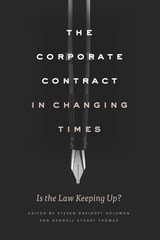
The Corporate Contract in Changing Times
Is the Law Keeping Up?Edited by Steven Davidoff Solomon and Randall Stuart Thomas
University of Chicago Press, 2019
With The Corporate Contract in Changing Times, Steven Davidoff Solomon and Randall Stuart Thomas bring together leading corporate law scholars, judges, and lawyers from top corporate law firms to explore what needs to change and what has prevented reform thus far. Among the topics addressed are how the law could be adapted to the reality that activist hedge funds pose a more serious threat to corporations than the hostile takeovers and how statutory laws, such as the rules governing appraisal rights, could be reviewed in the wake of appraisal arbitrage. Together, the contributors surface promising paths forward for future corporate law and public policy.
The Dignity of Commerce
Markets and the Moral Foundations of Contract LawNathan B. Oman
University of Chicago Press, 2016
With The Dignity of Commerce, Nathan B. Oman argues persuasively that well-functioning markets are morally desirable in and of themselves and thus a fit object of protection through contract law. Markets, Oman shows, are about more than simple economic efficiency. To do business with others, we must demonstrate understanding of and satisfy their needs. This ability to see the world from another’s point of view inculcates key virtues that support a liberal society. Markets also provide a context in which people can peacefully cooperate in the absence of political, religious, or ideological agreement. Finally, the material prosperity generated by commerce has an ameliorative effect on a host of social ills, from racial discrimination to environmental destruction.
The first book to place the moral status of the market at the center of the justification for contract law, The Dignity of Commerce is sure to elicit serious discussion about this central area of legal studies.

The Fall and Rise of Freedom of Contract
F. H. Buckley, ed.
Duke University Press, 1999
The 1970s was a decade of regulatory triumphalism in North America, marked by a surge in consumer, securities, and environmental regulation. Legal scholars predicted the “death of contract” and its replacement by regulation and reliance-based theories of liability. Instead, we have witnessed the reemergence of free bargaining norms. This revival can be attributed to the rise of law-and-economics, which laid bare the intellectual failure of anticontractarian theories. Scholars in this school note that consumers are not as helpless as they have been made out to be, and that intrusive legal rules meant ostensibly to help them often leave them worse off. Contract law principles have also been very robust in areas far afield from traditional contract law, and the essays in this volume consider how free bargaining rights might reasonably be extended in tort, property, land-use planning, bankruptcy, and divorce and family law.
This book will be of particular interest to legal scholars and specialists in contract law. Economics and public policy planners will also be challenged by its novel arguments.
Contributors. Gregory S. Alexander, Margaret F. Brinig, F. H. Buckley, Robert Cooter, Steven J. Eagle, Robert C. Ellickson, Richard A. Epstein, William A. Fischel, Michael Klausner, Bruce H. Kobayashi, Geoffrey P. Miller, Timothy J. Muris, Robert H. Nelson, Eric A. Posner, Robert K. Rasmussen, Larry E. Ribstein, Roberta Romano, Paul H. Rubin, Alan Schwartz, Elizabeth S. Scott, Robert E. Scott, Michael J. Trebilcock

The Harmonization of Civil and Commercial Law in Europe
Gian Antonio Benacchio
Central European University Press, 2005
The Three and a Half Minute Transaction
Boilerplate and the Limits of Contract DesignMitu Gulati and Robert E. Scott
University of Chicago Press, 2012
Boilerplate language in contracts tends to stick around long after its origins and purpose have been forgotten. Usually there are no serious repercussions, but sometimes it can cause unexpected problems. Such was the case with the obscure pari passu clause in cross-border sovereign debt contracts, until a novel judicial interpretation rattled international finance by forcing a defaulting sovereign—for one of the first times in the market’s centuries-long history—to repay its foreign creditors. Though neither party wanted this outcome, the vast majority of contracts subsequently issued demonstrate virtually no attempt to clarify the imprecise language of the clause.

Trust, Ethnicity, and Identity
Beyond the New Institutional Economics of Ethnic Trading Networks, Contract Law, and Gift-ExchangeJanet Tai Landa
University of Michigan Press, 1995
Trust, Ethnicity, and Identity deals with the economic role of laws and institutions in achieving social order in a decentralized economy. Specifically, this book considers the coordinating role of three major nonprice institutions--ethnic trading networks, contract law, and gift-exchange--in economizing on transaction costs and thus facilitating the process of exchange in decentralized economies in different historical contexts.
The major unifying theme of the book is this: identity matters when traders operate in an environment characterized by contract uncertainty, where the legal framework for the enforcement of contracts is not well developed. This in turn points out the importance of trust embedded in particularistic exchange relations such as kinship or ethnicity.
One unique facet of this book is that the author uses a property rights--public choice approach--part of the New Institutional Economics--to provide a unifying theoretical framework to explain such diverse exchange institutions as contract law, ethnic trading networks, and gift-exchange, In addition, it goes beyond the New Institutional Economics paradigm by incorporating some crucial concepts from sociology, anthropology, and bioeconomics, such as social structure, social norms, culture, reciprocity, and kin-related altruism. This broad interdisciplinary framework gives Landa's work a relevance beyond economics to law, political science, sociology, anthropology, and bioeconomics.