Results by title
12 books match the query 'Cosmopolitanism in literature'
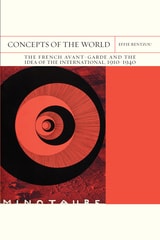
Concepts of the World
The French Avant-Garde and the Idea of the International, 1910–1940Effie Rentzou
Northwestern University Press, 2022
The writers and artists of the French avant-garde aspired to reach a global audience that would be wholly transformed by their work. In this study, Effie Rentzou delves deep into their depictions of the interwar world as an international and modern landscape, one marked by a varied cosmopolitanism. The avant-garde’s conceptualization of the world paralleled, rejected, or expanded prevailing notions of the global sphere.
The historical avant garde—which encompassed movements like futurism, Dada, and surrealism—was self-consciously international, operating across global networks and developed with the whole world as its horizon and its public. In the heady period between the end of the Belle Époque and the tumult of World War II, both individual artists (including Guillaume Apollinaire, Blaise Cendrars, Francis Picabia, Louis Aragon, Leonora Carrington, and Nicolas Calas) and collective endeavors (such as surrealist magazines and exhibitions) grappled with contemporary anxieties about economic growth, imperialism, and colonialism, as well as various universalist, cosmopolitan, and internationalist visions. By probing these works, Concepts of the World offers an alternative narrative of globalization, one that integrates the avant-garde’s enthusiasm for, as well as resistance to, the process. Rentzou identifies within the avant-garde a powerful political language that expressed the ambivalence of living and creating in an increasingly globalized world—a language that profoundly shaped the way the world has been conceptualized and is experienced today.
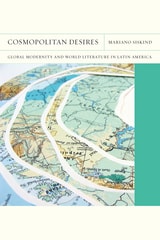
Cosmopolitan Desires
Global Modernity and World Literature in Latin AmericaMariano Siskind
Northwestern University Press, 2014
Mariano Siskind’s groundbreaking debut book redefines the scope of world literature, particularly regarding the place of Latin America in its imaginaries and mappings. In Siskind’s formulation, world literature is a modernizing discursive strategy, a way in which cultures negotiate their aspirations to participate in global networks of cultural exchange, and an original tool to reorganize literary history. Working with novels, poems, essays, travel narratives, and historical documents, Siskind reads the way Latin American literary modernity was produced as a global relation, from the rise of planetary novels in the 1870s and the cosmopolitan imaginaries of modernism at the turn of the twentieth century, to the global spread of magical realism. With its unusual breadth of reference and firm but unobtrusive grounding in philosophy, literary theory, and psychoanalysis, Cosmopolitan Desires will have a major impact in the fields of Latin American studies and comparative literature.
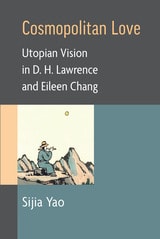
Cosmopolitan Love
Utopian Vision in D. H. Lawrence and Eileen ChangSijia Yao
University of Michigan Press, 2023
Finalist: 2024 Southern Atlantic Modern Language Association (SAMLA) Book Award Finalist | 05/21/2024
Love, and the different manifestations of it, is a common theme in literature around the world. In Cosmopolitan Love, Sijia Yao examines the writings of D. H. Lawrence, a British writer whose literature focused primarily on interpersonal relationships in domestic settings, and Eileen Chang, a Chinese writer who migrated to the United States and explored Chinese heterosexual love in her writing. While comparing the writings of a Chinese writer and an English one, Yao avoids a direct comparison between East and West that could further enforce binaries. Instead, she uses the comparison to develop an idea of cosmopolitanism that shows how the writers are in conversation with their own culture and with each other. Both D. H. Lawrence and Eileen Chang wrote stories that are influenced by—but sometimes stand in opposition to—their own cultures. They offer alternative understandings of societies dealing with modernism and cultural globalization. Their stories deal with emotional pain caused by the restrictions of local politics and economics and address common themes of incestuous love, sexual love, adulterous love, and utopian love. By analyzing their writing, Yao demonstrates that the concept of love as a social and political force can cross cultural boundaries and traditions to become a basis for human meaning, the key to a cosmopolitan vision.
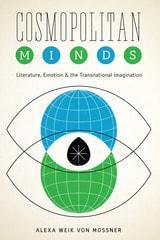
Cosmopolitan Minds
Literature, Emotion, and the Transnational ImaginationBy Alexa Weik von Mossner
University of Texas Press, 2014
During World War II and the early Cold War period, factors such as race, gender, sexual orientation, or class made a number of American writers feel marginalized in U.S. society. Cosmopolitan Minds focuses on a core of transnational writers—Kay Boyle, Pearl S. Buck, William Gardner Smith, Richard Wright, and Paul Bowles—who found themselves prompted to seek experiences outside of their home country, experiences that profoundly changed their self-understanding and creative imagination as they encountered alternative points of views and cultural practices in Europe, Asia, and Africa.
Alexa Weik von Mossner offers a new perspective on the affective underpinnings of critical and reflexive cosmopolitanism by drawing on theories of emotion and literary imagination from cognitive psychology, philosophy, and cognitive literary studies. She analyzes how physical dislocation, and the sometimes violent shifts in understanding that result from our affective encounters with others, led Boyle, Buck, Smith, Wright, and Bowles to develop new, cosmopolitan solidarities across national, ethnic, and religious boundaries. She also shows how, in their literary texts, these writers employed strategic empathy to provoke strong emotions such as love, sympathy, compassion, fear, anger, guilt, shame, and disgust in their readers in order to challenge their parochial worldviews and practices. Reading these texts as emotionally powerful indictments of institutionalized racism and national violence inside and outside of the United States, Weik von Mossner demonstrates that our emotional engagements with others—real and imagined—are crucially important for the development of transnational and cosmopolitan imaginations.
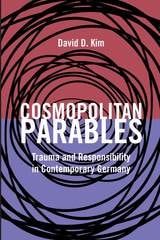
Cosmopolitan Parables
Trauma and Responsibility in Contemporary GermanyDavid D. Kim
Northwestern University Press, 2017
To exemplify this global challenge, Kim examines three internationally acclaimed writers of German origin—Hans Christoph Buch, Michael Krüger, and W. G. Sebald—joined by their own harrowing experiences and stunning entanglements with Holocaust memory, postcolonial responsibility, and communist legacy. This bold new study is the first of its kind, interrogating transnational memories of trauma alongside globally shared responsibilities for justice. More important, it addresses the question of remembrance—whether the colonial past or the postwar legacy serves as a proper foundation upon which cosmopolitanism is to be pursued in today's era of globalization.
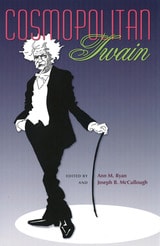
Cosmopolitan Twain
Edited by Ann M. Ryan and Joseph B. McCullough
University of Missouri Press, 2008
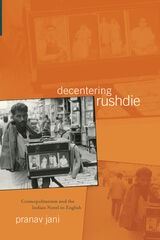
Decentering Rushdie
Cosmopolitanism and the Indian Novel in EnglishPranav Jani
The Ohio State University Press, 2010
Interrogating current theories of cosmopolitanism, nationalism, and aesthetics in Postcolonial Studies, Decentering Rushdie offers a new perspective on the Indian novel in English. Since Salman Rushdie’s Midnight’s Children won the Booker Prize in 1981, its postmodern style and postnational politics have dominated discussions of postcolonial literature. As a result, the rich variety of narrative forms and perspectives on the nation that constitute the field have been obscured, if not erased altogether.
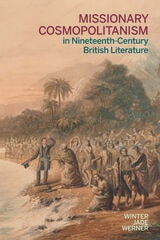
Missionary Cosmopolitanism in Nineteenth-Century British Literature
Winter Jade Werner
The Ohio State University Press, 2020
Missionary Cosmopolitanism identifies the nineteenth-century novel as thematically and formally attuned to the tension between missionaries’ cosmopolitan values and the moral impoverishment of their imperialist and expansionist practices. Werner’s chapters interact with canonical works such as Charlotte Brontë’s Jane Eyre and Charles Dickens’s Bleak House, along with lesser-known works by Robert Southey and Sydney Owenson. Ultimately, Missionary Cosmopolitanism demonstrates that nineteenth-century literature both illustrated and helped define missionary discourses regarding cosmopolitan ideas, showing how global evangelicalism continues to tap into the “new cosmopolitanisms” of today.
Strategic Occidentalism
On Mexican Fiction, the Neoliberal Book Market, and the Question of World LiteratureIgnacio M. Sánchez Prado
Northwestern University Press, 2018
In the course of this analysis, Ignacio M. Sánchez Prado engages with theories of world literature, proposing that “world literature” is a construction produced at various levels, including the national, that must be studied from its material conditions of production in specific sites. In particular, he argues that Mexican writers have engaged in a “strategic Occidentalism” in which their idiosyncratic connections with world literature have responded to dynamics different from those identified by world-systems or diffusionist theorists.
Strategic Occidentalism identifies three scenes in which a cosmopolitan aesthetics in Mexican world literature has been produced: Sergio Pitol’s translation of Eastern European and marginal British modernist literature; the emergence of the Crack group as a polemic against the legacies of magical realism; and the challenges of writers like Carmen Boullosa, Cristina Rivera Garza, and Ana García Bergua to the roles traditionally assigned to Latin American writers in world literature.
Theaters of Translation
Cosmopolitan Vernaculars in Shakespeare's EnglandAndrew S. Keener
University of Alabama Press, 2025
Explores the profound influence of multilingual dictionaries, dialogues, and grammars on English Renaissance playwrights
In Theaters of Translation, Andrew S. Keener offers a fascinating account of the ways that plays by Thomas Kyd, Mary Sidney Herbert, Ben Jonson, and their fellow English contemporaries were shaped by and part of a multilingual Europe where dictionaries, grammars, and language-learning materials circulated widely. He proposes a fresh, multilingual approach to English Renaissance drama that challenges the histories of early modern European languages as sites of national and linguistic cohesion.
Covering the period between 1570 and 1640, when England’s drama and the English language itself were evolving, Keener uses the term “cosmopolitan vernaculars” to examine how nonclassical European languages modeled transnational forms of belonging for playgoers, readers, and authors in Renaissance England. Combining recent contributions to cosmopolitan theory and transnational studies of early modern literature and culture, Keener highlights both the ways in which cosmopolitanism manifests through Europe’s vernacular languages—in print and performance—and the ways languages themselves can exhibit cosmopolitanism for those who encounter them on the page or on the stage.
Theaters of Translation opens up new transnational interpretations of English Renaissance plays and casts fresh light on historical anecdotes, such as Jonson inscribing a copy of Pietro Aretino’s scandalous Italian dialogues or Shakespeare’s First Folio being advertised for sale in Germany before its London publication. It offers much of interest to readers and scholars of Renaissance Europe, early modern drama, and the development of national European languages.
Victorian Poetry, Europe, and the Challenge of Cosmopolitanism
Christopher M. Keirstead
The Ohio State University Press, 2011
The scope and complexity of the encounter with Europe in Victorian poetry remains largely underappreciated despite recent critical attention to the genre’s global and transnational contexts. Providing much more than colorful settings or a convenient place of self-exile from England, Europe—as destination and idea—formed the basis of a dynamic, evolving form of critical cosmopolitanism much in tune with attempts to theorize the concept today. Christopher M. Keirstead’s Victorian Poetry, Europe, and the Challenge of Cosmopolitanism synthesizes the complex relationship between several notable Victorian poets, including Elizabeth Barrett Browning, Robert Browning, Matthew Arnold, and A. C. Swinburne, and their respective attitudes toward Europe as a cosmopolitan whole. Examining their international relationships and experiences, the monograph explores the ways in which these poets worked to reconcile their emotional and intellectual affinity for world citizenship with their British identity.
Violet America
Regional Cosmopolitanism in U.S. FictionJason Arthur
University of Iowa Press, 2013