Results by title
21 books match the query 'Crime in literature'

A Common Spring
Crime Novel and ClassicNadya Aisenberg
University of Wisconsin Press, 1980
Nadya Aisenberg discusses the potentialities of the crime novel, its implications, principles, and scope, and its analogy ot myth and the fairy tale. She proposes that the detective story and the thriller have made an unacknowledged contribution to "serious" literature. Her discussion of Dickens, Conrad, and Green indicate that each borrowed many important ingredients from the formulaic novel.
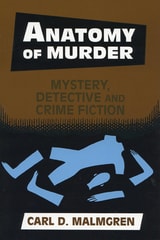
Anatomy of Murder
Mystery, Detective, and Crime FictionCarl D. Malmgren
University of Wisconsin Press, 2001
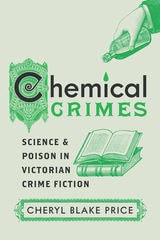
Chemical Crimes
Science and Poison in Victorian Crime FictionCheryl Blake Price
The Ohio State University Press, 2019
From the Newgate and Silver Fork novels of the 1830s to the emergent genres of science and detective fiction of the 1890s, Price advocates for the classification of a new type of poisoner, one who combined crime with methodical scientific know-how: the chemical criminal. Chemical Crimes shows how authors used the subversiveness of chemical crimes to challenge the supposed disciplinary force of forensic detection and suggests that generic developments were inspired as much by criminal scientific innovation as they were by the rise of the detective–scientist. By focusing on chemical crime’s appearance at significant moments, this book traces how reactions to Victorian science inspired change in nineteenth-century crime fiction.
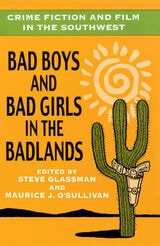
Crime Fiction and Film in the Southwest
Bad Boys and Bad Girls in the BadlandsEdited by Steve Glassman and Maurice O'Sullivan
University of Wisconsin Press, 2001
When Joe Leaphorn and Jim Chee, Tony Hillerman’s oddly matched tribal police officers, patrol the mesas and canyons of their Navajo reservation, they join a rich traditon of Southwestern detectives. In Crime Fiction and Film in the Southwest, a group of literary critics tracks the mystery and crime novel from the Painted Desert to Death Valley and Salt Lake City. In addition, the book includes the first comprehensive bibliography of mysteries set in the Southwest and a chapter on Southwest film noir from Humphrey Bogart’s tough hood in The Petrified Forest to Russell Crowe’s hard-nosed cop in L.A. Confidential.
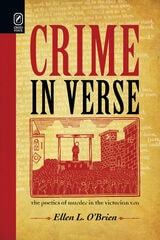
Crime in Verse
The Poetics of Murder in the Victorian EraEllen L. O’Brien
The Ohio State University Press, 2008

Fiction, Crime, and Empire
CLUES TO MODERNITY AND POSTMODERNISMJon Thompson
University of Illinois Press, 1993
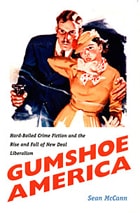
Gumshoe America
Hard-Boiled Crime Fiction and the Rise and Fall of New Deal LiberalismSean McCann
Duke University Press, 2000
Gumshoe America traces the way those problems surfaced in hard-boiled crime fiction from the1920s through the 1960s. Beginning by using a forum on the KKK in the pulp magazine Black Mask to describe both the economic and political culture of pulp fiction in the early twenties, McCann locates the origins of the hard-boiled crime story in the genre’s conflict with the racist antiliberalism prominent at the time. Turning his focus to Dashiell Hammett’s career, McCann shows how Hammett’s writings in the late 1920s and early 1930s moved detective fiction away from its founding fables of social compact to the cultural alienation triggered by a burgeoning administrative state. He then examines how Raymond Chandler’s fiction, unlike Hammett’s, idealized sentimental fraternity, echoing the communitarian appeals of the late New Deal. Two of the first crime writers to publish original fiction in paperback—Jim Thompson and Charles Willeford—are examined next in juxtaposition to the popularity enjoyed by their contemporaries Mickey Spillane and Ross Macdonald. The stories of the former two, claims McCann, portray the decline of the New Deal and the emergence of the rights-based liberalism of the postwar years and reveal new attitudes toward government: individual alienation, frustration with bureaucratic institutions, and dissatisfaction with the growing vision of America as a meritocracy. Before concluding, McCann turns to the work of Chester Himes, who, in producing revolutionary hard-boiled novels, used the genre to explore the changing political significance of race that accompanied the rise of the Civil Rights movement in the late 1950s and the 1960s.
Combining a striking reinterpretation of the hard-boiled crime story with a fresh view of the political complications and cultural legacies of the New Deal, Gumshoe America will interest students and fans of the genre, and scholars of American history, culture, and government.
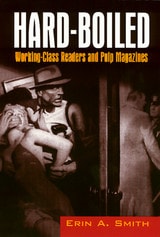
Hard-Boiled
Erin A. Smith
Temple University Press, 2000
Relying on pulp magazine advertising, the memoirs of writers and publishers, Depression-era studies of adult reading habits, social and labor history, Smith offers an innovative account of how these popular stories were generated and read. She shows that although the work of pulp fiction authors like Dashiell Hammett, Raymond Chandler, and Erle Stanley Gardner have become “classics” of popular culture, the hard-boiled genre was dominated by hack writers paid by the word, not self-styled artists. Pulp magazine editors and writers emphasized a gritty realism in the new genre. Unlike the highly rational and respectable British protagonists (Miss Marple and Hercule Poirot, for instance), tough-talking American private eyes relied as much on their fists as their brains as they made their way through tangled plotlines.
Casting working-class readers of pulp fiction as “poachers,” Smith argues that they understood these stories as parables about Taylorism, work, and manhood; as guides to navigating consumer culture; as sites for managing anxieties about working women. Engaged in re-creating white, male privilege for the modern, heterosocial world, pulp detective fiction shaped readers into consumers by selling them what they wanted to hear – stories about manly artisan-heroes who resisted encroaching commodity culture and the female consumers who came with it. Commenting on the genre’s staying power, Smith considers contemporary detective fiction by women, minority, and gay and lesbian writers.

Imagining the Penitentiary
Fiction and the Architecture of Mind in Eighteenth-Century EnglandJohn Bender
University of Chicago Press, 1987
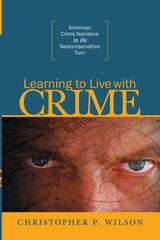
Learning to Live with Crime
American Crime Narrative in the Neoconservative TurnChristopher P. Wilson
The Ohio State University Press, 2010
Since the mid-1960s, the war on crime has reshaped public attitudes about state authority, criminal behavior, and the responsibilities of citizenship. But how have American writers grappled with these changes? What happens when a journalist approaches the workings of organized crime not through its legendary Godfathers but through a workaday, low-level figure who informs on his mob? Why is it that interrogation scenes have become so central to prime-time police dramas of late? What is behind writers’ recent fascination with “cold case” homicides, with private security, or with prisons?
In Learning to Live with Crime, Christopher P. Wilson examines this war on crime and how it has made its way into cultural representation and public consciousness. Under the sway of neoconservative approaches to criminal justice and public safety, Americans have been urged to see crime as an inevitable risk of modern living and to accept ever more aggressive approaches to policing, private security, and punishment. The idea has been not simply to fight crime but to manage its risks; to inculcate personal vigilance in citizens; and to incorporate criminals’ knowledge through informants and intelligence gathering. At its most scandalous, this study suggests, contemporary law enforcement has even come to mimic crime’s own operations.
Lewd and Notorious
Female Transgression in the Eighteenth CenturyKatharine Kittredge, Editor
University of Michigan Press, 2003
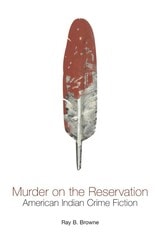
Murder on the Reservation
American Indian Crime FictionRay B. Browne
University of Wisconsin Press, 2004
Mysteries of Africa
Eugene Schleh
University of Wisconsin Press, 1991
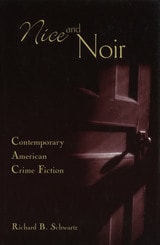
Nice and Noir
Contemporary American Crime FictionRichard B. Schwartz
University of Missouri Press, 2002
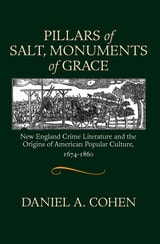
Pillars of Salt, Monuments of Grace
New England Crime Literature and the Origins of American Popular Culture, 1674-1860Daniel A. Cohen
University of Massachusetts Press, 2006
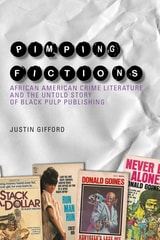
Pimping Fictions
African American Crime Literature and the Untold Story of Black Pulp PublishingJustin Gifford
Temple University Press, 2013
Gifford draws from an impressive array of archival materials to provide a first-of-its-kind literary and cultural history of this distinctive genre. He evaluates the artistic and symbolic representations of pimps, sex-workers, drug dealers, and political revolutionaries in African American crime literature-characters looking to escape the racial containment of prisons and the ghetto.
Gifford also explores the struggles of these black writers in the literary marketplace, from the era of white-owned publishing houses like Holloway House-that fed books and magazines like Players to eager black readers-to the contemporary crop of African American women writers reclaiming the genre as their own.
Probable Cause
Crime Fiction in AmericaLeRoy Lad Panek
University of Wisconsin Press, 1990
American crime fiction has developed into writing that has a commitment to democracy and the democratic way of life, a compassion and empathy and a style which has created a significant branch of American literature.
Spirit of Australia
The Crime Fiction of Arthur W. UpfieldUniversity of Wisconsin Press, 1988
Library of Congress subject headings for this publication:
Upfield, Arthur William, -- 1888-1964 -- Criticism and interpretation.
Detective and mystery stories, Australian -- History and criticism.
Bonaparte, Napoleon, Inspector (Fictitious character)
National characteristics, Australian, in literature.
Australia -- In literature.
Police in literature.
Crime in literature.