Results by title
6 books match the query 'Crimes against humanity'
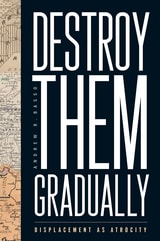
Destroy Them Gradually
Displacement as AtrocityAndrew R. Basso
Rutgers University Press, 2024
Perpetrators of mass atrocities have used displacement to transport victims to killing sites or extermination camps to transfer victims to sites of forced labor and attrition, to ethnically homogenize regions by moving victims out of their homes and lands, and to destroy populations by depriving them of vital daily needs. Displacement has been treated as a corollary practice to crimes committed, not a central aspect of their perpetration. Destroying Them Gradually examines four cases that illuminate why perpetrators have destroyed populations using displacement policies: Germany’s genocide of the Herero (1904–1908); Ottoman genocides of Christian minorities (1914–1925); expulsions of Germans from East/Central Europe (1943–1952); and climate violence (twenty-first century). Because displacement has been typically framed as a secondary aspect of mass atrocities, existing scholarship overlooks how perpetrators use it as a means of executing destruction rather than a vehicle for moving people to a specific location to commit atrocities.
[more]
Duty to Respond
Mass Crime, Denial, and Collective ResponsibilityNenad Dimitrijevic
Central European University Press, 2011
The subject of the book is responsibility for collective crime. Collective crime is an act committed by a significant number of the members of a group, in the name of all members of that group, with the support of the majority of group members, and against individuals targeted on the basis of their belonging to a different group.The central claim is that all members of the group in whose name collective crime is committed share responsibility for it. This book's special interest is with analytical and normative defense of arguments that purport to explain reasons for, and the character of, responsibility of decent people. Those who did not intend, support, or committed wrong, are still accountable in a non-vicarious manner. The basis of their responsibility is the crime-specific relationship between group identity and personal identity.
[more]
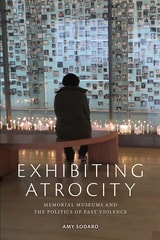
Exhibiting Atrocity
Memorial Museums and the Politics of Past ViolenceSodaro, Amy
Rutgers University Press, 2018
Honorable Mention, 2021 Outstanding First Book Award from the Memory Studies Association
Today, nearly any group or nation with violence in its past has constructed or is planning a memorial museum as a mechanism for confronting past trauma, often together with truth commissions, trials, and/or other symbolic or material reparations. Exhibiting Atrocity documents the emergence of the memorial museum as a new cultural form of commemoration, and analyzes its use in efforts to come to terms with past political violence and to promote democracy and human rights.
Through a global comparative approach, Amy Sodaro uses in-depth case studies of five exemplary memorial museums that commemorate a range of violent pasts and allow for a chronological and global examination of the trend: the U.S. Holocaust Memorial Museum in Washington, DC; the House of Terror in Budapest, Hungary; the Kigali Genocide Memorial Centre in Rwanda; the Museum of Memory and Human Rights in Santiago, Chile; and the National September 11 Memorial Museum in New York. Together, these case studies illustrate the historical emergence and global spread of the memorial museum and show how this new cultural form of commemoration is intended to be used in contemporary societies around the world.
Download open access ebook.
[more]

How America Gets Away with Murder
Illegal Wars, Collateral Damage and Crimes Against HumanityMichael Mandel
Pluto Press, 2004
[more]
Landscapes of Movement and Predation
Perspectives from Archaeology, History, and AnthropologyBrenda J. Bowser and Catherine M. Cameron
University of Arizona Press, 2024
Landscapes of Movement and Predation is a global study of times and places where people were subject to brutality, displacement, and loss of life, liberty, livelihood, and possessions. Extensive landscapes of predation emerged in the colonial era when Europeans expanded across much of the world, appropriating land and demanding labor from Indigenous people, resulting in the enslavement of millions of Africans and Indigenous Americans.
Landscapes of predation also developed in precolonial times in places where people were subjected to repeated ruthless attacks and dislocation. With contributions from archaeologists and a historian, the book provides a startling new perspective on an aspect of the past that is often overlooked: the role of violence in shaping where, how, and with whom people lived. Using ethnohistoric, ethnographic, historic, and archaeological data, the authors explore the actions of both predators and their targets and uncover the myriad responses people took to protect themselves.
Contributors
Fernando Almeida
Thomas John Biginagwa
Brenda J. Bowser
Catherine M. Cameron
Charles Cobb
Robbie Ethridge
Thiago Kater
Richard M. Leventhal
Lydia Wilson Marshall
Cliverson Pessoa
Neil Price
Ben Raffield
Andrés Reséndez
Samantha Seyler
Fabíola Andréa Silva
[more]
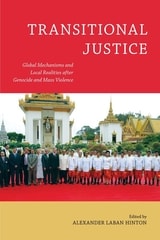
Transitional Justice
Global Mechanisms and Local Realities after Genocide and Mass ViolenceHinton, Alexander Laban
Rutgers University Press, 2011
How do societies come to terms with the aftermath of genocide and mass violence, and how might the international community contribute to this process? Recently, transitional justice mechanisms such as tribunals and truth commissions have emerged as a favored means of redress. Transitional Justice, the first edited collection in anthropology focused directly on this issue, argues that, however well-intentioned, transitional justice needs to more deeply grapple with the complexities of global and transnational involvements and the local on-the-ground realities with which they intersect.Contributors consider what justice means and how it is negotiated in different localities where transitional justice efforts are underway after genocide and mass atrocity. They address a variety of mechanisms, among them, a memorial site in Bali, truth commissions in Argentina and Chile, First Nations treaty negotiations in Canada, violent youth groups in northern Nigeria, the murder of young women in post-conflict Guatemala, and the gacaca courts in Rwanda.
[more]