Results by title
24 books match the query 'Criminals & Outlaws'
Alabama's Outlaw Sheriff, Stephen S. Renfroe
William Warren Rogers Sr.
University of Alabama Press, 2005
Among the villains, heroes, rogues and demigods who inhabit Southern folklore, Stephen S. Renfroe deserves a place. In the twentieth-century a few popular magazine and newspaper articles have been written about Renfroe, while Carl Carmer’s Stars Fell on Alabama, published in 1934, devoted several pages to him. Other than this, all is previously know about the enigmatic sheriff who because an outlaw is in the form of a legend.
In general, Renfroe appeared in the Black Belt town of Livingston, Alabama in the late 1860s and quickly became a member of the Ku Klux Klan. Allegedly playing a major role in driving out carpetbaggers and ridding Sumter County of Radical Republican rule, he was awarded with the office of sheriff. However, he reverted to a pattern of crime that earned him disgrace and ostracism.
As to his origins, his background, and the details of his career—much has been speculated but little has been documented. Although no statue commemorates Renfroe’s role as a statesman, educator, or solider (his highest military rank was that of private), a case can be made that he helped shape the course of politics in Alabama’s Black Belt.
Arkansas Godfather
The Story of Owney Madden and How He Hijacked Middle AmericaGraham Nown
Butler Center for Arkansas Studies, 2013
Chicago Heights
Little Joe College, the Outfit, and the Fall of Sam GiancanaCharles Hager with David T. Miller, Foreword by Louis Corsino, Afterword by Ashleigh D'Andrea
Southern Illinois University Press, 2018
In this riveting true story of coming of age in the Chicago Mob, Charles “Charley” Hager is plucked from his rural West Virginia home by an uncle in the 1960s and thrown into an underworld of money, cars, crime, and murder on the streets of Chicago Heights.
Street-smart and good with his hands, Hager is accepted into the working life of a chauffeur and “street tax” collector, earning the moniker “Little Joe College” by notorious mob boss Albert Tocco. But when his childhood friend is gunned down by a hit man, Hager finds himself a bit player in the events surrounding the mysterious, and yet unsolved, murder of mafia chief Sam Giancana.
Chicago Heights is part rags-to-riches story, part murder mystery, and part redemption tale. Hager, with author David T. Miller, juxtaposes his early years in West Virginia with his life in crime, intricately weaving his own experiences into the fabric of mob life, its many characters, and the murder of Giancana.
Fueled by vivid recollections of turf wars and chop shops, of fix-ridden harness racing and the turbulent politics of the 1960s, Chicago Heights reveals similarities between high-level organized crime in the city and the corrupt lawlessness of Appalachia. Hager candidly reveals how he got caught up in a criminal life, what it cost him, and how he rebuilt his life back in West Virginia with a prison record.
Based on interviews with Hager and supplemented by additional interviews and extensive research by Miller, the book also adds Hager’s unique voice to the volumes of speculation about Giancana’s murder, offering a plausible theory of what happened on that June night in 1975.
Death of a Gunfighter
The Quest for Jack Slade, the West's Most Elusive LegendDan Rottenberg
Westholme Publishing, 2008
The True Story of One of America’s Most Enigmatic and Tragic Heroes
Awarded Best Western History Book of 2008 by the Wild West History Association
"A superb biography"—Foreword Reviews
"An ambitious, well-written effort to restore a Wild West desperado to history.... Readers will surely remember Jack Slade from henceforth. A treat for Western history buffs and fans of true crime."—Kirkus Reviews
"An enjoyable read, and it is also a heroic effort."—Wall Street Journal
"Every bit the page-turner as Roughing It, with one added advantage—Rottenberg's book approaches the truth."—Wild West magazine
"Now and then a book of Western history comes along that captures an era and clears up many a mystery; Death of a Gunfighter is such a book."—Colorado Central magazine
In 1859, as the United States careened toward civil war, Washington's only northern link with America's richest state, California, was a stagecoach line operating between Missouri and the Pacific. Yet the stage line was plagued by graft, outlaws, and hostile Indians. At this critical moment, the company enlisted a former wagon train captain and Mexican War veteran to clean up its most dangerous division. Over the next three years, Joseph Alfred "Jack" Slade exceeded his employers' wildest dreams, capturing bandits and horse thieves and driving away gangs; he even shot to death a disruptive employee. He kept the stagecoaches and the U.S. Mail running, and helped launch the Pony Express, all of which kept California in the Union—and without California's gold, the Union would have failed to finance its cause. Across the Great Plains he became known as "The Law West of Kearny."
Slade's legend grew when he was shot multiple times and left for dead, only to survive and exact revenge on his would-be killer. But once Slade had restored the peace, leaving him without challenges, his life descended into an alcoholic Dr. Jekyll and Mr. Hyde nightmare, transforming him from a courageous leader, charming gentleman, and devoted husband into a vicious, quick-triggered ruffian—a purported outlaw —who finally lost his life at the hands of vigilantes.
Since Slade's death in 1864, persistent myths and stories have defied the efforts of writers and historians, including Mark Twain, to capture the real Jack Slade. Despite his notoriety, the pieces of Slade's fascinating life—including his marriage to the beautiful Maria Virginia—have remained scattered and hidden. He was never photographed and left almost no personal writings, not even a letter. In Death of a Gunfighter: The Quest for Jack Slade, the West's Most Elusive Legend, journalist Dan Rottenberg assembles years of research to reveal the true story of Jack Slade, one of America's greatest tragic heroes.
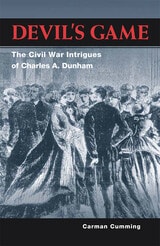
Devil's Game
The Civil War Intrigues of Charles A. DunhamCarman Cumming
University of Illinois Press, 2003
The first book-length study of one of the Civil War's most outlandish and mysterious characters
Devil's Game traces the amazing career of Charles A. Dunham, Civil War spy, forger, journalist, and master of dirty tricks. Writing for a variety of New York papers under alternate names, Dunham routinely faked stories, created new identities, and later boldly cast himself to play those roles. He achieved his greatest infamy when he was called to testify in Washington concerning Abraham Lincoln's assassination. Many parts of Dunham's career remain shadowy, but Cumming offers the first detailed tour of Dunham's convoluted, high-stakes, international deceits, including his effort to sell Lincoln on plans for a raid to capture Jefferson Davis.
Exhaustively researched and unprecedented in depth, this carefully crafted assessment of Dunham's motives, personality, and the complex effects of his schemes changes assumptions about covert operations during the Civil War.

Encyclopedia of Arkansas Music
Ali Welky
Butler Center for Arkansas Studies, 2013
What do a rockabilly musician turned cinematic swamp monster, a composer of player-piano music, an avant-garde cellist, a musical instrument that lent its name to a weapon, a rock musician turned Catholic monk, some of the best audio speakers in the world, and the creator of Schoolhouse Rock! have in common? That’s right–they all come from Arkansas.
Encyclopedia of Arkansas Music is a special project of the Encyclopedia of Arkansas History & Culture (EOA), an online encyclopedia launched in 2006 by the Butler Center for Arkansas Studies at the Central Arkansas Library System.
This colorful, photo-filled reference work spanning all aspects of Arkansas’s musical past and present includes more than 150 entries on musicians, ensembles, musical works, and events.

Every Last Tie
The Story of the Unabomber and His FamilyDavid Kaczynski
Duke University Press, 2016
Fourth City
Essays from the Prison in AmericaEdited by Doran Larson
Michigan State University Press, 2014
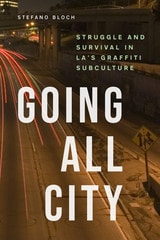
Going All City
Struggle and Survival in LA's Graffiti SubcultureStefano Bloch
University of Chicago Press, 2019
In the age of commissioned wall murals and trendy street art, it’s easy to forget graffiti’s complicated and often violent past in the United States. Though graffiti has become one of the most influential art forms of the twenty-first century, cities across the United States waged a war against it from the late 1970s to the early 2000s, complete with brutal police task forces. Who were the vilified taggers they targeted? Teenagers, usually, from low-income neighborhoods with little to their names except a few spray cans and a desperate need to be seen—to mark their presence on city walls and buildings even as their cities turned a blind eye to them.
Going All City is the mesmerizing and painful story of these young graffiti writers, told by one of their own. Prolific LA writer Stefano Bloch came of age in the late 1990s amid constant violence, poverty, and vulnerability. He recounts vicious interactions with police; debating whether to take friends with gunshot wounds to the hospital; coping with his mother’s heroin addiction; instability and homelessness; and his dread that his stepfather would get out of jail and tip his unstable life into full-blown chaos. But he also recalls moments of peace and exhilaration: marking a fresh tag; the thrill of running with his crew at night; exploring the secret landscape of LA; the dream and success of going all city.
Bloch holds nothing back in this fierce, poignant memoir. Going All City is an unflinching portrait of a deeply maligned subculture and an unforgettable account of what writing on city walls means to the most vulnerable people living within them.
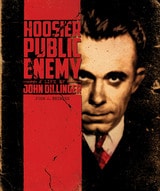
Hoosier Public Enemy
A Life of John DillingerJohn Beineke
Indiana Historical Society Press, 2014
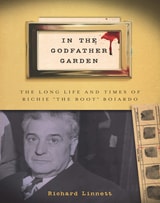
In the Godfather Garden
The Long Life and Times of Richie "the Boot" BoiardoLinnett, Richard
Rutgers University Press, 2013
To the press and the police, this secretive Don insisted he was nothing more than a simple man who enjoyed puttering about in his beloved vegetable garden on his Livingston, New Jersey, estate. In reality, the Boot was a confidante and kingmaker of politicians, a friend of such celebrities as Joe DiMaggio and George Raft, an acquaintance of Joseph Valachi—who informed on the Boot in 1963—and a sworn enemy of J. Edgar Hoover.
The Boot prospered for more than half a century, remaining an active boss until the day he died at the age of ninety-three. Although he operated in the shadow of bigger Mafia names across the Hudson River (think Charles "Lucky" Luciano and Louis “Lepke” Buchalter, a cofounder of the Mafia killer squad Murder Inc. with Jacob “Gurrah” Shapiro), the Boot was equally as brutal and efficient. In fact, there was a mysterious place in the gloomy woods behind his lovely garden—a furnace where many thought the Boot took certain people who were never seen again.
Richard Linnett provides an intimate look inside the Boot’s once-powerful Mafia crew, based on the recollections of a grandson of the Boot himself and complemented by never-before-published family photos. Chronicled here are the Prohibition gang wars in New Jersey as well as the murder of Dutch Schultz, a Mafia conspiracy to assassinate Newark mayor Kenneth Gibson, and the mob connections to several prominent state politicians.
Although the Boot never saw the 1972 release of The Godfather, he appreciated the similarities between the character of Vito Corleone and himself, so much so that he hung a sign in his beloved vegetable garden that read “The Godfather Garden.” There’s no doubt he would have relished David Chase’s admission that his muse in creating the HBO series The Sopranos was none other than “Newark’s erstwhile Boiardo crew.”
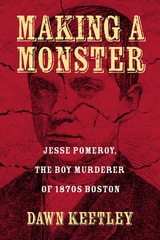
Making a Monster
Jesse Pomeroy, the Boy Murderer of 1870s BostonDawn Keetley
University of Massachusetts Press, 2017
In this book, Dawn Keetley details the story of Pomeroy's crimes and the intense public outcry. She explores the two reigning theories at the time—that he was shaped before birth when his pregnant mother visited a slaughterhouse and that he imitated brutal acts found in popular dime novels. Keetley then thoughtfully offers a new theory: that Pomeroy suffered a devastating reaction to a smallpox vaccination which altered his brain, creating a psychopath who revealed the human potential for brutality. The reaction to Pomeroy's acts, then and now, demonstrates the struggle to account for exactly those aspects of human nature that remain beyond our ability to understand.

Not the Camilla We Knew
One Woman's Path from Small-town America to the Symbionese Liberation ArmyRachael Hanel
University of Minnesota Press, 2022
The mystery of how an ordinary Minnesota girl came to be, briefly, one of the most wanted domestic terrorists in the United States
Behind every act of domestic terrorism there is someone’s child, an average American whose life took a radical turn for reasons that often remain mysterious. Camilla Hall is a case in point: a pastor’s daughter from small-town Minnesota who eventually joined the ranks of radicals like Sara Jane Olson (aka Kathleen Soliah) in the notorious Symbionese Liberation Army before dying in a shootout with Los Angeles Police in May 1974. How could a “good girl” like Camilla become one of the most wanted domestic terrorists in the United States? Rachael Hanel tells her story here, revealing both the deep humanity and the extraordinary circumstances of Camilla Hall’s life.
Camilla’s childhood in a tight-knit religious family was marred by loss and grief as, one after another, her three siblings died. Her path from her Minnesota home to her final, radical SLA family featured years as an artist and activist—in welfare offices, political campaigns, union organizing, culminating in a love affair that would be her introduction to the SLA. Through in-depth research and extensive interviews, Hanel pieces together Camilla’s bewildering transformation from a “gentle, zaftig, arty, otherworldy” young woman (as one observer remarked), working for social change within the system, into a gun-wielding criminal involved in the kidnapping of Patty Hearst.
During this time of mounting unrest and violence, Camilla Hall’s story is of urgent interest for what it reveals about the forces of radicalization. But as Hanel ventures ever further into Camilla’s past, searching out the critical points where character and cause might intersect, her book becomes an intriguing, disturbing, and ultimately deeply moving journey into the dark side of America’s promise.
Out of the Red
My Life of Gangs, Prison, and RedemptionChristian L. Bolden
Rutgers University Press, 2020
Faculty Senate Award for Research from Loyola University New Orleans
Out of the Red is one man’s pathbreaking story of how social forces and personal choices combined to deliver an unfortunate fate. After a childhood of poverty, institutional discrimination, violence, and being thrown away by the public education system, Bolden's life took him through the treacherous landscape of street gangs at the age of fourteen. The Bloods offered a sense of family, protection, excitement, and power. Incarcerated during the Texas prison boom, the teenage former gangster was thrust into a fight for survival as he navigated the perils of adult prison. As mass incarceration and prison gangs swallowed up youth like him, survival meant finding hope in a hopeless situation and carving a path to his own rehabilitation. Despite all odds, he forged a new path through education, ultimately achieving the seemingly impossible for a formerly incarcerated ex-gangbanger.
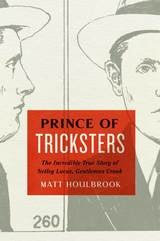
Prince of Tricksters
The Incredible True Story of Netley Lucas, Gentleman CrookMatt Houlbrook
University of Chicago Press, 2016
The lives of Netley Lucas are as flamboyant as they are unlikely. In Prince of Tricksters, Matt Houlbrook picks up the threads of Lucas’s colorful lies and lives. Interweaving crime writing and court records, letters and life-writing, Houlbrook tells Lucas’s fascinating story and, in the process, provides a panoramic view of the 1920s and ’30s. In the restless times after the Great War, the gentlemanly trickster was an exemplary figure, whose tall tales and bogus biographies exposed the everyday difficulties of knowing who and what to trust. Tracing how Lucas both evoked and unsettled the world through which he moved, Houlbrook shows how he prompted a pervasive crisis of confidence that encompassed British society, culture, and politics.
Taking readers on a romp through Britain, North America, and eventually into Africa, Houlbrook confronts readers with the limits of our knowledge of the past and challenges us to think anew about what history is and how it might be made differently.
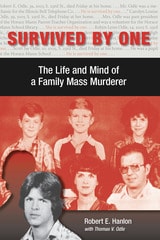
Survived by One
The Life and Mind of a Family Mass MurdererRobert E. Hanlon, PhD with Thomas V. Odle
Southern Illinois University Press, 2013
On November 8, 1985, 18-year-old Tom Odle brutally murdered his parents and three siblings in the small southern Illinois town of Mount Vernon, sending shockwaves throughout the nation. The murder of the Odle family remains one of the most horrific family mass murders in U.S. history. Odle was sentenced to death and, after seventeen years on death row, expected a lethal injection to end his life. However, Illinois governor George Ryan’s moratorium on the death penalty in 2000, and later commutation of all death sentences in 2003, changed Odle’s sentence to natural life.
The commutation of his death sentence was an epiphany for Odle. Prior to the commutation of his death sentence, Odle lived in denial, repressing any feelings about his family and his horrible crime. Following the commutation and the removal of the weight of eventual execution associated with his death sentence, he was confronted with an unfamiliar reality. A future. As a result, he realized that he needed to understand why he murdered his family. He reached out to Dr. Robert Hanlon, a neuropsychologist who had examined him in the past. Dr. Hanlon engaged Odle in a therapeutic process of introspection and self-reflection, which became the basis of their collaboration on this book.
Hanlon tells a gripping story of Odle’s life as an abused child, the life experiences that formed his personality, and his tragic homicidal escalation to mass murder, seamlessly weaving into the narrative Odle’s unadorned reflections of his childhood, finding a new family on death row, and his belief in the powers of redemption.
As our nation attempts to understand the continual mass murders occurring in the U.S., Survived by One sheds some light on the psychological aspects of why and how such acts of extreme carnage may occur. However, Survived by One offers a never-been-told perspective from the mass murderer himself, as he searches for the answers concurrently being asked by the nation and the world.
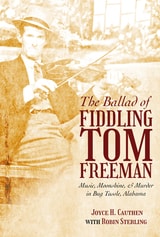
The Ballad of Fiddling Tom Freeman
Music, Moonshine, and Murder in Bug Tussle, AlabamaJoyce H. Cauthen with Robin Sterling
University of Alabama Press, 2026
A raw, firsthand account of feuds, fiddling, moonshining, and survival in a small Alabama town, told by its most colorful chronicler and shaped through careful historical insight.
The Ballad of Fiddling Tom Freeman is a riveting portrait of a forgotten America, drawn from the handwritten memoirs of a bootlegger, fiddler, and chronicler of life in Bug Tussle, Alabama, in the first half of the twentieth century. Today, rural voices are often drowned out by polished narratives, but this book resurrects the unfiltered perspective of a man who lived through—and candidly documented—the chaos and violence in his home place as he shared stories of the large close-knit families who lived there.
Freeman’s storytelling is as wild and tangled as the lives he describes, and author Joyce H. Cauthen, with the assistance of historical researcher Robin Sterling, brings clarity and context to his tales without sanding down their rough edges. The result is a vivid, bottom-up history of a place where lawlessness and loyalty often walked hand in hand.
The Ballad of Fiddling Tom Freeman stands out as a testament to the power of personal narrative. Not just a story about one man, it’s a window into a community shaped by hardship, music, and survival, told in a voice that refuses to be forgotten. This book is essential reading for historians, folklorists, musicians, and anyone drawn to the untamed stories of America’s backroads and backwoods.
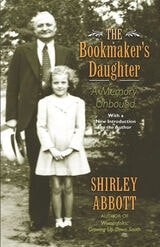
The Bookmaker's Daughter
A Memory UnboundShirley Abbott
University of Arkansas Press, 2006
This deeply felt memoir is a journey through family history, feminist insight, and southern mythology. In it a daughter reflects on the complicated and volatile love she and her father shared. Shirley Jean Abbott grew up in Hot Springs, Arkansas, in the 1940s and 50s and was the beloved daughter of Alfred Bemont Abbott, affectionately known as “Hat.” Hat wasn’t a bookmaker in the literary sense, even though he allowed Shirley’s mother to believe as much while they were dating. Rather, his craft was gambling, and his business was horse racing.
Despite the corruption, which put food on the table and rabbit coats in the closet, Abbott remembers the kind and attentive father who spent nights reading to her. He alone is responsible for opening the door to a world of language and literature for her. And she ran with it. Against her father’s wishes, after graduation she headed for New York City. In the end, the girl he had nurtured into an independent and intelligent young woman had outgrown the small town where she grew up. The Bookmaker’s Daughter was originally published by Ticknor and Fields in 1992 and was a Book of the Month Club selection.
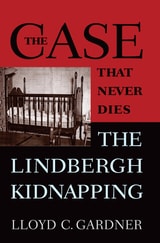
The Case That Never Dies
The Lindbergh KidnappingLloyd C. Gardner
Rutgers University Press, 2012
Winner of the 2004 New Jersey Studies Academic Alliance Book Award for Scholarly Non-Fiction | Named a 2005 Honor Book by the New Jersey Council for the Humanities
Essential reading for anyone interested in the most famous American crime of the twentieth century
Since its original publication in 2004, The Case That Never Dies has become the standard account of the Lindbergh kidnapping. Now, in a new afterword, historian Lloyd C. Gardner presents a surprise conclusion based on recently uncovered pieces of evidence that were missing from the initial investigation as well as an evaluation of Charles Lindbergh’s role in the search for the kidnappers. Out of the controversies surrounding the actions of Colonel Lindbergh, Norman Schwarzkopf, commander of the New Jersey State Police, and FBI director J. Edgar Hoover, Gardner presents a well-reasoned argument for what happened on the night of March 1, 1932.
The Case That NeverDies places the Lindbergh kidnapping, investigation, and trial in the context of the Depression, when many feared the country was on the edge of anarchy. Gardner delves deeply into the aspects of the case that remain confusing to this day, including Lindbergh’s dealings with crime baron Owney Madden, Al Capone’s New York counterpart, as well as the inexplicable exploits of John Condon, a retired schoolteacher who became the prosecution’s best witness. The initial investigation was hampered by Colonel Lindbergh, who insisted that the police not attempt to find the perpetrator because he feared the investigation would endanger his son’s life. He relented only when the child was found dead.
After two years of fruitless searching, Bruno Richard Hauptmann, a German immigrant, was discovered to have some of the ransom money in his possession. Hauptmann was arrested, tried, and sentenced to death. Throughout the book, Gardner pays special attention to the evidence of the case and how it was used and misused in the trial. Whether Hauptmann was guilty or not, Gardner concludes that there was insufficient evidence to convict him of first-degree murder.
Set in historical context, the book offers not only a compelling read, but a powerful vantage point from which to observe the United States in the 1930s as well as contemporary arguments over capital punishment.
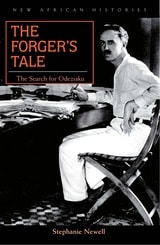
The Forger’s Tale
The Search for OdeziakuStephanie Newell
Ohio University Press, 2006
Between 1905 and 1939 a conspicuously tall white man with a shock of red hair, dressed in a silk shirt and white linen trousers, could be seen on the streets of Onitsha, in Eastern Nigeria. How was it possible for an unconventional, boy-loving Englishman to gain a social status among the local populace enjoyed by few other Europeans in colonial West Africa?
In The Forger’s Tale: The Search for Odeziaku Stephanie Newell charts the story of the English novelist and poet John Moray Stuart-Young (1881–1939) as he traveled from the slums of Manchester to West Africa in order to escape the homophobic prejudices of late-Victorian society. Leaving behind a criminal record for forgery and embezzlement and his notoriety as a “spirit rapper,” Stuart-Young found a new identity as a wealthy palm oil trader and a celebrated author, known to Nigerians as “Odeziaku.”
In this fascinating biographical account, Newell draws on queer theory, African gender debates, and “new imperial history” to open up a wider study of imperialism, (homo)sexuality, and nonelite culture between the 1880s and the late 1930s. The Forger’s Tale pays close attention to different forms of West African cultural production in the colonial period and to public debates about sexuality and ethics, as well as to movements in mainstream English literature.
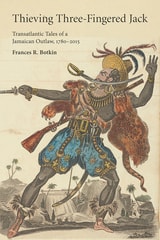
Thieving Three-Fingered Jack
Transatlantic Tales of a Jamaican Outlaw, 1780-2015Botkin, Frances R.
Rutgers University Press, 2018
The fugitive slave known as “Three-Fingered Jack” terrorized colonial Jamaica from 1780 until vanquished by Maroons, self-emancipated Afro-Jamaicans bound by treaty to police the island for runaways and rebels. A thief and a killer, Jack was also a freedom fighter who sabotaged the colonial machine until his grisly death at its behest. Narratives about his exploits shed light on the problems of black rebellion and solutions administered by the colonial state, creating an occasion to consider counter-narratives about its methods of divide and conquer. For more than two centuries, writers, performers, and storytellers in England, Jamaica, and the United States have “thieved" Three Fingered Jack's riveting tale, defining black agency through and against representations of his resistance.
Frances R. Botkin offers a literary and cultural history that explores the persistence of stories about this black rebel, his contributions to constructions of black masculinity in the Atlantic world, and his legacies in Jamaican and United States popular culture.
This Is Where I Am
A MemoirZeke Caligiuri
University of Minnesota Press, 2016
Prison is where Zeke Caligiuri is. Powderhorn Park in South Minneapolis, dubbed “Murderapolis” the year he turned eighteen, is where he comes from. It was the same neighborhood his father grew up in but had changed dramatically by the early 1990s. Yet in Zeke’s family, father and mother and grandmother kept things together while all around them the houses decayed and once-safe streets gave way to the crush of poverty and crime.
This Is Where I Am is Zeke Caligiuri’s clear-eyed account of how he got from there to here, how a boy who had every hope went from dreaming of freedom to losing it, along with nearly everything and everyone he loved. Tenderhearted in its reflections on his lost childhood, brutally candid in its description of a life of hanging and hustling, Zeke’s memoir recreates a world of tagging and goofing gone awry, of moving from smoking pot to unsuccessful attempts at dealing crack, of watching his father weep at the funeral of a seventeen-year-old boy, of going to jail: first strike. It is a place where, when asked what he's going to do with his life, a friend can only answer: “What the fuck are you talking about?”
This Is Where I Am is Zeke's own answer: he is going to tell his story, every sharp detail and sobering word, with the natural grace of a gifted writer and the hard-won wisdom of hindsight.
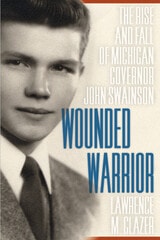
Wounded Warrior
The Rise and Fall of Michigan Governor John SwainsonLawrence M. Glazer
Michigan State University Press, 2010
Few people today remember John Swainson. As a teenage soldier he lost both legs in a WWII landmine explosion. Back in the United States, following a meteoric political rise in the Michigan State Senate, Swainson was elected as Michigan's youngest governor since Stevens T. Mason.
In 1970 Swainson was elected to the Michigan Supreme Court, becoming one of the few public officials to have served in the legislative, executive, and judicial branches of state government. Then, in 1957, he was indicted on federal charges of bribery and perjury, and convicted of lying to a federal grand jury. Forced to leave the state Supreme Court and disbarred from practicing law, he became a pariah, sinking into depression and alcoholism. He virtually disappeared from public view.
Lawrence M. Glazer re-examines the FBI's investigation of Swainson and delves into his 1975 trial in detail. He reveals new information from eye-witnesses who never testified and, in a poignant coda, relates the little-known story of Swainson's rehabilitation and return to public life as a historian.
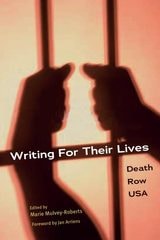
Writing for Their Lives
Death Row USAEdited by Marie Mulvey-Roberts. Foreword by Jan Arriens
University of Illinois Press, 2007
Exposing little-known facts about the five modes of execution practiced in the United States today, Writing for Their Lives documents the progress of life on death row from a capital trial to execution and beyond, through the testimony of the prisoners themselves as well as those who watch, listen, and write to them. What emerges are stories of the survival of the human spirit under even the most unimaginable circumstances, and the ways in which some prisoners find penitence and peace in the most unlikely surroundings. In spite of the uniformity of their prison life and its nearly inevitable conclusion, prisoners able to read and write letters are shown to retain and develop their individuality and humanity as their letters become poems and stories.
Writing for Their Lives serves ultimately as an affirmation of the value of life and provides bountiful evidence that when a state executes a prisoner, it takes a life that still had something to give.
This edition features an introduction by the editor as well as a foreword by Jan Arriens. Dr. Mulvey-Roberts will be donating her profits from the sale of this volume to the legal charity Amicus, which assists in capital defense in the United States."