Results by title

11 books match the query 'Critical Race Theory'
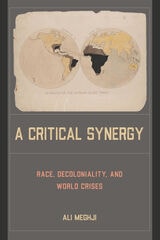
cover of A Critical Synergy: Race, Decoloniality, and World Crises

A Critical Synergy

Race, Decoloniality, and World Crises

Meghji, Ali

Temple University Press, 2023

Practitioners of decolonial theory and critical race theory (CRT) often use one or the other, but not both. In his provocative book, A Critical Synergy, Ali Meghji suggests using the two theories in tandem rather than attempting to hierarchize or synthesize them. Doing so allows for the study of social phenomena in a way that captures their global and historical roots, while acknowledging their local, national, and contemporary particularities.

The differences between decolonial thought and CRT, Meghji insists, does not necessarily imply one approach is stronger. Rather, he asserts, they often provide alternative but not incompatible viewpoints of the same social problem. Meghji presents case studies of capitalism, the COVID-19 pandemic, climate crisis, and twenty-first-century far-right populism to show that with both theories, we can understand more, as insights may be lost by using only one.

Meghji is not calling for a universal theoretical synthesis in A Critical Synergy, but rather a practice that can help open sociology and social science to the tradition of pluriversality much more broadly.
[more]
cover of Critical Race Theory: The Cutting Edge

Critical Race Theory

The Cutting Edge

Richard Delgado

Temple University Press, 2013

Critical Race Theory has become a dynamic, eclectic, and growing movement in the study of law. With this third edition of Critical Race Theory, editors Richard Delgado and Jean Stefancic have created a reader for the twenty-first century-one that shakes up the legal academy, questions comfortable liberal premises, and leads the search for new ways of thinking about our nation's most intractable, and insoluble, problem-race.

The contributions, from a stellar roster of established and emerging scholars, address new topics, such as intersectionality and black men on the "down low." Essays also confront much-discussed issues of discrimination, workplace dynamics, affirmative action, and sexual politics. Also new to this volume are updated section introductions, author notes, questions for discussion, and reading lists for each unit. The volume also covers the spread of the movement to other disciplines such as education.

Offering a comprehensive and stimulating snapshot of current race jurisprudence and thought, this new edition of Critical Race Theory is essential for those interested in law, the multiculturalism movement, political science, education, and critical thought.
[more]
cover of How “Indians” Think: Colonial Indigenous Intellectuals and the Question of Critical Race Theory

How “Indians” Think

Colonial Indigenous Intellectuals and the Question of Critical Race Theory

Gonzalo Lamana

University of Arizona Press, 2019
The conquest and colonization of the Americas marked the beginning of a social, economic, and cultural change of global scale. Most of what we know about how colonial actors understood and theorized this complex historical transformation comes from Spanish sources. This makes the few texts penned by Indigenous intellectuals in colonial times so important: they allow us to see how some of those who inhabited the colonial world in a disadvantaged position thought and felt about it.
 
This book shines light on Indigenous perspectives through a novel interpretation of the works of the two most important Amerindian intellectuals in the Andes, Felipe Guaman Poma de Ayala and Garcilaso de la Vega, el Inca. Building on but also departing from the predominant scholarly position that views Indigenous-Spanish relations as the clash of two distinct cultures, Gonzalo Lamana argues that Guaman Poma and Garcilaso were the first Indigenous activist intellectuals and that they developed post-racial imaginaries four hundred years ago. Their texts not only highlighted Native peoples’ achievements, denounced injustice, and demanded colonial reform, but they also exposed the emerging Spanish thinking and feeling on race that was at the core of colonial forms of discrimination. These authors aimed to alter the way colonial actors saw each other and, as a result, to change the world in which they lived.
[more]
cover of Power to the Transfer: Critical Race Theory and a Transfer Receptive Culture

Power to the Transfer

Critical Race Theory and a Transfer Receptive Culture

Dimpal Jain

Michigan State University Press, 2020
Currently, U.S. community colleges serve nearly half of all students of color in higher education who, for a multitude of reasons, do not continue their education by transferring to a university. For those students who do transfer, often the responsibility for the application process, retention, graduation, and overall success is placed on them rather than their respective institutions. This book aims to provide direction toward the development and maintenance of a transfer receptive culture, which is defined as an institutional commitment by a university to support transfer students of color. A transfer receptive culture explicitly acknowledges the roles of race and racism in the vertical transfer process from a community college to a university and unapologetically centers transfer as a form of equity in the higher education pipeline. The framework is guided by critical race theory in education, which acknowledges the role of white supremacy and its contemporary and historical role in shaping institutions of higher learning.
[more]
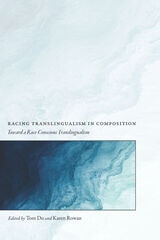
cover of Racing Translingualism in Composition: Toward a Race-Conscious Translingualism

Racing Translingualism in Composition

Toward a Race-Conscious Translingualism

edited by Tom Do and Karen Rowan

Utah State University Press, 2022

Racing Translingualism provides both theoretical and pedagogical reconsiderations of the translingual approach to language diversity by addressing the intersections of race and translingualism.
 
This collection extends the disciplinary conversations about translingualism by foregrounding the role race and racism play in the construction and maintenance of language differences. In doing so, the contributors examine the co-naturalization of race and language in order to theorize a race-conscious translingual praxis. The book begins by offering generative critiques of translingualism, centering on the ways in which the approach’s democratic orientation to language avoids issues of race, language, and power and appeals to colorblind racist tropes of equal opportunity. Following these critiques, contributors demonstrate the important intersections of race and translingualism by drawing upon voices typically marginalized by monolingual language ideologies and pedagogies. Finally, Racing Translingualism concludes by attending to the pedagogical implications of a race-conscious translingual praxis in writing and literacy education.
 
Making the case for race-conscious, rather than colorblind, theories and pedagogies, Racing Translingualism offers a unique take on how translingualism is theorized and practiced and moves the field forward through its direct consideration of the links between language, race, and racism.
 
Contributors: Lindsey Albracht, Steven Alvarez, Bethany Davila, Tom Do, Jaclyn Hilberg, Bruce Horner, Aja Martinez, Esther Milu, Stephanie Mosher, Yasmine Romero, Karen Rowan, Rachael Shapiro, Shawanda Stewart, Brian Stone, Victor Villanueva, Missy Watson

 
[more]
cover of Rock This Way: Cultural Constructions of Musical Legitimacy

Rock This Way

Cultural Constructions of Musical Legitimacy

Mel Stanfill

University of Michigan Press, 2023

Any and all songs are capable of being remixed. But not all remixes are treated equally. Rock This Way examines transformative musical works—cover songs, remixes, mash-ups, parodies, and soundalike songs—to discover what contemporary American culture sees as legitimate when it comes to making music that builds upon other songs. Through examples of how popular discussion talked about such songs between 2009 and 2018, Mel Stanfill uses a combination of discourse analysis and digital humanities methods to interrogate our broader understanding of transformative works and where they converge at the legal, economic, and cultural ownership levels. 

Rock This Way provides a new way of thinking about what it means to re-create and borrow music, how the racial identity of both the reusing artist and the reused artist matters, and the ways in which the law polices artists and their works. Ultimately, Stanfill demonstrates that the extent to which a work is seen as having new expression or meaning is contingent upon notions of creativity, legitimacy, and law, all of which are shaped by white supremacy.

[more]
cover of The Aesthetic Character of Blackness: Sounds Like Us

The Aesthetic Character of Blackness

Sounds Like Us

Jemma DeCristo

Duke University Press, 2025
In The Aesthetic Character of Blackness, Jemma DeCristo theorizes the means by which black art liberates the free world but does not and cannot liberate black people. Drawing on Frederick Douglass, W. E. B. Du Bois, and Alain Locke and as well as the aesthetic thought of Immanuel Kant, Friedrich Schiller, Friedrich Nietzsche, and Theodor Adorno, DeCristo critiques the exaltation of black culture and art’s saving power by analyzing the violence underneath aesthetic production. She tracks black music’s representational and anti-representational capacities in projects of black non/humanization from nineteenth-century abolitionism and the founding of the recording industry to the emergence of black queer blues performers and the rise of the Black Arts Movement of the 1960s. Theorizing the contemporary neoliberalization of black audio-visual spectacle, DeCristo ultimately demonstrates that the voluptuous world of black aesthetics beautifies an anti-black world that wields black art and culture as a weapon against black life.
[more]
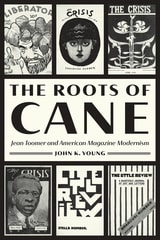
cover of The Roots of Cane: Jean Toomer and American Magazine Modernism

The Roots of Cane

Jean Toomer and American Magazine Modernism

John K. Young

University of Iowa Press, 2024

The Roots of Cane proposes a new way to read one of the most significant works of the New Negro Renaissance, Jean Toomer’s Cane. Rather than focusing on the form of the book published by Boni and Liveright, what Toomer would later call a single textual “organism,” John Young traces the many pieces of Cane that were dispersed across multiple modernist magazines from 1922 through 1923. These periodicals ranged from primarily political monthlies to avant-garde arts journals to regional magazines with transnational aspirations.

Young interweaves a periodical-studies approach to modernism with book history and critical race theory, resituating Toomer’s uneasy place within Black modernism by asking how original readers would have encountered his work. The different contexts in which those audiences were engaging with Toomer’s portraits of racialized identity in the Jim Crow United States, yield often surprising results.

 
[more]
cover of Torn: Asian/white Life and the Intimacy of Violence

Torn

Asian/white Life and the Intimacy of Violence

Anna M. Moncada Storti

Duke University Press, 2026
In Torn, Anna M. Moncada Storti searches for the ordinary and obscured impressions of the US empire, theorizing the pervasiveness of its violence through the language and patterns of intimacy. Reading for the intimacy of violence, Storti compiles an inventory of quotidian, psychic, and affective tensions that arise within the bodies of empire’s historical subjects. She raises Asian/white life as the representative case study to examine a familiar narrative of inner strife—that being of two distinct racial histories is to be rendered a body in tension, torn between ancestral lineages. Rather than refute this stance, Storti tracks the duress of fragmentation as a sign of war’s permanent mark on racial and sexual subjection. Traversing an archive of aesthetic, literary, and cultural portrayals of Asian/white racial mixture, Storti observes how Asian Americans refuse, rework, or reify the logics of progress and disavowal that have long fueled the US war machine. Tending to tension, she argues for a sustained confrontation with empire’s ordinary life, a prerequisite for anti-imperial solidarity.
[more]
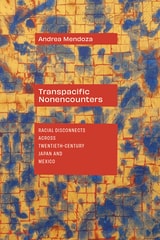
cover of Transpacific Nonencounters: Racial Disconnects Across Twentieth-Century Japan and Mexico

Transpacific Nonencounters

Racial Disconnects Across Twentieth-Century Japan and Mexico

Andrea Mendoza

Duke University Press, 2026
In Transpacific Nonencounters, Andrea Mendoza works across the seemingly unconnected histories of race and nation in modern Mexico and Japan, showing the commonalities in the way race figures in their state and social formations through a method Mendoza calls the theory of nonencounter. Intellectual and cultural productions of racial knowledge were important for the formation of the modernizing Mexican and Japanese states at the beginning of the twentieth century and helped conceive the project of national modernity through ideologies that promoted multiracial and multiethnic belonging—mestizaje and Pan-Asian co-prosperity. Despite the diasporic, economic, and political points of contact that connected these states throughout the twentieth century, however, traditional Eurocentric comparative and area-based studies treat the formations and legacies of Mexican mestizo nationalism and Japanese imperialism as wholly unrelated phenomena. Transpacific Nonencounters proposes a theory of nonencounter to formulate the logic of disciplinary disconnection, offering a framework and hermeneutic for a transpacific account of how Japanese imperialism and Mexican mestizo settler nationalism structured and reinforced one another through the modern formations of race and racism.
[more]
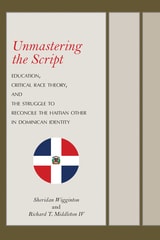
cover of Unmastering the Script: Education, Critical Race Theory, and the Struggle to Reconcile the Haitian Other in Dominican Identity

Unmastering the Script

Education, Critical Race Theory, and the Struggle to Reconcile the Haitian Other in Dominican Identity

Sheridan Wigginton and Richard T. Middleton IV

University of Alabama Press, 2019

Analyzes textbooks in the Dominican Republic for evidence of reproducing Haitian Otherness

Unmastering the Script: Education, Critical Race Theory, and the Struggle to Reconcile the Haitian Other in Dominican Identity examines how school curriculum–based representations of Dominican identity navigate black racial identity, its relatedness to Haiti, and the culturally  entrenched pejorative image of the Haitian Other in Dominican society. Wigginton and Middleton analyze how social science textbooks and historical biographies intended for young Dominicans reflect an increasing shift toward a clear and public inclusion of blackness in Dominican identity that serves to renegotiate the country’s long-standing antiblack racial master script.
 
The authors argue that although many of the attempts at this inclusion  reflect a lessening of “black denial,” when considered as a whole, the  materials often struggle to find a consistent and coherent narrative for the place of blackness within Dominican identity, particularly regarding the ways in which blackness continues to be meaningfully related to the otherness of Haitian racial identity. Unmastering the Script approaches the text materials as an example of “reconstructing” and “unburying” an African past, supporting the uneven, slow, and highly context-specific nature of the process.
 
This work engages with multiple disciplines including history, anthropology, education, and race studies, building on a new wave of Dominican scholarship that considers how contemporary perspectives of Dominican identity both accept the existence of an African past and seek to properly weigh its importance. The use of critical race theory as the framework facilitates unfolding the past political and legal agendas of governing elites in the Dominican Republic and also helps to unlock the nuance of an increasingly black-inclusive Dominican identity. In addition, this framework allows the unveiling of some of the socially damaging effects the Haitian Other master script can have on children, particularly those of Haitian ancestry, in the Dominican Republic.
 
[more]