Results by title
10 books match the query 'Culture wars'
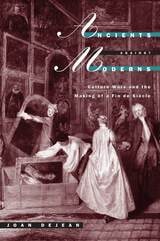
Ancients against Moderns
Culture Wars and the Making of a Fin de SiecleJoan DeJean
University of Chicago Press, 1996
DeJean brilliantly reassesses our current culture wars from the perspective of that earlier fin de siècle (the first to think of itself as such), and rereads the seventeenth-century Quarrel from the vantage of our own warring "ancients" and "moderns." In so doing, DeJean shows that a fin de siècle taking place in the shadow of culture wars can be more a source of constructive cultural revolution than of apocalyptic gloom and doom. Just as the first fin de siècle's battle of the books served as the spark that set off the Enlightenment, introducing radically new sexual and social politics that laid the groundwork for modernity, so can our current culture wars result in radical, liberating changes—if we take an active stand against our own "ancients" who seek to stifle such reforms.
Classics, the Culture Wars, and Beyond
Eric Adler
University of Michigan Press, 2016
Beginning with a short intellectual history of the academic culture wars, Eric Adler’s book examines popular polemics including those by Allan Bloom and Dinesh D’Souza, and considers the oddly marginal role of classical studies in these conflicts. In presenting a brief history of classics in American education, the volume sheds light on the position of the humanities in general.
Adler dissects three significant controversies from the era: the so-called AJP affair, which supposedly pitted a conservative journal editor against his feminist detractors; the brouhaha surrounding Martin Bernal’s contentious Black Athena project; and the dustup associated with Victor Davis Hanson and John Heath’s fire-breathing jeremiad, Who Killed Homer? He concludes by considering these controversies as a means to end the crisis for classical studies in American education. How can the study of antiquity—and the humanities—thrive in the contemporary academy? This book provides workable solutions to end the crisis for classics and for the humanities as well.
This major work also includes findings from a Web survey of American classical scholars, offering the first broadly representative impression of what they think about their discipline and its prospects for the future. Adler also conducted numerous in-depth interviews with participants in the controversies discussed, allowing readers to gain the most reliable information possible about these controversies.
Those concerned about the liberal arts and the best way to educate young Americans should read this book. Accessible and jargon-free, this narrative of scholarly scandals and their context makes for both enjoyable and thought-provoking reading.
Culture Wars and Enduring American Dilemmas
Irene Taviss Thomson
University of Michigan Press, 2010
"Irene Taviss Thomson gives us a nuanced portrait of American social politics that helps explain both why we are drawn to the idea of a 'culture war' and why that misrepresents what is actually going on."
---Rhys H. Williams, Professor and Chair, Department of Sociology, Loyola University Chicago
"An important work showing---beneath surface conflict---a deep consensus on a number of ideals by social elites."
---John H. Evans, Department of Sociology, University of California, San Diego
The idea of a culture war, or wars, has existed in America since the 1960s---an underlying ideological schism in our country that is responsible for the polarizing debates on everything from the separation of church and state, to abortion, to gay marriage, to affirmative action. Irene Taviss Thomson explores this notion by analyzing hundreds of articles addressing hot-button issues over two decades from four magazines: National Review, Time, The New Republic, and The Nation, as well as a wide array of other writings and statements from a substantial number of public intellectuals.
What Thomson finds might surprise you: based on her research, there is no single cultural divide or cultural source that can account for the positions that have been adopted. While issues such as religion, homosexuality, sexual conduct, and abortion have figured prominently in public discussion, in fact there is no single thread that unifies responses to each of these cultural dilemmas for any of the writers.
Irene Taviss Thomson is Professor Emeritus of Sociology, having taught in the Department of Social Sciences and History at Fairleigh Dickinson University for more than 30 years. Previously, she taught in the Department of Sociology at Harvard University.
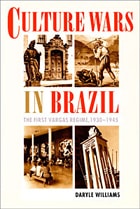
Culture Wars in Brazil
The First Vargas Regime, 1930–1945Daryle Williams
Duke University Press, 2001
Williams draws on a rich selection of textual, pictorial, and architectural sources in his exploration of the dynamic nature of educational film and radio, historical preservation, museum management, painting, public architecture, and national delegations organized for international expositions during the unsettled era in which modern Brazil’s cultural canon took definitive form. In his close reading of the tensions surrounding official policies of cultural management, Williams both updates the research of the pioneer generation of North American Brazilianists, who examined the politics of state building during the Vargas era, and engages today’s generation of Brazilianists, who locate the construction of national identity of modern Brazil in the Vargas era.
By integrating Brazil into a growing body of literature on the cultural dimensions of nations and nationalism, Culture Wars in Brazil will be important reading for students and scholars of Latin American history, state formation, modernist art and architecture, and cultural studies.

Culture Wars
School and Society in the Conservative RestorationIra Shor
University of Chicago Press, 1992
"An outstanding work of educational theory and history."—John Coatsworth, University of Chicago
Enemy Within
Culture Wars and Political Identity in Novels of the French Third RepublicGilbert D. Chaitin
The Ohio State University Press, 2008

The New Censors
Movies and the Culture WarsCharles Lyons
Temple University Press, 1997
The New Censors, the first study of the complex ways movies have been shaped in the years since the demise of the Code, covers a wide range of movies, protests, and government actions. From feminists against "Dressed to Kill," to religious campaigns against "The Last Temptation of Christ," to homosexuals ire over "Basic Instinct," Lyons links a study of public outrage against movies to the broader culture wars over "family values," pornography, and various lifestyle issues.
This book provides a contemporary history of controversial movies and a timely discussion of how cultural politics continues to affect the movie industry.
The Roots of Polarization
From the Racial Realignment to the Culture WarsNeil A. O'Brian
University of Chicago Press, 2024
A deeply researched account of how battles over civil rights in the 1960s shaped today’s partisan culture wars.
In the late twentieth century, gay rights, immigration, gun control, and abortion debates all burst onto the political scene, scrambling the parties and polarizing the electorate. Neil A. O’Brian traces the origins of today’s political divide on these issues to the 1960s when Democrats and Republicans split over civil rights. It was this partisan polarization over race, he argues, that subsequently shaped partisan fault lines on other culture war issues that persist to this day.
Using public opinion data dating to the 1930s, O’Brian shows that attitudes about civil rights were already linked with a range of other culture war beliefs decades before the parties split on these issues—and much earlier than previous scholarship realized. Challenging a common understanding of partisan polarization as an elite-led phenomenon, The Roots of Polarization argues politicians and interest groups, jockeying for power in the changing party system, seized on these preexisting connections in the mass public to build the parties’ contemporary coalitions.
Whose America?
Culture Wars in the Public SchoolsJonathan Zimmerman
University of Chicago Press, 2022
Critical Race Theory. The 1619 Project. Mask mandates. As the headlines remind us, American public education is still wracked by culture wars. But these conflicts have shifted sharply over the past two decades, marking larger changes in the ways that Americans imagine themselves. In his 2002 book, Whose America?, Zimmerman predicted that religious differences would continue to dominate the culture wars. Twenty years after that seminal work, Zimmerman has reconsidered: arguments over what American history is, what it means, and how it is taught have exploded with special force in recent years. In this substantially expanded new edition, Zimmerman meditates on the history of the culture wars in the classroom—and on what our inability to find common ground might mean for our future.
Whose America?
Culture Wars in the Public SchoolsJonathan Zimmerman
University of Chicago Press, 2022
In this expanded edition of his 2002 book, Zimmerman surveys how battles over public education have become conflicts at the heart of American national identity.
Critical Race Theory. The 1619 Project. Mask mandates. As the headlines remind us, American public education is still wracked by culture wars. But these conflicts have shifted sharply over the past two decades, marking larger changes in the ways that Americans imagine themselves. In his 2002 book, Whose America?, Zimmerman predicted that religious differences would continue to dominate the culture wars. Twenty years after that seminal work, Zimmerman has reconsidered: arguments over what American history is, what it means, and how it is taught have exploded with special force in recent years. In this substantially expanded new edition, Zimmerman meditates on the history of the culture wars in the classroom—and on what our inability to find common ground might mean for our future.