Results by title
11 books match the query 'Curriculum planning'
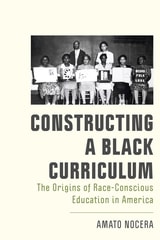
Constructing a Black Curriculum
The Origins of Race-Conscious Education in AmericaAmato Nocera
Rutgers University Press, 2027
Constructing a Black Curriculum reframes how we understand Black Americans’ intellectual and political engagement with education during the first half of the twentieth century. It traces the powerful, diffuse movement created by Black Americans to build what Nocera calls a “Black Curriculum:" a communal effort to represent Black identity, guide racial consciousness, and rebut claims of inferiority. This curriculum first developed as a public educational project in Black learned societies and during the Harlem Renaissance before making its way into schools. The struggle for a Black curriculum was not only a fight against white supremacy, but also an internal debate among Black advocates over the very nature of how race should be represented and taught. This book illuminates this struggle through the work of Black intellectuals (Alexander Crummell, Carter G. Woodson, Hubert Harrison, and Alain Locke) and the intellectual contributions of African American educators (Nannie Burroughs, Jane Dabney Shackelford, and Julia Davis). This essential history provides vital context for contemporary debates over curriculum reform, racial knowledge, and the enduring quest for educational equity.
Curriculum as Conversation
Transforming Traditions of Teaching and LearningArthur N. Applebee
University of Chicago Press, 1996
“Applebee's central point, the need to teach 'knowledge in context,' is absolutely crucial for the hopes of any reformed curriculum. His experience and knowledge give his voice an authority that makes many of the current proposals on both the left and right seem shallow by comparison.”—Gerald Graff, University of Chicago

Developing 21st Century Literacies
A K-12 School Library Curriculum Blueprint with Sample LessonsBeth E. Tumbleson
American Library Association, 2011
Fundamentals of Curriculum Planning, Development, Implementation, and Evaluation in English Language Teaching
Eman Elturki
University of Michigan Press, 2026
This book offers a systematic guide to navigating the different phases of the curriculum, from its inception to its evaluation. Part I explores the conceptual and theoretical foundations that shape curriculum and instruction. Part II provides practical knowledge and guidelines that programs and individual teachers can adopt or adapt to their specific educational contexts with the goal is to optimize the teaching and learning experience. Elturki draws largely on knowledge from the field of education, particularly curriculum studies, to complement what we know about L2 teaching and learning from Applied Linguistics, Second Language Acquisition, and English Language Teaching. Each chapter begins with pre-reading questions to stimulate thinking and concludes with post-reading questions for reflection, encouraging readers to connect the material to their own context.
Inclusive Teaching
Strategies for Promoting Equity in the College ClassroomKelly A. Hogan
West Virginia University Press, 2022
Award-winning teachers offer practical tips for addressing inequities in the college classroom and for making all students feel welcome and included.
In a book written by and for college teachers, Kelly Hogan and Viji Sathy provide tips and advice on how to make all students feel welcome and included. They begin with a framework describing why explicit attention to structure enhances inclusiveness in both course design and interactions with and between students. Inclusive Teaching then provides practical ways to include more voices in a series of contexts: when giving instructions for group work and class activities, holding office hours, communicating with students, and more. The authors finish with an opportunity for the reader to reflect on what evidence to include in a teaching dossier that demonstrates inclusive practices.
The work of two highly regarded specialists who have delivered over a hundred workshops on inclusive pedagogy and who contribute frequently to public conversations on the topic, Inclusive Teaching distills state-of-the-art guidance on addressing privilege and implicit bias in the college classroom. It seeks to provide a framework for individuals and communities to ask, Who is being left behind and what can teachers do to add more structure?
Instructional Design for Librarians and Information Professionals
American Library Association, 2011

Issues in Curriculum
Selected Essays from Past NSSE YearbooksEdited by Margaret Early and Kenneth J. Rehage
University of Chicago Press, 1999
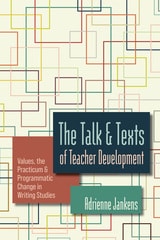
The Talk and Texts of Teacher Development
Values, the Practicum, and Programmatic Change in Writing StudiesAdrienne Jankens
Utah State University Press, 2026
Through her multi-site analysis, Jankens examines the ways values are reflected in syllabi, committee meetings, and classroom practices. She demonstrates how values that are often unstated or assumed can be made explicit and linked to programmatic action, thus supporting development and aligning instructional goals with broader institutional objectives. Offering a nuanced framework on practicum courses, Jankens also highlights the importance of local contexts and distinguishes among tacit, implicit, explicit, emergent, and articulated values. This layered understanding helps reveal the often hidden mechanisms by which writing program values are enacted in day-to-day teaching practices.
Teacher development is a crucial site for enacting and understanding programmatic values, and making these values explicit can guide meaningful programmatic change. Providing an institutional ethnography of Jankens’s own writing program and situating those findings within broader conversations in writing studies, The Talk and Texts of Teacher Development adds to scholarship exploring the focus of the practicum course, the positionality and experience of graduate teaching assistants in writing programs, and the perennial work of the field to identify its core values and disciplinary identity.
User Experience as Innovative Academic Practice
Kate Crane
University Press of Colorado, 2022
Using Technology to Teach Information Literacy
American Library Association, 2008

ePortfolios@edu
What We Know, What We Don’t Know, and Everything In-BetweenMary Ann Dellinger
University Press of Colorado, 2021
This book is also available as an open access ebook through the WAC Clearinghouse.