Results by title
34 books match the query 'Desire in literature'
A Cosmos of Desire
The Medieval Latin Erotic Lyric in English ManuscriptsThomas C Moser, Jr.
University of Michigan Press, 2004
Thomas C. Moser, Jr. explores the fascinating body of medieval Latin erotic poetry found in English manuscripts. His study describes the intellectual and social context from which the great erotic songs of the twelfth century emerged, and examines a variety of erotic poems, from school exercises to the magnificent lyrics found in Arundel 384. He also illuminates the influence of neoplatonic philosophy on this poetry, explicating key neoplatonic texts and applying that analysis in close readings of erotic lyrics from the same period and milieu.
A Cosmos of Desire will interest scholars of medieval literature as well as specialists in Latin poetry and philosophy. Students of Middle English literature will find that it fills an important gap in our understanding of English intellectual life between the twelfth and the fourteenth century. All Latin prose and poetry is translated, some works for the first time, and the book is generously illustrated with photographs of the manuscripts discussed.
Thomas C. Moser, Jr. is Associate Professor of English at the University of Maryland, College Park.
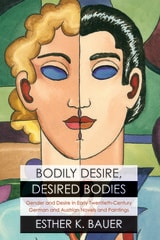
Bodily Desire, Desired Bodies
Gender and Desire in Early Twentieth-Century German and Austrian Novels and PaintingsEsther K. Bauer
Northwestern University Press, 2014
Bodily Desire, Desired Bodies examines the diverse ways that literary works and paintings can be read as screens onto which new images of masculinity and femininity are cast. Esther Bauer focuses on German and Austrian writers and artists from the 1910s and 1920s —specifically authors Franz Kafka, Vicki Baum, and Thomas Mann, and painters Otto Dix, Christian Schad, and Egon Schiele—who gave spectacular expression to shifting trends in male and female social roles and the organization of physical desire and the sexual body.
Bauer’s comparative approach reveals the ways in which artists and writers echoed one another in undermining the gender duality and highlighting sexuality and the body. As she points out, as sites of negotiation and innovation, these works reconfigured bodies of desire against prevailing notions of sexual difference and physical attraction and thus became instruments of social transformation.
Carnal Rhetoric
Milton’s Iconoclasm and the Poetics of DesireLana Cable
Duke University Press, 1995
Cable traces the development of Milton’s iconoclastic poetics from its roots in the antiprelatical tracts, through the divorce tracts and Areopagitica, to its fullest dramatic representation in Eikonoklastes and Samson Agonistes. Arguing that, like every creative act, metaphor is by nature a radical and self-transgressing agent of change, she explores the site where metaphoric language and imaginative desire merge. Examining the demands Milton places on metaphor, particularly his emphasis on language as a vehicle for mortal redemption, Cable demonstrates the ways in which metaphor acts for him as that creative and radical agent of change. In the process, she reveals Milton’s engagement, at the deepest levels of linguistic creativity, with the early modern commitment to an imaginative and historic remaking of the world.
An insightful and synthetic book, Carnal Rhetoric will appeal to scholars of English literature, Milton, and the Renaissance, as well as to those with an interest in the theory of affective stylistics as it pertains to reader-response criticism, semantics, epistemology, and the philosophy and psychology of language.
Closet Devotions
Richard Rambuss
Duke University Press, 1998
Through startling rereadings of works ranging from the devotional verse of the metaphysical poets (Donne, Herbert, Crashaw, and Traherne) to photographer Andres Serrano’s controversial “Piss Christ,” from Renaissance religious iconography to contemporary gay porn, Rambuss uncovers the highly charged erotic imagery that suffuses religious devotional art and literature. And he explores one of Christian culture’s most guarded (and literal) closets—the prayer closet itself, a privileged space where the vectors of same-sex desire can travel privately between the worshiper and his or her God.
Elegantly written and theoretically astute, Closet Devotions illuminates the ways in which sacred Christian devotion is homoeroticized, a phenomenon that until now has gone unexplored in current scholarship on religion, the body, and its passions. This book will attract readers across a wide array of disciplines, including gay and lesbian studies, literary theory and criticism, Renaissance studies, and religion.
DESIRING ROME
Male Subjectivity and Reading Ovid’s FastiRichard J. King
The Ohio State University Press, 2006
Desiring Rome expands upon recent recognition of the Fasti’s centrality to early imperial politics by situating the poem’s “failure” within broader negotiations of identity between early imperial citizen-subjects and the cultural ideology of Roman manhood.
Dark Smiles
Race and Desire in George EliotAlicia Carroll
Ohio University Press, 2002
Although George Eliot has long been described as “the novelist of the Midlands,” she often brought the outer reaches of the empire home in her work. Dark Smiles: Race and Desire in George Eliot studies Eliot’s problematic, career-long interest in representing racial and ethnic Otherness.
Placing Eliot’s diverse and wide-ranging treatment of Otherness in its contemporary context, Alicia Carroll argues that Eliot both engages and resists traditional racial and ethnic representations of Otherness. Carroll finds that Eliot, like other women writers of her time, often appropriates narratives of Otherness to explore issues silenced in mainstream Victorian culture, particularly the problem of the desirous woman. But if Otherness in Eliot’s century was usually gendered as woman and constructed as the object of white male desire, Eliot often seeks to subvert that vision. Professor Carroll demonstrates Eliot’s tendency to “exoticize” images of girlhood, vocation, and maternity in order to critique and explore gendered subjectivities. Indeed, the disruptive presence of a racial or ethnic outsider often fractures Eliot’s narratives of community, creating a powerful critique of home culture.
The consistent reliance of Eliot’s work upon racial and ethnic Otherness as a mode of cultural critique is explored here for the first time in its entirety.

Desire and Truth
Functions of Plot in Eighteenth-Century English NovelsPatricia Meyer Spacks
University of Chicago Press, 1990
Desire in the Canterbury Tales
Elizabeth Scala
The Ohio State University Press, 2015
Desire in the Canterbury Tales coordinates the compulsions of desire with the act of misreading to define the driving force of Chaucer’s story collection. With Chaucer’s competitive pilgrimage as an important point of departure, this study examines the collection’s manner of generating stories out of division, difference, and contestation. It argues that Chaucer’s tales are produced as misreadings and misrecognitions of each other. Looking to the main predicate of the General Prologue’s famous opening sentence (“longen”) as well as the thematic concerns of a number of tale-tellers, and working with a theoretical model that exposes language as the product of such longing, Scala posits desire as the very subject of the Canterbury Tales and misrecognition as its productive effect. In chapters focusing on both the well-discussed tales of fragment 1 and the marriage group as well as the more recalcitrant religious stories, Desire in the Canterbury Tales offers a comprehensive means of accounting for Chaucer’s poem.
Desire
Flaubert, Proust, Fitzgerald, Miller, Lana Del ReyPer Bjørnar Grande
Michigan State University Press, 2020
Desiring Voices
Women Sonneteers and PetrarchismMary B. Moore
Southern Illinois University Press, 2000
“How do I love thee? Let me count the ways,” wrote Elizabeth Barrett Browning in her Sonnets from the Portuguese.Desiring Voices: Women Sonneteers and Petrarchism proposes that we attend to the ways that women poets from the sixteenth through the twentieth centuries have both echoed and transformed the literary and erotic conventions that strongly influenced their fates as women, wives, and lovers.
Mary B. Moore analyzes and provides context for love sonnet sequences by Italian, French, English, and American women poets in the light of current knowledge concerning attitudes towards women at the time they wrote. Through close readings of the poems combined with theory and criticism about constructs of women, historical events, and biographical contexts, Moore reveals patterns of revision among women poets that shed further light on the poets themselves, on Petrarchism as a convention, and on ideas about women. She focuses on Petrarchan sonnet sequences by women because the poems serve both as works of art and as documents that illuminate the range and limitations of female roles as erotic subjects (agents of speech, action, knowledge, and desire) as well as their more usual roles as erotic objects.
Combining theory with close reading, Moore enhances the value of many generally neglected poems by women. After a thorough discussion of the Petrarchan sonnet tradition, she analyzes the work of Gaspara Stampa, Louise Labé, Lady Mary Wroth, Charlotte Smith, Elizabeth Barrett Browning, and Edna St. Vincent Millay.
Grief and the Hero
The Futility of Longing in the IliadEmily P. Austin
University of Michigan Press, 2021
Grief and the Hero examines Achilles’ experience of the futility of grief in the context of the Iliad’s study of anger. No action can undo his friend Patroklos’ death, but the experience of death drives him to behave as though he can achieve something restorative. Rather than assuming that grief gives rise to anger, as most scholars have done, Grief and the Hero pays close attention to the poem’s representation of the origin of these emotions. In the Iliad, only Achilles’ grief for Patroklos is joined with the word pothê, “longing”; no other grief in the poem is described with this term. The Iliad depicts Achilles’ grief as the rupture of shared life—an insight that generates a new way of reading the epic. Achilles’ anguish drives him to extremes, oscillating between self-isolation and seeking communal expressions of grief; between weeping abundantly and relentlessly pursuing battle; between varied threats of mutilation, deeds of vengeance, and other vows. Yet his yearning for life shared with Patroklos is the common denominator. Here lies the profound insight of the Iliad. All of Achilles’ grief-driven deeds arise from his longing for life with Patroklos, and thus all of these deeds are, in a deep sense, futile. He yearns for something unattainable—undoing the reality of death. Grief and the Hero will appeal not only to scholars and students of Homer but to all humanists. Loss, longing, and even revenge touch many human lives, and the insights of the Iliad have broad resonance.
Homosexual Desire in Shakespeare's England
A Cultural PoeticsBruce R. Smith
University of Chicago Press, 1994
"The best single analysis of the homoerotic element in Renaissance English literature."—Keith Thomas, New York Review of Books
"Smith's lucid and subtle book offer[s] a poetics of homosexual desire. . . . Its scholarship, impressively broad and deftly deployed, aims to further a serious social purpose: the redemptive location of homosexual desire in history and the recuperation for our own time, through an understanding of its discursive embodiments, of that desire's changing imperatives and parameters."—Terence Hawkes, Times Literary Supplement
"The great strength of Bruce Smith's book is that it does not sidestep the complex challenge of engaging in the sexual politics of the present while attending to the resistant discourses and practices of Renaissance England. Homosexual Desire in Shakespeare's England demonstrates how a commitment to the present opens up our understanding of the past."—Peter Stallybrass, Shakespeare Quarterly
"A major contribution to the understanding of homosexuality in Renaissance England and by far the best and most comprehensive account yet offered of the homoeroticism that suffuses Renaissance literature."—Claude J. Summers, Journal of Homosexuality

Imperial Desire
Dissident Sexualities And Colonial LiteraturePhilip Holden
University of Minnesota Press, 2003
Illuminates the intersections between colonial thought and homosexuality
An exploration of the intersection of colonialism and homosexuality in fiction and travel writing from Robinson Crusoe to the present, this volume brings together two dynamic fields of academic inquiry: colonial discourse analysis, which considers literary texts as expressions of colonial power; and queer theory, which interrogates the representation, enforcement, and subversions of sexualities in literature and culture.
These writers reexamine the work of Kipling, Conrad, Forster, Lessing, and others, ranging from male adventure stories to postcolonial novels. This volume will provoke and inform readers concerned with gender and sexuality, colonial history and literature, or with any of the works and authors revisited—and reexperienced—here. Contributors: Anjali Arondekar, U of California, Santa Cruz; John C. Beynon, California State U, Fresno; Joseph A. Boone, USC; Sarah Cole, Columbia U; Lois Cucullu, U of Minnesota; Maria Davidis, Cornell; Dennis Denisoff, Ryerson U; Mark Forrester, U of Maryland; Terry Goldie, York U; Christopher Lane, Northwestern U; Tim Middleton, Bath Spa U College, UK; Hans Turley, U of Connecticut.
Inaugural Wounds
The Shaping of Desire in Five Nineteenth-Century English NarrativesRobert E. Lougy
Ohio University Press, 2004
Desire, Jacques Lacan suggests, is a condition or expression of our wounded nature. But because such desire is also unconscious, it can be expressed only indirectly, for what we consciously desire is hardly ever what we really want. Desire makes itself known, but disguises its presence—appearing, for example, in unconscious but repetitive, and sometimes even self-destructive, patterns of behavior.
Informed by the voices of Freud and Lacan regarding the nature of language and desire, Inaugural Wounds examines the ways in which five major nineteenth-century English writers explored the trajectories and shapes of desire. Arguing that we need to give to novels the same kind of close scrutiny we give to poetry, author Robert Lougy suggests that when we do so, we discover that they often astound us by the resonance and range of their language, as well as by their ability to take us to strange and haunting places.
The five narratives examined—Charles Dickens’s Martin Chuzzlewit, William Thackeray’s Journey from Cornhill to Grand Cairo, Elizabeth Gaskell’s Ruth, Wilkie Collins’s The Woman in White, and Thomas Hardy’s Jude the Obscure—testify to the mysterious origins of desire. Although each of the novels tells its own story in its own way, they share a fascination with the nature of desire itself.
Drawing upon recent work that has challenged historicist approaches toward nineteenth-century British literature, Professor Lougy uses the insights of psychoanalysis to enable us to more fully appreciate the depth and power of these novels. Of great value to Victorian and psychoanalytic scholars, Inaugural Wounds will be useful for teaching undergraduates as well.
Intricate Relations
Sexual and Economic Desire in American Fiction, 1789-1814Karen A. Weyler
University of Iowa Press, 2005
Intricate Relations charts the development of the novel in and beyond the early republic in relation to these two thematic and intricately connected centers: sexuality and economics. By reading fiction written by Americans between 1789 and 1814 alongside medical theory, political and economic tracts, and pedagogical literature of all kinds, Karen Weyler recreates and illuminates the larger, sometimes opaque, cultural context in which novels were written, published, and read.
In 1799, the novelist Charles Brockden Brown used the evocative phrase “intricate relations” to describe the complex imbrication of sexual and economic relations in the early republic. Exploring these relationships, he argued, is the chief job of the “moral historian,” a label that most novelists of the era embraced. In a republic anxious about burgeoning individualism in the 1790s and the first two decades of the nineteenth century, the novel foregrounded sexual and economic desires and explored ways to regulate the manner in which they were expressed and gratified.
In Intricate Relations, Weyler argues that understanding how these issues underlie the novel as a genre is fundamental to understanding both the novels themselves and their role in American literary culture. Situating fiction amid other popular genres illuminates how novelists such as Charles Brockden Brown, Hannah Foster, Samuel Relf, Susanna Rowson, Rebecca Rush, and Sally Wood synthesized and iterated many of the concerns expressed in other forms of public discourse, a strategy that helped legitimate their chosen genre and make it a viable venue for discussion in the decades following the revolution.
Weyler’s passionate and persuasive study offers new insights into the civic role of fiction in the early republic and will be of great interest to literary theorists and scholars in women’s and American studies.
Lines of Flight
Discursive Time and Countercultural Desire in the Work of Thomas PynchonStefan Mattessich
Duke University Press, 2002
Mattessich theorizes a new kind of time—subjective displacement—dramatized in the parody, satire, and farce deployed through Pynchon’s oeuvre. In particular, he is interested in showing how this sense of time relates to the counterculture of the 1960s and 1970s. Examining this movement as an instance of flight or escape and exposing the beliefs behind it, Mattessich argues that the counterculture’s rejection of the dominant culture ultimately became an act of self-cancellation, a rebellion in which the counterculture found itself defined by the very order it sought to escape. He points to parallels in Pynchon’s attempts to dramatize and enact a similar experience of time in the doubling-back, crisscrossing, and erasure of his writing. Mattessich lays out a theory of cultural production centered on the ethical necessity of grasping one’s own susceptibility to discursive forms of determination.
Mail and Female
Epistolary Narrative and Desire in Ovid's HeroidesSara H. Lindheim
University of Wisconsin Press, 2003
Using feminist and psychoanalytic approaches to examine the "female voice" in the Heroides, Sara H. Lindheim closely reads these fictive letters in which the women seemingly tell their own stories. She points out that in Ovid’s verse epistles all the women represent themselves in a strikingly similar and disjointed fashion. Lindheim turns to Lacanian theory of desire to explain these curious and hauntingly repetitive representations of the heroines in the "female voice." Lindheim’s approach illuminates what these poems reveal about both masculine and feminine constructions of the feminine
Michael Field
Decadent ModernsSarah Parker
Ohio University Press, 2019
In the last twenty years, Michael Field has emerged as one of the most fascinating poets of the Victorian era. Through their collaborative partnership as “Michael Field,” Katharine Bradley and Edith Cooper engaged in the aesthetic and decadent movements of the fin de siècle, while their poetry and verse drama articulate ideas associated with the New Woman and boldly express queer and lesbian desire. Michael Field: Decadent Moderns extends the focus on these key literary and cultural contexts by emphasizing their continuing significance within twentieth-century literary modernism. Through a series of interdisciplinary essays, this book addresses Michael Field’s energetic engagements with a range of topics including ecology, perfume, tourism, art history, sculpture, formalism, classics, and book history. In doing so, Michael Field: Decadent Moderns highlights the modernity, radicalism, and relevance of their work, both within the nineteenth and twentieth centuries as well as in our own cultural moment.
Contributors: Leire Barrera-Medrano, Joseph Bristow, Jill R. Ehnenn, Sarah E. Kersh, Kristin Mahoney, Catherine Maxwell, Alex Murray, Sarah Parker, Margaret D. Stetz, Kate Thomas, and Ana Parejo Vadillo.
Mimesis, Desire, and the Novel
Rene Girard and Literary CriticismPierpaolo Antonello
Michigan State University Press, 2015
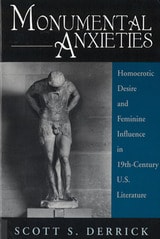
Monumental Anxieties
Homoerotic Desire and Feminine Influence in 19-th Century U.S. LiteratureDerrick, Scott S
Rutgers University Press, 1997
Scott Derrick has written an original book that contributes significantly to current revisions of the nineteenth-century American literary tradition's representation of gender and sexuality. His interpretation of feminist, lesbian-feminist, and gay issues in nineteenth-century American literature as complementary enlarges our historical understanding and helps build the coalition politics needed in these areas."-John Carlos Rowe, University of California, Irvine
Recent gender-based scholarship on nineteenth-century American literature has established male authors' crucial awareness of the competition from popular women writers. And critical work in gay studies and queer theory has stressed the importance in canonical American literature of homoerotic relations between men, even before "homosexuality" became codified at the end of the century. Scott Derrick draws on these insights to explore the ways in which male authors struggle to refigure literature-historically devalued as feminine-as a masculine and heterosexual enterprise. Derrick focuses on scenes of compositional crisis that reveal how male identity itself is at risk in the perils and possibilities of being a male author in a feminized literary marketplace.
He suggests that traditionally valued texts by Hawthorne, Poe, James, Sinclair, and Crane have at their core combustible four-sided conflicts between feminine identifications and masculine distancings, homoerotic longings and homophobic dreads, conflicts which are largely determined by domestic ideals of male and female roles within the nineteenth-century family. The negotiation of such conflicts is controlled by the nature of fiction writing, which both frees the imagination to explore forbidden fantasies and harnesses the imagination to public understandings of the proper form and content of fiction. Thus Monumental Anxieties also contributes to recent debates about the social shaping of contemporary homosexuality and to the history of American masculinity.
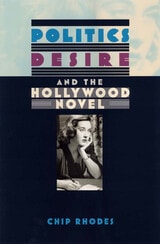
Politics, Desire, and the Hollywood Novel
Chip Rhodes
University of Iowa Press, 2008
Rhodes considers how novels about the film industry changed between the studio era of the 1930s and 1940s and the era of deregulated film making that has existed since the 1960s. He asserts that Americans are now driven by cultural, rather than class, differences and that our mainstream notion of love has gone from repressed desire to “abnormal desire” to, finally, strictly business.
Politics, Desire, and the Hollywood Novel pays close attention to six authors—Nathanael West, Raymond Chandler, Budd Schulberg, Joan Didion, Bruce Wagner, and Elmore Leonard—who have toiled in the film industry and written to tell about it. More specifically, Rhodes considers both screenplays and novels with an eye toward the different formulations of sexuality, art, and ultimately political action that exist in these two kinds of storytelling.
Quare Joyce
Joseph Valente, Editor
University of Michigan Press, 2000
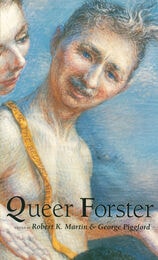
Queer Forster
Edited by Robert K. Martin and George Piggford
University of Chicago Press, 1997
Many previous critics of Forster downplayed his homosexuality or read Forster naively in terms of gay liberation. This collection situates Forster within the Bloomsbury Group and examines his relations to major figures such as Henry James, Edward Carpenter, and Virginia Woolf. Particular attention is paid to Forster's several accounts of India and their troubled relation to the British colonial enterprise. Analyzing a wide range of Forster's work, the authors examine material from Forster's undergraduate writings to stories written more than a half-century later.
A landmark book for the study of gender in literature, Queer Forster brings the terms "queer" and "gay" into conversation, opening up a dialogue on wider dimensions of theory and allowing a major revaluation of modernist inventions of sexual identity.
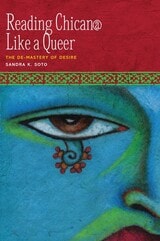
Reading Chican@ Like a Queer
The De-Mastery of DesireBy Sandra K. Soto
University of Texas Press, 2010
A race-based oppositional paradigm has informed Chicano studies since its emergence. In this work, Sandra K. Soto replaces that paradigm with a less didactic, more flexible framework geared for a queer analysis of the discursive relationship between racialization and sexuality. Through rereadings of a diverse range of widely discussed writers—from Américo Paredes to Cherríe Moraga—Soto demonstrates that representations of racialization actually depend on the sexual and that a racialized sexuality is a heretofore unrecognized organizing principle of Chican@ literature, even in the most unlikely texts. Soto gives us a broader and deeper engagement with Chican@ representations of racialization, desire, and both inter- and intracultural social relations.
While several scholars have begun to take sexuality seriously by invoking the rich terrain of contemporary Chicana feminist literature for its portrayal of culturally specific and historically laden gender and sexual frameworks, as well as for its imaginative transgressions against them, this is the first study to theorize racialized sexuality as pervasive to and enabling of the canon of Chican@ literature. Exemplifying the broad usefulness of queer theory by extending its critical tools and anti-heteronormative insights to racialization, Soto stages a crucial intervention amid a certain loss of optimism that circulates both as a fear that queer theory was a fad whose time has passed, and that queer theory is incapable of offering an incisive, politically grounded analysis in and of the current historical moment.
Recursive Desire
Rereading Epic TraditionJeremy M. Downes
University of Alabama Press, 1997
A groundbreaking rethinking of epic tradition through recursive literary analysis.
Epic has often been seen as a dead genre, intrinsically patriarchal and nationalistic. Furthermore, the psychological model most frequently applied to the relations between poets has been a violent one--the Freudian masterplot of Oedipus slaying the father to possess the mother. The limited usefulness of such simplistic explanations of epic is readily apparent when confronted with the continuing production of epic poetry long after its so-called death; when confronted with the contemporary drive toward epic among women poets, people of color, and postcolonial poets; and when faced with epic's fundamentally recursive desire--obvious in oral epic, but common to the entire genre--to repeat rather than to kill or evade its precursors.
Recursive desire, rooted in more basic preoedipal negotiations of union and separation rather than in Oedipal conflict, provides an elegant and far more useful explanation. By rereading and substantially redefining epic in this way, this book recognizes and reinvests with meaning the vital recursive qualities of the genre. Examining a diverse array of texts from the Epic of Gilgamesh to Derek Walcott's Osmeros, from the Homeric epics to H.D.'s Helen in Egypt. The book develops a broadened, inclusive, and living tradition of epic poetry, demonstrating the continuities of that tradition across dramatic discontinuities in time, place, worldview, and technology.
Recursive Desire rereads epic tradition and specific epic poems in ways that challenge traditional notions of the genre and open up unexplored fields of endeavor to students of epic, of poetry, and of narrative. With its more powerful and comprehensive psychological model of poetic relations, the book provides readers with a new understanding of epic poetry and its vital, shifting, polyvocal array (and disarray) of textual forces.
Sexuality and Being in the Poststructuralist Universe of Clarice Lispector
The Différance of DesireBy Earl E. Fitz
University of Texas Press, 2001
Driven by an unfulfilled desire for the unattainable, ultimately indefinable Other, the protagonists of the novels and stories of acclaimed Brazilian writer Clarice Lispector exemplify and humanize many of the issues central to poststructuralist thought, from the nature of language, truth, and meaning to the unstable relationships between language, being, and reality. In this book, Earl Fitz demonstrates that, in turn, poststructuralism offers important and revealing insights into all aspects of Lispector's writing, including her style, sense of structure, characters, themes, and socio-political conscience.
Fitz draws on Lispector's entire oeuvre—novels, stories, crônicas, and children's literature—to argue that her writing consistently reflects the basic tenets of poststructuralist theory. He shows how Lispector's characters struggle over and humanize poststructuralist dilemmas and how their essential sense of being is deeply dependent on a shifting, and typically transgressive, sense of desire and sexuality.
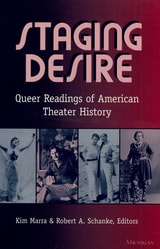
Staging Desire
Queer Readings of American Theater HistoryKim Marra and Robert A. Schanke, Editors
University of Michigan Press, 2002
Essays cover the careers of major figures Clyde Fitch, Rachel Crothers, Mercedes de Acosta, Djuna Barnes, Cole Porter, Lorenz Hart, George Kelly, William Inge, James "Acorn" Oaks, Adam "Vagabond" Badeau, Eric Bentley, Loie Fuller, Robert Edmond Jones, and Jean Rosenthal. Grounded in research into the history of sexuality, the book engages central problems of terminology and evidence in analyzing sexual practices of the past and the modes of articulation of sexuality in theater, conditioned by American culture's peculiar anxieties about both.
Kim Marra is Associate Professor of Theatre Arts, University of Iowa. Robert A. Schanke is Professor of Theatre, Central College, Iowa. They edited Passing Performances: Queer Readings of Leading Players in American Theater History, a previous volume in this series.
Sticky Rice
A Politics of Intraracial DesireCynthia Wu
Temple University Press, 2018
Cynthia Wu’s provocative Sticky Rice examines representations of same-sex desires and intraracial intimacies in some of the most widely read pieces of Asian American literature. Analyzing canonical works such as John Okada’s No-No Boy, Monique Truong’s The Book of Salt, H. T. Tsiang’s And China Has Hands, and Lois-Ann Yamanaka’s Blu’s Hanging, as well as Philip Kan Gotanda’s play, Yankee Dawg You Die, Wu considers how male relationships in these texts blur the boundaries among the homosocial, the homoerotic, and the homosexual in ways that lie beyond our concepts of modern gay identity.
The “sticky rice” of Wu’s title is a term used in gay Asian American culture to describe Asian American men who desire other Asian American men. The bonds between men addressed in Sticky Rice show how the thoughts and actions founded by real-life intraracially desiring Asian-raced men can inform how we read the refusal of multiple normativities in Asian Americanist discourse. Wu lays bare the trope of male same-sex desires that grapple with how Asian America’s internal divides can be resolved in order to resist assimilation.
Tales Out of School
Gender, Longing, and the Teacher in Fiction and FilmJo Keroes
Southern Illinois University Press, 1999
Jo Keroes's scope is wide: she examines the teacher as represented in fiction and film in works ranging from the twelfth-century letters of Abelard and Heloise to contemporary films such as Dangerous Minds and Educating Rita. And from the twelfth through the twentieth century, Keroes shows, the teaching encounter is essentially erotic.
Tracing the roots of eros from cultural as well as psychological perspectives, Keroes defines erotic in terms broader than the merely sexual. She analyzes ways in which teachers serve as convenient figures on whom to map conflicts about gender, power, and desire. To show how portrayals of men and women differ, she examines pairs of texts, using a film or a novel with a woman protagonist (Up the Down Staircase, for example) as counterpoint to one featuring a male teacher (Blackboard Jungle) or The Prime of Miss Jean Brodie balanced against Dead Poets Society.
The portrayals of teachers, like all images a culture presents of itself, reveal much about our private and social selves. Keroes points out authentic accounts of authoritative women teachers who are admired and respected by colleagues and students alike. Real teachers differ from the stereotypes we see in fiction and film, however. Male teachers are often portrayed as heroes in film and fallibly human in fiction, whereas women in either genre are likely to be monstrous or muddled and are virtually never women of color. Among other things, Keroes demonstrates, the tension between reality and representation reveals society's ambivalence about power in the hands of women.
The Burdens of Intimacy
Psychoanalysis and Victorian MasculinityChristopher Lane
University of Chicago Press, 1998
Lane discredits the conservative notion that Victorian literature expresses only a demand for repression and moral restraint. But he also refutes historicist and Foucauldian approaches, arguing that they dismiss the very idea of repression and end up denouncing psychoanalysis as complicit in various kinds of oppression. These approaches, Lane argues, reduce Victorian literature to a drama about politics, power, and the ego. Striving instead to reinvigorate discussions of fantasy and the unconscious, Lane offers a clear, often startling account of writers who grapple with the genuine complexities of love, desire, and friendship.
The Ruling Passion
British Colonial Allegory and the Paradox of Homosexual DesireChristopher Lane
Duke University Press, 1995
Through attentive readings of sexual and political allegory in the work of Kipling, Forster, James, Beerbohm, Firbank, and others—and deft use of psychoanalytic theory—The Ruling Passion interprets turbulent scenes of masculine identification and pleasure, power and mastery, intimacy and antagonism. By foregrounding the shattering effects of male homosexuality and interracial desire, and by insisting on the centrality of unconscious fantasy and the death drive, The Ruling Passion examines the startling recurrence of colonial failure in narratives of symbolic doubt and ontological crisis. Lane argues compellingly that Britain can progress culturally and politically only when it has relinquished its residual fantasies of global mastery.
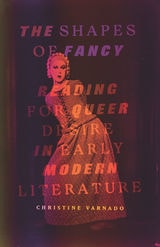
The Shapes of Fancy
Reading for Queer Desire in Early Modern LiteratureChristine Varnado
University of Minnesota Press, 2020
Exploring forms of desire unaccounted for in previous histories of sexuality
What can the Renaissance tell us at our present moment about who and what is “queer,” as well as the political consequences of asking? In posing this question, The Shapes of Fancy offers a powerful new method of accounting for ineffable and diffuse forms of desire, mining early modern drama and prose literature to describe new patterns of affective resonance.
Starting with the question of how and why readers seek traces of desire in texts from bygone times and places, The Shapes of Fancy demonstrates a practice of critical attunement to the psychic and historical circulations of affect across time within texts, from texts to readers, and among readers. Closely reading for uncharted desires as they recur in early modern drama, witchcraft pamphlets, and early Atlantic voyage narratives and demonstrating how each is structured by qualities of secrecy, impossibility, and excess, Christine Varnado follows four “shapes of fancy”: the desire to be used to others’ ends; indiscriminate, bottomless appetite; paranoid self-fulfilling suspicion; and melancholic longings for impossible transformations and affinities. These affective dynamics go awry in atypical and perverse ways. In other words, argues Varnado, these modes of feeling are recognizable on the page or stage as “queer” because of how, and not by whom, they are expressed.
This new theorization of desire expands the notion of queerness in literature, decoupling the literary trace of queerness from the binary logics of same-sex versus opposite-sex and normative versus deviant that have governed early modern sexuality studies. Providing a set of methods for analyzing affect and desire in texts from any period, The Shapes of Fancy stages an impassioned defense of the inherently desirous nature of reading, making a case for readerly investment and identification as vital engines of meaning making and political insight.
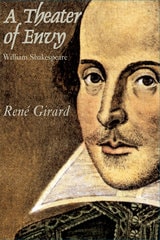
Theater Of Envy
William ShakespeareRene Girard
St. Augustine's Press, 2004
In this ground-breaking work, one of our foremost literary and cultural critics turns to the major figure in English literature, William Shakespeare, and proposes a dramatic new reading of nearly all his plays and poems. The key to A Theater of Envy is Girard's novel reinterpretation of "mimesis." For Girard, people desire objects not for their intrinsic value, but because they are desired by someone else - we mime or imitate their desires. This envy - or "mimetic desire" - he sees as one of the foundations of the human condition.
Bringing such proocative and iconoclastic insights to bear on Shakespeare, Girard reveals the previously overlooked coherence of problem plays like Troilus and Cressida, and makes a convincing argument for elevating A Midsummer Night's Dream from the status of a chaotic comedy to a masterpiece. The book abounds with novel and provocative interpretations: Shakespeare becomes "a prophet of modern advertising," and the threat of nuclear disaster is read in the light of Hamlet. Most intriguing of all, perhaps, is a brief, but brilliant aside in which an entirely new perspective is brought to the chapter on Joyce's Ulysses in which Stephen Dedalus gives a lecture on Shakespeare. In Girard's view only Joyce, perhaps the greatest of twentieth-century novelists, comes close to understanding the greatest of Renaissance playwrights.
Throughout this impressively sustained reading of Shakespeare, Girard's prose is sophisticated, but contemporary, and accessible to the general reader.
When the Lamp is Shattered
Desire and Narrative in CatullusMichaela Janan
Southern Illinois University Press, 1993
The poetry of the Late Roman Republican poet Gaius Valerius Catullus, a rich document of the human heart, is the earliest-known reasonably complete body of erotic verse in the West.
Though approximately 116 poems survive, uncertainties about the condition of the fragmented manuscript and the narrative order of the poems make the Catullan text unusually problematic for the modern critic. Indeed, the poems can be arranged in a number of ways, making a multitude of different plots possible and frustrating the reader’s desire for narrative closure.
Micaela Janan contends that since unsatisfied desire structures both the experience of reading Catullus and its subject matter, critical interpretation of the text demands a "poetics of desire." Furthermore, postmodern critical theory, narratology, and psychoanalysis suggest a flexible concept of the "subject" as a site through which a multitude of social, cultural, and unconscious forces move. Human consciousness, Janan contends, is inherently incomplete and in a continuous process of transformation. She therefore proposes an original and provocative feminist reading of Catullus, a reading informed by theories of consciousness and desire as ancient as Plato and as contemporary as Freud and Lacan.
The Late Roman Republic in which Catullus lived, Janan reminds us, was a time of profound social upheaval when political and cultural institutions that had persisted for centuries were rapidly breaking down—a time not unlike our own. Catullus’ poetry provides an unusually honest look at his culture and its contradictory representations of class, gender, and power. By bringing to the study of this major work of classical literature the themes of consciousness and desire dealt with in postmodern scholarship, Janan’s book invites a new conversation among literary disciplines.