Results by title
16 books match the query 'Detective and mystery stories'
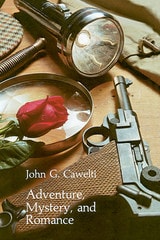
Adventure, Mystery, and Romance
Formula Stories as Art and Popular CultureJohn G. Cawelti
University of Chicago Press, 1976

An Introduction to the Detective Story
Leroy Lad Panek
University of Wisconsin Press, 1987
This book is a no-apologies introduction to Detective Fiction. It's written in an aggressive, modern English well-suited to a genre which has traditionally broken ground in terms of aggressive writing, contemporary scenarios, and tough dialogue.

Crime Uncovered
DetectiveEdited by Barry Forshaw
Intellect Books, 2015
Taking readers into the worlds of such beloved authors as P. D. James, Henning Mankell, Jo Nesbø, Ian Rankin, and Håkan Nesser, this book zeroes in on the characteristics that define the iconic characters they created, discussing how they relate to their national and social settings, questions of class, and to the criminals they relentlessly pursue. Showing how the role of the authority figure has changed—and how each of these writers creates characters who work both within and against the strictures of official investigations—the book shows how creators cleverly subvert expectations of both police procedure and the crime genre itself.
Written by a leading expert in the field and drawn from interviews with the featured authors, Crime Uncovered: Detectivewill thrill the countless fans of Inspector Rebus, Harry Hole, Adam Dalgliesh, and the other enduring police detectives who define the genre.
In the Beginning
First Novels in Mystery SeriesMary Jean Demarr
University of Wisconsin Press, 1995
This volume contains fourteen essays by authoritative academics studying the field of mystery and detective fiction. The essays all concentrate on the first novels in established series, analyzing ways in which the opening books of the series do or do not create patterns followed in succeeding novels.
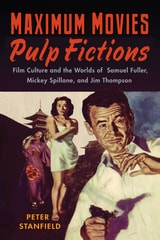
Maximum Movies—Pulp Fictions
Film Culture and the Worlds of Samuel Fuller, Mickey Spillane, and Jim ThompsonStanfield, Peter
Rutgers University Press, 2011

Mind-Bending Mysteries and Thrillers for Teens
A Programming and Readers' Advisory GuideAmy Alessio
American Library Association, 2014
Mysteries of Africa
Eugene Schleh
University of Wisconsin Press, 1991
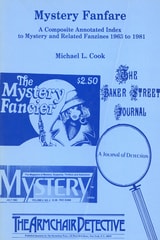
Mystery Fanfare
A Composite Annotated Index to Mystery and Related Fanzines 1963–1981Michael L. Cook
University of Wisconsin Press, 1983
This work is a composite index of the complete runs of all mystery and detective fan magazines that have been published, through 1981. Added to it are indexes of many magazines of related nature. This includes magazines that are primarily oriented to boys' book collecting, the paperbacks, and the pulp magazine hero characters, since these all have a place in the mystery and detective genre.
Mystery Reader's Advisory
The Librarian's Clues to Murder and MayhemAmerican Library Association, 2002
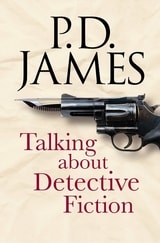
Talking about Detective Fiction
P. D. James
Bodleian Library Publishing, 2009
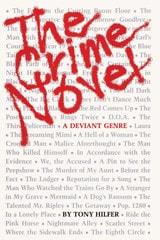
The Crime Novel
A Deviant GenreBy Tony Hilfer
University of Texas Press, 1990
Although rarely distinguished from the detective story, the crime novel offers readers a quite different experience. In the detective novel, a sympathetic detective figure uses reason and intuition to solve the puzzle, restore order, and reassure readers that "right" will always prevail. In the crime novel, by contrast, the "hero" is either the killer, the victim, a guilty bystander, or someone falsely accused, and the crime may never be satisfactorily solved.
These and other fundamental differences are set out by Tony Hilfer in The Crime Novel, the first book that completely defines and explores this popular genre. Hilfer offers convincing evidence that the crime novel should be regarded as a genre distinct from the detective novel, whose conventions it subverts to develop conventions of its own.
Hilfer provides in-depth analyses of novels by Georges Simenon, Margaret Millar, Patricia Highsmith, and Jim Thompson. He also treats such British novelists as Patrick Hamilton, Shelley Smith, and Marie Belloc Lowndes, as well as the American novelists Cornell Woolrich, John Franklin Bardin, James M. Cain, and Fredric Brown. In addition, he defines the distinctions between the American crime novel and the British, showing how their differences correspond to differences in American and British detective fiction.
This well-written study will appeal to a general audience, as well as teachers and students of detective and mystery fiction. For anyone interested in the genre, it offers valuable suggestions of "what to read next."
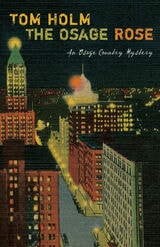
The Osage Rose
Tom Holm
University of Arizona Press, 2008
Life is looking easy for J. D. Daugherty, a crusty ex-cop who has set up his own PI firm in Tulsa, Oklahoma, just after World War I. J. D. expects to make a straightforward living off the intrigues of the city’s wealthy socialites, but then Rose Chichester, a privileged young white woman, runs off with Tommy Ruffle, a young Indian who is heir to Osage oil. Hired by Rose’s father to track down the young pair, J. D. and his associate, a Cherokee named Hoolie Smith, find themselves caught in the cross fire of a deadly scheme. When Tommy turns up murdered and with Rose still missing, J. D. and Hoolie must navigate a twisting maze of deception, race riots, and gun battles in their unrelenting search for the truth—a search that ultimately leads to an intimate secret no one suspected.
Tom Holm writes a true private-eye mystery, yet he entwines the story’s layers of conspiracy and deceit with the realities of prejudice and hatred that existed during the early years of Oklahoma statehood. Rooted firmly in its time, Holm’s well-researched novel tells a complex and compelling story of individuals struggling to find justice at any cost in a world still caught between modernity and its Wild West legacy.
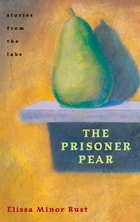
The Prisoner Pear
Stories from the LakeElissa Minor Rust
Ohio University Press, 2005
The twelve stories in The Prisoner Pear: Stories from the Lake take place in an affluent suburb of Portland, Oregon, but they could be taken from any number of similar enclaves across the United States. These stories infuse stark reality with occasional hints of magical realism to explore what the American dream means to twenty-first-century suburbanites. In a city where the homecoming queen still makes the front page of the weekly newspaper, ducks caught in storm drains and stolen campaign signs make up the bulk of the paper’s crime reports. The community’s hidden complexities, however, rival those of Sherwood Anderson’s Winesburg, Ohio.
Each of the stories begins with an entry from the newspaper’s police blotter. Elissa Minor Rust fills in the background to these small, odd events-a headless parakeet found in a mailbox, a nude jogger, an alarmingly deathlike discarded teddy bear. Her stories, both humorous and disturbing, probe beneath the clear, hard surface of a community into the murky depths beneath.
The lake at the center of town is a constant in the lives of this town’s people, and it reappears throughout the book as a symbol of wealth and power, of love and loss. The Prisoner Pear offers a rare look inside the heart of suburban America. Reading these stories is, as one character observes, “like seeing the town from the inside out, as if the lake was its heart and the rest merely its bones and skin.”
The Reader and the Detective Story
George N. Dove
University of Wisconsin Press, 1997
George Dove demonstrates how the English soft-boiled mystery and the American private-eye story, although they have different settings and develop different plots, belong in the same subgenre and follow the same formula, inherited directly from Poe’s “The Murders in the Rue Morgue.”
The Readers' Advisory Guide to Mystery
John Charles
American Library Association, 2012
You Know My Method
Science of the DetectiveJ.K. Van Dover
University of Wisconsin Press, 1994
The four principal writers covered are Edgar Allan Poe, Sir Arthur Conan Doyle, R. Austin Freeman, and Arthur B. Reeve. Another dozen more writers are treated somewhat more briefly: Gaboriau, Pinkerton, Green, Morrison, Futrelle, and Leroux, among others.