Results by title
28 books match the query 'Dialogues'
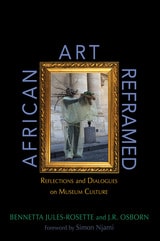
African Art Reframed
Reflections and Dialogues on Museum CultureBennetta Jules-Rosette and J. R. Osborn; Foreword by Simon Njami
University of Illinois Press, 2020
The authors take a three-pronged approach. Part One ranges from curiosity cabinets to virtual websites to offer a history of ethnographic and art museums and look at their organization and methods of reaching out to the public. In the second part, the authors examine museums as ecosystems and communities within communities, and they use semiotic methods to analyze images, signs, and symbols drawn from the experiences of curators and artists. The third part introduces innovative strategies for displaying, disseminating, and reclaiming African art. The authors also propose how to reinterpret the art inside and outside the museum and show ways of remixing the results.
Drawing on extensive conversations with curators, collectors, and artists, African Art Reframed is an essential guide to building new exchanges and connections in the dynamic worlds of African and global art.
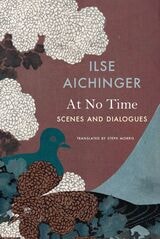
At No Time
Scenes and DialoguesIlse Aichinger
Seagull Books, 2023
A member of the Gruppe 47 writers’ group which sought to renew German-language literature after World War II, Ilse Aichinger (1921–2016) achieved great acclaim as a writer of fiction, poetry, prose, and radio drama. The vignettes in At No Time each begin in recognizable situations, often set in Vienna or other Austrian cities, but immediately swerve into bizarre encounters, supernatural or fantastical situations. Precisely drawn yet disturbingly skewed, they are both naturalistic and disjointed, like the finest surrealist paintings. Created to be experienced on the page or on the radio rather than the stage, they echo the magic realism of her short stories. Even though they frequently take a dark turn, they remain full of humor, agility, and poetic freedom.
Bakhtin
Essays and Dialogues on His WorkEdited by Gary Saul Morson
University of Chicago Press, 1986
A groundbreaking collection of essays on the influential critic and philosopher
Mikhail Bakhtin (1895-1975) was a Russian philosopher and literary critic whose influence on a wide range of intellectual fields has only grown since his death, with his emphasis on dialogue and suspicion of systems having particularly resonance in literary studies and linguistics. This collection of essays, all originally published in the the journal Critical Inquiry, explores his literary and linguistic theory and its implications for theory in general and critical practice.
In addition to the critical essays, this book includes previously untranslated excerpts from Bakhtin's essays and notebooks.
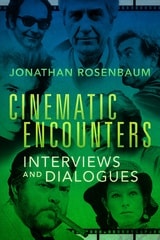
Cinematic Encounters
Interviews and DialoguesJonathan Rosenbaum
University of Illinois Press, 2018
Cinematic Encounters collects more than forty years of interviews that embrace Rosenbaum's vision of film criticism as a collaboration involving multiple voices. Rosenbaum accompanies Orson Welles on a journey back to Heart of Darkness, the unmade film meant to be Welles's Hollywood debut. Jacques Tati addresses the primacy of décor and soundtrack in his comedic masterpiece PlayTime, while Jim Jarmusch explains the influence of real and Hollywoodized Native Americans in Dead Man. By arranging the chapters chronologically, Rosenbaum invites readers to pursue thematic threads as if the discussions were dialogues between separate interviews. The result is a rare gathering of filmmakers trading thoughts on art and process, on great works and false starts, and on actors and intimate moments.

Danish Directors
Dialogues on a Contemporary National CinemaEdited by Mette Hjort and Ib Bondebjerg
Intellect Books, 1995
Each interview is preceded by a photograph of the director, biographical information, and a filmography. Frame enlargements are used throughout to help clarify particular points of discussion and the book as a whole is contextualised by an informative general introduction. A valuable addition to the growing library of books on Scandinavian film, national cinema and minority cinema.
Dialogues
Saint Gregory the Great
Catholic University of America Press, 1959
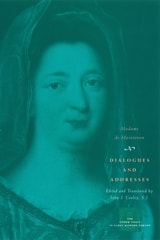
Dialogues and Addresses
Madame de Maintenon
University of Chicago Press, 2004
Denounced by her contemporaries as a political schemer and religious fanatic, Maintenon has long been criticized as an opponent of gender equality. The writings in this volume faithfully reflect Maintenon's respect for social hierarchy and her stoic call for women to accept the duties of their state in life. But the writings also echo Maintenon's more feminist concerns: the need to redefine the virtues in the light of women's experience, the importance of naming the constraints on women's freedom, and the urgent need to remedy the scandalous neglect of the education of women.
In her writings as well as in her own model school at Saint-Cyr, Maintenon embodies the demand for educational reform as the key to the empowerment of women at the dawn of modernity.
Dialogues in Cuban Archaeology
Edited by L. Antonio Curet, Shannon Lee Dawdy, and Gabino La Rosa Corzo
University of Alabama Press, 2005
A critical, dialogic examination of Cuban and Caribbean archaeology, advancing contemporary interpretations of heritage and identity.
Many Americans are aware of the political, economic, and personal impacts of the U.S. embargo on Cuba. But the communication blockade between scholars has also affected the historical course of academic disciplines and research in general. With the easing of restrictions in the 1990s, academics are now freer to conduct research in Cuba, and the Cuban government has been more receptive to collaborative projects.
This volume provides a forum for the principal Cuban and American archaeologists to update the current state of Cuban archaeological research--from rock art and potsherds to mortuary practices and historical renovation--thereby filling in the information gap created by the political separation. Each group of researchers brings significant new resources to the effort, including strong conservation regulations, innovative studies of lithic and shell assemblages, and transculturation theories. Cuban research on the hacienda system, slavery, and urban processes has in many ways anticipated developments in North American archaeology by a decade or more. Of special interest are the recent renovation projects in Old Havana that fully integrate the work of historians, architects, and archaeologists--a model project conducted by agreement between the Cuban government and UNESCO.
The selection of papers for this collection is based on a desire to answer pressing research questions of interest for North American Caribbeanists and to present a cross-section of Cuban archaeological work. With this volume, then, the principal players present results of recent collaborations and begin a renewed conversation, a dialogue, that can provide a foundation for future coordinated efforts.
Dialogues in Paradise
Can Xue
Northwestern University Press, 1989
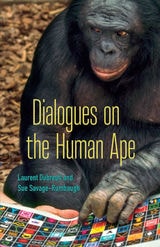
Dialogues on the Human Ape
Laurent Dubreuil
University of Minnesota Press, 2018
A primatologist and a humanist together explore the meaning of being a “human animal”
Humanness is typically defined by our capacity for language and abstract thinking. Yet decades of research led by the primatologist Sue Savage-Rumbaugh has shown that chimpanzees and bonobos can acquire human language through signing and technology.
Drawing on this research, Dialogues of the Human Ape brings Savage-Rumbaugh into conversation with the philosopher Laurent Dubreuil to explore the theoretical and practical dimensions of what being a “human animal” means. In their use of dialogue as the primary mode of philosophical and scientific inquiry, the authors transcend the rigidity of scientific and humanist discourses, offering a powerful model for the dissemination of speculative hypotheses and open-ended debates grounded in scientific research.
Arguing that being human is an epigenetically driven process rather than a fixed characteristic rooted in genetics or culture, this book suggests that while humanness may not be possible in every species, it can emerge in certain supposedly nonhuman species. Moving beyond irrational critiques of ape consciousness that are motivated by arrogant, anthropocentric views, Dialogues on the Human Ape instead takes seriously the continuities between the ape mind and the human mind, addressing why language matters to consciousness, free will, and the formation of the “human animal” self.
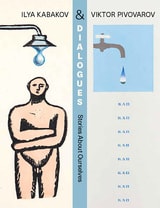
Dialogues
Ilya Kabakov and Viktor Pivovarov, Stories about OurselvesKsenia Nouril
Rutgers University Press, 2020
This exhibition catalog brings together Kabakov and Pivovarov’s key works for the first time, putting the two artists in dialogue and recreating their artistic community. It not only includes nearly hundred pages of full-color illustrations, but also provides complete English translations of the Russian texts that appear in the volume, plus new interviews with each artist. Taken together, they give viewers a new appreciation of the different aesthetic strategies each artist used to depict the absurdities of everyday life in the Soviet era. Published in partnership with the Zimmerli Museum.

Encounters and Dialogues with Martin Heidegger, 1929-1976
Heinrich Wiegand Petzet
University of Chicago Press, 1993
A well-known art historian and an intimate friend of Heidegger's, Heinrich Wiegand Petzet provides a rich portrait of Heidegger that is part memoir, part biography, and part cultural history. By recounting chronologically a series of encounters between the two friends from their meeting in 1929 until the philosopher's death in 1976, as well as between Heidegger and other contemporaries, Petzet reveals not only new aspects of Heidegger's thought and attitudes toward the historical and intellectual events of his time but also the greater cultural and social context in which he articulated his thought.
History, Tragedy, Theory
Dialogues on Athenian DramaEdited and with an introduction by Barbara Goff
University of Texas Press, 1995
Greek tragedy has held sway over the imagination of audiences for well over two millennia. This collection of essays on Athenian drama, the proceedings of a conference held at the University of Texas at Austin in 1992, demonstrates that Greek tragedy still retains its power to provoke debate and to engage the interest of specialists and non-classicists alike.
The book includes essays by seven of the foremost scholars of Greek drama—Helene Foley, Michelle Gellrich, Peter W. Rose, David Rosenbloom, Richard Seaford, Bernd Seidensticker, and Froma I. Zeitlin. These writers explore the work of all three great tragedians, Aeschylus, Sophocles, and Euripides, and approach them from a variety of perspectives on history and theory, including poststructuralism and Marxism. They investigate the possibilities for coordinating theoretically informed readings of tragedy with a renewed attention to the pressure of material history within those texts. The collection thus represents a response within classics to "New Historicism" and the debates it has generated within related literary disciplines.
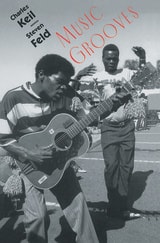
Music Grooves
Essays and DialoguesCharles Keil and Steven Feld
University of Chicago Press, 1994
Music Grooves ranges from jazz, blues, polka, soul, rock, world beat, rap, karaoke, and other familiar genres to major scholarly debates in music theory, ethnomusicology, and popular culture studies. The authors develop and create links between the fields of ethnomusicology and popular culture studies and relate the contents of musics from America, Greece, Cuba, Africa, and Papua New Guinea to artists as diverse as James Brown, Aretha Franklin, L'il Wally Jagiello, Bo Diddley, Walt Solek, Madonna, Paul Simon, Miles Davis, Thelonious Monk, and Billie Holiday.
Keil and Feld offer a fascinating view of the shaping of central ideas and terms in ethnomusicology such as "engendered feeling," "interpretive moves," "participatory discrepancies," "iconicity of style," "people's music," "schizophonia," and "lift-up-over sounding." From Keil's critique of Leonard Meyer's musicological approach to Feld's recent work on world beat, this volume covers an array of vital issues in media studies, musicology and ethnomusicology, popular culture, anthropology, and sociology. It will interest anyone concerned with the nature and meaning of music in the modern world.
Our Search with Socrates for Moral Truth
Gary Michael Atkinson
Catholic University of America Press, 2015
Ousmane Sembene
Dialogues with Critics and WritersThomas Cassirer
University of Massachusetts Press, 1993
This volume celebrates the work of Ousmane Sembène, the brilliant African filmmaker and writer. Since the 1950s, working in his native Senegal, Sembène has produced a series of films and novels that incisively depict the realities of contemporary African experience, particularly that of urban and industrial Africa. The book begins with critical essays on Sembène’s oeuvre by Frederick Ivor Case, Françoise Pfaff, Mbye Cham, and Claire Andrade-Warkins. There follows a series of presentations by distinguished black writers who discuss their craft and the ways in which language can function as a political act of cultural legitimation. These writers include Toni Cade Bambara, Earl Lovelace, Ngũgĩ wa Thiong’o, John Edgar Wideman, and Sembène.
The next section reproduces Sembène’s remarks on his film Camp de Thiaroye and an extended interview he recorded in Toronto in 1992. His comments are presented in both French and English. The volume concludes with annotated bibliographies of Sembène’s novels and of the films he has written and directed.
Philosophy in a Time of Terror
Dialogues with Jurgen Habermas and Jacques DerridaGiovanna Borradori
University of Chicago Press, 2003
Plato and Tradition
The Poetic and Cultural Context of PhilosophyPatricia Fagan
Northwestern University Press, 2013
Plato’s dialogues are some of the most widely read texts in Western philosophy, and one would imagine them fully mined for elemental material. Yet, in Plato and Tradition, Patricia Fagan reveals the dialogues to be continuing sources of fresh insight. She recovers from them an underappreciated depth of cultural reference that is crucial to understanding their central philosophical concerns. Through careful readings of six dialogues, Fagan demonstrates that Plato’s presentation of Socrates highlights the centrality of tradition in political, erotic, and philosophic life. Plato embeds Socrates’s arguments and ideas in traditional references that would have been familiar to contemporaries of Socrates or Plato but that today’s reader typically passes over. Fagan’s book unpacks this cultural and literary context for the proper and full understanding of the philosophical argument of the Platonic dialogues. She concludes that, as Socrates demonstrates in word and deed, tradition is essential to successful living. But we must take up tradition with a critical openness to questioning its significance and future. Her original and compelling analyses may change the views of many readers who think themselves already well versed in the dialogues.
Plato through Homer
Poetry and Philosophy in the Cosmological DialoguesZdravko Planinc
University of Missouri Press, 2003
Plato's Philosophers
The Coherence of the DialoguesCatherine H. Zuckert
University of Chicago Press, 2009
Faced with the difficult task of discerning Plato’s true ideas from the contradictory voices he used to express them, scholars have never fully made sense of the many incompatibilities within and between the dialogues. In the magisterial Plato’s Philosophers, Catherine Zuckert explains for the first time how these prose dramas cohere to reveal a comprehensive Platonic understanding of philosophy.
To expose this coherence, Zuckert examines the dialogues not in their supposed order of composition but according to the dramatic order in which Plato indicates they took place. This unconventional arrangement lays bare a narrative of the rise, development, and limitations of Socratic philosophy. In the drama’s earliest dialogues, for example, non-Socratic philosophers introduce the political and philosophical problems to which Socrates tries to respond. A second dramatic group shows how Socrates develops his distinctive philosophical style. And, finally, the later dialogues feature interlocutors who reveal his philosophy’s limitations. Despite these limitations, Zuckert concludes, Plato made Socrates the dialogues’ central figure because Socrates raises the fundamental human question: what is the best way to live?
Plato’s dramatization of Socratic imperfections suggests, moreover, that he recognized the apparently unbridgeable gap between our understandings of human life and the nonhuman world. At a time when this gap continues to raise questions—about the division between sciences and the humanities and the potentially dehumanizing effects of scientific progress—Zuckert’s brilliant interpretation of the entire Platonic corpus offers genuinely new insights into worlds past and present.
Reading the Difficulties
Dialogues with Contemporary American Innovative PoetryThomas Fink
University of Alabama Press, 2013
New Strategies for Reading the Most Innovative Poetry of Our Time.
Definitions of what constitutes innovative poetry are innumerable and are offered from every quarter. Some critics and poets argue that innovative poetry concerns free association (John Ashbery), others that experimental poetry is a “re-staging” of language (Bruce Andrews) or a syntactic and cognitive break with the past (Ron Silliman and Lyn Hejinian). The tenets of new poetry abound.
But what of the new reading that such poetry demands? Essays in Reading the Difficulties ask what kinds of stances allow readers to interact with verse that deliberately removes many of the comfortable cues to comprehension—poetry that is frequently nonnarrative, nonrepresentational, and indeterminate in subject, theme, or message.
Some essays in Thomas Fink and Judith Halden-Sullivan’s collection address issues of reader reception and the way specific stances toward reading support or complement the aesthetic of each poet. Others suggest how we can be open readers, how innovative poetic texts change the very nature of reader and reading, and how critical language can capture this metamorphosis. Some contributors consider how the reader changes innovative poetry, what language reveals about this interaction, which new reading strategies unfold for the audiences of innovative verse, and what questions readers should ask of innovative verse and of events and experiences that we might bring to reading it.

Rousseau, Judge of Jean-Jacques
DialoguesJean-Jacques Rousseau
Dartmouth College Press, 2012
Set in Motion
Essays, Interviews, and DialoguesA. R. Ammons
University of Michigan Press, 1996

Socrates and the Fat Rabbis
Daniel Boyarin
University of Chicago Press, 2009
The Danish Directors 2
Dialogues on the New Danish Fiction CinemaEdited by Mette Hjort, Eva Jørholt and Eva Novrup Redvall
Intellect Books, 2010
With insider information about the making, marketing and distribution of award-winning films, and interviews with seminal directors such as Anders Thomas Jensen, Annette K. Olesen, and Lone Scherfig, The Danish Directors 2 allows readers entry into what might seem to be a forbidding body of work. The editors are knowledgeable and sensitive interrogators, and their appreciation of the specific qualities of each director’s work elicits thoughtful replies. This volume will appeal to students, scholars, and cinephiles alike.
The Danish Directors 3
Dialogues on the New Danish Documentary CinemaEdited by Mette Hjort, Ib Bondebjerg, and Eva Novrup Redvall
Intellect Books, 2014
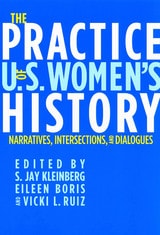
The Practice of U.S. Women's History
Narratives, Intersections, and DialoguesEdited by S. Jay Kleinberg, Eileen Boris, and Vicki L. Ruiz
Rutgers University Press, 2008
In the last several decades, U.S. women’s history has come of age. Not only have historians challenged the national narrative on the basis of their rich explorations of the personal, the social, the economic, and the political, but they have also entered into dialogues with each other over the meaning of women’s history itself.
In this collection of seventeen original essays on women’s lives from the colonial period to the present, contributors take the competing forces of race, gender, class, sexuality, religion, and region into account. Among many other examples, they examine how conceptions of gender shaped government officials’ attitudes towards East Asian immigrants; how race and gender inequality pervaded the welfare state; and how color and class shaped Mexican American women’s mobilization for civil and labor rights.

The Why of Music
Dialogues in an Unexplored Region of AppreciationDonald N. Ferguson
University of Minnesota Press, 1969
The Why of Music was first published in 1969. Minnesota Archive Editions uses digital technology to make long-unavailable books once again accessible, and are published unaltered from the original University of Minnesota Press editions.
In his many tears of teaching and writing about music Professor Ferguson has given much thought to the question of the why of music — why does music affect us as it does, why are we deeply moved by some music by not by other music, what is it about music that "sends" us, and where does it send us? In this book he explores such questions in depth and provides intriguing answers. The discussions are presented in the form of dialogues between the author and several friends.
As Professor Ferguson explains, the book is intended to take the reader on a guided tour, a tour which follows, in part, the familiar roads of formal music appreciation but which leads more often into byways where, almost hidden by the brilliant Hows that line the more familiar roads, lurks the essential Why of music. He describes this Why as the fertilizing commerce between music and human experience—a portrayal, not of the tangible facts of experience, but of the concern aroused by our encounter with those facts. He explains that while avant-garde abstractionism is concerned only with music as art—a concern too specialized for the general music lover to grasp and too narrow to sustain interest—the Why of enduring music lies in its endeavor to portray experience as it lives in Everyman's mind.