Results by title
26 books match the query 'Dickens, Charles'
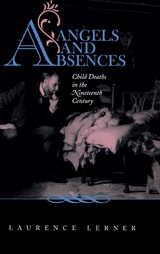
Angels and Absences
Child Deaths in the Nineteenth CenturyLaurence Lerner
Vanderbilt University Press, 1997
What is the difference between public and private feeling, and how far can we deduce past feelings from the words that have been left us? Why do child deaths figure so often and so prominently in the literature of the nineteenth century, and how was the theme of the death of a child used to elicit such poignant responses in the readers of that era? In this fascinating new book, Laurence Lerner vividly contrasts the contempt with which twentieth- century criticism so often dismisses such works as mere sentimentality with the enthusiasm and tears of nineteenth-century contemporaries.
Drawing examples from both real and literary deaths, Lerner delves into the writings of well-known authors such as Dickens, Coleridge, Shelley, Flaubert, Mann, Huxley, and Hesse, as well as lesser known writers like Felicia Hemans and Lydia Sigourney. In the process, he synthesizes fresh ideas about the thorny subjects of sentimentality, aesthetic judgment, and the function of religion in literature.
Lerner's forthright and evocative prose style is enjoyable reading, and he excels in teasing out the moral implications and the psychosocial entanglements of his chosen narrative and lyrical texts. This is a book that will illuminate an important aspect of the history of private life. It should have wide application for those interested in the history, sociology, and literature of the nineteenth century.
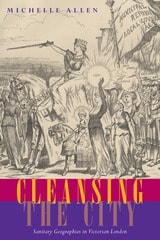
Cleansing the City
Sanitary Geographies in Victorian LondonMichelle Allen
Ohio University Press, 2008
From the novels of Charles Dickens and George Gissing to anonymous magazine articles and pamphlets, resistance to reform found expression in the nostalgic appreciation of a threatened urban landscape and anxiety about domestic autonomy in an era of networked sanitary services. Cleansing the City emphasizes the disruptions and disorientation occasioned by purification—a process we are generally inclined to see as positive. By recovering these sometimes oppositional, sometimes ambivalent responses, Michelle Allen elevates a significant undercurrent of Victorian thought into the mainstream and thus provides insight into the contested nature of sanitary modernization.
Collaborative Dickens
Authorship and Victorian Christmas PeriodicalsMelisa Klimaszewski
Ohio University Press, 2019
From 1850 to 1867, Charles Dickens produced special issues (called “numbers”) of his journals Household Words and All the Year Round, which were released shortly before Christmas each year. In Collaborative Dickens, Melisa Klimaszewski undertakes the first comprehensive study of these Christmas numbers. She argues for a revised understanding of Dickens as an editor who, rather than ceaselessly bullying his contributors, sometimes accommodated contrary views and depended upon multivocal narratives for his own success.
Klimaszewski uncovers connections among and between the stories in each Christmas collection. She thus reveals ongoing conversations between the works of Dickens and his collaborators on topics important to the Victorians, including race, empire, supernatural hauntings, marriage, disability, and criminality. Stories from Wilkie Collins, Elizabeth Gaskell, and understudied women writers such as Amelia B. Edwards and Adelaide Anne Procter interact provocatively with Dickens’s writing. By restoring links between stories from as many as nine different writers in a given year, Klimaszewski demonstrates that a respect for the Christmas numbers’ plural authorship and intertextuality results in a new view of the complexities of collaboration in the Victorian periodical press and a new appreciation for some of the most popular texts Dickens published.
Contemporary Dickens
Edited by Eileen Gillooly and Deirdre David
The Ohio State University Press, 2008
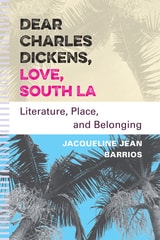
Dear Charles Dickens, Love, South LA
Literature, Place, and BelongingJacqueline Jean Barrios
University of Iowa Press, 2026
Jacqueline Jean Barrios confronts the cultural challenges that big canonical books pose to new generations of readers. Instead of erasing the differences between Dickens’s implied audiences and his current ones, Barrios demonstrates how youth can serve as the visionaries who bridge the gap. By placing literature in everyday surroundings, students at any school and in any location can learn from the embodied and the poetic and even question the universalism that masks unexamined reverence for the Western canon.

Dickens The Novelist
Leavis, F. R.
Rutgers University Press, 1979
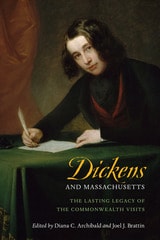
Dickens and Massachusetts
The Lasting Legacy of the Commonwealth VisitsDiana C. Archibald
University of Massachusetts Press, 2015
Charles Dickens traveled to North America twice, in 1842 and twenty-five years later in 1867–68, and on both trips Massachusetts was part of his itinerary. Although many aspects of his U.S. travels disappointed him, Massachusetts was the one state that met and even exceeded Dickens's expectations for “the republic of [his] imagination.” From the mills of Lowell to the Perkins School for the Blind, it offered an alternate vision of America that influenced his future writings, while the deep and lasting friendships he formed with Bostonians gave him enduring ties to the commonwealth.
This volume provides insight from leading scholars who have begun to reassess the significance of Massachusetts in the author's life and work. The collection begins with a broad biographical and historical overview taken from the full-length narrative of the award-winning exhibition Dickens and Massachusetts: A Tale of Power and Transformation, which attracted thousands of visitors while on display in Lowell. Abundant images from the exhibition, many of them difficult to find elsewhere, enhance the story of Dickens's relationship with the vibrant cultural and intellectual life of Massachusetts. The second section includes essays that consider the importance of Dickens's many connections to the commonwealth.
In addition to the volume editors, contributors include Chelsea Bray, Iain Crawford, Andre DeCuir, Natalie McKnight, Lillian Nayder, and Kit Polga.

Dickens' Working Notes for His Novels
Charles Dickens
University of Chicago Press, 1987
Harry Stone, an internationally recognized Dickens scholar, provides the reader with a full account of Dickens' methods of planning and working. In a comprehensive introduction and extensive notes, he uses Dickens' written plans to illuminate the thought and technique of the novels. He examines creative concerns, such as Dickens' process of naming and visualization, and technical matters, such as his use of various pen nibs, ink colors, and papers.
By making fully available and comprehensible Dickens' own cache of in-process plans, possibilities, and alternatives for shaping his novels, Dickens' Working Notes offers unparalleled insights into the novelist's art and into the nature of the creative imagination.
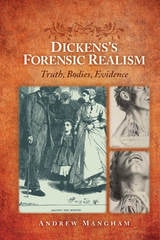
Dickens's Forensic Realism
Truth, Bodies, EvidenceAndrew Mangham
The Ohio State University Press, 2017
As Mangham shows, forensic medicine grew out of a perceived need to understand things with accuracy, leaning in part on the range of objectivities that inspired the inorganic sciences. At the same time, it had the burden of assisting the law in convicting the guilty and in exonerating the innocent. Practitioners of forensic medicine were uniquely mindful of unwanted variables such as human error and the vagaries of interpretation. In readings of Oliver Twist, Our Mutual Friend, Bleak House, The Pickwick Papers, Great Expectations, and Dickens’s early journalism, Mangham demonstrates that these questions about signification, perception, and reality are central to the stylistic complexities and playful tone often associated with Dickens. Moreover, the medico-legal context of Dickens’s fiction illuminates the richness and profundity, style and impact of Dicken’s narratives.
Dickens's Hyperrealism
John R. Reed
The Ohio State University Press, 2009
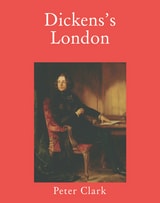
Dickens's London
Peter Clark
Haus Publishing, 2012
In five walks through central London, Peter Clark explores “The First Suburbs”—Camden Town, Chelsea, Greenwich, Hampstead, Highgate and Limehouse—as they feature in Dickens’s writing and illuminates the settings of Dickens’s life and his greatest works of journalism and fiction. Describing these storied spaces of today’s central London in intimate detail, Clark invites us to experience the city as it was known to Dickens and his characters. These walks take us through the locations and buildings that he interacted with and wrote about, creating an imaginative reconstruction of the Dickensian world that has been lost to time.
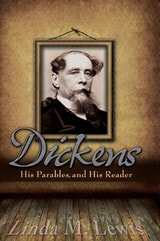
Dickens, His Parables, and His Reader
Linda M. Lewis
University of Missouri Press, 2011
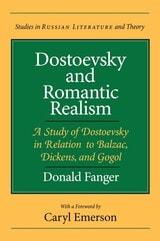
Dostoevsky and Romantic Realism
A Study of Dostoevsky in Relation to Balzac, Dickens, and GogolDonald Fanger
Northwestern University Press, 1998
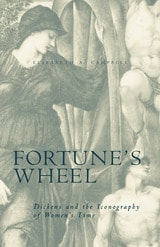
Fortune’s Wheel
Dickens and the Iconography of Women’s TimeElizabeth A. Campbell
Ohio University Press, 2003
In the first half of the nineteenth century, England became quite literally a world on wheels. The sweeping technological changes wrought by the railways, steam-powered factory engines, and progressively more sophisticated wheeled conveyances of all types produced a corresponding revolution in Victorian iconography: the image of the wheel emerged as a dominant trope for power, modernity, and progress.
In Fortune’s Wheel, an original and illuminating study, Elizabeth Campbell explores the ways in which Charles Dickens appropriated and made central to his novels the dominant symbol of his age. Between 1840 and 1860, a transformation took place in Dickens’ thinking about gender and time, and this revolution is recorded in iconographic representations of the goddess Fortune and wheel imagery that appear in his work.
Drawing on a rich history of both literary and visual representations of Fortune, Professor Campbell argues that Dickens’ contribution to both the iconographic and narrative traditions was to fuse the classical image of the wheel with the industrial one. As the wheel was increasingly identified as the official Victorian symbol for British industrial and economic progress, Dickens reacted by employing this icon to figure a more pessimistic historical vision—as the tragic symbol for human fate in the nineteenth century.
Fortune’s Wheel ably portrays the concept that, in both text and illustrations, images of fortune and the wheel in Dickens’ work record his abandonment of a linear, progressive, and arguably masculine view of history to embrace a cyclical model that has been identified with “women’s time.”
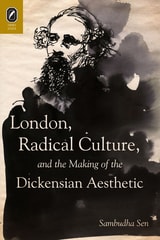
London, Radical Culture, and the Making of the Dickensian Aesthetic
Sambudha Sen
The Ohio State University Press, 2012

NOVEL PROFESSIONS
INTERESTED DISINTEREST AND THE MAKING OF THE VICTORIAN NOVELJennifer Ruth
The Ohio State University Press, 2006
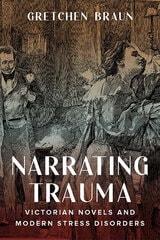
Narrating Trauma
Victorian Novels and Modern Stress DisordersGretchen Braun
The Ohio State University Press, 2022
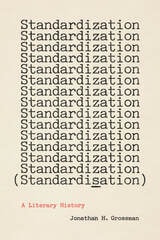
Standardization (Standardisation)
A Literary HistoryJonathan H. Grossman
University of Chicago Press, 2026
An innovative study of the history of standardization that draws on both technical documents and novels.
Jonathan H. Grossman’s elegant analysis of standardization approaches the topic by exploring how institutions create standards. Grossman tracks how published standards documents became the dominant means of homogenizing durable objects during the nineteenth century’s industrialization of manufacturing, including printing. Examining these documents as a genre, he reconstructs the nineteenth-century history of published standards documents and shows how they evolved to produce uniformity across manufactured objects.
Shifting focus from the standardized creation of objects to their use by subjects, Grossman then probes how people reimagined, through print, the ways in which their subjectivity combined with identical, interchangeable manufactured objects. To understand that relation, he looks to nineteenth-century novels by Charles Dickens, Mark Twain, and Elizabeth Gaskell, revealing how these books depicted the interchangeability of the subjects implied by this production of identical objects. The novels do not merely observe the interplay between subjects and standardized objects; they materialize it in the assemblage of readers holding their industrially manufactured, print copy.
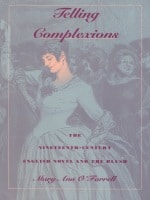
Telling Complexions
The Nineteenth-Century English Novel and the BlushMary Ann O Farrell
Duke University Press, 1997
Although the blush was used to tell the truth of character and body, O’Farrell shows how it is actually undermined as a stable indicator of character in novels such as Pride and Prejudice, Persuasion, North and South, and David Copperfield. She reveals how these writers then moved on in search of other bodily indicators of mortification and desire, among them the swoon, the scar, and the blunder. Providing unique and creative insights into the constructedness of the body and its semiotic play in literature and in culture, Telling Complexions includes parallel examples of the blush in contemporary culture and describes ways that textualized bodies are sometimes imagined to resist the constraints imposed by such construction.

Text and Culture
The Politics of InterpretationDaniel Cottom
University of Minnesota Press, 1989
Text and Culture was first published in 1989. Minnesota Archive Editions uses digital technology to make long-unavailable books once again accessible, and are published unaltered from the original University of Minnesota Press editions.
In Text & Culture, Daniel Cottom examines the political aspects of contemporary disciplines of interpretation. He pleads against limiting the act of reading by disqualifying some readings as "wrong" or unscholarly, and he argues for the necessity of multiple readings, claiming that a closed-off text glosses over differences that are political in nature. He proceeds, then, from the notion of text to culture. Just as the reading of the text is conditioned by irreducible political differences, so is the reading of culture. Finally, to illustrate and further develop his arguments, Cottom presents an extensive analysis of Great Expectations.
Cottom's materials range from academic jokes to King Lear, and the writers he discusses range from Kant to Derrida, from Freud to Basil Bernstein, from Ludwig Wittgenstein and Bronislaw Malinowski to Erving Goffman, Clifford Geertz, and Stanley Fish. This study is especially concerned with the way "culture" and related terms, such as "context" and "norm," are part of a larger discourse in the contemporary humanities and social sciences - a discourse in which their effect is to repress recognition of important historical differences, conflicts, and possibilities. At the same time that he shows how difficult it is to get "beyond culture," he tries to indicate how interpretation may be turned into a more socially responsible practice.
Daniel Cottom is associate professor of English at the University of Florida. He is the author of Social Figures: George Eliot, Social History, and Literary Representation (Minnesota, 1987) and The Civilized Imagination: A Study of Ann Radcliffe, Jane Austen, and Sir Walter Scott.
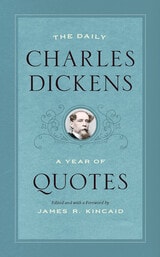
The Daily Charles Dickens
A Year of QuotesCharles Dickens
University of Chicago Press, 2018
A bedside companion to dip into year round, this book introduces each month with a longer seasonal quote, while concise bits of wisdom and whimsy mark each day. Hopping gleefully from Esther Summerson’s abandonment by her mother in Bleak House to a meditation on the difficult posture of letter-writing in The Pickwick Papers, this anthology displays the wide range of Dickens’s stylistic virtuosity—his humor and his deep tragic sense, his ear for repetition, and his genius at all sorts of voices. Even the devotee will find between these pages a mix of old friends and strangers—from Oliver Twist and Ebenezer Scrooge to the likes of Lord Coodle, Sir Thomas Doodle, Mrs. Todgers, and Edwin Drood—as well as a delightful assortment of the some of the novelist’s most famous, peculiar, witty, and incisive passages, tailored to fit the season. To give one particularly apt example: David Copperfield blunders, in a letter of apology to Agnes Wickfield, “I began one note, in a six-syllable line, ‘Oh, do not remember’—but that associated itself with the fifth of November, and became an absurdity.”
Never Pecksniffian or Gradgrindish, this daily dose of Dickens crystallizes the novelist’s agile humor and his reformist zeal alike. This is a book to accompany you through the best of times and the worst of times.
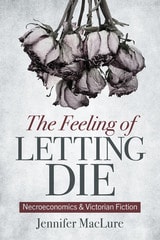
The Feeling of Letting Die
Necroeconomics and Victorian FictionJennifer MacLure
The Ohio State University Press, 2023
In The Feeling of Letting Die, Jennifer MacLure explores how Victorian novels depict the feelings that both fuel and are produced by an economic system that lets some people die in service of the free market. MacLure argues that Victorian authors present capitalism’s death function as a sticking point, a series of contradictions, and a problem to solve as characters grapple with systems that allow, demand, and cause the deaths of their less fortunate fellows.
Utilizing Achille Mbembe’s theorization of necropolitics, MacLure uses the term “necroeconomics,” positioning Victorian authors—even those who were deeply committed to liberal capitalism—as hyperaware of capitalism’s death function. Examining both canonical and lesser-known works by Elizabeth Gaskell, Harriet Martineau, Charles Dickens, William Morris, and George Eliot, The Feeling of Letting Die shows capitalism as not straightforwardly imposed via economic policy but instead as a system functioning through the emotions and desires of the human beings who enact it. In doing so, MacLure reveals how emotion functions as both the legitimating epistemic mode of capitalism and its most salient threat.
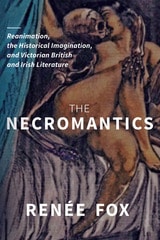
The Necromantics
Reanimation, the Historical Imagination, and Victorian British and Irish LiteratureRenée Fox
The Ohio State University Press, 2023
Winner, 2025 Sonya Rudikoff Award for the best first book in Victorian Studies
Honorable Mention, 2023 North American Victorian Studies Association First Book Prize
Honorable Mention, American Council for Irish Studies Donald Murphy Prize for Distinguished First Book
The Necromantics dwells on the literal afterlives of history. Reading the reanimated corpses—monstrous, metaphorical, and occasionally electrified—that Mary Shelley, Robert Browning, Charles Dickens, W. B. Yeats, Bram Stoker, and others bring to life, Renée Fox argues that these undead figures embody the present’s desire to remake the past in its own image. Fox positions “necromantic literature” at a nineteenth-century intersection between sentimental historiography, medical electricity, imperial gothic monsters, and the Irish Literary Revival, contending that these unghostly bodies resist critical assumptions about the always-haunting power of history.
By considering Irish Revival texts within the broader scope of nineteenth-century necromantic works, The Necromantics challenges Victorian studies’ tendency to merge Irish and English national traditions into a single British whole, as well as Irish studies’ postcolonial efforts to cordon off a distinct Irish canon. Fox thus forges new connections between conflicting political, formal, and historical traditions. In doing so, she proposes necromantic literature as a model for a contemporary reparative reading practice that can reanimate nineteenth-century texts with new aesthetic affinities, demonstrating that any effective act of reading will always be an effort of reanimation.
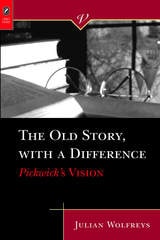
The OLD STORY, WITH A DIFFERENCE
Pickwick’s VisionJulian Wolfreys
The Ohio State University Press, 2006
The Old Story, with a Difference: Pickwick’s Vision explores in radically different ways from most approaches to nineteenth-century studies the tropes and metaphors of vision in Dickens’ first novel, The Pickwick Papers. Julian Wolfreys provides a close reading of Dickens’ Pickwick Papers and argues that this novel is an exemplary text for the re-consideration of concepts such as literature, history, the novel, and the whole notion of Victorian studies. True to the purpose of the Victorian Critical Interventions Series, Wolfreys challenges scholars to rethink the use of a canonical text in Victorian literature.
Challenging the commonplaces of historicist criticism, and demonstrating the need for a return to close reading, The Old Story, with a Difference presents a reading of the novel grounded in the twinned rigors of materialist historiography and theoretical inflections tending toward attentiveness to epistemological and linguistic concerns. Through such an orientation, Wolfreys unpacks the relation between the tropes of visuality and matters of memory, history, and the necessity of fiction to bear witness to the cultures, past and present, from which literature becomes generated and which it mediates. In doing so, he situates an argument for rethinking Dickens’ novel as the inaugural novel of Victorian fiction par excellence, in that novel’s efforts to remain open to the traces of the past in particular ways.
The Old Story, with a Difference holds profound implications for the study not only of Dickens’ works but Victorian literature and culture in general. Provocative and inventive, this ambitious analysis will challenge, goad, and invite the reader to return to acts of materialist reading informed by ethical and ideological urgency, rather than relapsing into the commonplaces of humanist cliché.
Towards the Ethics of Form in Fiction
Narratives of Cultural RemissionLeona Toker
The Ohio State University Press, 2010
Toker is especially interested in cultural remissions such as the carnivalesque—that is, the inverting of standard cultural hierarchies or the blurring of boundaries between normally separated social groups, actors and audiences, self and other. She argues that cultural remissions have the potential not simply to provide a break from the determinacies of our quotidian existence but also to return us to that existence with some alteration of our perceptions, beliefs, and values. Toker contends that the ethical consequences of reading fiction result from features of its aesthetics, particularly what she calls, following the semiotician Louis Hjemslev, “the form of the content”—the patterns arising from the artistic deployment of narrative details. In addition to addressing the carnivalesque discourse of Bakhtin as well as the theory of oppositionality developed by de Certeau and Chambers, she puts theory into practice through detailed analyses of canonical texts by Fielding, Sterne, Austen, Hawthorne, Dickens, Conrad, Joyce, and other writers.
Victorian Lessons in Empathy and Difference
Rebecca N. Mitchell
The Ohio State University Press, 2011