Results by title
10 books match the query 'Difference (Philosophy)'

Altarity
Mark C. Taylor
University of Chicago Press, 1987
In Altarity, Taylor develops a genealogy of otherness and difference that is based on the principle of creative juxtaposition. Rather than relying on a historical or chronological survey of crucial moments in modern philosophical thinking, he explores the complex question of difference through the strategies of contrast, resonance, and design. Taylor brings together the work of thinkers as diverse as Hegel, Heidegger, Merleau-Ponty, Lacan, Bataille, Kristeva, Levinas, Blanchot, Derrida, and Kierkegaard to fashion a broad intellectual scheme.
Situated in an interdisciplinary discourse, Altarity signifies a harnessing of continental and American habits of intellectual thought and illustrates the singularity that emerges from such a configuration. As such, the book functions as a mirror of our intellectual moment and offers the academy a rigorous way of acknowledging the limitations of its own interpretive practices.
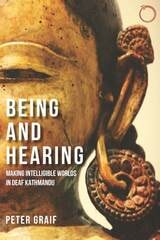
Being and Hearing
Making Intelligible Worlds in Deaf KathmanduPeter Graif
HAU, 2018
From pranks and protests, to diverse acts of love and resistance, to renewed distinctions between material and immaterial, deaf communities in Nepal have crafted ways to foreground the habits of perception that shape both their own experiences and how they are experienced by the hearing people around them. By exploring these often overlooked strategies, Being and Hearing makes a unique contribution to ethnography and comparative philosophy.
Critique of Black Reason
Achille Mbembe
Duke University Press, 2017
Derrida and Differance
David Wood and Robert Bernasconi
Northwestern University Press, 1988

Essay on Exoticism
An Aesthetics of DiversityVictor Segalen
Duke University Press, 2002
Written over the course of fourteen years between 1904 and 1918, at the height of the age of imperialism, Essay on Exoticism encompasses Segalen’s attempts to define “true Exoticism.” This concept, he hoped, would not only replace nineteenth-century notions of exoticism that he considered tawdry and romantic, but also redirect his contemporaries’ propensity to reduce the exotic to the “colonial.” His critique envisions a mechanism that appreciates cultural difference—which it posits as an aesthetic and ontological value—rather than assimilating it: “Exoticism’s power is nothing other than the ability to conceive otherwise,” he writes.
Segalen’s pioneering work on otherness anticipates and informs much of the current postcolonial critique of colonial discourse. As such Essay on Exoticism is essential reading for both cultural theorists or those with an interest in the politics of difference and diversity.
Geographies of Writing
Inhabiting Places and Encountering DifferenceNedra Reynolds
Southern Illinois University Press, 2004
Twenty-first-century technological innovations have revolutionized the way we experience space, causing an increased sense of fragmentation, danger, and placelessness. In Geographies of Writing: Inhabiting Places and Encountering Difference, Nedra Reynolds addresses these problems in the context of higher education, arguing that theories of writing and rhetoric must engage the metaphorical implications of place without ignoring materiality.
Geographies of Writing makes three closely related contributions: one theoretical, to reimagine composing as spatial, material, and visual; one political, to understand the sociospatial construction of difference; and one pedagogical, to teach writing as a set of spatial practices. Aided by seven maps and illustrations that reinforce the book’s visual rhetoric, Geographies of Writing shows how composition tasks and electronic space function as conduits for navigating reality.
Identity/Difference
Democratic Negotiations of Political ParadoxWilliam E. Connolly
University of Minnesota Press, 2002
A new edition of this classic work on the idea of difference.
In this foundational work in contemporary political theory, William Connolly makes a distinctive contribution to our understanding of the relationship between personal identity and democratic politics, particularly in the domains of religion, ethics, sexuality, and ethnicity. Every identity, Connolly argues, whether individual or social, presents us with a fundamental and troubling paradox: an identity establishes itself in relation to a set of differences, and it operates under powerful pressures to fix, regulate, or exclude some of these differences as otherness. The dignity of a people or political regime, and the quality of democratic culture, depends on the acknowledgment and ethos cultivated in response to these pressures.
In a substantial new essay, Connolly responds to the heated controversy surrounding his ideas when Identity\Difference was first published in 1991, while augmenting his discussion of the virtues of critical responsiveness. The issues of identity and difference cannot be ignored, he contends, and are ubiquitous in modern life.
Postmodernism and the Other
New Imperialism of Western CultureZiauddin Sardar
Pluto Press, 1997
Speech and Phenomena
And Other Essays on Husserl's Theory of SignsJacques Derrida
Northwestern University Press, 1973
Voice and Phenomenon
Introduction to the Problem of the Sign in Husserl's PhenomenologyJacques Derrida, Translated from the French by Leonard Lawlor
Northwestern University Press, 2011
Only in relation to phenomenology is it possible to measure the importance of deconstruction. Only in relation to Husserl’s philosophy is it possible to understand the novelty of Derrida’s thinking. Voice and Phenomenon therefore may be the best introduction to Derrida’s thought in general. To adapt Derrida’s comment on Husserl’s Logical Investigations, it contains “the germinal structure” of Derrida’s entire thought. Lawlor’s fresh translation of Voice and Phenomenon brings new life to Derrida’s most seminal work.