Results by title
9 books match the query 'Diversity in the workplace'
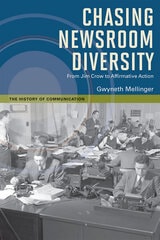
Chasing Newsroom Diversity
From Jim Crow to Affirmative ActionGwyneth Mellinger
University of Illinois Press, 2013

Corporate Futures
The Diffusion of the Culturally Sensitive Corporate FormEdited by George E. Marcus
University of Chicago Press, 1998
Late Editions 5, Corporate Futures, questions this idea of a "cultural landscape" by focusing on the the marked investment of corporations in the concept of culture, long the purview of anthropologists and, more recently, those involved in the humanistic disciplines. Emerging in the discourse of the workplace—and traveling beyond it to traditionally alternative associations—is the idea of a "corporate culture" with its own organization, management policies and practices, and ethos. How can we understand this culture of corporations, and to what extent does it reflect self-contained communities or fragmented human existence in groups under conditions of postmodernity? Corporate Futures tackles these issues and questions through conversations with managers, financial and risk analysts, and other participants in national and international organizations.
The results—engaging, intriguing, speculative, current—continue the work begun in earlier volumes to map the terrain of the present and navigate the uncertain future.
Praise for Late Editions: "If the succeeding volumes are as compassionate and informed as the first, this series could become an essential postmodern guidebook to the world's changing cultural terrain. I plan on letting it ease me into the next century."—Catherine Gysin, Utne Reader
Corporate Tribalism
White Men/White Women and Cultural Diversity at WorkThomas Kochman and Jean Mavrelis
University of Chicago Press, 2009
The 2008 elections shattered historical precedents and pushed race and gender back to the forefront of our national consciousness. The wide range of reactions to the efforts of Barack Obama, Hillary Clinton, and Sarah Palin dramatically reflected ongoing conflicts over diversity in our society, especially in the venue where people are most likely to encounter them: work. As more and more people who aren’t white men enter corporate America, we urgently need to learn how to avoid clashes over these issues and how to resolve them when they do occur.
Thomas Kochman and Jean Mavrelis have been helping corporations successfully do that for over twenty years. Their diversity training and consulting firm has helped managers and employees at numerous companies recognize and overcome the cultural bases of miscommunication between ethnic groups and across gender lines—and in Corporate Tribalism they seek to share their expertise with the world. In the first half of the book, Kochman addresses white men, explicating the ways that their cultural background can motivate their behavior, work style, and perspective on others. Then Mavrelis turns to white women, focusing on the particular problems they face, including conflicts with men, other women, and themselves. Together they emphasize the need for a multicultural—rather than homogenizing—approach and offer constructive ideas for turning the workplace into a more interactive community for everyone who works there.
Written with the wisdom and clarity gained from two decades of hands-on work, Corporate Tribalism will be an invaluable resource as we look toward a future beyond the glass ceiling.
Diversity, Equity, and Inclusion in Action
Planning, Leadership, and ProgrammingChristine Bombaro
American Library Association, 2020
All too often, in a hurried attempt to “catch up,” diversity training can create division among staff or place undue burdens on a handful of employees. Instead, academic libraries need approaches to diversity, equity, and inclusion (DEI) that position these priorities as ongoing institutional and professional goals. This book’s model programs will help academic libraries do exactly that, sharing a variety of initiatives that possess clear goals, demonstrable outcomes, and reproducible strategies. Librarians, administrators, and directors will all benefit from the programs detailed inside, which include such topics as
- a university library’s community of practice for interactions and learning around DEI;
- cultural competency training to create more welcoming instruction spaces;
- student workshops on literature searches that mitigate bias;
- overcoming the historic tendency to marginalize LGBTQ+ representation in archives;
- a curriculum and design workshop that moved from discussing social values to embedding them in actions;
- the founding of a library-led LGBT club for students at a rural community college;
- a liberal arts college’s retention-boosting program for first-generation students;
- tailoring a collection and library services to the unique needs of student veterans; and
- a framework for moving from diversity to equity and inclusion, toward a goal of social justice.
Enhancing Diversity
Educators with DisabilitiesRonald J. Anderson
Gallaudet University Press, 1998
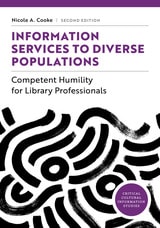
Information Services to Diverse Populations
Competent Humility for Library ProfessionalsNicole A. Cooke
American Library Association, 2026
Foreword by Cynthia Sturgis Landrum
The development of cultural competency skills and social awareness benefits LIS students, their future employers, and the library profession at large―not to mention library customers and society as a whole. Cooke's freshly updated text introduces readers to the contexts and situations that promote the development of empathy and build cultural competence. It marshals cutting edge research and relevant best practices to give readers a strong grasp of the political, social, economic, and technological divides among library patrons. It also covers outreach and library services to diverse populations, how to evaluate such services, and many other key topics. Complete with an updated syllabus, lesson plans, and exercises ready-made for course use, Cooke’s text
- demonstrates why social responsibility is a foundational value of librarianship;
- considers library services to members of marginalized racial or ethnic groups, older adults, people with mental health or physical disabilities, neurodiverse library users, refugees and immigrants, people experiencing homelessness or hunger, those growing up in or experiencing poverty, members of the LGBTQIA+ communities, and people who are incarcerated;
- features a myriad of testimonials drawn from a wide variety of settings that highlight the experiences of library and museum practitioners who are working with diverse populations;
- introduces a new model of cultural competence and cultural humility;
- authoritatively covers such essential concepts as intersectionality, privilege, marginalization, cultural competence, cultural humility, and counter-storytelling along with discussions of how they interplay in the communities that libraries serve;
- explores the impact of overwhelming whiteness of the library profession and what can be done to recruit, welcome, mentor, and retain racially and ethnically diverse library workers; and
- identifies potential employment and networking opportunities related to diversity and social justice in librarianship.
Managing Diversity in Organizations
Robert T. Golembiewski
University of Alabama Press, 1995
Managing Diversity in Organizations focuses on a key issue that organizations are facing—diversity. It is here, and it is growing. The only question now is how well we deal with diversity, especially in organizational contexts.
Golembiewski identifies the many forces and factors propelling us into the age of diversity in organizations—ethical, political, philosophic, demographic, and so on—and details the historical and contemporary approaches. Most practice has focused on a "level playing field" or equal opportunity and "tilting the playing field" or equal outcomes. This volume focuses on diversity as a strategic device rather than as a nicety rooted in behavioral and organizational research. Managing diversity successfully in organizations requires a thorough understanding of management infrastructure that is consistent with diversity--especially structures of work, policies, and procedures that institutionalize and build diversity.
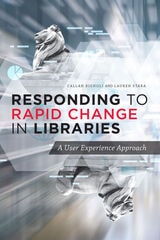
Responding to Rapid Change in Libraries
A User Experience ApproachLauren Stara and Callan Bignoli
American Library Association, 2020
In the face of rapid change and an ever-widening constellation of challenges, it’s crucial for library leaders to pull back to the question of “why?” Plotting a sustainable way forward depends upon recommitting ourselves to our underlying values, such as customer service and community-building, while fostering the improvements that change makes possible. With passion, patience, and fortitude, libraries can stride confidently into the future. In this book, noted speakers and consultants Bignoli and Stara speak directly to library directors, managers, administrators, and technology staff, offering concrete guidance on setting or resetting strategic priorities. Taking an interconnected and specific approach to planning for and strengthening the library environment as a whole, their book
- discusses why libraries should embrace change as a fundamental part of library life;
- explores how to harness rapid change to provide more responsive, user-centered library service;
- addresses the ways in which libraries straddle the physical and the digital, in areas such as service provision and collections, illuminating how they overlap and can be improved using similar philosophies;
- presents both a comprehensive overview of library technologies as well as related team and change management advice, all grounded in user experience principles;
- shows how the concepts of sustainability and flexibility apply to physical space planning and design, from furniture selection and arrangement to infrastructure; and
- provides sound guidance on project management, problem solving, preparing for future challenges, personal reflection and self-care, and other leadership topics.
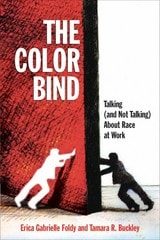
The Color Bind
Talking (and Not Talking) About Race at WorkErica Gabrielle Foldy
Russell Sage Foundation, 2014