Results by title
13 books match the query 'Dutch'
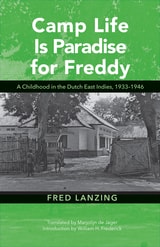
Camp Life Is Paradise for Freddy
A Childhood in the Dutch East Indies, 1933–1946Fred Lanzing
Ohio University Press, 2017
“Children see and hear what is there; adults see and hear what they are expected to and mainly remember what they think they ought to remember,” David Lowenthal wrote in The Past Is a Foreign Country. It is on this fraught foundation that Fred Lanzing builds this memoir of his childhood in a Japanese internment camp for Dutch colonialists in the East Indies during the World War II.
When published in the Netherlands in 2007, the book triggered controversy, if not vitriol, for Lanzing’s assertion that his time in the camp was not the compendium of horrors commonly associated with the Dutch internment experience. Despite the angry reception, Lanzing’s account corresponds more closely with the scant historical record than do most camp memoirs. In this way, Lanzing’s work is a substantial addition to ongoing discussions of the politics of memory and the powerful—if contentious—contributions that subjective accounts make to historiography and to the legacies of the past.
Lanzing relates an aspect of the war in the Pacific seldom discussed outside the Netherlands and, by focusing on the experiences of ordinary people, expands our understanding of World War II in general. His compact, beautifully detailed account will be accessible to undergraduate students and a general readership and, together with the introduction by William H. Frederick, is a significant contribution to literature on World War II, the Dutch colonial experience, the history of childhood, and Southeast Asian history.
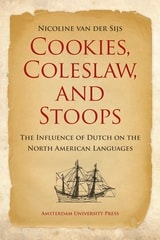
Cookies, Coleslaw, and Stoops
The Influence of Dutch on the North American LanguagesNicoline van der Sijs
Amsterdam University Press, 2010
From Santa Claus (after the Dutch folklore saint Sinterklaas) and his sleigh (the pronunciation of the Dutch slee is almost identical) to a dumbhead talking poppycock, the contributions of the Dutch language to American English are indelibly embedded to some of our most vernacular terms and expressions. The menu in most of our restaurants sports some originally Dutch names, and even our dollar is named after a Dutch coin (daalder). In this captivating volume, the renowned linguist Nicoline van der Sijs glosses over 300 Dutch loan words like these that travelled to the New World on board the Dutch ship the Halve Maan, captained by Henry Hudson, which dropped anchor in Manhattan more than 400 years ago. Surprisingly, the Dutch also gave several Native American languages words for everyday things like “pants”, “cat” and “turkey”. Lively and accessible, the information presented in this volume charts the journey of these words into the American territory and languages, from more obscure uses which maybe have survived in only regional dialects to such ubiquitous contributions to our language like Yankee, cookie, and dope. Each entry marks the original arrival of its term into American English and adds up-to-date information on its evolving meaning, etymology, and regional spread. Not to be missed by anyone with a passion for the history behind our everyday expressions, Cookies, Coleslaw and Stoops is the perfect gift for the linguistic adventurer in us all.
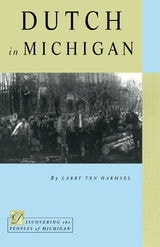
Dutch in Michigan
Larry Ten Harmsel
Michigan State University Press, 2002
Even though they are historically one of the smaller immigrant streams, nineteenth-century Dutch migrants and their descendants have made parts of West Michigan their own. The first Dutch in Michigan were religious dissenters whose commitment to Calvinism had long-reaching effects on their communities, even in the face of later waves of radicalized industrial immigrants and the challenges of modern life. From Calvin College to Meijer Thrifty Acres and the Tulip Festival, the Dutch presence has enriched and informed people throughout the state. Larry ten Harmsel skillfully weaves together the strands of history and modern culture to create a balanced and sensitive portrayal of this vibrant community.
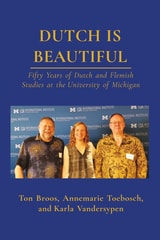
Dutch is Beautiful
Fifty Years of Dutch and Flemish Studies at the University of MichiganTon Broos, Annemarie Toebosch, and Karla Vandersypen
Michigan Publishing Services, 2019
Dutch is Beautiful tells the story of the fifty years of Dutch and Flemish Studies at the University of Michigan in Ann Arbor, Michigan, USA. It is an account of the efforts to promote Dutch and Flemish culture and language, as well as a description of how the teaching of Dutch language, literature, history and culture can be a tool to look at a world of diverse identities. It also offers a comprehensive overview of the beginnings of a successful program that included Dutch writers-in-residence, visiting Netherlands professors, cultural and educational events, arts, music, films, conferences and publications. Several alumni of the program look back at their college years with appreciation. Articles and essays on history, Anne Frank, and conversations on colonialism discuss critical and educational views on Dutch and Flemish Studies in past, present and future, when diversity, equity and inclusion are important goals and objectives, and public scholarship and academic activism will be a larger part of the curriculum. This book will inform, entertain, stimulate and impress everyone who is interested in the culture of the Low Countries. The title says it all!
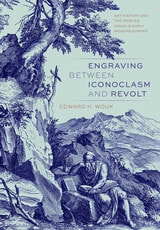
Engraving Between Iconoclasm and Revolt
Art History and the Printed Image in Early Modern EuropeEdward H. Wouk
University of Chicago Press, 0
An alternative history of Renaissance art from a Netherlandish perspective and focusing on printed images.
Through his treatises, letters, and support of printmaking projects, Bruges-born humanist Dominicus Lampsonius (1532–1599) tested the limits of what it meant to be an artist in the early modern period. This book—the first monographic study of Lampsonius to appear in the English language—investigates the convergence of art history, aesthetics, cultural politics, and theology in Lampsonius’s writings, with a particular focus on his novel theory of the printed image as a work of art.
In Lampsonius’s art history, painting recedes and engraving comes to the fore. This inversion of traditional hierarchies entailed a remaking of the Renaissance image as a graphic and replicable phenomenon. Here was a new way of looking at the image: not as a painted likeness of the sacred or the world, but rather as a graphic representation formed from the attenuated patterns of the engraved surface. In both meaning and making, printed images deflected the threats of iconoclasm precisely because, as manufactured objects, they could never be confused for what they represented—the sacred “prototype” they explicitly did not resemble. Tracing Lampsonius’s evolving views against the religious, political, and cultural upheaval of the Dutch Revolt, Edward H. Wouk considers the lasting implications of his efforts to change the course of art history.
Herman Gorter
Poems of 1890: A SelectionHerman Gorter
University College London, 2015

Intimacy Across Borders
Race, Religion, and Migration in the U.S. MidwestJane Juffer
Temple University Press, 2013
Examining how encounters produced by migration lead to intimacies-ranging from sexual, spiritual, and neighborly to hateful and violent, Jane Juffer considers the significant changes that have occurred in small towns following an influx of Latinos to the Midwest.
Intimacy across Borders situates the story of the Dutch Reformed Church in Iowa and South Africa within a larger analysis of race, religion, and globalization. Drawing on personal narrative, ethnography, and sociopolitical critique, Juffer shows how migration to rural areas can disrupt even the most thoroughly entrenched religious beliefs and transform the schools, churches, and businesses that form the heart of small-town America. Conversely, such face-to-face encounters can also generate hatred, as illustrated in the increasing number of hate crimes against Latinos and the passage of numerous anti-immigrant ordinances.
Juffer demonstrates how Latino migration to new areas of the U.S. threatens certain groups because it creates the potential for new kinds of families—mixed race, mixed legal status, and transnational—that challenge the conservative definition of community based on the racially homogeneous, coupled, citizen family.
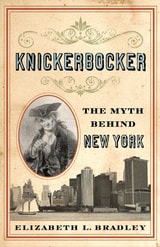
Knickerbocker
The Myth behind New YorkBradley, Elizabeth L
Rutgers University Press, 2009
Includes a gallery of images that brings Diedrich Knickerbocker, his myth, time, and place to life Knickerbocker engagingly traces the creation, evolution, and prevalence of Irving's imaginary historian in New York literature and history, art and advertising, from the early nineteenth century to the present day. Who would imagine this satiric character, at once a snob and a champion of the people, would endure for two hundred years? In Elizabeth L. Bradley's words, "Whether you call it 'blood,' style, attitude, or moxie, the little Dutchman could deliver." And, from this engaging work, it is clear that he does.
Bradley's stunning volume offers a surprising and delightful glimpse behind the scenes of New York history, and invites readers into the world of Knickerbocker, the antihero who surprised everyone by becoming the standard-bearer for the city's exceptional sense of self, or what we now call a New York "attitude."
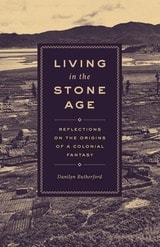
Living in the Stone Age
Reflections on the Origins of a Colonial FantasyDanilyn Rutherford
University of Chicago Press, 2018
Living in the Stone Age answers this question by following the adventures of officials sent to the New Guinea highlands in the 1930s to establish a foothold for Dutch colonialism. These officials became deeply dependent on the good graces of their would-be Papuan subjects, who were their hosts, guides, and, in some cases, friends. Danilyn Rutherford shows how, to preserve their sense of racial superiority, these officials imagined that they were traveling in the Stone Age—a parallel reality where their own impotence was a reasonable response to otherworldly conditions rather than a sign of ignorance or weakness. Thus, Rutherford shows, was born a colonialist ideology.
Living in the Stone Age is a call to write the history of colonialism differently, as a tale of weakness not strength. It will change the way readers think about cultural contact, colonial fantasies of domination, and the role of anthropology in the postcolonial world.
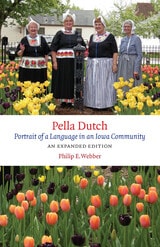
Pella Dutch
Portrait of a Language in an Iowa Community, An Expanded EditionPhilip E. Webber
University of Iowa Press, 1988
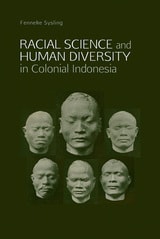
Racial Science and Human Diversity in Colonial Indonesia
Fenneke Sysling
National University of Singapore Press, 2016
In this new monograph, Fenneke Sysling draws on published works and private papers to describe the way Dutch racial scientists tried to make sense of the human diversity in the Indonesian archipelago. The making of racial knowledge, it contends, cannot be explained solely in terms of internal European intellectual developments. It was ‘on the ground’ that ideas about race were made and unmade with a set of knowledge strategies that did not always combine well. Sysling describes how skulls were assembled through the colonial infrastructure, how measuring sessions were resisted, what role photography and plaster casting played in racial science and shows how these aspects of science in practice were entangled with the Dutch colonial Empire.
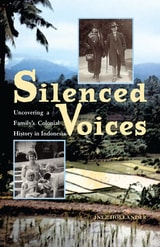
Silenced Voices
Uncovering a Family’s Colonial History in IndonesiaInez Hollander
Ohio University Press, 2008
Like a number of Netherlanders in the post–World War II era, Inez Hollander only gradually became aware of her family’s connections with its Dutch colonial past, including a Creole great-grandmother. For the most part, such personal stories have been, if not entirely silenced, at least only whispered about in Holland, where society has remained uncomfortable with many aspects of the country’s relationship with its colonial empire.
Unlike the majority of memoirs that are soaked in nostalgia for tempo dulu, Hollander’s story sets out to come to grips with her family’s past by weaving together personal records with historical and literary accounts of the period. She seeks not merely to locate and preserve family memories, but also to test them against a more disinterested historical record. Hers is a complicated and sometimes painful personal journey of realization, unusually mindful of the ways in which past memories and present considerations can be intermingled when we seek to understand a difficult past. Silenced Voices is an important contribution to the literature on how Dutch society has dealt with its recent colonial history.
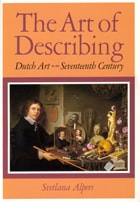
The Art of Describing
Dutch Art in the Seventeenth CenturySvetlana Alpers
University of Chicago Press, 1984
"There is no doubt that thanks to Alpers's highly original book the study of the Dutch masters of the seventeenth century will be thoroughly reformed and rejuvenated. . . . She herself has the verve, the knowledge, and the sensitivity to make us see familiar sights in a new light."—E. H. Gombrich, New York Review of Books