Results by title
10 books match the query 'Dylan, Bob'
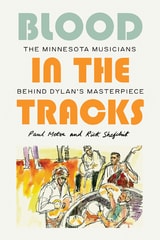
Blood in the Tracks
The Minnesota Musicians behind Dylan's MasterpiecePaul Metsa
University of Minnesota Press, 2023
The story of the Minneapolis musicians who were unexpectedly summoned to re-record half of the songs on Bob Dylan's most acclaimed album
When Bob Dylan recorded Blood on the Tracks in New York in September 1974, it was a great album. But it was not the album now ranked by Rolling Stone as one of the ten best of all time. “When something’s not right, it’s wrong,” as Dylan puts it in “You’re Gonna Make Me Lonesome When You Go”—and something about that original recording led him to a studio in his native Minnesota to re-record five songs, including “Idiot Wind” and “Tangled Up in Blue.” Six Minnesota musicians participated in that two-night recording session at Sound 80, bringing their unique sound to some of Dylan’s best-known songs—only to have their names left off the album and their contribution unacknowledged for more than forty years. This book tells the story of those two nights in Minneapolis, introduces the musicians who gave the album so much of its ultimate form and sound, and describes their decades-long fight for recognition.
Blood in the Tracks takes readers behind the scenes with these “mystery” Minnesota musicians: twenty-one-year-old mandolin virtuoso Peter Ostroushko; drummer Bill Berg and bass player Billy Peterson, the house rhythm section at Sound 80; progressive rock keyboardist Gregg Inhofer; guitarist Chris Weber, who owned The Podium guitar shop in Dinkytown; and Kevin Odegard, whose own career as a singer-songwriter had paralleled Dylan’s until he had to take a job as a railroad brakeman to make ends meet. Through in-depth interviews and assiduous research, Paul Metsa and Rick Shefchik trace the twists of fate that brought these musicians together and then set them on different paths in its wake: their musical experiences leading up to the December 1974 recording session, the divergent careers that followed, and the painstaking work required to finally obtain the official credit that they were due.
A rare look at the making—or remaking—of an all-time great album, and a long overdue recognition of the musicians who made it happen, Blood in the Tracks brings to life a transformative moment in the history of rock and roll, for the first time in its true context and with its complete cast of players.
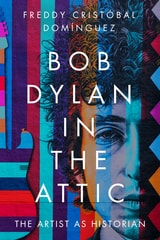
Bob Dylan in the Attic
The Artist as HistorianFreddy Cristóbal Domínguez
University of Massachusetts Press, 2022
Bob Dylan is an iconic American artist, whose music and performances have long reflected different musical genres and time periods. His songs tell tales of the Civil War, harken back to 1930s labor struggles, and address racial violence at the height of the civil rights movement, helping listeners to think about history, and history making, in new ways. While Dylan was warned by his early mentor, Dave Van Ronk, that, “You’re just going to be a history book writer if you do those things. An anachronism,” the musician has continued to traffic in history and engage with a range of source material—ancient and modern—over the course of his career.
In this beautifully crafted book, Freddy Cristóbal Domínguez makes a provocative case for Dylan as a historian, offering a deep consideration of the musician’s historical influences and practices. Utilizing interviews, speeches, and the close analysis of lyrics and live performances, Bob Dylan in the Attic is the first book to consider Dylan’s work from the point of view of historiography.
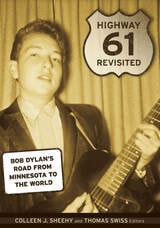
Highway 61 Revisited
Bob Dylan’s Road from Minnesota to the WorldColleen J. Sheehy
University of Minnesota Press, 2009
New essays consider Dylan’s latest work, his Minnesota roots, and his global reach
The young man from Hibbing released Highway 61 Revisited in 1965, and the rest, as they say, is history. Or is it? From his roots in Hibbing, to his rise as a cultural icon in New York, to his prominence on the worldwide stage, Colleen J. Sheehy and Thomas Swiss bring together the most eminent Dylan scholars at work today—as well as people from such far-reaching fields as labor history, African American studies, and Japanese studies—to assess Dylan’s career, influences, and his global impact on music and culture.
The Dylan effect has extended far beyond the United States in recent decades, and the essays here analyze his contribution to the people and cultures of the United Kingdom, Italy, and Japan. With a special focus on his Minnesota roots, including Greil Marcus’s spectacular tour of Dylan’s hometown, authors also take into account his most recent work and Martin Scorsese’s documentary No Direction Home.The first cultural and historical geography of his dramatic rise, storied career, and unmatched iconic status, Highway 61 Revisited maps the terrain of Bob Dylan’s music in the world.Contributors: John Barner, U of Georgia; Daphne Brooks, Princeton U; Court Carney, Stephen F. Austin State U; Alessandro Carrera, U of Houston; Michael Cherlin, U of Minnesota; Marilyn J. Chiat; Susan Clayton; Mick Cochrane, Canisius College; Thomas Crow, New York U; Kevin J. H. Dettmar, Pomona College, Carbondale; Sumanth Gopinath, U of Minnesota; Charles Hughes; C. P. Lee, U of Salford, Manchester, England; Alex Lubet, U of Minnesota; Greil Marcus, U of California, Berkeley; Aldon Lynn Nielsen, Pennsylvania State U; Roberto Polito, The New School; Robert Reginio, Frostburg State U; Heather Stur, U of Southern Mississippi; Mikiko Tachi, Chiba U, Japan; Gayle Wald, George Washington U; Anne Waldman, Naropa U; David Yaffe, Syracuse U.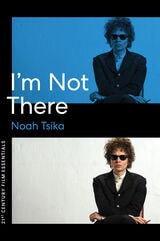
I'm Not There
Noah Tsika
University of Texas Press, 2023
An examination of director Todd Haynes and his Bob Dylan biopic.
As the first and only Bob Dylan “biopic,” I’m Not There caused a stir when released in 2007. Offering a surreal retelling of moments from Dylan’s life and career, the film is perhaps best known for its distinctive approach to casting, including Cate Blanchett and Marcus Carl Franklin, a Black child actor, as versions of Dylan though none of the characters bear his name. Greenlit by Bob Dylan himself, the film uses Dylan’s music as a score, a triumph for famed queer filmmaker Todd Haynes after encountering issues with copyright in previous projects.
Noah Tsika eloquently characterizes all the ways that Dylan and Haynes harmonize in their methods and sensibilities, interpreting the rule-breaking film as a biography that refuses chronology, disdains factual accuracy, flirts with libel, and cannibalizes Western cinema. Fitting the film’s inspiration, creation, and reception alongside its continuing afterlife, Tsika examines Dylan’s music in the film through the context of intellectual property, raising questions about who owns artistic material and artistic identities and how such material can be reused and repurposed. Tsika’s adventurous analysis touches on gender, race, queerness, celebrity, popular culture, and the law, while offering much to Haynes and Dylan fans alike.
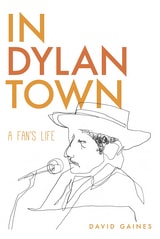
In Dylan Town
A Fan's LifeDavid Gaines
University of Iowa Press, 2015
Gaines’s personal journey toward creating such communities of passionate knowledge encompasses his own coming of age and marriages, fatherhood, and teaching. As a devoted fan who is also a professor of American literature, questions about teaching and learning are central to his experience. When asked, “Why Dylan?” he says, “He’s the writer I care about the most. He’s been the way into the best and longest running conversations I have ever had.” Talking with students, exchanging Dylan trivia with fellow fans, or cheering on fan-musicians doing Dylan covers during the Dylan Days festival, Gaines shows that, for many people, being a fan of popular culture couples serious critical and creative engagement with heartfelt commitment. Here, largely unheralded, the ideal of liberal education is realized every day.
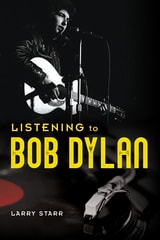
Listening to Bob Dylan
Larry Starr
University of Illinois Press, 2021
Reader-friendly and revealing, Listening to Bob Dylan encourages hardcore fans and Dylan-curious seekers alike to rediscover the music legend.
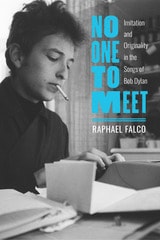
No One to Meet
Imitation and Originality in the Songs of Bob DylanRaphael Falco
University of Alabama Press, 2022
WINNER OF THE ELIZABETH AGEE PRIZE IN AMERICAN LITERATURE
A groundbreaking appreciation of Dylan as a literary practitioner.
The literary establishment tends to regard Bob Dylan as an intriguing, if baffling, outsider. That changed overnight when Dylan was awarded the 2016 Nobel Prize in Literature, challenging us to think of him as an integral part of our national and international literary heritage. No One to Meet: Imitation and Originality in the Songs of Bob Dylan places Dylan the artist within a long tradition of literary production and offers an innovative way to understand his unique and often controversial methods of composition.
Dylan expert Raphael Falco traces the similarities between the way Dylan borrows, digests, and transforms traditional songs and what Renaissance writers called imitatio. Although Dylan’s lyrical postures may suggest an avant-garde consciousness, No One to Meet shows that Dylan’s creative process creatively expands methods used by classical and Renaissance authors.
Drawing on numerous examples, including Dylan’s previously unseen manuscript excerpts and archival materials, Raphael Falco illuminates how the ancient process of poetic imitation, handed down from Greco-Roman antiquity, allows us to make sense of Dylan’s musical and lyrical technique. By placing Dylan firmly in the context of an age-old poetic practice, No One to Meet deepens our appreciation of Dylan’s songs and allows us to celebrate him as what he truly is: a great writer.
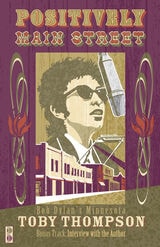
Positively Main Street
Bob Dylan’s MinnesotaToby Thompson
University of Minnesota Press, 2008
“That boy . . . this fellow, Toby . . . has got some lessons to learn.” —Bob Dylan, Rolling Stone, November 29, 1969
"Toby Thompson was there first." —Greil Marcus
“A first-rate novelistic account of Thompson’s own psyche as he uncovers the Dylan few people know . . . A new look at young Dylan done with kindness, enthusiasm and superb language.” —William Kennedy, Look Magazine
“Essential reading. Thompson, unprecedentedly, managed to interview not only Echo Helstrom, almost certainly the ‘Girl of the North Country,’ but Dylan’s mother and brother, his uncle, his friends.” —Michael Gray, Bob Dylan Encyclopedia
“Dylan fans will not want to miss this book.” —Sioux City Journal
“Enough to satisfy any Dylan fan with all the gossip he’ll ever need.” —Huntsville Times
“Well worth the attention of anyone who has fallen under the spell of the boy from the North Country.” —Los Angeles Times
“It’s a must.” —Ft. Worth Press
"Thompson tracked down anybody who knew 'Die-lan' (as the Hibbingites called him), including the guy at the local music store, the guy at the motorcycle shop, his English and music teachers, his uncles, his brother David and even his reluctant but ultimately charmingly chatty mother. Of course, Thompson traveled into a few dead ends. But the stuff with Dylan's mom and his high school girlfriend, Echo Helstrom, is priceless. Positively Main Street is a free-wheelin', fun and quick read that is surprisingly informative." —Minneapolis Star Tribune
"Hundreds of books have been written about Minnesota's most famous songwriter; Bob Dylan's life and music has been analyzed by fans, scholars, and even himself. So, why do we need Toby Thompson's Positively Main Street: Bob Dylan's Minnesota? Because it's a forgotten milestone. Published in 1971, it was the first biography on Dylan. Although it's been out of print since 1977, the book is, with the exception of Dylan's autobiography, perhaps the most readable and necessary volume on the folk icon." —City Pages
"The new Positively Main Street is a lovely little book, even better than the original, a cherished addition to the Dylan bookshelf. Thompson and the University of Minnesota Press have enhanced what was already a classic and made it available to a whole new audience. Dylan fans owe them a debt of gratitude." —The Dylan Daily
"[Thompson] ends up not only interviewing 'the Girl from the North Country,' Echo Haelstrom, and 'Bob’s' mother and brother and teachers etc., but also filling in for Dylan among his old friends and acquaintances, playing Dylan’s songs on the guitar and harmonica and singing them, in a way that may have seemed stratingly revolutionary at the time for a journalist to do, he actually recreates a bit of Dylan’s existence as his own." —Michael Lally, Lally's Alley
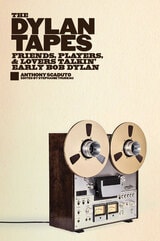
The Dylan Tapes
Friends, Players, and Lovers Talkin’ Early Bob DylanAnthony Scaduto
University of Minnesota Press, 2021
The raw material and interviews behind Anthony Scaduto’s iconic biography of Bob Dylan draw an intimate and multifaceted portrait of the singer-songwriter who defined his era
When Anthony Scaduto’s Bob Dylan: An Intimate Biography was first published in 1971, the Nobel Prize–winning songwriter, at thirty, had already released some of the most iconic albums of the 1960s, including Highway 61 Revisited and Blonde on Blonde. Scaduto’s book was one of the first to take an investigative journalist’s approach to its subject and set the standard for rock music biography. The Dylan Tapes, compiled from thirty-six hours of interviews, is a behind-the-scenes look at the making of Scaduto’s landmark book—and a close-up encounter with pivotal figures in Dylan’s life. These reel-to-reel tapes, found in a box in Scaduto’s basement, are a never-bootlegged trove of archival material about Dylan, drawn from conversations with those closest to him during the early years of his career.
In the era of ten-second takes, these interviews offer uncommon depth and immediacy as we listen to friends and lovers recall the Dylan they knew as he created his professional persona and perfected his craft—from folk music, protest songs, and electric rock through the traumatic impact of a motorcycle crash to his later, more self-reflecting songwriting. Echo Helstrom, Dylan’s “Girl from the North Country,” is here, as are Suze Rotolo, who graced the cover of the Freewheelin’ album, and Joan Baez, remembering her relationship “to Bobby.” We hear from Mike Porco, who gave Dylan his first gig in New York City; Sid and Bob Gleason, who introduced him to his hero Woody Guthrie; folk artists from Greenwich Village, like Phil Ochs and Ramblin’ Jack Eliot; John Hammond Sr., who gave him his first record contract; plus a host of musicians, activists, folk historians, and archivists—and, of course, Dylan himself.
From these reflections and frank conversations, many published here for the first time, a complex, finely observed picture emerges of one of the best known yet most enigmatic musicians of our time.
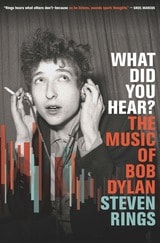
What Did You Hear?
The Music of Bob DylanSteven Rings
University of Chicago Press, 2025
Named one of PopMatters’ Best Books of 2025! Discover a new side of the songs of Bob Dylan by exploring the virtues of rough sounds, peculiar intonation, and a raspy voice.
Folk troubadour, rock star, country crooner—for a musician who adopted so many personas, Bob Dylan always sounds like himself. While he’s written many of the most iconic and impactful lyrics of the past sixty years, Dylan’s music has also reshaped our sonic imagination with his ragged voice, wailing harmonica, and rough-hewn guitar.
Music theorist Steven Rings argues that such sonic imperfections are central to understanding Dylan’s songs and their appeal. These blemishes can invoke authenticity or persona, signal his social commitments, and betray his political shortcomings. Rings begins—where else?—with Dylan’s voice, exploring its changeability, its unmistakable features, and its ability to inhabit characters, including the female narrator of “House of the Rising Sun.” Rings then turns to Dylan as an instrumentalist, examining his infamous adoption of the electric guitar in 1965, as well as his stylistically varied acoustic playing, which borrows sounds and techniques from Black blues musicians, among other influences. Rings charts the histories audible in Dylan’s harmonica as well as piano, which has been central to his music making since his earliest days of imitating Little Richard in his hometown of Hibbing, Minnesota. Finally, Rings guides readers through one of Dylan’s most famous songs, “A Hard Rain’s a-Gonna Fall,” analyzing its musical sources as well as variations in live performances. A companion website of audio and video examples helps readers notice the nuances and idiosyncrasies inherent in Dylan’s work and, even more importantly, their effects.
A close look at an underdiscussed but essential aspect of Dylan’s oeuvre, What Did You Hear? offers a fresh understanding of a singular performer, his musical choices, and the meanings that we can hear in his imperfect sounds.