Results by title
28 books match the query 'Early Modern England'
Before Intimacy
Asocial Sexuality in Early Modern EnglandDaniel Juan Gil
University of Minnesota Press, 2006
Engaging the poems of Wyatt, Sidney’s Astrophil and Stella, Spenser’s Amoretti and The Faerie Queene, and Shakespeare’s Troilus and Cressida and the Sonnets, Gil demonstrates how sexuality was conceived as a relationship system inhabited by men and women interchangeably—set apart from the “norm” and not institutionalized in a private or domestic realm. Going beyond the sodomy-as-transgression analytic, he asserts the existence of socially inconsequential sexual bonds while recognizing the pleasurable effects of violating the supposed traditional modes of bonding and ideals of universal humanity and social hierarchy.
Celebrating the ability of corporeal emotions to interpret connections between people who share nothing in terms of societal structure, Before Intimacy shows how these works of early modern literature provide a discourse of sexuality that strives to understand status differences in erotic contexts and thereby question key assumptions of modernity.
Daniel Juan Gil is assistant professor of English at TCU.
Both from the Ears and Mind
Thinking about Music in Early Modern EnglandLinda Phyllis Austern
University of Chicago Press, 2020
Coming To
Consciousness and Natality in Early Modern EnglandTimothy M. Harrison
University of Chicago Press, 2020
Common Prayer
The Language of Public Devotion in Early Modern EnglandRamie Targoff
University of Chicago Press, 2001
Through readings of William Shakespeare's Hamlet, Richard Hooker's Lawes of Ecclesiastical Politie, Philip Sidney's Apology for Poetry and his translations of the Psalms, John Donne's sermons and poems, and George Herbert's The Temple, Targoff uncovers the period's pervasive and often surprising interest in cultivating public and formalized models of worship. At the heart of this study lies an original and daring approach to understanding the origins of devotional poetry; Targoff shows how the projects of composing eloquent verse and improving liturgical worship come to be deeply intertwined. New literary practices, then, became a powerful means of forging common prayer, or controlling private and otherwise unmanageable expressions of faith.
Faithful Translators
Authorship, Gender, and Religion in Early Modern EnglandJaime Goodrich
Northwestern University Press, 2014
He Words Me
Men Writing as Women in Early Modern EnglandCatherine Loomis
Arizona Center for Medieval and Renaissance Studies, 2026
This anthology gives students and scholars access to a body of texts that provide a clearer understanding of what life was like for early modern women by presenting hundreds of little-known primary texts that contain details about early modern women’s work, relationships, emotional and intellectual development, friendships, and daily struggles. He Words Me brings together work from a variety of genres in which male authors adopt the voice of a female narrator and use that voice to provide intimate details about the lives of women.
These works introduce modern readers to less familiar genres, complement or contradict portrayals of women in canonical texts, and raise compelling questions about who speaks for women and when women can speak for themselves. Through these women’s voices, readers can encounter characters and experiences that will broaden their understanding of early modern English literature and culture, and of the history of women in the late sixteenth and early seventeenth centuries.
In Pursuit of Civility
Manners and Civilization in Early Modern EnglandKeith Thomas
Brandeis University Press, 2018
Increase And Multiply
Governing Cultural Reproduction In Early Modern EnglandDavid Glimp
University of Minnesota Press, 2003
A wide-ranging study of the ideology of population control in early modern England
Across the sixteenth and seventeenth centuries, a growing notion of the value of a large populace created a sense of urgency about reproduction; accordingly, a wide array of English writers of the time voiced the need not merely to add more people but also to ensure that England had an abundance of the right kinds of people. This need, in turn, called for a variety of institutions to train—and thus make, through a kind of nonbiological procreation—pious, enterprising, and dutiful subjects. In Increase and Multiply, David Glimp examines previously unexplored links between this emergent demographic mentality and Renaissance literature.
Glimp’s analysis centers on humanist pedagogy as a mechanism for creating people capable of governing both themselves and others. Acknowledging the ways in which authors such as Sidney, Shakespeare, and Milton advance their own work by appealing to this vision, Glimp argues that their texts allow us to read the scope and limits of this generative ideal, its capacity to reinforce order and to become excessive and destabilizing. His work provides unprecedented insight into the role of fantasies of nonbiological reproduction in early modern political theory, government practice, and literary production.
Just Anger
Representing Women's Anger in Early Modern EnglandGwynne Kennedy
Southern Illinois University Press, 2000
The first scholar to investigate the subject of women’s anger in early modern England, Gwynne Kennedy analyzes portrayals of and attitudes toward women’s anger in printed texts by or purporting to be written by women during the period.
Kennedy draws from recent critical work on emotions by historians, literary scholars, philosophers, and psychologists as well as comparative studies of the emotions by cultural anthropologists. Kennedy also examines a number of male-authored works, including sermons, conduct literature, philosophy, rhetoric, and medicine. The focus of her work, however, is on representations of women’s anger in printed works signed with women’s names in late sixteenth- and early seventeenth-century England. She addresses the ways these writings conform to, conflict with, or appear to reconfigure prevailing beliefs about women’s anger.
Kennedy looks at such literary texts as Mary Wroth’s romance, The Countess of Montgomery’s Urania, the first fiction by an English woman; Elizabeth Cary’s play, The Tragedy of Mariam, the earliest extant play in English by a woman; and Aemilia Lanyer’s verse collection, Salve Deus Rex Judaeorum. She also discusses religious writings by Protestant martyr Anne Askew and Elizabeth Cary’s history of Edward II. Kennedy considers as well defenses of women’s nature authored by women (Rachel Speght and Aemilia Lanyer) or published under female pseudonyms (“Jane Anger,” “Ester Sowernam,” and “Constantia Munda”).
Kennedy demonstrates the importance of class and race as factors affecting anger’s legitimacy and its forms of expression. She shows how early modern assumptions about women’s anger can help to create or exaggerate other differences among women. Her close scrutiny of anger against female inferiority emphasizes the crucial role of emotions in the construction of self-worth and identity.
Love's Quarrels
Reading Charity in Early Modern EnglandEvan Gurney
University of Massachusetts Press, 2018
Early modern English writers often complained that “charity had grown cold,” lamenting the dissolution of society's communal bonds. But far from diminishing in scope or influence, charity generated heated debates, animated by social, political, and religious changes that prompted urgent questions about the virtue's powers and functions. Charity was as much a problem as it was a solution, a sure sign of trouble even when invoked on behalf of peace and community.
Love's Quarrels charts charity's complex history from the 1520s to the 1640s and details the ways in which it can be best understood in biblical translations of the early sixteenth century, in Elizabethan polemic and satire, and in the political and religious controversies arriving at the outset of civil war. As key works from Edmund Spenser, Ben Jonson, and John Milton reveal, “reading charity” was fraught with difficulty as early modern England reconsidered its deepest held convictions in the face of mounting social disruption and spiritual pressure.
Memory's Library
Medieval Books in Early Modern EnglandJennifer Summit
University of Chicago Press, 2008
In Jennifer Summit’s account, libraries are more than inert storehouses of written tradition; they are volatile spaces that actively shape the meanings and uses of books, reading, and the past. Considering the two-hundred-year period between 1431, which saw the foundation of Duke Humfrey’s famous library, and 1631, when the great antiquarian Sir Robert Cotton died, Memory’s Library revises the history of the modern library by focusing on its origins in medieval and early modern England.
Summit argues that the medieval sources that survive in English collections are the product of a Reformation and post-Reformation struggle to redefine the past by redefining the cultural place, function, and identity of libraries. By establishing the intellectual dynamism of English libraries during this crucial period of their development, Memory’s Library demonstrates how much current discussions about the future of libraries can gain by reexamining their past.
Persecution, Plague, and Fire
Fugitive Histories of the Stage in Early Modern EnglandEllen MacKay
University of Chicago Press, 2011
The theater of early modern England was a disastrous affair. The scant record of its performance demonstrates as much, for what we tend to remember today of the Shakespearean stage and its history are landmark moments of dissolution: the burning down of the Globe, the forced closure of playhouses during outbreaks of the plague, and the abolition of the theater by its Cromwellian opponents.
Persecution, Plague, and Fire is a study of these catastrophes and the theory of performance they convey. Ellen MacKay argues that the various disasters that afflicted the English theater during its golden age were no accident but the promised end of a practice built on disappearance and erasure—a kind of fatal performance that left nothing behind but its self-effacing poetics. Bringing together dramatic theory, performance studies, and theatrical, religious, and cultural history, MacKay reveals the period’s radical take on the history and the future of the stage to show just how critical the relation was between early modern English theater and its public.
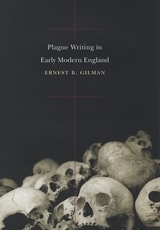
Plague Writing in Early Modern England
Ernest B. Gilman
University of Chicago Press, 2009
During the seventeenth century, England was beset by three epidemics of the bubonic plague, each outbreak claiming between a quarter and a third of the population of London and other urban centers. Surveying a wide range of responses to these epidemics—sermons, medical tracts, pious exhortations, satirical pamphlets, and political commentary—Plague Writing in Early Modern England brings to life the many and complex ways Londoners made sense of such unspeakable devastation.
Ernest B. Gilman argues that the plague writing of the period attempted unsuccessfully to rationalize the catastrophic and that its failure to account for the plague as an instrument of divine justice fundamentally threatened the core of Christian belief. Gilman also trains his critical eye on the works of Jonson, Donne, Pepys, and Defoe, which, he posits, can be more fully understood when put into the context of this century-long project to “write out” the plague. Ultimately, Plague Writing in Early Modern England is more than a compendium of artifacts of a bygone era; it holds up a distant mirror to reflect our own condition in the age of AIDS, super viruses, multidrug resistant tuberculosis, and the hovering threat of a global flu pandemic.
Print, Manuscript, and Performance
THE CHANGING RELATIONS OF THE MEDIA IN EARLY MODERN ENGLANDArthur F. Marotti and Michael D. Bristol
The Ohio State University Press, 2000
Although canonical literary writers such as Shakespeare, Jonson, and Rochester are discussed, the field of writing examined is a broad one, embracing political speeches, coterie manuscript poetry, popular pamphlets, parochially targeted martyrdom accounts, and news reports. Setting writers, audiences, and texts in their specific historical context, the contributors focus on a period in early modern England, from the late sixteenth through the late seventeenth century, when the shift from orality and manuscript communication to print was part of large-scale cultural change. Arthur F. Marotti’s and Michael D. Bristol’s introduction analyzes some of the sociocultural issues implicit in the collection and relates the essays to contemporary work in textual studies, bibliography, and publication history.
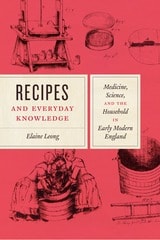
Recipes and Everyday Knowledge
Medicine, Science, and the Household in Early Modern EnglandElaine Leong
University of Chicago Press, 2018
In Recipes and Everyday Knowledge, Elaine Leong situates recipe knowledge and practices among larger questions of gender and cultural history, the history of the printed word, and the history of science, medicine, and technology. The production of recipes and recipe books, she argues, were at the heart of quotidian investigations of the natural world or “household science”. She shows how English homes acted as vibrant spaces for knowledge making and transmission, and explores how recipe trials allowed householders to gain deeper understandings of sickness and health, of the human body, and of natural and human-built processes. By recovering this story, Leong extends the parameters of natural inquiry and productively widens the cast of historical characters participating in and contributing to early modern science.
Recovering Disability in Early Modern England
Edited by Allison P. Hobgood and David Houston Wood
The Ohio State University Press, 2013
Retelling the Siege of Jerusalem in Early Modern England
Vanita Neelakanta
University of Delaware Press, 2019
Published by University of Delaware Press. Distributed worldwide by Rutgers University Press.
Sappho in Early Modern England
Female Same-Sex Literary Erotics, 1550-1714Harriette Andreadis
University of Chicago Press, 2001
Sex before Sex
Figuring the Act in Early Modern EnglandJames M. Bromley
University of Minnesota Press, 2013
What is sex exactly? Does everyone agree on a definition? And does that definition hold when considering literary production in other times and places? Sex before Sex makes clear that we cannot simply transfer our contemporary notions of what constitutes a sex act into the past and expect them to be true for the people who were then reading literature and watching plays. The contributors confront how our current critical assumptions about definitions of sex restrict our understanding of representations of sexuality in early modern England.
Drawing attention to overlooked forms of sexual activity in early modern culture, from anilingus and interspecies sex to “chin-chucking” and convivial drinking, Sex before Sex offers a multifaceted view of what sex looked like before the term entered history. Through incisive interpretations of a wide range of literary texts, including Romeo and Juliet, The Comedy of Errors, Paradise Lost, the figure of Lucretia, and pornographic poetry, this collection queries what might constitute sex in the absence of a widely accepted definition and how a historicized concept of sex affects the kinds of arguments that can be made about early modern sexualities.
Contributors: Holly Dugan, George Washington U; Will Fisher, CUNY–Lehman College; Stephen Guy-Bray, U of British Columbia; Melissa J. Jones, Eastern Michigan U; Thomas H. Luxon, Dartmouth College; Nicholas F. Radel, Furman U; Kathryn Schwarz, Vanderbilt U; Christine Varnado, U of Buffalo–SUNY.
The Acoustic World of Early Modern England
Attending to the O-FactorBruce R. Smith
University of Chicago Press, 1999
In this ear-opening journey into the sound-worlds of Shakespeare's contemporaries, Bruce R. Smith explores both the physical aspects of human speech (ears, lungs, tongue) and the surrounding environment (buildings, landscape, climate), as well as social and political structures. Drawing on a staggeringly wide range of evidence, he crafts a historical phenomenology of sound, from reconstructions of the "soundscapes" of city, country, and court to detailed accounts of the acoustic properties of the Globe and Blackfriars theaters and how scripts designed for the two spaces exploited sound very differently.
Critical for anyone who wants to understand the world of early modern England, Smith's pathbreaking "ecology" of voice and listening also has much to offer musicologists and acoustic ecologists.
The Aesthetics of Service in Early Modern England
Elizabeth Rivlin
Northwestern University Press, 2011
In The Aesthetics of Service in Early Modern England, Elizabeth Rivlin explores the ways in which servant-master relationships reshaped literature. The early modern servant is enjoined to obey his or her master out of dutiful love, but the servant's duty actually amounts to standing in for the master, a move that opens the possibility of becoming master. Rivlin shows that service is fundamentally a representational practice, in which the servant who acts for a master merges with the servant who acts as a master.
Rivlin argues that in the early modern period, servants found new positions as subjects and authors found new forms of literature. Representations of servants and masters became a site of contact between pressing material concerns and evolving aesthetic ones. Offering readings of dramas by Shakespeare, Jonson, and Thomas Dekker and prose fictions by Thomas Deloney and Thomas Nashe, Rivlin suggests that these authors discovered their own exciting and unstable projects in the servants they created.
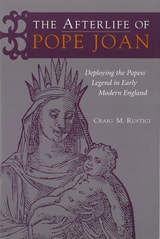
The Afterlife of Pope Joan
Deploying the Popess Legend in Early Modern EnglandCraig M. Rustici
University of Michigan Press, 2010
The legend concerning a popess had first taken written form in the thirteenth century and for several hundred years was more or less accepted. The Reformation, however, polarized discussions of the legend, pitting Catholics, who denied the story’s veracity, against Protestants, who suspected a cover-up and instantly cited Joan as evidence of papal depravity. In this heated environment, writers reimagined Joan variously as a sorceress, a hermaphrodite, and even a noteworthy author.
The Afterlife of Pope Joan examines sixteenth- and seventeenth-century debates concerning the popess’s existence, uncovering the disputants’ historiographic methods, rules of evidence, rhetorical devices, and assumptions concerning what is probable and possible for women and transvestites. Author Craig Rustici then investigates the cultural significance of a series of notions advanced in those debates: the claim that Queen Elizabeth I was a popess in her own right, the charge that Joan penned a book of sorcery, and the curious hypothesis that the popess was not a disguised woman at all but rather a man who experienced a sort of spontaneous sex change.
The Afterlife of Pope Joan draws upon the discourses of religion, politics, natural philosophy, and imaginative literature, demonstrating how the popess functioned as a powerful rhetorical instrument and revealing anxieties and ambivalences about gender roles that persist even today.
Craig M. Rustici is Associate Professor of English at Hofstra University.
The Book of the Play
Playwrights, Stationers, and Readers in Early Modern EnglandMarta Straznicky
University of Massachusetts Press, 2006
The Book of the Play is a collection of essays that examines early modern drama in the context of book history. Focusing on the publication, marketing, and readership of plays opens fresh perspectives on the relationship between the cultures of print and performance and more broadly between drama and the public sphere. Marta Straznicky's introduction offers a survey of approaches to the history of play reading in this period, and the collection as a whole consolidates recent work in textual, bibliographic, and cultural studies of printed drama.
Individually, the essays advance our understanding of play reading as a practice with distinct material forms, discourses, social settings, and institutional affiliation. Part One, “Real and Imagined Communities,” includes four essays on play-reading communities and the terms in which they are distinguished from the reading public at large. Cyndia Clegg surveys the construction of readers in prefaces to published plays; Lucy Munro traces three separate readings of a single play, Edward Sharpham's The Fleer; Marta Straznicky studies women as readers of printed drama; and Elizabeth Sauer describes how play reading was mobilized for political purposes in the period of the Civil War.
In Part Two, “Play Reading and the Book Trade,” five essays consider the impact of play reading on the public sphere through the lens of publishing practices. Zachary Lesser offers a revisionist account of black-letter typeface and the extent to which it may be understood as an index of popular culture; Alan Farmer examines how the emerging news trade of the 1620s and 1630s affected the marketing of printed drama; Peter Berek traces the use of generic terms on title pages of plays to reveal their intersection with the broader culture of reading; Lauren Shohet demonstrates that the Stuart masque had a parallel existence in the culture of print; and Douglas Brooks traces the impact print had on eclipsing performance as the medium in which the dramatist could legitimately lay claim to having authored his text.
The individual essays focus on selected communities of readers, publication histories, and ideologies and practices of reading; the collection as a whole demonstrates the importance of textual production and reception to understanding the place of drama in the early modern public sphere.
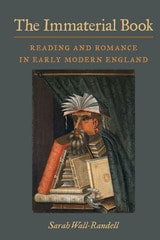
The Immaterial Book
Reading and Romance in Early Modern EnglandSarah Wall-Randell
University of Michigan Press, 2013
In romances—Renaissance England’s version of the fantasy novel—characters often discover books that turn out to be magical or prophetic, and to offer insights into their readers’ selves. The Immaterial Book examines scenes of reading in important romance texts across genres: Spenser’s Faerie Queene, Shakespeare’s Cymbeline and The Tempest, Wroth’s Urania, and Cervantes’ Don Quixote. It offers a response to “material book studies” by calling for a new focus on imaginary or “immaterial” books and argues that early modern romance authors, rather than replicating contemporary reading practices within their texts, are reviving ancient and medieval ideas of the book as a conceptual framework, which they use to investigate urgent, new ideas about the self and the self-conscious mind.
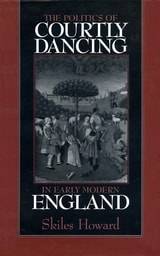
The Politics of Courtly Dancing in Early Modern England
Skiles Howard
University of Massachusetts Press, 1998
Skiles Howard examines the social and semiotic complexities of dancing as it changed over time and performed different work in court, city, and playhouse. She shows how dancing reflected and shaped wider social changes: the performance of gender roles facilitated the formation of the patriarchal family, the execution of physical tropes of hierarchy supported the rise of a centralized state, and rehearsals of spatial mastery assisted the project of national expansion. As a visual and kinetic discourse by which social norms were circulated, dancing inevitably became a site of contestation; as elite and popular practices collided, interacted, and were transformed, countervailing social forces found expression through the medium of dancing.
Interdisciplinary in its approach, this study draws on court masque and popular drama, dancing manuals, Puritan pamphlets, and educational and medical treatises to explore issues of power and the body, gender and rank, popular culture and European expansion.
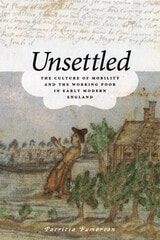
Unsettled
The Culture of Mobility and the Working Poor in Early Modern EnglandPatricia Fumerton
University of Chicago Press, 2006
Migrants made up a growing class of workers in late sixteenth- and seventeenth- century England. In fact, by 1650, half of England’s rural population consisted of homeless and itinerant laborers. Unsettled is an ambitious attempt to reconstruct the everyday lives of these dispossessed people. Patricia Fumerton offers an expansive portrait of unsettledness in early modern England that includes the homeless and housed alike.
Fumerton begins by building on recent studies of vagrancy, poverty, and servants, placing all in the light of a new domestic economy of mobility. She then looks at representations of the vagrant in a variety of pamphlets and literature of the period. Since seamen were a particularly large and prominent class of mobile wage-laborers in the seventeenth century, Fumerton turns to seamen generally and to an individual poor seaman as a case study of the unsettled subject: Edward Barlow (b. 1642) provides a rare opportunity to see how the laboring poor fashioned themselves, for he authored a journal of over 225,000 words and 147 pages of drawings. Barlow’s journal, studied extensively here for the first time, vividly charts what he himself termed his “unsettled mind” and the perpetual anxieties of England’s working and wayfaring poor. Ultimately, Fumerton explores representations of seamen as unsettled in the broadside ballads of Barlow’s time.
Virtuous Necessity
Conduct Literature and the Making of the Virtuous Woman in Early Modern EnglandJessica C. Murphy
University of Michigan Press, 2015
Women as Translators in Early Modern England
Deborah Uman
University of Delaware Press, 2012
Women as Translators in Early Modern England offers a feminist theory of translation that considers both the practice and representation of translation in works penned by early modern women. It argues for the importance of such a theory in changing how we value women’s work. Because of England’s formal split from the Catholic Church and the concomitant elevation of the written vernacular, the early modern period presents a rich case study for such a theory. This era witnessed not only a keen interest in reviving the literary glories of the past, but also a growing commitment to humanist education, increasing literacy rates among women and laypeople, and emerging articulations of national sentiment. Moreover, the period saw a shift in views of authorship, in what it might mean for individuals to seek fame or profit through writing. Until relatively recently in early modern scholarship, women were understood as excluded from achieving authorial status for a number of reasons—their limited education, the belief that public writing was particularly scandalous for women, and the implicit rule that they should adhere to the holy trinity of “chastity, silence, and obedience.”
While this view has changed significantly, women writers are still understood, however grudgingly, as marginal to the literary culture of the time. Fewer women than men wrote, they wrote less, and their “choice” of genres seems somewhat impoverished; add to this the debate over translation as a potential vehicle of literary expression and we can see why early modern women’s writings are still undervalued. This book looks at how female translators represent themselves and their work, revealing a general pattern in which translation reflects the limitations women faced as writers while simultaneously giving them the opportunity to transcend these limitations. Indeed, translation gave women the chance to assume an authorial role, a role that by legal and cultural standards should have been denied to them, a role that gave them ownership of their words and the chance to achieve profit, fame, status and influence.
Published by University of Delaware Press. Distributed worldwide by Rutgers University Press.